By now, the idea of “blowback”— that U.S. covert intelligence operations have yielded harmful, unintended consequences—is becoming widely known. Author Chalmers Johnson, most notably, has documented how our dirty dealings around the world, especially during the Cold War, have returned to haunt us. In recent decades, the men and women of our armed forces have been sent to vanquish despots that their own government once supported, from the CIA-trained Manuel Noriega to the U.S. arms recipient Saddam Hussein to Osama bin Laden, a beneficiary of U.S. funding to the Afghan mujahideen.
But perhaps no secret operations have yielded more devastating consequences than those carried out in Pakistan, which was considered a vital and strategically placed ally against Soviet communism, and later against Islamist terrorism. Covert American support propped up the repressive military dictatorships that have ruled Pakistan for the better part of its history as a nation, leading right up through the current crisis. U.S. funding, channeled from the CIA through the Pakistani intelligence service to fuel insurgencies in Soviet-occupied Afghanistan, helped give rise to Al Qaeda and the Taliban.
Now, the research and documentation provided by two British investigative journalists show the extent to which Pakistan, emboldened by the purposeful neglect of U.S. policymakers and the American intelligence community, spread nuclear materials and technologies to such notorious U.S. adversaries as Libya, North Korea, Saddam’s Iraq, and Iran. If we should go to war with Iran over nuclear weapons, we will have Pakistan—and ourselves—to thank for that as well.
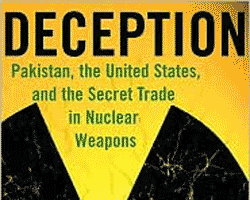
This story is told in a new book called Deception: Pakistan, the United States, and the Secret Trade in Nuclear Weapons, by Adrian Levy and Catherine Scott-Clark, longtime correspondents for the Sunday Times and then the Guardian, who reported from South Asia for more than a decade. Earlier this week I spoke at length with Levy about Pakistan’s proliferation activities, and America’s acquiescence.
The critical period stretches from the inauguration of Ronald Reagan through the end of the Soviet-Afghan War in 1989, when, Levy and Scott-Clark contend, the CIA, State Department, and Pentagon allowed Pakistan’s WMD program to remain on track. Reagan dismantled the federal Arms Control and Disarmament Agency, and downgraded the National Security Council and the office of the National Security Adviser. The CIA, under zealous director William Casey, was in ascendance, and intelligence was employed to push forward the Reagan political agenda. “They busied themselves by disrupting and interrupting all of the operations mounted by the various agencies to [block] the WMD program that would arm Pakistan,” explains Levy.
Pakistan is one of four nations that refuses to abide by the 1968 Nuclear Nonproliferation Treaty (the others are India, Israel, and North Korea), and while it is nominally a member of the International Atomic Energy Agency (IAEA), it has a long history of resisting oversight from the watchdog group. Thus, with the United States looking the other way, Pakistan was free to develop and sell nuclear materials and technologies.
Pakistan’s nuclear program got its start in the early 1970s under Zulfikar Ali Bhutto (Benazir Bhutto’s father) and was brought to fruition by the notorious Dr. Abdul Qadeer Khan, a German-trained scientist who had worked in a uranium enrichment facility in Europe and reportedly stolen technologies that he brought back to Pakistan. By the early 1980s, Pakistan, now under the military dictatorship of General Muhammad Zia-ul-Haq, possessed enriched uranium as well as bomb designs and other technology, much of it from China; by 1987 there was evidence that the country had usable weapons. (It is thought to have between 50 and 100 today.) During the 1980s, Levy says, “Pakistan stockpiled enormous amounts of fissionable material and ready-made assembled warheads and bombs without any check or security measures or command and control systems implemented. . .They had no idea how the security devices employed by the West worked, so there was no separation of warheads from triggers. . .and they didn’t have any of the things we call ‘permissive’ active links, which supposedly ensure a bomb can’t go off accidentally.”
After the Soviet intervention in Afghanistan in 1979, Pakistan was exempt from a U.S. law that prohibited aid to countries that import materials for nuclear weapons. Both Reagan and George H.W. Bush resisted sporadic efforts by Congress to suspend aid—some of which was covertly channeled to the military and potentially used to build nuclear weapons—and continued to certify that Pakistan itself did not have the bomb, despite credible evidence to the contrary. According to Deception, “State Department officials [were] actively obstructing other arms of government which could not help but fall over intelligence about Pakistan’s nuclear trade. Evidence was destroyed, criminal files were diverted, Congress was repeatedly lied to, and in several cases, in 1986 and 1987, presidential appointees even tipped off the Pakistani government so as to prevent its agents from getting caught in U.S. Customs Service stings that aimed to catch them buying nuclear components in America.”
By 1990, however, the Soviets had withdrawn from Afghanistan, and Pakistan was no longer needed as a security springboard for the United States. When U.S. aid was suspended in October 1990, Levy says, the Pakistanis warned what the consequences would be of ending their “special” relationship. General Mirza Aslam Beg, chief of army staff and a man determined to defy the West, sought out three U.S. officials—Ambassador Robert Oakley, Centcom commander Norman Schwarzkopf, and Assistant Secretary of Defense Harry Rowan—and told them that “if America turned its back on Pakistan, it would sell its nuclear technology, and Iran would be the first client. All three officials reported back and they got no feedback from Washington.”
According to information obtained by the authors of Deception, the Pakistani military and intelligence service, working with A. Q. Khan, wasted no time in carrying out General Beg’s threat. In the fall of 1990, they opened a channel with North Korea, offering what Levy and Scott-Clark call an “hors d’oeuvre” in the form of Stinger missiles. The Stinger, supplied by the U.S. in large numbers to the Afghan mujahideen, was regarded as a key weapon in winning the war against the Soviets in Afghanistan. The Pakistanis were supposed to collect the unused missiles and return them to the CIA, which, needless to say, they did not do. (Former mujahideen Stingers are now thought to be in the possession of North Korea, China, Iran, and a number of terrorist groups.) By the middle of the ’90s, Khan was making frequent visits to Pyongyang, and there were signs that the Pakistanis were trading nuclear technology for North Korean-built missiles and other arms—many of them duly noted by the CIA and British intelligence.
During the same time frame, in the fall of 1990, the world was reacting to Iraq’s invasion of Kuwait. On this matter, Pakistan appeared to be split: The civilian side of the government backed the Saudis who, of course, were socked into the American coalition. But the military, the real power in Pakistan, sided with Saddam Hussein. In fact, just as the United States began assembling troops for Desert Storm, a Pakistani agent arrived in Baghdad with the offer of designs for a nuclear bomb, and help in building one. The proposal seemed so outrageous, Levy says, Saddam thought he was being set up, and blocked the deal.
The details of the agent’s offer came to light five years later, in 1995, when an IAEA inspection team raided a farm owned by General Hussein Kamel, Hussein’s son-in-law, who had run Iraq’s weapons programs. Gary Dillon, a Briton who led the inspection, found boxes of documents including a one-page memo headed “Top Secret Proposal” that referred to the code name “A/B.” Dillon’s people thought it was a fake. “The memo appeared to be from the Mukhabarat, the Iraqi intelligence service, and dated 6 October 1990,” he told Levy and Scott-Clark in an interview for their book. “It was an account of a meeting that had taken place in the offices of the Mukhabarat.”
Reportedly, the memo said, “We have enclosed for you the following proposal from the Pakistani scientist Dr. Abd-el-Qadeer Khan [sic] regarding the possibility of helping Iraq establish a project to enrich uranium and manufacture a nuclear weapon.” The Pakistani offer included not only blueprints for making a bomb, but advice on how to build a uranium-enrichment facility and obtain components, which were to be run through Dubai, from European companies.
The inspection team was alarmed. “We registered our extreme concern to the IAEA and I tried to prick the U.S. interest, too,” Dillon told the authors. After reviewing the documents, “I believed that they were an accurate representation of what Pakistan had put on the table—although we could never know for sure. As for the overall code name ‘A/B,’ I puzzled over this for some time until I realized what the letters stood for: Atom Bomb. The truth is often far simpler than one thinks.”
When it became clear that American-led Gulf War forces would defeat Hussein’s army, the Pakistani military about-faced, dropping Iraq and approaching Iran. In a meeting with the prime minister, “Beg came straight out with it,” a Pakistani official told Levy and Scott-Clark. “‘We should transfer nuclear technology to a friendly state, for the sum of $12 billion.’ By friendly state he meant Iran, and with that figure Beg could have underwritten the defense budget for a decade to come.”
Later, in the summer of 2003, IAEA inspectors, who had been tracking Iran’s nuclear weapons program since the 1990s, would observe the “remarkable similarities between the Iranian centrifuges and those acquired then adapted by Khan.” According to Deception, “swipe samples taken from the pilot plant at Nantz revealed particles of highly enriched uranium that could not have been produced inside Iran, as they were enriched well beyond the capabilities of the Iranian rig.”
The Iranians eventually admitted they had imported used components, but refused to identify the source. Realizing the jig was up, Iran actually approached the United States, offering what the book calls an incredible deal. “In return for the United States addressing Iran’s security concerns, the lifting of economic sanctions and normalization of relations. . .Tehran was offering to cut off support to Hamas and the Islamic Jihad” and rein in Hezbollah in Lebanon. Secretary of State Colin Powell favored the deal, but the Pentagon and White House rejected it, and continued efforts to destabilize this “axis of evil” country. Beyond that, the U.S. took no action related to the obvious Pakistani sales to Iran, and sandbagged an effort by the British to address Pakistan’s rampant nuclear proliferation. The road laid at that time may yet lead to war with Iran.
The Pakistanis also appear to have engaged in nuclear dealings with the Saudis, our long-term allies in the Middle East. According to Levy, by the early 1990s, the Saudis already had bought nuclear-capable missiles from China, in a deal brokered by Pakistan. Then “the Saudis requested warheads for the missiles and gave millions to the Pakistani nuclear program by way of a down payment.” Officials at the IAEA suspected the deal, and so did German and Israeli intelligence agencies. But, again, no one could get Washington to assist in getting to the bottom of it, Levy says. One U.S. nuclear specialist interviewed for Deception explained, “When the Saudis said there was no Pakistani deal, our side, without any further investigation, accepted the answer. We took an entirely different approach when the guy across the border in Iraq said: ‘I have no WMD.'” The Pakistanis, it turned out, also sold materials to Libya and offered them to Syria.
When George W. Bush first took office, even some of the hawks on his team expressed the desire to address Pakistan’s nuclear program, which had continued apace after the coup by General Pervez Musharraf in 1999. But after 9/11, according to Levy and Scott-Clark, “the Bush administration weighed [Pakistan’s] value as a potential ally against the harm Pakistan’s nuclear program could do, just as Carter and Reagan had done before. Despite overwhelming evidence of a building nuclear crisis, in which a state leaking nuclear technology was also concealing terrorists who were seeking it, the White House decided to do nothing.”
The White House again began approving aid to Pakistan, which has totaled $10 billion since September 2001. And when both Libya and Iran made disclosures to the IAEA about the source of their nuclear technologies, Pakistan offered up a convenient fall guy in A. Q. Khan. In February 2004, Khan confessed on national television that he had been involved in “unauthorized proliferation activities.” Pakistani nuclear materials spread around the globe, the story went, had all been sold on the black market by Khan, without the knowledge of the military or the government, which professed to be shocked by his confession. Khan was arrested, but never tried, and Musharraf will not allow him to be questioned by Western countries or international agencies—a restriction to which Bush agreed, still loyal to his man in Islamabad.
Just this week, the New York Times broke the story (after holding it back for three years at the request of the White House) that “Over the past six years, the Bush administration has spent almost $100 million on a highly classified program” to help Musharraf “secure his country’s nuclear weapons.” Nevertheless, the story continues, “with the future of that country’s leadership in doubt, debate is intensifying about whether Washington has done enough to help protect the warheads and laboratories, and whether Pakistan’s reluctance to reveal critical details about its arsenal has undercut the effectiveness of the continuing security effort.” In fact, according to an op-ed in last Sunday’s Times, protecting Pakistan’s domestic nuclear arsenal may soon become another job for American troops.
I asked Adrian Levy about the crisis that has come to a head in Pakistan in recent months, with the explosive visit of former prime minister Benazir Bhutto in October, followed by Musharraf’s November 3 crackdown and imposition of so-called emergency rule. He spoke of the by now widely known behind-the-scenes dealings between Bhutto and Musharraf over a possible power-sharing agreement—dealings that have broken down but may not, Levy believes, be completely dead.
The United States has been involved here as well, seeking a solution that provides at least the veneer of democracy, while still preserving Musharraf’s rule; the Pentagon wants to see the military remain in power, even though the State Department has been warning since 2001 that this is a doomed strategy, certain to advance destabilization. Levy and Scott-Clark spoke with Bhutto just before and just after her return to Pakistan in October, and she said that in any power-sharing agreement, she would have to “give up foreign policy, the WMD program, internal and external security, and elements of the financial portfolio as well,” Levy reports.
Perhaps Musharaff can save himself by yielding more power to Bhutto, who is growing bolder as the crisis develops. But it is also possible that the military may cut Musharaff out, says Levy, forging an alliance with Bhutto. “I think [the military] will accept slipping out of power for now, and may well in the future evolve into a political force, as the military has in Turkey and Thailand,” he says. The military currently owns 12 percent of all the land in Pakistan, and as businessmen probably favors moderation in the long term. “But that is long term, and this evolution depends on the West building and supporting a democratic movement in Pakistan that can resist or stand up to and contain the military.”
Such an evolution seems unlikely, given the American government’s long and checkered history with Pakistan—of overlooking even nuclear proliferation in the interest of furthering its own flawed foreign-policy agenda.