Is KBR Defenseless?
How the American and European contractors in Iraq stay above the law.
Editor's Note: In the latest issue of Mother Jones, Daphne Eviatar explored KBR's attempts to use the so-called "political question doctrine"—a legal precedent allowing a court to decline ruling on matters it believes should be sussed out by other branches of government—to immunize itself from lawsuits brought by former employees who survived a deadly 2004 ambush in Iraq (and the family members of those who didn't). While in 2006 the company succeeded in convincing a federal court that its activities in Iraq were effectively above the law, an appeals court overturned that decision on May 28, paving the way for the lawsuits to proceed.
On April 9, 2004, Edward Sanchez and a group of kbr truck drivers were milling around Camp Anaconda, near the Iraqi city of Balad, waiting for the go-ahead for their convoy to move out. The truckers had been told that morning that the roads outside the base were Code Red—off-limits. What they hadn't heard is that earlier that day at least six other kbr convoys had been attacked by insurgents. So when the company's security officials announced hours later that the road was open, Sanchez climbed into his unarmored, camouflaged vehicle and joined the line of idling trucks waiting to head outside the wire.
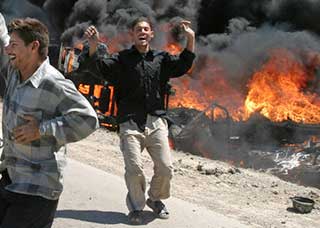
About an hour and a half into the trip, Sanchez saw kbr tractor trailers in flames along the side of the road, then heard drivers screaming over their radios. "Bill Bradley yelled for help twice," Sanchez, a 39-year-old rancher from New Mexico, recalls. "That was the last I ever heard from him." In what became known as the Good Friday Massacre, Bradley and 5 other American drivers were killed and 14 were wounded; 1 is still missing and presumed dead.
The military's heavy reliance on contractors in Iraq has led to significant civilian casualties: more than 1,000 contractors have been killed and another 13,000 have been wounded since the war began. With their employees in harm's way, kbr and other contractors have sought ways to immunize themselves from liability, as Sanchez and nine others who survived the attack—and relatives of those who didn't—discovered in 2005, when they sued kbr and its former parent company, Halliburton, for wrongful death and fraud. The plaintiffs have gathered compelling evidence that the companies had reason to believe the convoy would come under siege but dispatched it anyway. But kbr has fought back with a controversial defense. Invoking the so-called "political question doctrine," which allows the court to avoid deciding questions it believes should be left to other branches of government, kbr's lawyers have successfully argued that judging the contractor would require the court to judge the U.S. military, which is beyond the scope of its authority.
The survivors say they simply want a court to determine whether kbr violated a basic commitment to protect its employees. "When I saw some of the evidence in black and white," says Ray Stannard, a 49-year-old former Marine from El Paso who was driving for kbr that day, "that's when I knew—these people are murderers." Stannard, who injured his leg and broke his arm during the hours-long attack, says he has seen emails sent among kbr's top brass revealing that supervisors knew they were sending the men into an area under insurgent assault. Those emails, like much of the evidence in this case, have been filed under seal at kbr's insistence. But deposition testimony from former kbr security personnel, which is public record, confirms the company was warned repeatedly of the danger.
A lawyer for the company argues that what kbr's security team knew on the day of the attack is irrelevant. "The military decides everything and is responsible for everything"—including providing security for kbr convoys—says David Kasanow, who is defending the company in this and similar cases. So for a court to weigh kbr's actions, it would also have to take the military's into account.
In September 2006, Judge Gray H. Miller, a recent Bush appointee to the federal court in Houston, agreed. There is no way, he wrote, to "try a case set on a battlefield during wartime without an impermissible intrusion into powers expressly granted to the Executive by the Constitution." In late January, kbr's lawyers echoed that argument to a federal appeals court in a session that was closed to the public at kbr's request.
As Mother Jones went to press, the appeals court had yet to render a verdict, but if it upholds Miller's ruling, the implications are vast. If kbr isn't subject to American law, then neither is any other contractor working alongside U.S. troops. "Simply because an act took place in a contingency operation doesn't mean the court can't decide a claim," says Laura Dickinson, a University of Connecticut law professor and expert on government contracting law. "That alone shouldn't be the basis for assertion of the political question doctrine."
Yet at least three similar cases filed against kbr, all claiming the company failed to protect its employees, have been dismissed on the same grounds. Most recently, several women who worked for kbr in Iraq claimed they were sexually assaulted by coworkers. In each case, kbr argued successfully that the court lacks jurisdiction either because the women's employment contracts, signed with a Cayman Islands-based subsidiary of kbr, require disputes to be decided in private arbitration or because, as a military contractor operating overseas, the company is immune from civil legal liability.
Congress is considering legislation to allow for prosecution of private security guards who've gunned down Iraqi civilians. But the question of how private military companies treat the unarmed workers they send into the line of fire—or why these workers have no legal recourse—isn't part of the discussion.
"What amazes me about this process," says Scott Allen, a Houston lawyer representing the surviving kbr drivers, "is that I thought one of the reasons we went to war over there was to establish a democracy. If this were going on in Iraq, this would be used as an example of how there's no democracy. I thought that's what we were fighting for."
I thought that's what we were there for too...WTF?
There is no democracy in Iraq or for that matter the law does not apply is the attitude of most of the Middle East Contractors from KBR,to DynCorp,To ITT,to Blackwater,Custer Battlefields and a host of others. I lost my hearing working for DynCorp in Qatar,because the employer was too cheap to provide its security guards with the proper hearing protection for operating a 50 caliber gun. I have been to DynCorps insurer AIG,I filed under the Defense Base Act, all to no avail. We risked our lives for our country,yet these coporate contractors feel no responsibility for their lack of protection of their employees. All they care about is profiteering in the Middle East.
i worked for many years for KB&R when it was just B&R (brothers and other relatives)- the more things the more they stay the same - the company was never responsible for anything - i saw an experienced foreman drive a front loader off into an excavation with hundreds of rebar end pointing straight up - nothing was barracaded or in compliance - he and the loader suffered several penetrations - he survived and was fired for operating equipment for which he was not licensed
I think that a lot of this 'defense contractor' stuff just needs to be done away with. I vote to bring the troops home post-haste, forthwith, so that Congress can clear the deck to deal with this administration. Rep. Conyers has the papers, last I heard.
There are thousands of cases including rape, murder, negligence and fraud which have been deemed no law applies. These are mercenaries operating above the law. The Military Industrial Media complex is making sure that most of these stories do not make it into the mainstream news. Americans should be demanding answers and withdrawl of these contractors immediately.
Please tell me again just why the Congress thought allowing the the Pentagon and the Executive branch to hire and then have the taxpayer finance a hugh private army which the Executive branch then set above any and all laws either in the U.S. or elsewhere was a good idea?
Way to go Congress!
I tell you this, the only way to begin to solve this problem and all others that originate in Washington, DC (and the boardrooms of the giant multi-nationals who are the real government of the U.S.) is to throw out every one of the incumbents who voted to authorize "military force" in Iraq or who then subsequently voted to continune funding for first the invasion of and then the occupation of Iraq. You say that sounds radical. Perhaps. I'll bet you though that most of the signers of the Declaration of Independence would have agreed with me.
Just another outrage committed by the bush administration for its buddies in business. Contractors sent to support war activities need to be kept to even stronger standards than those at home. They need to be fully accountable down to the last penny to the American public; after all, we are supporting them, we are paying the bills. They need to be accountable for the actions of their people and be held responsible when those actions result in harm to either their own employees or the civilian population.
Anything less is a shameless parody of all we claim to hold dear in this country. I hope that the perpetrators of this, and all crimes relating to the illegal war in Iraq, are found, tried, and punished to the full extent of the law and that includes the current administration.
I am a U.S. citizen. I abhor this war and the harm that has been done in my name with my money. I am sick of being treated like witless scum who does not have a right to know or protest actions taken by my government. This abuse by the contractor buddies of bush and cheney needs to stop immediately.
Let me see if I got this right? You get offered a Job overseas in a war zone @ more $$$ that you could make here in the USA in 5 yrs. No benifits tho, & if you get hurt it's tuff luck.
No one sees the downside here, & they take a job like this, get hurt & have the nerve to complain.....
What am I drinking here or is this just another dump on KBR etc.
We need to find a way to get rid of contracting in Federal and State governments. Indiana is contracting a lot also and the main reason, as I see it, is to escape responsibility and to repay contributions. When they will not allow legal action,we are dead in the water.
The simple truth is; I have been seriously hurt in Iraq, while on a Military base! While there are a lot of civilians in these in war zones; most are there to support our troops, and some; because they are trying to do something good in the midst of so much that is bad in any war. And as the United States has moved toward a leaner military force, which relies more heavily on civilians to carry out non-combat roles; the number of American civilians stepping into the danger zone has been climbing.
I find myself rereading KBR’s core values: “are at the forefront of our daily business. Incorporating these core values in our daily work, and making them an integral part of our culture, is key to our future success”. Our values solidify who we are and what we believe. KBR's values are:
• Uncompromising commitment to Health, Safety and Environment
• Integrity in all we do
Our mission defines what we set out to do each day. KBR's mission is: To safely deliver any project, any time, in any environment for the benefit of our customers, shareholders, employees and the communities we serve.
Our track record has proven that time and again when faced with the task at hand, regardless of the challenges, we deliver the work that is expected of us. To that end, KBR’s motto or slogan is 'We Deliver'. They want to recognize as an organization that is the safety benchmark for the industry and is accident and injury free…And that there is not one thing that we do that is worth injury to an employee. Exceeding Goals and Setting New Standards; This was a banner year for PII. We exceeded our targets in three key indexes. Our lost-time incident rate improved from .056 in 2002 to 0.37 in 2003. Fewer people were injured at work. Our recordable incident rate dropped from 1.36 to 1.08 even though we worked 500,000 more hours. Our vehicle incident rate went from 0.95 to 0.87, and, in July 2003, we reached a remarkable milestone – ESG employees, had driven more than 500 million miles without a single work-related vehicle fatality. http://www.halliburton.com/public/pubsdata/hse/pdf/H03948
In summary, we can see how they achieve these goals. My goal is help others…By letting KBR know what Dignity and Respect really is. Having an open door policy is there to help! Especially when you’re basic legally protected rights have been violate!
I think that a lot of this
I think that a lot of this 'defense contractor' stuff just needs to be done away with. I vote to bring the troops home post-haste, forthwith, so that Congress can clear the deck to deal with this administration. Rep. Conyers has the papers, last I heard.