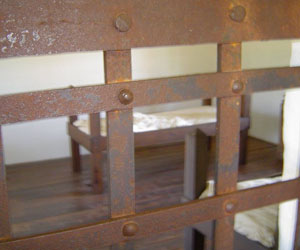
America's Tough Love Habit

For decades, Americans have tolerated "tough love" treatment not just for terrorists, but for vulnerable youth.

—Photo used under a Creative Commons license by flickr user gloomy50
Mon May 4, 2009 12:50 PM PST

We are, famously, blasé about our acts of torture overseas. But why? The laser-like focus on fixing the economy, wanting to avoid more political divisiveness, the diminishment of watchdog journalism—are all part of the explanation. But there's another overlooked reason as well.

Americans tend to valorize tough love—at times, even tough love that verges on torture—in prisons, mental hospitals, drug rehabs, and teen boot camps. We aren't squeamish about the psychological aspects of torture. We might even admire them.

Thousands of troubled children, for instance, now attend tough "wilderness programs" "emotional growth boarding schools" and other "tough love" camps where they face conditions like total isolation, sleep deprivation, food deprivation, and daily emotional attacks.


story continues below story continued from above

Thousands also attend religiously based residential programs, some of which claim to "cure" homosexuality and stop teen promiscuity. In this context, the recent poll showing that evangelicals are the group with the highest level of support for torture begins to make sense.

If we think humiliation, stress positions, and isolation are OK for disobedient teens, why not for suspected terrorists?

As the author of the first book-length history and expose of the troubled-teen industry, I’m familiar not only with the distressing stories of abuse coming from these programs, but also with their roots in the same tactics now being exposed in the CIA torture program.

If more people understood the psychological and physical consequences of these "thought reform" techniques, I don't think we'd find them acceptable for anyone.

Here's what is known about the parallels between "enhanced interrogation" teen boot camps and the idea of "thought reform" programs first described by psychiatrist Robert J. Lifton in the 1950’s—and about how they damage the mind and body.

As we’ve learned from the torture memos, the tactics used against suspected Al-Qaeda prisoners were based on American military counter-interrogation training known as SERE (Survival, Evasion, Resistance and Escape). SERE tried to teach soldiers to resist tactics that were used by the Chinese and Koreans in the 1950’s to break American servicemen and their own citizens.

Breaking someone, it turns out, needn’t involve much of what conventionally has been called torture. Instead, by the skilful control of the environment and use of things like complete isolation from the outside world, stress positions, hard physical labor, sleep deprivation, food deprivation, temperature extremes and humiliation, one can create a regime that relatively quickly warps the mind and produces at least the illusion of compliance.

(Details in the 1963 CIA Interrogation Manual here.)

All of these tactics—everything short of water-boarding—have been found to be used in a surprising number of teen programs. In 1974, in fact, a Congressional investigation said that tactics used by The Seed program on kids were "similar to the highly refined brainwashing techniques employed by the North Koreans in the early 1950's."

Hundreds of programs operating now are directly or indirectly tied to the program that was the model for The Seed, a cult called Synanon.

In an October 2007 Congressional hearing, Government Accountability Office investigators and other witnesses described teens being publicly humiliated, sleep deprived, starved, denied medical care and "forced to eat vomit [and] lie in urine and feces." So this has been done to kids for at least three decades. 

The key to understanding why these controlling, humiliating regimens work to produce apparent compliance and how dangerous they are to mental health is social neuroscience. It turns out that the human stress system is modulated by social support. That means that what turns off—or on—our stress systems, is mainly other people.

In fact, keeping one's stress hormones balanced requires the comfort of others: Even short periods of forced isolation can make them spiral out of control.

If in addition, you deprive someone of all physical affection, further overload the stress system via temperature extremes, low calorie diets, and physical stresses like over-exercise or confinement, you have a perfect storm of traumatic experience.

A critical element here is combining these tactics to undermine any sense of control—the more helpless a person feels, the more dangerous traumatic stress becomes. The psychologists who devised the "enhanced interrogation techniques" explicitly wanted to create dependence, reading the literature on what psychologist Martin Seligman termed "learned helplessness."

Learned helplessness is actually based on an animal model of depression, and has also been linked with causing PTSD, panic attacks, and even reduced immunity.

Another aspect that interrogators recognize to be critical in destroying a person's sense of self is humiliation. This includes seemingly benign things like taking away preferred clothing and more extreme identity degradation tactics like keeping people either naked or in humiliating outfits and denying bathroom access, including hygiene.

Constant emotional attacks—particularly sexual humiliation and insults that emphasize worthlessness and hopelessness—also help leave people vulnerable to the provision of brief moments of kindness, for which, by that point, most people will do or say anything.

It seems hard to believe that it is that easy to break people’s wills—but understanding the brain’s stress system again offers insight. Under intense stress, higher brain regions have less control over the mind and body: the faster, more reactive regions dominate in order to facilitate fight or flight.

This literally makes us less intelligent and more pliable—and that makes evolutionary sense. Early humans who were contemplative during emergencies probably left fewer descendants.

And chronic, intense stress can be even more damaging: it "burns in" these hair-trigger responses and connections that give greater control to lower brain regions while damaging the area needed for long-term learning and memory, the hippocampus. This can produce depression, post-traumatic stress disorder, and even high blood pressure, heart disease, and stroke.

However, because of social modulation of stress and the importance of a sense of control, these conditions do not have anywhere near as great an impact if the person chooses voluntarily to undergo them, has social support and knows that the ordeal will end at a certain time.

Comparing a teen who chooses to stay up all night partying or a guy who likes to stand while working at the office with people who are forced to do those things is thus invalid. The physiology of voluntarily undergoing time-limited stress induced by people you trust and being forced into it by those you don’t are completely different.

There would be an interesting debate to be had on the use of these regimes if they produced lasting positive behavior change in the direction desired by their enforcers. In terms of interrogation, some people might find it acceptable to intentionally provoke depression and PTSD in suspected terrorists if that could prevent attacks. In terms of addicts and teenagers, however, it makes no sense at all, given that both PTSD and depression increase the risk of developing new addictions or relapse to older ones.

And, in fact, imposing traumatic stress—as the researchers who studied the victims of the Koreans and the Chinese discovered back in the 1950’s and 60’s—is not a good way of producing either reliable information or behavior change. Damaging the brain regions responsible for concentration and memory and potentially inducing psychotic delusions is not a good way to discover the truth or promote better behavior.

Stories of teens held in abusive drug programs are instructive here: there are countless cases of false confessions. Kids who had done nothing more than smoke pot came out with tales of shooting heroin and smoking crack—virgins told stories of becoming prostitutes forced to have sex with animals in order to support their habits. These were not isolated events—having interviewed dozens of kids with this experience, false confessions were a common thread, many of them bizarre. Drug-related behavior after the program was often far worse than before.

Further, while many people are resilient to traumatic stress and some are made stronger by it, the damage done by imposing it doesn’t just affect victims. Perpetrators are harmed, too—by feelings of guilt, by having to shut off compassion and empathy and by the corrupting nature of having absolute power over people.

This also produces an acceptance of the previously unacceptable, a culture of callousness that erodes trust and replicates itself, causing more hopelessness and calls for even more extreme measures.

If we want to return to America’s ideals, we have to look at why we’ve tolerated this kind of treatment for anyone—not just terrorists, but vulnerable youth—for decades.

Most of all, we need to stop thinking that getting tough is the answer to everything. It’s often harder to resist kindness and compassion than it is to submit to brute force and tell your captors what you think they want to hear. This is, in part, why the FBI wanted nothing to do with "enhanced interrogation." The data on both teen treatment and legal interrogations by the FBI are clear: torturous tactics are both unnecessary and harmful.

By eliminating these coercive regimes from every aspect of our culture, we will not only do good, but do well.

Maia Szalavitz is the author of "Help At Any Cost: How the Troubled-Teen Industry Cons Parents and Hurts Kids."

Get Mother Jones by Email - Free. Like what you're reading? Get the best of MoJo three times a week.
Comments
no profile pic for comment author

Wilderness Programs---not all tough love

I agree with you. It is inane that we want to bring up loving, responsible caring adults by treating them with tough love. Tough love jades, hardens and makes mean people. It is difficult though...young people today are brought up in a world that attempts to influence and conform on all sides. Without a very stable and secure home environment, young people are vulnerable to so many different pressures that threaten the human soul. So, many of these young people act out and try to find self and belonging among gangs, drugs, premature sex, etc. They feel entitled to have everything that their parents have...now! Parents, many times, feel helpless and although they love their children, they do not know how to help them.

Interestingly enough, you mentioned "wilderness programs". While it is true, some of the programs have been notorious for this "tough love," there is one program in particular that runs on a completely different philosophy. ANASAZI Foundation (www.anasazi.org) is a non-profit wilderness program. Because it is non-profit, not a lot of money is spent on marketing and advertising. Unfortunately, this means that few people are able to benefit from it. Go to their website, read their testimonials, ask for a reference list and talk to parents that have been through the program with their children. This program offers a whole new way of looking at these youth. They are great...and they are treated as such. They are loved and trusted and expected to be the incredible people that they are. I highly recommend this program.

no profile pic for comment author

The Children

They don't need tuff love. They need "The Conservative Reconstruction Project" and to be taught the truth about life and living in America. No other program could have such a profound effect on them. We need to defenestrate all the others and start new.

no profile pic for comment author

Check out Jon Krakauer's

Check out Jon Krakauer's coverage of Anasazi's treatment of kids from Outside Magazine. The kids are given so little food that they have to resort to eating lizards!!!!!

I am sorry, but if you are not providing enough calories to kids such that they have to eat lizards, I don't see how you can say that it *isn't* tough love.

If a child voluntarily wants to go to an Outward Bound program, knowing in advance that that's what he or she is in for, that's one thing. But forcing that on children cannot be considered kind, gentle, supportive treatment.

no profile pic for comment author

The Surgeon General issued a

The Surgeon General issued a report citing the dangers of adolescent residential treatment centers. These programs have a habit of attempting to dodge regulation by dodging definition. If "wilderness programs" are being exposed as abusive, the facilities claim to be "therapeutic boarding schools", "boot camps", etc. Look at the programs policies and ignore the nebulous descriptions of the program, because they are businesses and they will sell you what they think you want to here. There are no industry-wide independent studies of the the efficacy of these programs, even after nearly thirty years. That should be a strong indicator of the fear these teen prisons have of transparency.

Nothing is worse than losing a child or losing a child's love and trust by placing them in an abusive program. My own family was ripped apart by the decision to place a child in what is one of the most abusive teen programs on U.S. soil - Peninsula Village.

Look further than the flashy websites and the dazzling promises of people trying to sell you a program.

Kevin.

no profile pic for comment author

Is it spam?

This should probably be flagged as spam, but it does illustrate something worth noting about the troubled teen industry. These people are sincere. They're as convinced of the unquestionable goodness of their respective programs as any nazi ever was of theirs. Being sincere doesn't mean they're right.

Carsten, I must say that you and your friends are doing a wonderful job on that wiki!

http://wiki.fornits.com/index.php?title=ANASAZI_Foundation

no profile pic for comment author

There are some good

There are some good programes with mixture of some really bad one's as well,but for me i need programes that aware children all aspects of life and fulfill their basic needs.

no profile pic for comment author

Excellent, Precise and True

Having experienced a complete nervous breakdown at age fourteen due to the techniques in the Kids Helping Kids program, and lived through the hell that this "tough love" pshychological insanity does to a teenager, I can say with certainty that the way Ms. Szalavitz has described torture, teen programs and the culture that encapsulates and allows these horrible abuses to occur is nothing less than brilliant.

Many of us have lived this tragedy but for those who haven't, I believe it would be a very difficult concept to convey. I am so very happy to be validated by the intense research Ms. Szalavitz has conducted in the name of "Truth and Justice". Her articulation and insight provides those of us who are (or were) victims of this atrocity a place to turn, and adds significant understanding to our experience. Over twenty years later, it is still difficult to understand exactly what was done to my "group of kids" and why.

This article sheds even more light on the topic of the "Troubled Teen Industry" as well as America's blind eye or quiet allowance for tortures conducted for any number of reasons.

Having been tortured, I can say that the information drawn from my isolation and abuse in the program was absolutely false. I eventually couldn't distinguish reality from the world being suggested to me by my captors.

Thank you Ms. Szalavitz for your research and your subsequent contributions on this subject.

no profile pic for comment author

The key to understanding why

The key to understanding why these controlling, humiliating regimens work to produce apparent compliance and how dangerous they are to mental health is social neuroscience. It is an excellent topic for preparing essays, term papers and research papers in high school, college or university.
creative writing | annotated bibliography | case study | lab report

no profile pic for comment author

Starts at home

I think the key point in this article is that the policies we preach to those overseas must be moderated and at very least active in our own lives. We need more love in our homes, and if we did I think society would be a better place.

no profile pic for comment author

I went to a "therapeutic

I went to a "therapeutic wilderness program" in Texas, Lonestar Expeditions. I was only allowed to shower once a week, which didn't even matter when you had to sleep on dirt anyway and you would get dirty the hour after you got your shower. I wasn't allowed to talk to my parents except through written letters, that were all read by my "counselor". Anything that they saw was "destructive" in my letters they would put me on "harm watch" and I would be under watch 24 hours a day, including when you use the bathroom. I was very suicidal throughout the whole process and couldn't even voice my feelings about it which made me even more depressed. We didnt have toilets and had to stay in talking distance to use the bathroom, in a hole that you would dig up yourself. They wouldnt allow you to use toilet paper if you were just peeing. Lucky for me I never had my period while there, but I could only imagine how bad it would be. I was there during the winter, which was around 28-40 degrees most of the time. As for the food, they had a rotation but every week was the same food. When I tried writing letters to my parents about everything that was going on and they asked the couselors about it they lied to my parents telling them that "if I wanted to take a shower bad enough etc. etc. I could." Not telling them the means I had to go about doing things. In 30 degree weather I was not about to wrap a tarp around four trees(that had holes in it so people could see your naked body) and take a water drum and wash my body with "camp suds". Not to mention it was impractical when you are only allowed to wash your 1 set of clothes once a week.

I went to sleep every night crying wondering how my parents could just drop me off with mere strangers in living conditions they didn't even know about.

Throughout the whole process I never a positive outcome if anything I was angered, depressed, and saddened at my parents and the people around me. Just thinking about my experience makes me shed tears. I would never put my child in such a condition.

I really think its inhumane, and dont understand how it isn't unconstitutional to put mere children in these conditions.

I wouldn't ever recommend it.

no profile pic for comment author

موقع منتديات

موقع منتديات العاب دليل العاب طبخ العاب بنات العاب سيارات العاب باربي العاب للبنات فقط العاب تلبيس العاب تلبيس بنات العاب بنات فقط دليل مواقع العاب قص الشعر العاب ترتيب الشعر العاب اطفال العاب بنات جديدة العاب البنات العاب قص شعر العاب ترتيب تلبيس بنات العاب الطبخ العاب السيارات العاب مغامرات العاب اكشن العاب استراتيجية العاب ذكاء العاب ذكاء للكبار العاب مسدسات العاب تصويب العاب سباق سيارات باربي العاب جديدة العاب سونيك العاب ميك اب العاب مكياج توبيكات 2009 العاب بنات 2009 العاب طرزان العاب براتز العاب ديزني العاب دراجات العاب دبابات دليل المواقع قوقل الياهو الهوتميل  رسائل حب توبيكات ملونه تسريحات 2009 صور×صور رسائل شوق صور ماسنجر توبكات ملونه توبكات مسجات توبيكات حزينه فساتين سهرة رموز متحركة للماسنجر حنان دشتي رجيم  الطب النبوي منال العالم صور 2009  اناشيد طيور الجنة توبيكات فيديو صور العاب طبخ جديدة  hguhf العاب    http://www.arabstart.com/sitemaps/sitemap_index.xml.gz http://forum.arabstart.com/sitemap_index.xml.gz

no profile pic for comment author

müzik indir

des informations très utiles

no profile pic for comment author

Torture doesnt solve problems

It just doesn't seem to be working using torture to solve all the worlds problems. From Guantanamo Bay to religious camps for curing gay children, there has to be a better answer than brutality or bullying. If my child was different I would never subject them to being told they are not normal and being forced to accept someone else's version of normality.
Swarovski

no profile pic for comment author

laptop charger are not good

laptop charger are not good for you but may help some. China might be the next super power and we should start beleiveing that. Torture will only make things worse is anything else. I wonder what peole would do without it. It does not make sense

no profile pic for comment author

Jail reminds me a lot of

Jail reminds me a lot of Process Control Systems - people may not like them but they have a place in society. I don't agreeing with terrorising the people in them though. The primary aim of any prison must be to rehabilitate.

no profile pic for comment author

http://www.residentialtreatment411.com

Really "therapeutic wilderness program" helps a lot but the program sometime itself becomes a stress and than to recover that we need to follow some other stress related program dont know why such programs are sometimes preferred but may be it could be helpful somehow, i think better to go for such programmes it is good to go for adolescent residential treatment

Post a comment
Alternately, you may login to or register an account
The content of this field is kept private and will not be shown publicly.
  • Web page addresses and e-mail addresses turn into links automatically.
  • Allowed HTML tags: <a> <ul> <ol> <li> <blockquote> <img>
  • Lines and paragraphs break automatically.

More information about formatting options


Jail.org - Inmate Search
Criminal records, instant public records & people search & current court records. www.jail.org

U.S. Public Records Search
Search County & State Court Records, Criminal records, Vital and Adoption Records www.PublicRecordsInfo.com

Records.com - People Search
Public Records and Background Checks. Instantly Search Criminal Records, Addresses and Court Records www.Records.com

Court Records & County Records
Find Instant Public Records, Criminal Records as Well as County Property Records Search. www.PublicRecordsIndex.com

Mother Jones Podcast
Get in on the conversation! We talk about culture, politics, the environment, the economy and more. Listen now!

TalkBackTees.com
A treasure trove of liberal wit, wisdom and quotations, from ancient to modern, on colorful, cotton tees.

Support Independent Artists
Amazing art, crafts, apparel, paper-goods and more. A carefully curated selection of sundries since 1999.

FREE CONNECTIONS FOR GREEN SINGLES
Meet progressive singles in the environmental, vegetarian & animal rights community who share your values