Next Up: The Battle Over Wall Street Reform
Obama and Barney Frank want a financial "supercop." Chris Dodd has other ideas.
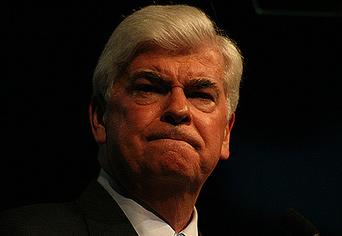
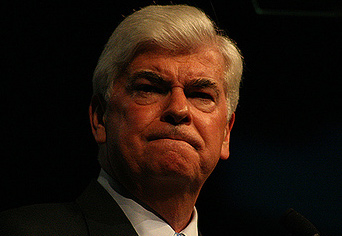
As congressional Democrats move financial reform to the top of their agenda, they're bracing for bitter battles with industry and industry-friendly Republicans. But perhaps the biggest roadblock will come from one of their own: Christopher Dodd (D-Conn).
The powerful chairman of the Senate banking committee opposes a key reform that its proponents say would convert our sieve-like regulatory system into a genuine watchdog, by giving a single entity the power to regulate systemic risk. That sets Dodd on a collision course with President Barack Obama and House financial services committee chairman Barney Frank (D-Mass.), who both favor a financial "supercop."
One cause of the economic crisis was that financial services firms could shop around for the softest regulator, escaping scrutiny for risky behavior. That's because they're monitored according to what kind of company they are, not what they actually do. Thrifts, investment banks, insurance companies, private equity firms, and hedge funds all deal in mortgages or mortgage derivatives. Yet these entities fall under regulatory regimes of varying strictness. The Office of Thrift Supervision oversees the thrifts. The Securities and Exchange Commission oversees investment banks; nationally chartered banks are regulated by the Office of the Comptroller of the Currency and are members of the Federal Reserve. Insurance companies are often monitored by state regulatory bodies. And hedge funds and private equity firms are barely regulated at all.
"Financial products and institutions should be regulated for the economic function they provide and the risks they present, not the legal form they take," Treasury Secretary Timothy Geithner has said. "We can't allow institutions to cherry-pick among competing regulators, and shift risk to where it faces the lowest standards and constraints." The Obama administration has indicated that it wants one agency—most likely the Federal Reserve—to enforce tougher standards across the board.
That's the part of the plan that Dodd, a longtime recipient of financial industry largesse, opposes. (Dodd's office did not respond to a call for comment.) Instead, he wants a "council" of regulators (likely the Treasury, the Fed, the Federal Deposit Insurance Corporation, and the Securities and Exchange Commission). But this proposal is dead on arrival at the White House, which doesn't want oversight done by committee. "The idea of having a council of regulators was pretty much vetoed," one participant in an administration meeting with banking industry officials told the Associated Press on Friday.
In addition to the single systemic risk regulator, Obama has called for more stringent capital, liquidity, and transparency requirements, a tougher SEC, and a new commission that attempts to predict risks to the financial system. He also wants the Federal Reserve to wield regulatory clout over any entity that might need to borrow from it as a lender of last resort. Dodd's backing for any or all of those initiatives would be crucial, and could require the White House or House negotiators to cave on the systemic risk regulator. Steve Adamske, a spokesman for Frank, says that while Frank definitely supports giving systemic regulatory power to the Fed, Dodd's position is "not a dealbreaker" because there's "no deal yet"—the legislation hasn't been written. Dodd also has allies that might be able to change the administration's mind: FDIC chair Sheila Bair and SEC chair Mary Schapiro prefer the "council of regulators" option.
Some experts caution that the debate over creating new regulatory entities is a distraction from the real failures that helped cause the financial crisis. "The reality is that we have a systematic risk regulator. It is called the Federal Reserve Board," economist Dean Baker wrote in the Guardian last week. "They blew it completely. We will do far more to prevent the next crisis by holding our current risk regulator accountable for its failure (fire people) than by pretending that we somehow had a gap in our regulatory structure and creating another worthless bureaucracy."
This debate will heat up soon, because financial regulation is the "next stop on the train" for House Democrats, says Adamske. Rep. Frank plans to hold hearings on potential regulatory regimes in May and June and may produce legislation in June, Adamske said. A spokesman for House speaker Nancy Pelosi confirmed the schedule.
Republicans could take advantage of the disagreement within Democratic ranks, but Adamske says he hopes financial reform will still win votes from across the aisle. "We did pass a credit card bill a few weeks ago that got 350 votes, and our predatory lending bill got 300 votes," says. "We'll get probably some, but we don't know how many we'll get." But before Democrats start wooing Republicans, they might want to make sure they can convince Sen. Dodd.
FINANCIAL SERVICES REGULATION
I BELIEVE PRESIDENT OBAMA COULD LOOK HIGH AND LOW, FAR AND WIDE AND NOT FIND A BETTER PERSON FOR FINANCIAL OVERSIGHT THAN ELLIOTT SPITZER.
GRANTED, THE GUY MADE A MISTAKE IN HIS LIFE AND HAS SUFFERED SUBSTANTIALLY FOR THAT MISTAKE. HOWEVER, THE MISTAKE HE MADE WAS NOT CHEATING THE PEOPLE OR THE STATE. HE RESIGNED, HE WASN'T CHARGED WITH ANY CRIME OR MISDEMEANOR. I DON'T BELIEVE THERE IS ANYONE MORE KNOWLEDGEABLE ABOUT THE FINANCIAL INDUSTRY THAN ELLIOTT SPITZER AND WE ALL KNOW HOW HE FEELS ABOUT WALL STREET.
I SINCERELY BELIEVE THAT PRESIDENT OBAMA COULD DO THE COUNTRY AND THE PEOPLE WELL BY EMPLOYING SPITZER AS A WATCHDOG OVER THE FINANCIAL INDUSTRY.
The Dispute Here is Who Will Be the Regulator
And Dodd opposes the Fed having that role, and I agree with him.
The Fed is the most opaque, most corrupt (see the recent resignation of the NY Fed Chair), and most captured by the industry that it is supposed to regulate of any of the bodies out there.
Federal reserve as regulator
I don't think the bank that prints our money and charges us interest should be regulating anything. It should be dissolved and congress and the treasury should do their constitutional duties. What or whoever does the regulating needs to be overseen by Congress and all findings made public. We the people need to know.
Banking tentacles
We need, above all, election and lobby reform so that no government official can be in the pocket of any corporate interest. This octopus -- the banking industry -- is squeezing the bejaysus out of the people; yet they have their tentacles so deeply imbedded in our government that they act with impunity. The Fed is created of the banks, by the banks, and for the banks -- and they will watch out for us? Puh-leeeze. Dodd is totally discredited; in my opinion, his opinion has been bought and paid for.
Since when did the Fed become a regulator?
The Fed is essentially the central bank of the US, not a stock, commodities, or insurance regulator. Like other developed countries (the UK and Spain to cite two cases with which I am familiar), the US has market regulators as well as central bankers.
The Fed no doubt contributed to the current situation through its interest-rate policies and its opposition to regulation, but the failure was systemic, driven by a dominant ideology that led to the undoing of Depression-era reforms, the underfunding and understaffing of regulatory bodies (most significantly the SEC), and the stacking of regulatory bodies with "free market" ideologues (e.g., Wendy Gramm).
I don't necessarily see that a single regulator means better regulation. Remember that the last time the US attempted such unification it produced the frightful Fatherland Security Department.
By the way, the best material I have seen on the crisis and the mistaken path that the Obama Administration has set off on is in Simon Johnson's article in The Atlantic and his (two) appearances on Bill Moyers's Journal -- as well as William Black's appearance on the Moyers's PBS program. All are available online.
End of the line!
This issue seems to be resetting itself for another go around. I agree whole heartedly with some of the other posts we need to fix what's broken in DC and that's all the money floating around. We need to put a leash on the lobbyists and return control of the government to the people. I'm tired of busting my bum only to watch my taxes go to some wanker on Wall Street. Then while he's having a good laugh someone else is trying to rip us off.
Either we send a message to Congress that they are all on notice and if we don't see some serious reform we start voting them out - Republican or Democrat - or this is going to keep happening again and again.
DC needs a serious flush!
watchdog
Go to www.beyondrealtime.com and look for the article title. Fox guarding the Hen House. In it will be snippits from people commenting on Obama's push to have the Fed as financial watchdog. What a joke, a private cartel protected by government given even more power then it already has. Either Obama's clueless or in bed with the Banksters because the Fed is the reason why we are in such a mess. Do the research. Dodd is no prize either (I'm from CT) as he's in bed with the insurance companies (healthcare anyone?)
Ralph Nader has it down as does Paul. Kill the Fed and restructure how money is created in this country before it's too late.
At this point in time, given Obama's inability to kick ass, it's already too late.
Please listen carefully.
Please listen carefully. The Troll has just witnessed a new all-time low involving the Judicial mafia--who covers the big-bank’s backs.
A Federal Judge had earlier issued a ruling to protect BofA from a negligence claim. But since there was no applicable law to support this decision, the judge made up his own precedent. He quoted from a case which was unrelated to the controversy and used a caption (a different case altogether) which was applicable but did not contain its own wording to support the judge.
On appeal with the circuit court, the appellate panel ruled as follows:
They affirmed the judge’s decision but for a different reason then the judge had used. They quoted a caption from a criminal narcotics case involving illegal-search-and-seizure. They did not quote any specific language because naturally, none existed to support the conclusion. The second case was even less relevant then the first (by miles). It was used purely as an insult to the litigant. [Translation: Didn’t like the first citation? Here’s a fresh one’] .
We are thus living in a country where the inmates have taken control of the prison.
The idea that a single judge can by influenced is bad enough. However, the federal appeals judges are a panel of three and sit for life and have no where to be promoted.
Its as if they do this for sport.
The ripple effect is that the various lawyers dare not confront these judges--lest they be fed into the dog-food grinder too. Bottom line: Be very afraid. Its coming to a theater near you. The reality-alto.
As for Dodd, I suspect someone in a powerful position has something very very bad about Dodd which he is (essentially) being black-mailed with.
Spitzer had written an article in the Washington Post which was quite damning about the big banks. http://www.washingtonpost.com/wp-dyn/content/article/2008/02/13/AR2008021302783.html
Three weeks later he was on the cover of every newspaper in the USA with a newly revealed scandal, forcing him to resign as a condition of avoiding prosecution. I agree that he should be reinstated to a post of authority and allowed to bust these banks. But the scary part is that he was NOT on the cover of any newspaper when he wrote that article. Woh onto us for the day goith away (Tennessee Williams).
a non issue
this is a non issue. it does not matter how many agencies contribute to the regulator, what matters is their independence of the Wall Street and the hedgies.
The incestuous relationship between the government, banks and academia is exemplified by Geithner and Summers who appear disinclined to push their greedy (former) buddies against the Wall.
The banking industry bigwigs are now totally focused on their personal fortunes and bonuses, hence the short-terminsm and opportunism. The priority would be to force these guys to concentrate on their jobs and the ONLY way to do this is to severely limit their compensation. And this is precisely what Geithner resists.
I don't necessarily see that
I don't necessarily see that a single regulator means better regulation. Remember that the last time the US attempted such unification it produced the frightful Fatherland Security Department .