Is the Economy a Casualty of War?
Washington Dispatch: Increasingly, Democrats are blaming the war for the economic downturn, but many economists say Iraq spending isn't the culprit.
February 29, 2008
|
|
Nobel Prize-winning economist Joseph Stiglitz has blamed the Iraq war for sending the United States into a recession. On Wednesday, he told a London think tank that the war caused the credit crunch and the housing crisis that are propelling the current economic downturn. Testifying before the Senate's Joint Economic Committee the following day, he said our involvement in Iraq has long been "weakening the American economy" and "a day of reckoning" has finally arrived.
Stiglitz's contention that the war is causing the nation's economic woes has become an increasingly popular meme in Democratic circles. (And a source of indignation in Republican ones. Before Stiglitz's testimony, White House spokesman Tony Fratto said, "People like Joe Stiglitz lack the courage to consider the cost of doing nothing and the cost of failure.") Rep. Barbara Lee (D-Calif.), a leading anti-war voice and cochair of the Congressional Progressive Caucus, is among leading Democrats who echo Stiglitz's view. "The war is the primary reason for this recession and we have to drum that home," she told me. Meanwhile, a coalition of progressive and anti-war groups—including MoveOn.org and Americans United for Change—announced a $20 million campaign to convince voters that the war is related to the nation's ongoing economic troubles, an effort that is headlined by former Senator John Edwards and his wife Elizabeth.
Polls show that voters trust the Democrats over the Republicans to manage both the Iraq War and the economy, so pitching these two issues as interconnected could make political sense. The war and the economy are undoubtedly linked, but there's a potential problem for anyone who claims the war led to a recession: Many economists say this isn't so.
"I hate the war; I'm happy to trash it," says Dean Baker, the codirector of the progressive-leaning Center for Economic and Policy Research. "There are lots of bad things you could say about it. It didn't cause the recession."
When President Bush said last week that "spending in the war might help with jobs" and that "this economy is down because we built too many houses and the economy’s adjusting," even well-known Bush-basher Paul Krugman had to concede the point. In a blog post, he wrote, "Hate to say this, but he’s right."
Baker also agrees with the president on the cause of the recession. "It's the housing bubble," he says, adding that there's "no ambiguity."
Desmond Lachman, an economist and resident fellow at the conservative American Enterprise Institute, says that simply removing the billions of dollars a year in Iraq spending from the economy without replacing it could actually make the recession worse, because the spending drives demand and keeps people employed. "War spending helped the U.S. get out of the Great Depression," Lachman says.
The idea that Bush's war is linked with Bush's recession is obviously politically attractive for the Democrats. It's an argument they could use with fiscal and budgetary conservatives who might normally be inclined to vote Republican.
But arguing a causal relationship could be perilous. Faiz Shakir, the research director at the Center for American Progress, which is part of the "Iraq/Recession" coalition, said the groups behind the campaign don't intend to assert a cause-and-effect link between the war and the economy. Instead, he says, they will make the less controversial argument that the same money could be better spent at home. "We are certainly linking Iraq and the economy together, and we are talking about priorities," he says. "All of us believe there are numerous factors that have caused the recession. The Iraq War should be considered as one small piece of what has caused the recession, however it shouldn't be the overarching narrative of what is driving it." Just the same, at least one of CAP's partners in the campaign, MoveOn.org, makes explicit reference to what it calls the "Iraq recession." And Moira Mack, a spokeswoman for the campaign, has spoken of the war and the "resulting economic downturn."
To keep from being contradicted by otherwise friendly economists, anti-war activists ought to be careful they don't go too far and turn arguments about spending priorities into sound bytes about cause and effect.
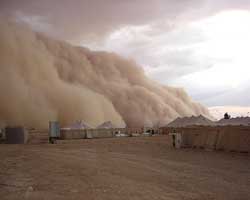
Photo of an approaching sandstorm in Iraq by flickr user tobo used under a Creative Commons license.
Nick Baumann is Mother Jones' Washington Fellow.

http://en.wikipedia.org/wiki/Parable_of_the_broken_window#War
It is not possible to be a "winner". War is always and forever bad for an economy. Sometimes war can be necessary (Iraq was not, nor Afghanistan) but it can never be 'economically' necessary.
During times of war inflation has always been a problem. I disagree with Stiglitz about the sub-prime problem as the deregulation, repeal of Glass-Steagal, Graham Leach Bliely act The U.S. Senate voted 90-8 today to approve S. 900, the Gramm-Leach-Bliley Act gave rise to predatory lending.
These acts repealed the Depression-era barriers that separate banking, insurance and securities. Sen. Phil Gramm, chairman of the Senate Committee on Banking, Housing and Urban Affairs, issued the following statement: "I believe we have passed what will prove to be the most important banking bill in 60 years. It overturns the key provision of the Glass-Steagall act that divided the American financial system.
So AEI has it backwards. The inflation caused by the war AND the subprime mess by deregulation, a depression era bill to stem the problem of predatory lending is what is causing the problem and not vice versa. War in Iraq will NOT help bolster our economy.
The current recession may not be entirely caused by the war spending, but it is entirely related to the neoclassic economic policies of the Republicans who have decimated the middle class and are deporting our economic capacity for the sake of profits that are being moved out of our economy instead of being kept in it in the form of durable wealth and a vital middle class.
As for the recession being caused by too many houses, that's plain bull puckey. If you build a house, when you're done there is something left that is persistent wealth. When you build a bomb, all it does is blow up and usually take a house with it and you're left with a pile of rubble and some dead people, not wealth. With a growing domestic economy and a growing rather than shrinking middle class, we could afford all the houses we've been building. With off-shoring our manufacturing capacity and our middle class wages and potential, we are left a debtor nation with a decreasing wealth.
It is in fact accurate, appropriate and demonstrable to attach the current economic problems to both the occupation of Iraq and the misbegotten Republican policies. Stiglitz is right. You are not.
Between the cost of the war and tax cuts for the rich, we are losing the opportunity to invest in alternative energy infrastructure that would reduce our dependence on foreign oil, improve our educational system so that Americans remain the best innovators in the world, and taking practical steps to protect ourselves from biological weapons and epidemics (these steps would involve reforming our inefficient health care system.) The war may not be causing the recession, but it sure isn't helping us get out either.
prices go up and our ability to buy crap (and necessities) goes down.
stagflation.
d
This just shows that a Nobel prize is an inadequate replacement for common sense.
Didn’t we used to hear that wars were GOOD for our economy?
Now I will only say this once and at a brisk, college lecture pace, for the non-Trolls in attendance:
Our economy is suffering from the long-term effects of financial “inbreeding”.
In particular, the budget deficit (the second ‘mother’ of all “evils” according to Ronald Rogain in 1980 campaign), has disempowered the independent and medium sized companies, from which all sustainable growth and decent jobs flow. It has also sparked off inflation (The first ‘mother’ of all “evils” according to the former President.)
Larger, wall street companies and chain banks favor a budget deficit because in theory, it supports their profits. But it does so by burning the proverbial cigarette past the filter.
When the government needs to borrow, it raises the yield on the Treasury notes. The banks no longer need to lend money to people or small companies. They take the depositor’s money and (though a novel pseudo-laundering system), lend it back to the government. I say “lend it back” because the banks are also borrowing from the Federal Reserve. That money goes to finance the large, Wall Street borrowers, who, BTW: have a totally different set of auditing criteria then do the non-publicly traded companies. The FDIC has one rating system for loans to public companies and a different, much stricter set of auditing requirements for loans to people and independent companies. Thus, a perfectly good and solid loan to a “Main Street” restaurant can be deemed risky when money borrowed by Enron (for example) might well have a lower risk rating.
The larger companies use their financial leverage to:
1. Buy out the competition and thus raise prices and/or lower quality.
2. Discharge large portions of their workforces in the process.
3. Send manufacturing overseas.
The Banks also have the advantage of using the money shortage to raise their interest rates on things like credit cards. This in turn causes the credit worthiness of the general public to plummet, as few people can support the 32.99 percent interest rates and begin to fall behind. Essentially, if every person’s credit rating dropped 50 points overnight, the profit realized by the banks would increase exponentially. And that is essentially what has been occurring, except not overnight. Over the past 7+ years of George-o-nomics.
However, just as a milk-cow on bovine growth hormone can only produce milk for 5 years, rather then the traditional 20, the system of intentional budget deficits has (pre-maturely) sent our economy to the day of inevitable “judgment”. The economically powerful have lifted so much (unnecessary) wealth from the general population that now, their cash is beginning to devalue because it has become a tool for a machine which can no longer function.
Allowing 10 years to pass without any increase in the minimum wage also did not help our economy.
Lastly, wars turn out to be bad for the economy in the long term and good in the short run. We are now well past the short-run and into the long-term effects.
Vote for Obama, as he has the brains and independence to deduce these events without the need for a troll lecture.
If the currency exchange regime is a fixed rate system, then the effect of waging war is Keynesian in nature. Here the government spends, which will result in an increase in activity in the economy. So the problems coming from this spending comes later in the form of increased interest rates, which means the pressure on the dollar is upwards, but since the exchange rates are fixed the government is forced to maintain the fixed rates or loose credibility. If they have to adjust the exchange rates due to the increased interest rate then the increased value in the currency means foreign goods are cheaper in the US but American goods sold abroad are more expensive--thus exports will slow and eventually companies will have to slow down meaning a rise in unemployment. This is what happened during the Vietnam War but it took longer to effect the entire economy because the system of exchange was based on the Gold Standard which was slow to change. The costs of Vietnam War in fact destroyed that exchange system, so in this sense a war is a short term boom and then comes the hell, in particular stagflation which we see hitting us now but it happened in considerably less time than in the Vietnam era--most likely this is due to the exchange system but also because of where the war is being fought. The global economy was not effected by goods produced in Vietnam but in the Middle East it is--hence the inherent danger to national and global security.
When the system of exchange rates is floating (which is our present system) then the effect is the opposite since it makes its pronouncement in a more immediate fashion because as the government goes into debt the currency exchange is automatically devalued by the market mechanism--this is what floating means. That means that the dollar goes down not up. If the dollar goes down then it ought to mean exports should go up and imports go down which should benefit the economy. But this did not occur in the degree necessary to benefit from waging war in the short run because our major trading partners absorbed a great deal of the shock in the currency market by buying dollars in a quantity just large enough to keep the dollar in relation to their currencies more or less constant (by doing this they help finance our debt but they weaken themselves--China and Japan in particular are now feeling the crunch and will because of their own domestic issues be forced to let the dollar fall). Still the effect of government spending when exchange rates are floating is that the economy contracts.
For the US where its currency has been the world's currency of choice since the end of WWII, the consequence of the Iraq War points in the direction of the end of American Hegemony. Like the 1970's oil has tripled but today it is the shear magnitude of the tripling and now the quadrupling in price since 2001--it is not possible to compare in the sense of scaling because going from 3 dollars a barrel to 12 dollars a barrel is not like going from 25 dollars a barrel to 100 dollars a barrel because of the magnitude in costs in terms of the whole economy is far greater today than it was then. The dollar today is weak but the reason for its weakness is directly due to the instability of a region in the world where the major determination of all economic activity is directly linked to the dollar--oil is priced in dollars--one speaks of petrodollars not petro-euros or petro-yen or petro-pounds. If the dollar goes down then all goods that are directly attached to dollar will have to go up in price. So the most stupid place on earth to wage a war is in the Middle East. If one looks at the real meaning of this in terms of "national security" it is obvious that Bush and the newest Republican presidential candidate, John McCain, represent major threats to national security--while the media presents them as being "strong on national security". The real threat is that all countries that sell goods the world over that are priced solely in the American dollar, find that it is necessary to drop the dollar (because it isn't a stable form of exchange) and adopt a bundle of currencies to have their products priced in. This means that "national security" is directly linked to the fiscal responsibility of American leadership and that it is impossible to speak of being strong on national security when a military action directly threatens the currency advantage of having the dollar as the primary measure of all value in goods and services. Loose the dollar as world's choice of exchange and American Hegemony ends as well--if that happens then we have been truly defeated and ironically by a mere 19 men armed with sophisticated weapons like knives and ballpoint pens and the knowledge to pilot an a few airplane into some buildings.
Anyone that claims that war is good for the economy is missing the reality of what war does. War in terms of an investment is seldom one the brings a return--the cost is almost always greater than the return which as a rule means war is unwise. War is an unsound business concept unless you are a company that benefits from the American Corporate Social Welfare System. Still it is because of WWII that the US obtained such large stakes in the world as a whole in economic terms, and the first Gulf War was economically not a burden because the costs were absorbed by others.
As a result, the side effect of any stimulus package is now lasting stagflation and a very weak dollar. These problems will be more serious and difficult to solve than a brief recession after a speculative binge.
Back to the article, Iraq war spending did not cause the reccesion (maybe general war spending for 70 years did) but we cannot address the SYMPTOMS if all discretionary spending goes to the war and national security machines.
from a European perspective and experience
(the main characteristics very briefly):
War inflations were always began with the
"structural changes" in any war going
country, before they started a war with the building up of armies and the need of armaments. Structural changes away from the civilian (or "market worthy
economy" towards a war going economy.
The role of the state is getting ever
bigger and bigger, it becomes an ever
bigger customer in the economy, and
becomes a demand factor.
This implies an accompanying structural
change of purchasing power, a shift from
the civilian, individual, purchasing
power towards the purchasing of the state.
Financing: in antic wars till about two
hundred years ago first of all war chests were build up before a war (from
taxes) then direct war taxes were levied
(all eventually very unpopular, as well
as currency deterioration: the amount of
silver or gold in coins got thinned out
and ever more coins were issued - until
even the most silly peasant realized he
would not get anything for his money any
more. That's then been a "currency collapse" (there is long list of such
collapes; when the name and face of coins had to be started all over again,
see "Numismatic", the history of coins.
They all tell their stories, how they
were used for taxing, got diluted, and
so on, all lies included.)
About two hundred years ago, with the
emergence of banks and the central banks
all war going state were showing up
instantly as clients for credits in times of wars. Instead of direct taxation government borrowing became the
means to finance (also a reason why a
war would not become unpopular sooner).
And this is the third structural change:
the state a client in the credit market,
a fierce competitor to credits used for
the "market worthy or civilian" part of
the economy. For instance from Hitlers'
period we known the "silent expropriation": practically all funds,
savings, deposits, whatever, got "borrowed", the regime had during the
later years of the war problems to pay
for the army supply and such firms got
paid with special promissory notes.
Censorship played an important part in
nobody having "an interest" in such
economic matters, the leader did "not
wish such economic matters", understably. And he was helped by the
fact that the outside world had not much
knowledge about such matters either. Only very people could tell and explain
such things.
Because of this means of borrowing instead of direct war taxes we know of
"deferred inflations" like after WWI and
II, when, after the action was over,
people realized the lack of goods and
services for their own need ("market
worthy goods and services"), the left
over goods from the war being of not
much use when food and clothing are really scarce, and so forth. Hence the
collapse of currencies after those wars
(not because the wars were lost, but
because the apparent lack of what people
subjectively, their daily needs).
Such structural changes can be brought
about with non-military goods and services, like building "babylonian
towers" to create jobs and keep people
busy,or bureaucracy employing millions
just for the sake of acting as employer,
or, another example, the "ton ideology"
in Communist days, when steel and coal
were produced for the reason to keep
up statistically with the West. Hence
they produced steel, just to rust away,
no use otherwise for it, and they produced the acid rain, good for statistics bad for the forests. And, be
it noted, those countries had all nicely
rationed the civilian cosumption, like
food and whatever else, by reason of
necessity.
A currency collapse and national bankruptcy can also be brought about by
intentionally starving out the people,
inhibiting all such production, wheeling and dealing. Examples are the Taliban
regime before 2001. Or Zimbabwe right
now where the regime manages to bring
down all market worthy production and
faces a real shortage of all such goods
and services - needless to say, that such policy is accompanied by a hyper-
inflation, the deterioration of the
currency.
Of interest might also be; the Roman
Empire, whose emperors, because of their
policy, had an ongoing problem financing
their foreign policy. Even though they
levied taxes in the countries they ruled
the tax income never matched the costs.
It was a period when no government
credit was available. Banks were pretty
unknown then.
I have to admit, I was pretty worried that "The smoking gun could come in the form of a mushroom cloud." What a relief there actually wasn't any WMD after all. Now it's a War on Terror and that sounds good because I'd rather fight them over there than over here.
I thought the sub-prime thing was the cause of the housing crisis? And the housing crisis was the cause of the economic slow down? Too many realtors who couldn't make their Lexus payment. Bad for the economy.
People are probably saving too much again. We all need to spend more of our money and keep the economy going. Isn't that the patriotic thing to do?
WARNING: this comment was cut-and-pasted from somewhere else. Had it been a real comment you would have been told where to go and what to do when you got there.
But...
One of the reasons the fed is limited in how it responds to this crisis is because of the high inflation we are experiencing. What is the main cause? The high cost of oil. Why is oil so high? Partially due to growth in demand but also because it is pegged to the dollar. The value of the dollar has dropped like a rock. What are the reasons it's dropped? There are many, but among them is the giant fiscal deficits that the Bush administration has run. Why the deficits? Partly due to one of the largest tax-cuts in history and partly due to an extremely expensive war.
So. Tax cut + expensive war = cheap dollar = expensive oil & increased inflation = limited ability to solve credit crunch due to housing problems.
I think it's safe to say that Bush certainly hasn't helped.
Chalmers Johnson
"Why the US has really gone broke:
The economic disaster that is military keynesianism"
http://mondediplo.com/2008/02/05military
I think the people evaluating the situation are not looking at the Big Modern picture.
Its not just the cost of the war but the longterm cleanup & treatment of our troops, replacement of wornout equipment, replacing the personal who call it done due to back to back deployments. & the most long term damage-the image of a aggresive,dominating,War mongering nation who will hold other to international law but refuse to abide by it ourselves.
We need somebode with some "critical thinking" WOW
http://webpages.charter.net/tbob/war.html
It is still in Google sandpile.