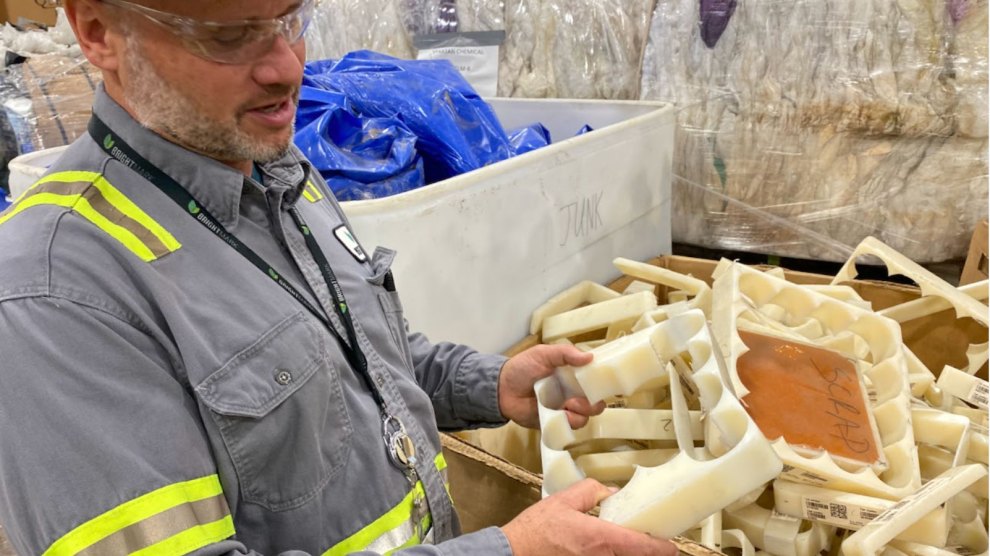
Jay Schabel, president of the plastics division at Brightmark, at the firm's new recycling plant in northeast Indiana, which aims to turn plastic waste into diesel, naphtha, and wax. James Bruggers
Reversing its own Trump-era proposal, the US Environmental Protection Agency has spurned a lobbying effort by the chemical industry to relax clean-air regulations on two types of chemical or “advanced” recycling of plastics.
The decision, announced by the EPA on May 24, covers pyrolysis and gasification, two processes that use chemical methods to break down plastic waste. Both have largely been regulated as incineration for nearly three decades and have therefore had to meet stringent emission requirements for burning solid waste under the federal Clean Air Act.
But in the final months of the Trump administration, the EPA proposed an industry-friendly rule change in August 2020 stating that pyrolysis does not involve enough oxygen to constitute combustion, and that emissions from the process should therefore not be regulated as incineration.
Pyrolysis, or the process of decomposing materials at high temperatures in an oxygen-free environment, has been around for centuries. Traditional uses have ranged from making tar from timber for wooden ships to transforming coal into coke for steelmaking.
And we respect that! But maybe you’re of a mind to support our work directly instead? We have until December 31 to raise the last $400,000 we need to keep our nonprofit newsroom running at full strength into 2026. Will you make a gift today?
We noticed you have an ad blocker on. Can you pitch in a few bucks to help fund Mother Jones' investigative journalism?
Billionaires own the media,
but they don’t own us.
At Mother Jones we know these aren’t conventional times, and they require unconventional coverage. That’s what deliver every day: fierce, independent journalism you can’t find elsewhere. Perhaps never in the history of our country has that been more necessary than now. But we can’t do it without reader support—your support. Please chip in today.
Billionaires own the media,
but they don’t own us.
At Mother Jones we know these aren’t conventional times, and they require unconventional coverage. That’s what deliver every day: fierce, independent journalism you can’t find elsewhere. Perhaps never in the history of our country has that been more necessary than now. But we can’t do it without reader support—your support. Please chip in today.