Yesterday we posted my magazine piece making the case that we should focus strongly on massive climate R&D, even if that means spending less money on building out green infrastructure with existing technology (primarily wind and solar). Surprisingly, I didn’t persuade everyone instantly that I’m right! So it’s probably worthwhile responding briefly to some of the most common criticisms.
Note that this list is not exhaustive, and I reserve the right to revise and extend any of my answers at a later time.
We don’t need new tech. We can reach our climate goals by massive deployment of tech we already have.
Putting aside the political likelihood of this happening, it just isn’t true. A huge national commitment to wind and solar would probably reduce US carbon emissions from fossil fuels by 80 percent or so over the next three decades. But (a) that still leaves 20 percent, (b) this accounts only for carbon emissions from transportation and electricity generation, and (c) it does nothing about carbon emissions from China and the rest of the world. Existing tech is just flatly not enough to get the world to zero emissions by 2050, let alone get us there and begin elimination of the carbon already in the atmosphere, which is our real goal.
Why are you blaming China for its climate emissions? The United States is the real culprit.
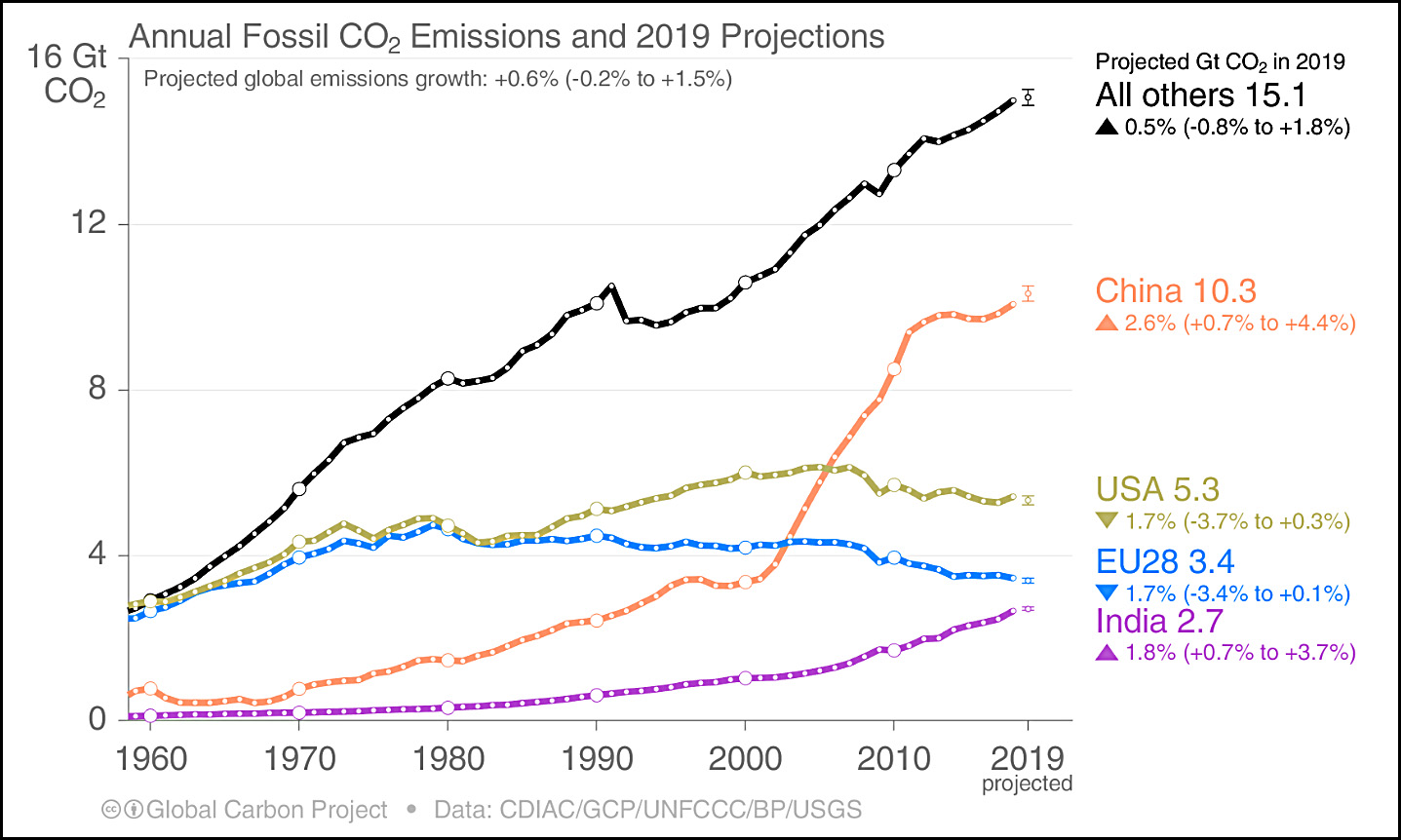
I’m not blaming anyone. It’s just a fact that the US accounts for only 16 percent of global carbon emissions. China accounts for much more and its carbon emissions are rising. The same is true for other non-Western countries as they try to catch up to Western lifestyles. As a simple matter of facing reality, this means that any serious climate plan has to focus not just on the US, but on how we can get non-developed countries to reverse their climate emissions. Setting a good example might be a nice idea, but it won’t do the job: we need to provide them with ways to continue improving their standards of living without emitting ever more carbon. That almost certainly means providing them with technology that they’ll adopt not because they’re good global citizens, but because it’s cheaper and better.
You can’t just blindly toss money at R&D. It takes careful planning and management, and then it has to be demonstrated and deployed.
Yes, of course. I was writing a piece for popular consumption, and that necessarily means that it will come out sounding something like “Let’s shovel a ton of money at the scientists!” But this is only because the details of how we produce large-scale innovation are uninteresting to a lay audience and would make a long article even longer. Needless to say, when I argue that we should spend a lot of money on R&D, I mean that we should spend money on primary research, demonstration projects, engineering, deployment, and proper management for the whole enterprise.
Focusing on R&D is just an excuse to do nothing in the present.
For some conservatives, this is true. But we can’t let bad faith arguments from a few people stop us from doing the right thing.
R&D is a chancy thing. We can’t afford to sit on our hands while we all hope that some shiny object will save us in the future.
Yes, there’s some risk here. But the very risk of R&D is the reason we need to focus on it right now. Even in the best case, R&D that we start today is unlikely to pay off in less than a decade or two, and then there’s another decade or two to roll it out on a massive scale. In other words, we’re already out of time. If we don’t begin a huge effort immediately there’s zero chance of reaching our climate goals by 2050. In the meantime, of course we should continue our present efforts and then some. We just shouldn’t focus federal spending on it at the expense of more spending on R&D.
Real-world deployment is the way we reduce the cost of tech so that it’s available to everyone. That should be Job 1.
This is true, and if I thought that merely deploying existing tech could get us to our goals, I’d be all in favor of it. But again, the evidence suggests this isn’t true. We need more.
We still need massive deployment of wind and solar!
I agree. But we can largely do this without a lot of federal government help if we have to. Tax subsidies are nice, but not absolutely necessary. In a pinch, simply mandating a phased conversion to renewable power and electrification would work fine. But there’s really no way to get massive spending on R&D except via simple federal government funding.
Just a quick note that we’re still waiting to see the actual text of President Trump’s “phase one” trade deal with China. It’s supposedly waiting on translation and legal review, but that’s just a pretext. The real issue is almost certainly different: it doesn’t bind China to buy $50 billion worth of agricultural products, as Trump and his team have been loudly claiming for the past week.
This is typical Trump. Get headlines with a big claim and then wait a while to release the details. By then nobody cares anymore and the details get a small blurb on page A17 and become yet another entry on the many “Trump Lies” lists that we’re all keeping. But the big claim is what most people remember.
For the record, then: the China deal will turn out to have virtually no binding commitments for China to buy anything. They will continue to buy the stuff they need and Trump will pretend that it’s a huge win even though trade figures will make it plain that China is buying no more from us than they always have.
I will of course keep you updated if I turn out to be wrong. But don’t hold your breath for that.
California last year embarked on a unique social and political experiment in the U.S. What would happen if the government required corporate boards to include female directors? The answer: Companies would add them in droves. Ninety-three California-based members of the Russell 3000—an index which includes most public companies on major U.S. stock exchanges—had all-male boards when the law was signed on Sept. 30, 2018, according to Equilar, a corporate governance-data firm. As of this Nov. 22, the most-recent date for which comprehensive data are available, that number had dropped to 17. A few companies have since said that they have added female board members as the year-end deadline for compliance nears.
In the year 2019 it should not be a huge inconvenience to find at least one woman who can sit on your board. Just do it, for God’s sake.
Derek Thompson writes in the Atlantic that the real failure of Silicon Valley over the past decade isn’t so much the catastrophe of social media, but the fact that all these smart people are working on software instead of doing things that revolutionize the real, physical world:
The digital age has coincided with a slump in America’s economic dynamism. The tech sector’s innovations have made a handful of people quite rich, but it has failed to create enough middle-class jobs to offset the decline of the country’s manufacturing base, or to help solve the country’s most pressing problems: deteriorating infrastructure, climate change, low growth, rising economic inequality….These failures—perhaps more than the toxicity of the web—underlie the meanness and radicalism of our era.
This is an old complaint. It usually goes something like, “The best minds of a generation are spending their careers writing dating apps.” But I think Thompson is being too quick to judge here.
For starters, the tech industry has never been dedicated to building better infrastructure or addressing climate change or fixing economic inequality. The same is true of the auto industry and the farming industry. So what? Should we blame them too for focusing on the wrong things?
Beyond that, the tech industry has probably had more impact on the physical world than Thompson gives it credit for. Cell phones have revolutionized banking and communications in Africa, for example. Self-driving cars aren’t here yet, but they will be soon and that’s sure going to have an impact on the physical world. Genome sequencing has been revolutionized by software development. Ditto for pharmaceutical development. You may or may not like facial recognition, but boy howdy has it changed the physical world. Or ask the Pentagon how important software development is to keeping the US the preeminent military power in the world. (Alternatively, ask Boeing about the real-world impact of bad software.) Video games may strike a lot of us elderly folks as kind of silly, but it’s an industry that has transformed the way we spend our free time. The pace of robotics and prosthetic limb development—and what’s more physical than that?—has skyrocketed over the past few years, and that’s due more to software improvements than anything else.
Then there’s the software development that doesn’t make big headlines. Back in the 90s, for example, it turned out that a big chunk of our productivity growth was due to improved use of back-office logistics software in the retail industry. That wasn’t because of any single thing Silicon Valley developed, but because of dozens or hundreds of things that finally came together and remade the way companies ran their operations.
Then there’s the 800-pound gorilla: artificial intelligence. It’s easy to laugh at it right now, but Silicon Valley is working relentlessly on it and in another decade or two it’s going to change the world more than any technology in the history of mankind.
It’s certainly true that we’re failing to build better infrastructure or address climate change. But let’s put the blame for that where it belongs: on our political leaders, not Silicon Valley. If we want that to change, we need to elect better leaders, not kvetch about DoorDash and WeWork.
Spurred by the tone of reporting over the latest PISA test results, Bob Somerby has been pointing out that American kids have actually improved their school performance considerably over the past few decades. Nobody ever seems to acknowledge that.
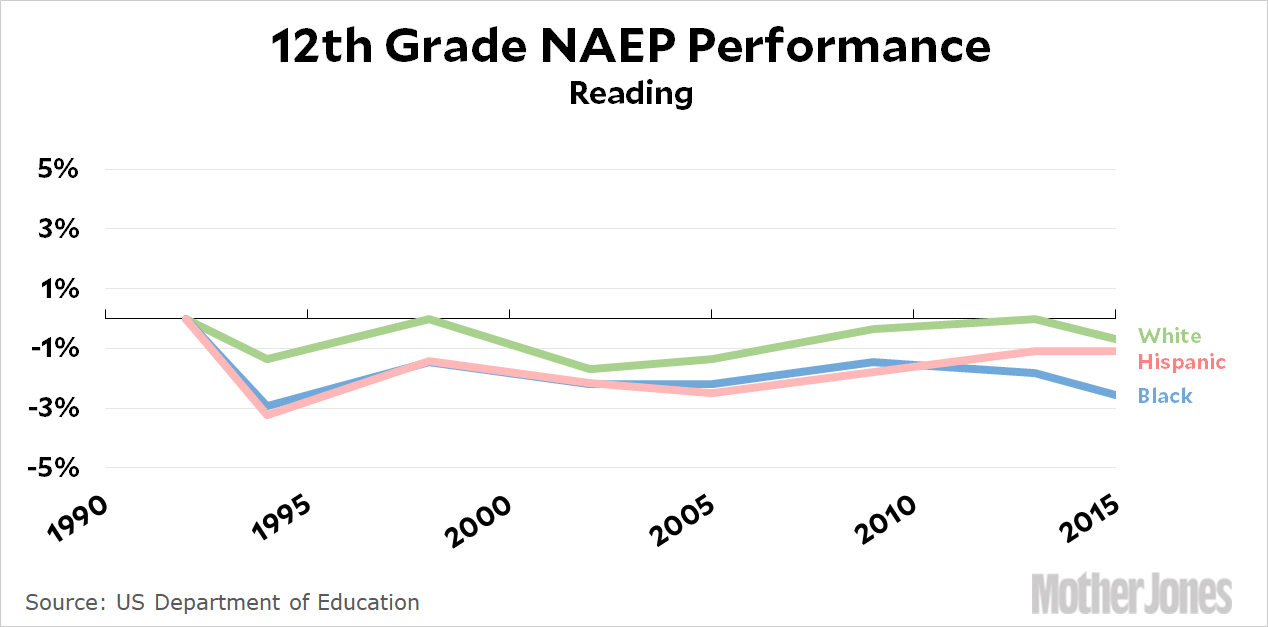
And that’s true. Sort of. But there is a caveat: performance in 4th and 8th grade on the national NAEP test has indeed improved. But a lot of that improvement washes out in high school. Here’s the improvement in reading scores since 1992:
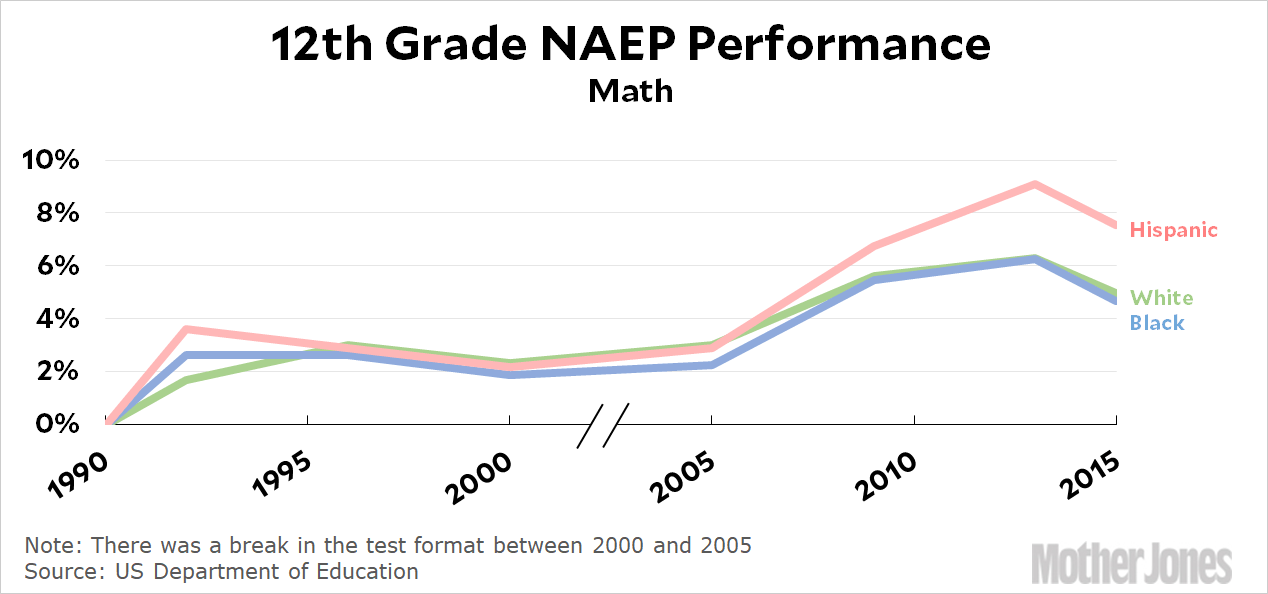
Not so good! Here’s math:
Much better—though even a 5 percent improvement is no great shakes. The best way to summarize student performance since the early 90s is that elementary schools seem to be doing a better job but middle and high schools are having a tough time maintaining the improvements. By the time kids actually finish school, they’re doing a little better in math than they used to and about the same in reading.
That said, I think there’s at least one thing that’s clear: today’s kids aren’t doing worse than kids in the past. This seems to be a common belief, but there’s virtually no evidence for it.
This is a chicken. Big deal, you say? Sure, but it’s a Colombian chicken. I had to travel more than three thousand miles to get a picture of this chicken! Show a little respect.
In the war against climate change, what should we focus on: R&D spending or infrastructure buildout?
This is an evergreen question, but here’s my answer. My proposal is that the United States should spend massive amounts of money on both these things. Practically speaking, however, that won’t happen. We’ll have to make choices. That being the case, I believe we should heavily prioritize R&D. There are two reasons for this:
To a large extent, we can push for green infrastructure via regulation. The brute force way is similar to CAFE standards in cars: we simply put increasingly stringent caps on carbon emissions, which would force utilities to move toward renewable electricity generation. Ditto for other sources of greenhouse gases.
More importantly, R&D is speculative and takes a long time to come to fruition. We need to begin an enormous R&D push now if we’re to have any chance of producing useful solutions in the next decade or two. We simply can’t wait to get started, and there’s really no way to get it going except via government investment.
Life and politics are always about choices and tradeoffs. It would be nice if we could get everything we want, but with our planet at stake it’s reckless to make plans based on that. We have to assume that climate funding is going to be hard to get and that we’ll need to set priorities. Compared to infrastructure, R&D funding is less partisan; more urgently needed; and has no other plausible sponsor than the federal government. For that reason, I would fight for everything, but strongly prioritize R&D if choices have to be made.
In my climate piece today I make a detailed case for massive investment in R&D. I want to outline my argument here in the simplest possible terms:
I am all in favor of building out green energy infrastructure on a huge scale. This means primarily solar, wind, nuclear, grid upgrades, and massive electrification of the economy.
However, this is a big political lift and isn’t likely to happen. More to the point, it only barely matters anyway. Electrification can probably solve only about half our global greenhouse gas problem by 2050, and even if the United States (and Europe) cut their carbon emissions to zero today it would barely be a bump in the road to ever increasing global warming.
This is the key: global warming is global. Any serious plan has to include a plausible way to reduce carbon emissions in China, India, southeast Asia, and other non-Western countries, which is where virtually all of the increase in carbon emissions is coming from. However, they have shown no inclination to sacrifice their economic growth by radically reducing their carbon emissions. I know this is a conservative talking point designed to allow them to shrug away any action, but it happens to be true anyway.
There’s really only one way to get all these developing countries to cut carbon emissions: massive R&D that develops new, cheaper ways of providing energy. This has to include not just electric generation, but also things like cement, airplane travel, land use, chemical production, and other things that electrification won’t solve. Importantly, it also has to include some way of removing carbon from the atmosphere, since no matter how much we reduce emissions we’re still going to end up with too much carbon in the atmosphere by 2050.
Then we give away all our new technology for free to everyone.
That’s basically it. Naturally you want some evidence that I’m right about all this stuff, and for that you have to read my full piece in the current issue of the magazine. Click here for all the grim and gritty details.
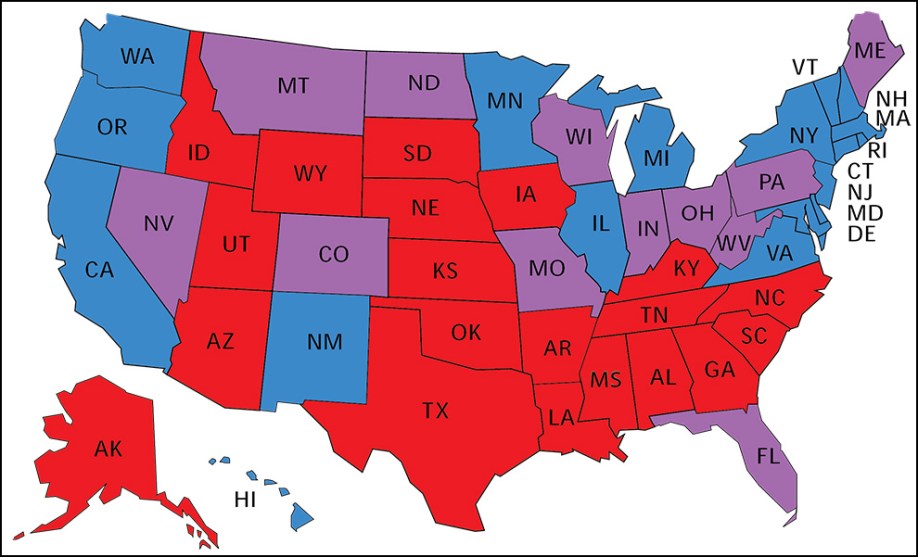
Democrats have a Senate problem, and not just in the sense that Republicans currently hold the majority or that the prospect of that changing in 2020 is relatively slim. The problem is that the odds of ever changing it are slimmer than is generally realized. Data for Progress, a progressive think tank and advocacy organization, is trying to raise alarm bells about the issue. In a new memo, co-founder Colin McAuliffe writes that “the Senate is an irredeemable institution” that’s biased 3 percentage points in the GOP’s favor and systematically underweights the interests of nonwhite Americans.
This kind of stuff bugs me. A mere four years ago, we were bombarded with articles about how the House was almost permanently out of the grasp of Democrats. Thanks to gerrymandering and other issues, Dems would have to win a vast share of the national vote to have any chance of winning even a slim House majority. Then, two years later, Democrats won the House in a landslide.
Now it’s the Senate. But as recently as five years ago Democrats held the Senate, and as recently as ten years ago they held a filibuster-proof majority in the Senate. I know life comes at you fast these days, but nothing has changed all that much in the past ten years. Democrats are still fully able to win control of the Senate.
But how? As Yglesias says, working-class whites are moving steadily into the Republican camp, and the Senate’s overrepresentation of small, rural states means that working-class whites are increasingly overrepresented too. So what can possibly be done? Statehood for Washington DC and Puerto Rico? Needless to say, that’s a nonstarter. The Republican Senate would never support it.
But perhaps there’s another way. I know this will sound ridiculous, but hear me out: Democrats could figure out how to appeal to working-class whites.
I know that many progressives would rather move to Canada than even consider such a thing. After all, working-class whites are racist! They hate gays! They love guns! They go to church! They oppose liberal immigration laws! They want to ban abortion! They drive pickup trucks! They like low taxes! They don’t understand intersectionality!
Well, yeah. That’s true of many of them, though certainly not all. And “not all” is a key point here. It’s not as if Democrats have to appeal to stone racists or lunatic gun nuts to win in rural states. They just have to ease up on some of the things that rural voters think are important. Doing this doesn’t automatically mean that you want immigrants in cages or black men to be the targets of mass incarceration. Nor does it mean you want to force women to give birth against their will or fry the planet via climate change. It just means you accept the reality that sometimes society moves more slowly than you’d like.
In 2008, Democrats won Senate seats in Montana, South Dakota, Iowa, Arkansas, Louisiana, West Virgina, and North Carolina. Places like that seem like nothing more than dreams these days. But they aren’t. If working-class whites can move into the Republican camp over the course of only a few years, they can move out in just a few years too. But progressives have to actually care about them and be willing to compromise here and there to win their votes. This is what politics is all about, and always has been.
I’ll take a wild guess that you don’t need any convincing about the need for action on climate change. You know that since the start of the Industrial Revolution we’ve dumped more than 500 billion tons of carbon into the atmosphere and we’re adding about 10 billion more each year. You know that global temperatures have risen 1 degree Celsius over the past century and we’re on track for 2 degrees within another few decades.
And you know what this means. It means more extreme weather. More hurricanes. More droughts. More flooding. More wildfires. More heat-related deaths. There will be more infectious disease as insects move ever farther north. The Northwest Passage will be open for much of the year. Sea levels will rise by several feet as the ice shelves of Greenland and the Antarctic melt, producing bigger storm swells and more intense flooding in low-lying areas around the world.
Some of this is already baked into our future, but to avoid the worst of it, climate experts widely agree that we need to get to net-zero carbon emissions entirely by 2050 at the latest. This is the goal of the Paris Agreement, and it’s one that every Democratic candidate for president has committed to. But how to get there?
Let’s start with the good news. About three-quarters of carbon emissions come from burning fossil fuels for power, and we already have the technology to make a big dent in that. Solar power is now price-competitive with the most efficient natural gas plants and is likely to get even cheaper in the near future. In 2019, Los Angeles signed a deal to provide 400 megawatts of solar power at a price under 4 cents per kilowatt-hour—including battery storage to keep that power available day and night. That’s just a start—it will provide only about 7 percent of electricity needed in Los Angeles—but for the first time it’s fully competitive with the current wholesale price of fossil fuel electricity in Southern California.
Wind power—especially offshore wind—is equally promising. This means that a broad-based effort to build solar and wind infrastructure, along with a commitment to replace much of the world’s fossil fuel use with electricity, would go pretty far toward reducing global carbon emissions.
How far? Bloomberg New Energy Finance estimates that by 2050, wind and solar can satisfy 80 percent of electricity demand in most advanced countries. But due to inadequate infrastructure in some cases and lack of wind and sun in others, not all countries can meet this goal, which means that even with favorable government policies and big commitments to clean energy, the growth of wind and solar will probably provide only about half of the world’s demand for electricity by midcentury. “Importantly,” the Bloomberg analysts caution, “major progress in de-carbonization will also be required in other segments of the world’s economy to address climate change.”
This inevitably means we have to face up to some bad news. If existing technologies like wind, solar, and nuclear can get us only halfway to our goal—or maybe a bit more—the other half would seem to require cutting back on energy consumption.
Let’s be clear about something: We’re not talking about voluntary personal cutbacks. If you decide to bicycle more or eat less meat, great—every little bit helps. But no one who’s serious about climate change believes that personal decisions like this have more than a slight effect on the gigatons of carbon we’ve emitted and the shortsighted policies we’ve enacted. Framing the problem this way—a solution of individual lifestyle choices—is mostly just a red herring that allows corporations and conservatives to avoid the real issue.
The real issue is this: Only large-scale government action can significantly reduce carbon emissions. But this doesn’t let any of us off the hook. Our personal cutbacks might not matter much, but what does matter is whether we’re willing to support large-scale actions—things like carbon taxes or fracking bans—that will force all of us to reduce our energy consumption.
Solutions depend on how acceptable these policies are to the public. To get a rough handle of what a significant reduction means, the Nature Conservancy has a handy app that can help you calculate what it would take to cut your household carbon footprint in half. If you’re an average household, you need to pare down to one car. If it’s an suv or a sports car, get rid of it. You need a small, high-mileage vehicle (the calculator assumes a regular gasoline car) and drive it no more than 10,000 miles per year. That’s for your whole family. You need to cut way back on heating and cooling. You need to live in a house no bigger than 1,000 square feet. And you need to buy way less stuff—about half of what you buy now.
There are solutions to some of these problems—electrification obviously helps with transportation, and better insulation helps with heating and cooling—but only to a point. One way or another, any government policy big enough to make a serious dent in climate change will also force people to make major lifestyle cutbacks or pay substantially higher taxes—or both.
How many of us are willing to do that? It turns out we have a pretty good idea. In 2018, the Energy Policy Institute at the University of Chicago fielded a national poll on climate change. Only 71 percent of respondents agreed it was happening, and of those, more than 80 percent said the federal government should do something about it.
Then the pollsters presented a scenario in which a monthly tax would be added to your electric bill to combat climate change. If the tax was $1, only 57 percent supported it. If the tax was $10, that plummeted to 28 percent. Those aren’t typos. Only about half of Americans are willing to pay $1 per month to fight climate change. Only about a quarter are willing to pay $10 per month.
And that’s hardly the only evidence of the uphill climb we face. There’s abundant confirmation of the public’s unwillingness to accept sacrifices in living standards to combat climate change. In France, a 2018 gasoline tax increase had to be withdrawn after yellow vest activists—generally an eco-friendly movement—took to the streets in furious protest. In Germany, where the growth of renewable energy has made it possible to shut down old power plants, the Fukushima disaster in Japan prompted the closing of climate-friendly nuclear plants before coal plants—despite the fact that German nukes have a spotless safety record over the past 30 years and are under no threat from tsunamis. In Canada, a recent poll reported that most people say they’re willing to make changes in their daily lives to fight climate change—but only when the changes are kept vague. When pollsters asked specific questions, only small fractions said they’d fly less frequently, purchase an electric car, or give up meat. And a paltry 16 percent said they’d be willing to pay a climate tax of $8–$40 per month.
None of this should surprise us. Fifteen years ago, UCLA geography professor Jared Diamond wrote a book called Collapse. In it, he recounted a dozen examples of societies that faced imminent environmental catastrophes and failed to stop them. It’s not because they were ignorant about the problems they faced. The 18th-century indigenous inhabitants of Easter Island, Diamond argues, knew perfectly well that deforesting their land would lead to catastrophe. They just couldn’t find the collective will to stop. Over and over, human civilizations have destroyed their environments because no one—no ruler, corporation, or government—was willing to give up their piece of it. We have overfished, overgrazed, overhunted, overmined, overpolluted, and overconsumed. We have destroyed our lifeblood rather than make even modest changes to our lifestyles.
Even if we could get wealthy Western countries to accept serious belt-tightening, they’re not where the growth of greenhouse gas emissions is taking place right now. It’s happening in developing countries like China and India. Most people in these countries have living standards that are a fraction of ours, and they justifiably ask why they should cut back on energy consumption and consign themselves to poverty while those of us in affluent countries—which caused most of the problem in the first place—are still driving SUVs and running air conditioners all summer.
This is the hinge point on which the future of climate change rests. Clearly the West is not going to collectively agree to live like Chinese farmers. Just as clearly, Chinese farmers aren’t willing to keep living in shacks while we sit around watching football on 60-inch TV screens in our climate-controlled houses as we lecture them about climate change.
This is why big government spending on wind and solar—everyone’s favorite solution to global warming—isn’t enough to do the job. Subsidies for green energy might reduce US emissions, but even if the United States eliminated its carbon output completely, it would only amount to a small reduction in global emissions.
Yes, we should be fully committed to the kind of framework that congressional Democrats propose in the Green New Deal, which provides goals for building infrastructure and ways of retraining workers affected by the transition to clean energy. But there’s no chance this will solve the problem on a global scale, and 2050 isn’t that far away. We don’t have much time left.
So what do we do? We need to figure out ways to produce far more clean energy, in far more ways, at a cost lower than we pay for fossil fuel energy. As the socialist writer Leigh Phillips warns his allies, “Households need clean energy options to be cheaper than fossil fuels currently are, not for fossil fuels to be more expensive than clean energy options currently are.”
This requires a reckoning. Time is running out, and we can no longer pretend that we can beat climate change by asking people to do things they don’t want to do. We need to focus our attention almost exclusively not on things people don’t like, but on something people do like: spending money. Lots of money.
As the Green New Deal suggests, part of the solution is building infrastructure for what we already know how to do. But our primary emphasis needs to be on R&D aimed like a laser at producing cheap, efficient, renewable energy sources—a program that attacks climate change while still allowing people to use lots of energy. This is the kind of spending that wins wars, after all. And make no mistake, this is a war against time and physics. So let’s propose a truly gargantuan commitment to spending money on clean energy research.
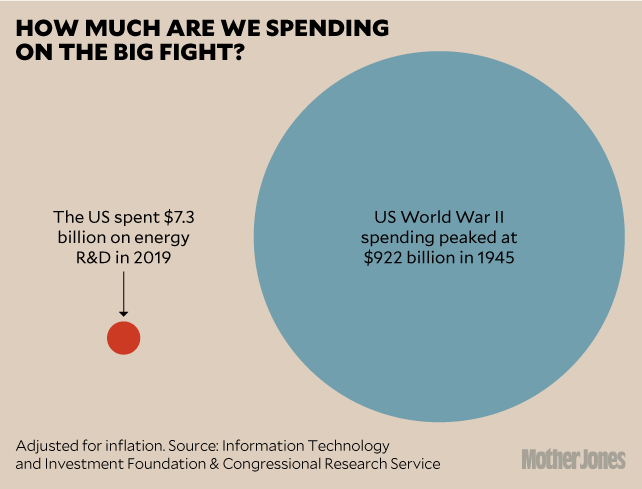
How gargantuan? The International Energy Agency estimates that the world spends about $22 billion per year on clean energy innovation. The US share of that is $7 billion—that’s about 0.03 percent of our economy. (Trump proposed cutting that figure almost in half.) This is pathetic if you accept that climate change is an existential threat to our planet. During World War II, the United States devoted 30 percent of its economy to the war effort—or one thousand times what we’re spending on green tech.
There were three elements to this mass mobilization. First, Americans were asked to make modest sacrifices over the course of a few years. Victory gardens were planted, tin was collected, sugar and gasoline were rationed. Men enlisted and women went to work in factories. The rich paid high taxes and the rest of us bought war bonds. Perhaps there’s a limit to how much we can ask of people, but plainly we can ask something of them.
Office of War Information
Second, we built an enormous war machine: 89,000 tanks, 300,000 aircraft, 1,200 major combat ships, 64,500 landing craft, 2.7 million machine guns, and $2.6 trillionworth of munitions in today’s dollars. And it’s worth noting that much of this we simply gave away to allies like Britain and the Soviet Union. This was a global war that required American leadership and funding on a global scale.
Third, we spent money on R&D. There was the Manhattan Project to build the atomic bomb, but there was also the development of radar, code breaking, computers, jet aircraft, plastic explosives, and M&Ms.
That last part isn’t a joke. It’s true that M&Ms were developed with a candy coating so they’d melt in your mouth, not in your hand, but they provided their first jolt of calories on the battlefield, not in corner candy shops. They were initially produced by a private company in 1941, but for the next five years were available exclusively to the military.
Why mention that? Because there’s never any telling beforehand what research will pan out and what won’t. M&Ms were obviously not as crucial to the war effort as the Bletchley Park code-breaking project was, but they were an unexpected success in their own way. We should commit to funding any clean energy research that looks even a little promising. We should do our best to get commitments from other countries to do the same. If we’re successful, we’ll end up developing cheap technology that can spread quickly around the world and truly address warming on a global basis. Other countries will adopt our technology not only because it requires no sacrifice, but because it’s actually cheaper and better than what they have now. Why wouldn’t they take advantage of our R&D, especially if we give it away for nothing?
M&M’s were able to scale up production thanks to massive military purchases.
Mars, Inc.
So how much should we spend? For argument’s sake let’s be modest and aim for only 10 percent of peak World War II–level spending. That’s $700 billion per year in today’s dollars—a hundred times more than we currently spend on energy R&D, but barely 15 percent of what we spent to defeat the Axis. It also amounts to not quite 16 percent of our current federal budget.
That’s a big number, and we won’t get there at once. It requires a combination of raising money and cutting spending in other areas. The most obvious candidate for cuts is our swollen defense budget—which accounts for one-sixth of all federal spending—but that’s politically risky, and given that climate change is truly an existential threat, we have to continually remind ourselves not to put up roadblocks to addressing it. Maybe we can persuade defense contractors that creating green tech is profitable. But if we have to keep building tanks and missiles for political reasons while we dial up spending on clean energy R&D, maybe that’s just something we have to do.
If an R&D commitment bigger than the Manhattan Project were all we needed, our task would be relatively easy. No one is actually opposed to the concept of R&D, after all, and every climate plan worth the name acknowledges the value of continuing it.
What I’m proposing is not just that we focus on R&D, but that we focus nearly exclusively on R&D—at least at first. That we throw gobs of money at all the projects I detail in the following pages, and any others that seem promising.
Why so much emphasis on R&D? Turns out I share something with those environmentalists who think that talk of voluntary personal sacrifice is mostly just a smoke screen. I first became skeptical of the standard approach to climate change about a decade ago. Since then I’ve watched as, year after year, we’ve done far too little even though we know perfectly well how critical it is. Sure, Europe has a cap-and-trade plan to reduce carbon emissions, but we couldn’t pass even a modest version of cap and trade in the United States. President Barack Obama raised mileage standards for cars and trucks, but President Donald Trump promptly rolled them back. Everything has been like that. There have been a few minor victories here and there, but all of them against a background of relentlessly increasing emissions.
How could this be? It’s not that nothing is happening. There are plenty of dedicated activists, climatologists, and politicians who have worked hard for years to rein in climate change, and these people are heroes. The problem is that the global public—or at least their elected representatives—are plainly reluctant to accept many of the policies the experts propose.
Take Germany. It’s one of the most green-centric countries on the planet, and it boasts both a highly educated, highly productive workforce and a population genuinely dedicated to tackling climate change. Their Energiewende—or clean energy transition—took off in the 1990s, and Germany represents one of the best cases we have of a major economy making a serious effort to address climate change.
But Germany’s progress is tepid. There’s been a massive commitment to wind and solar over the past two decades, which now represent a third of Germany’s energy production, but that’s barely made a dent in their greenhouse gas emissions. The reason is simple. Instead of using green energy to eliminate fossil fuels, Germany has used it to subsidize other priorities: expanding overall power capacity to support a growing economy; increasing exports of electric power; and eliminating those aforementioned nuclear power plants. Use of coal has declined only slightly, and use of natural gas has increased by about half. As a result, progress has plateaued. Greenhouse gas emissions dropped about 17 percent from 1990 to 2000; then dropped only 12 percent more over the next decade; and have barely dropped in the past decade. German households already pay some of the highest energy prices in Europe, but they’ve been unwilling to cut their electricity usage, which has remained stubbornly stable since 2000. And overall power consumption hasn’t declined at all; it’s higher than it was two decades ago.
The American LegionUS Department of The Treasury
If this kind of pitiful response to climate change continues—even in a country with the means and political will to really make change—the end result will be the greatest catastrophe in human history or an unprecedented experiment in geoengineering with uncertain and potentially disastrous effects. It’s past time for a radically different approach. As in World War II, a call for modest sacrifice is fine: It produces a sense of solidarity against a common enemy and gives people a personal stake in the outcome. But in the end, that’s not what won the war. It was big spending and lots of R&D.
This approach will require some sacrifice from the progressive community. If we truly accept that climate change is an existential threat, then it has to take priority over other things we’d normally fight for. Desert habitats may be compromised by utility-scale solar plants. Birds will be killed by wind turbines. Labor unions need to accept that some existing jobs will be lost as fossil fuel plants are shut down. Nuclear power is probably part of the answer, at least for a while.
A cold-blooded dedication to stopping climate change means having the willingness to step away from our comfortable shibboleths, accept the criticism that comes with that, and place ourselves squarely behind a plan that has a chance of working. Building out renewable energy will get us part of the way there, but we’ve got more to do and not much time to do it.
This isn’t a rosy-hued proposal. You can find plenty of naysayers for every project I propose funding. Solar presents problems of geography. Wind presents land-use problems. Carbon sequestration requires mammoth infrastructure. Nuclear produces radioactive waste. Biofuels have been unable to overcome technical problems even after decades of effort. Fusion power has always been 30 years in the future and still is. Geoengineering is just scary as hell.
Ultimately, massive R&D might fail. But unlike current plans, it has one powerful benefit: At least it’s not guaranteed to fail.
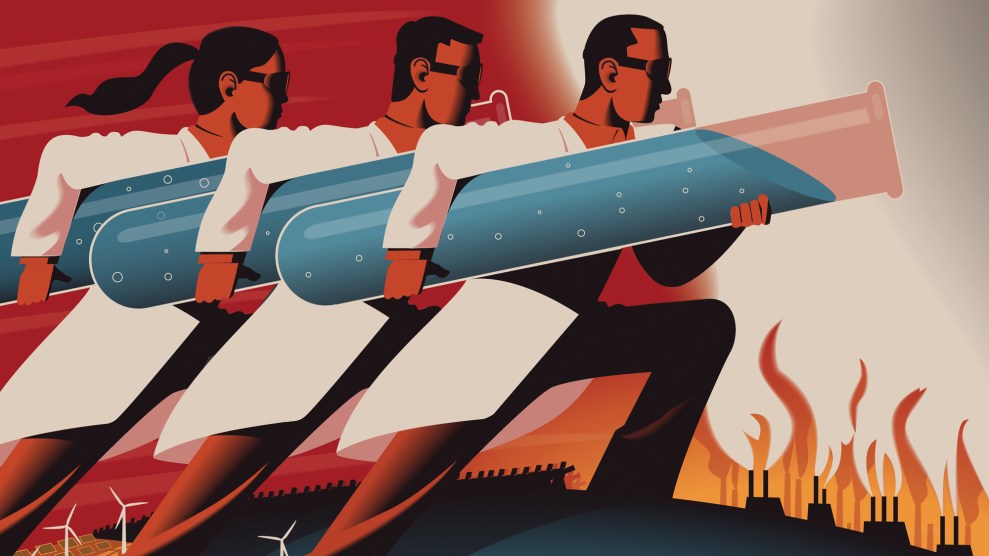
Only Science Can Save Us Now
We need to pump billions into these promising green technologies.
John Tomac
Renewable Energy
Over the past 40 years, the price of delivering one watt of solar power has dropped from about $100 to $1. This makes solar one of the most promising success stories of carbon-free power, and a technology that needs relatively little government research help to keep improving. But although the cost is now close to that of the most efficient natural gas power plants, close isn’t always good enough for investors. The price of large-scale solar needs to keep dropping if it’s going to have a serious global impact, and money for both R&D and the massive infrastructure build-outs that the Green New Deal framework imagines can make that happen.
The same is true of wind turbine technology, which has benefited from steady improvements in blade design, tower height, and computer control. Wind farms today supply electricity for about half the price they did a decade ago, and offshore wind is another promising area for expansion. Denmark, for example, has lots of shallow offshore regions that are ideal for wind turbines and produces nearly half of its electricity via wind. But not every country has Denmark’s advantages. It’s difficult to anchor wind towers in water more than 200 feet deep, and creative new ways to build turbines in deeper waters are good targets for R&D spending.
Solar and wind get most of the attention among renewable energy sources, but there are other promising technologies. For example, ground source heat pumps take advantage of the fact that temperatures just a few feet below ground tend to stay the same throughout the year. In summer, they can pump warm air out of the house, and in winter, the underground warmth can heat water. Heat pumps’ only real drawback is that they cost a lot to install, which makes them an ideal target for both research (to lower costs) and federal subsidies (to incentivize installing them in the meantime).
There are less familiar types of renewable energy, including tidal power and geothermal energy, which are not yet always more cost-effective than fossil fuels. But some of them will probably be instrumental in the future, so we should invest in them all.
Nuclear Power
Nuclear power plants are almost carbon-free and provide steady “base load” power that doesn’t depend on sun or wind. That’s the good news. The bad news is that they produce radioactive waste with lifetimes measured in hundreds of centuries. They’re also expensive and vulnerable to catastrophic meltdowns.
But they don’t have to be. Failsafe technology has been on the drawing board for years and is incorporated into designs known as Gen IV nuclear power. In the last 10 years, the United States has committed $678 million to new nuclear technologies, and boosting this amount could produce commercial reactors virtually immune to meltdowns within a few years.
In China, experimental reactors are being built that use thorium rather than uranium as their nuclear fuel. Thorium is more abundant than uranium, but its biggest advantage is that it produces far less—and less dangerous—nuclear waste than uranium reactors. If their research goes well, China hopes to have commercial thorium reactors online within a decade.
Nuclear power may not be a long-term answer to climate change, but it’s relatively green and the technology is relatively advanced. With additional R&D, it could be made better and safer and could provide a stopgap source of carbon-neutral energy until we have permanent solutions up and running.
Energy Storage
It’s not enough to generate electricity cleanly; we also need to store it. Batteries—the kind that power electric cars—have gotten lots of attention, but there are other ways to store power. You can, and we already do, pump water uphill into a reservoir and use it later to power turbines on the way down. You can heat salt into molten form and draw off the heat later to drive steam engines, which turns out to be surprisingly efficient. And there’s compressed air, an old technology now being tried by some utilities. During the day, a solar plant can generate power that compresses air, stores it underground, and releases it at night to power turbines.
There are only two feasible storage options for use in cars and trucks right now: hydrogen fuel cells and lithium-ion batteries. One promising research avenue for fuel cells is solar-powered electrolysis of ordinary water. The cost has dropped by half over the past decade but needs to fall considerably more to become competitive.
Battery technology is the target of intense research. Some research is focused on alternatives like nickel-zinc and potassium-ion, and there’s seemingly weekly news of advances in solid-state batteries and so-called supercapacitors. All of these are prime targets for worthwhile government investment.
Land Use
Although global warming is primarily the result of CO2 emissions, there are other greenhouse gases. Among them are methane and nitrous oxide, largely produced by farming and ranching. These go under the rubric of “land use,” which is responsible for about 20 percent of all greenhouse gas emissions. This includes deforestation, methane from cows, and nitrous oxide from fertilizers. But agriculture also presents opportunities to remove carbon from the atmosphere, sometimes by measures as simple as changing the way soil is tilled or treating farmland with compost. These methods are called “carbon farming,” and in France there’s a government initiative called “4 per 1,000,” which aims to increase carbon storage in soil by 0.4 percent per year.
Until recently, carbon farming has been a fringe activity, despite the promise it holds not to merely slow the growth of carbon emissions, but to actually remove carbon that’s already there—for example, through massive reforestation. There’s every reason to think that a serious commitment to further research, along with government-sponsored incentives for farmers, could make a big contribution to fighting climate change.
Carbon Capture
Here’s a disturbing fact: Even if we stopped emitting carbon completely, that wouldn’t be enough. “Meeting the climate goals of the Paris Agreement is going to be nearly impossible without removing carbon dioxide from the atmosphere,” researchers Jan Christoph Minx and Gregory Nemet warned in the Washington Post in 2018. Given how much damage we’ve already done and the near certainty that we’ll increase carbon emissions for at least another decade, we need to figure out how to remove greenhouse gases from the atmosphere on a massive scale.
According to the International Energy Agency, governments around the world set aside $28 billion for carbon capture projects over the past decade but spent only $4 billion. We’ve given up just when we should be doubling down. The Energy Futures Initiative, a think tank, recommends that the United States commit $10.7 billion over the next 10 years for carbon capture R&D.
The infrastructure to store carbon needs to be built at roughly the same scale as the infrastructure that produced it, which means that pumping even a fraction of it underground would require construction on a scale similar to today’s entire oil extraction industry. That doesn’t seem politically feasible, but even storing a fraction of our carbon emissions could be a big part of the solution.
Carbon dioxide can also be removed from the air, combined with hydrogen, and turned into fuel. The fuel itself emits carbon when it’s burned, but the entire cycle is net carbon neutral. A team of scientists at Harvard recently announced a cost breakthrough, estimating they could do this for less than $100 per ton of carbon removed from the atmosphere—or $1 for every gallon of gasoline we burn.
There are also natural methods of carbon capture. A research team in Zurich, after studying satellite images of the entire globe, estimated that 2 billion acres of land not in use for agriculture are suitable for reforesting; the researchers say this would remove two-thirds of all the carbon dioxide that humans have added to the atmosphere since the dawn of the Industrial Revolution. Other teams are investigating gene editing that would increase the amount of carbon that plants can store in their root systems.
All of these solutions, from industrial facilities to planting more trees, need intensive research to be made viable. They’re ideal targets for an R&D program dedicated not to dribs and drabs that can disappear with the next Congress, but one that fights climate change like a war.
Concrete
The world uses about 20 billion tons of concrete every year. Unfortunately, concrete’s main constituent is cement, and the chemical process for creating cement is CaCO3 + heat ➞ CaO + CO2. In other words, the concrete industry is basically a huge global machine that digs up limestone, heats it, and turns it into quicklime and CO2. The industry is responsible for about 8 percent of global carbon emissions.
Cement production can be made more efficient, but that helps only at the margins. What we really need is a replacement as cheap and durable as the real thing. Companies are already working on this, including some that approach net-zero carbon by pumping CO2 back into the concrete during the curing process.
Concrete is one of the world’s most popular building materials, and engineers are naturally reluctant to experiment with unproven replacements. Nobody wants to find out, a decade after a skyscraper has gone up, that a new type of concrete doesn’t age well. That makes concrete a long-lead item in the war on climate change, which means large-scale research needs to be funded now.
Adaptation
This is not a widely loved subject, because it means we’re openly admitting that maybe we’ll fail to stop climate change. And no one wants to say that. But the truth is we’ve already failed to stop it, and we’re vanishingly unlikely to keep global warming under 2 degrees Celsius. Even 3 degrees is looking all too likely. Either scenario would require some serious adaptation. Yet the implementation of adaptation strategies is in its infancy.
Part of the problem is that adaptation means something different in every place in the world. In Bangladesh and Battery Park, the problem is storm surges, while in the Sahel the problem is drought and declining pastureland. California worries about coastal erosion, while Kansas fears crop losses from insects.
Half a dozen big US cities have started work on adaptation plans, including New York and Chicago. In 2019, New York City Mayor Bill de Blasio proposed a $10 billion plan to protect lower Manhattan from rising sea levels. That’s a start, but only barely. With storms likely to become bigger and more frequent, we need to invent better forecasting systems. Restoring mangrove forests can protect some coastlines and restoring oyster beds can help others. Far more preventive work like this needs to be done, and far more funding needs to be committed to it.
Biofuels
The best-known biofuel is ethanol made from corn—which is no more carbon-friendly than gasoline once you factor in its entire production cycle. But that doesn’t mean biofuels are a dead end. The real holy grails in this area are algae-based and have received much less investment than ethanol. One of their many technological challenges is the lack of a scalable method for drying out algae so that energy-storing lipids can be separated out. But the drying process could be replaced by pyrolysis, which involves heating plants to a high enough temperature that they effectively melt into fuel. And pyrolysis isn’t just viable for algae. The pyrolysis of wood chips could theoretically be carbon-negative on a long enough timeline because it would require planting more trees, and the carbon-heavy charcoal byproducts could be returned to the soil.
Even with these innovations, ethanol is a low-density fuel and will be less important as more cars and trucks go electric. But other things will require high-density liquid fuel. Air travel, for example, can’t yet be electric-powered like cars, and by 2050 commercial aircraft will emit about a gigaton of carbon every year, consuming a quarter of the “carbon budget” that would keep us under 1.5 degrees Celsius warming—if flights continue to use petroleum-based jet fuel. We need alternatives.
Production of meat—especially beef—is responsible for at least 15 percent of global greenhouse gas emissions. If we replaced three-quarters of animal-based food with grains and vegetables, we would effectively reduce annual emissions in 2050 by more than two gigatons—the equivalent of one-sixth of current emissions.
Sure, people should cut back on meat, and those corn and soy fields could be turned into forests or crops for human consumption. But historically, as poor countries get richer, one of the first things that happens is an increase in meat consumption. This makes recent announcements about plant-based burgers and oat milk more than just a gimmick. And if those products get good enough—and production gets efficient enough—they too could go a long way toward reducing carbon emissions associated with a meat-rich diet.
Fusion Energy
Fusion reactors use hydrogen as fuel and produce negligible radioactive waste. It sounds perfect, but to make a fusion reactor work, hydrogen has to be heated to temperatures hotter than the sun’s core and held in place for at least several seconds. No one has come close to doing this on an adequate scale.
But fusion power is too promising to give up on. MIT’s SPARC (Smallest Possible Affordable Robust Compact) project, for example, could begin producing power on a small scale by 2025. That’s also the year that ITER (International Thermonuclear Experimental Reactor), a massive fusion project, is scheduled to reach “first plasma,” the beginning of serious testing on a larger scale.
A surprising number of startups have begun work on innovative ideas for creating fusion reactors on a smaller and less expensive scale than megaprojects like iter. They could be good candidates for federal investment.
Geoengineering
This is everybody’s least favorite idea: massive engineering projects to cool down the Earth if it turns out we can’t reduce carbon emissions. Some geoengineering proposals sound crazy, like putting a fleet of mirrors in orbit to reflect sunlight back into space. Others are more practical, like mimicking the effect of volcanoes by spraying aerosols of sulfate particles into the stratosphere. This is both feasible and cheap: A program that costs $2–$5 billion per year could reduce global temperatures by a quarter of a degree Celsius.
But while sulfates can lower global temperatures, they don’t do anything to actually remove CO2 from the atmosphere. If spraying ever stops, temperatures would jump. Another proposal, called Project Vesta, seeks to mimic a natural method of removing carbon that normally works over millions of years. It involves grinding up a mineral called olivine and spreading it on tropical beaches, where it combines with CO2, washes out to sea, and falls to the ocean floor. This has the benefit of removing carbon from the atmosphere, but it costs a lot more than sulfate spraying.
Other possibilities include seeding the seas with iron to increase the population of carbon-absorbing phytoplankton, a marine algae, and thinning the cover of high-altitude cirrus clouds, which trap heat.
All of these proposals have drawbacks, including a political one: Who decides? The United States could easily spray megatons of sulfate aerosols into the atmosphere. So could China or Brazil or the European Union. But the result is global and might impact some areas more than others.
Geoengineering is inherently dangerous because there’s no way to know beforehand what the side effects might be—and they could be enormous. And once it starts, there’s no going back. If anything, the very danger of geoengineering is the best argument for continuing to study it. No one can say for sure that we’ll never have to resort to it, and if we do, we ought to be prepared.
The history of science is littered with accidental discoveries. Many of us are alive today only because Alexander Fleming accidentally left open a petri dish containing a staph bacteria and discovered penicillin. This is why an R&D program for clean energy needs to be huge and wide-ranging. We simply don’t know which discoveries are most likely to pan out, and climate change is dire enough that we can’t afford to close off any possibilities.
And we respect that! But maybe you’re of a mind to support our work directly instead? We have until December 31 to raise the last $400,000 we need to keep our nonprofit newsroom running at full strength into 2026. Will you make a gift today?
We noticed you have an ad blocker on. Can you pitch in a few bucks to help fund Mother Jones' investigative journalism?
Billionaires own the media,
but they don’t own us.
At Mother Jones we know these aren’t conventional times, and they require unconventional coverage. That’s what deliver every day: fierce, independent journalism you can’t find elsewhere. Perhaps never in the history of our country has that been more necessary than now. But we can’t do it without reader support—your support. Please chip in today.
Billionaires own the media,
but they don’t own us.
At Mother Jones we know these aren’t conventional times, and they require unconventional coverage. That’s what deliver every day: fierce, independent journalism you can’t find elsewhere. Perhaps never in the history of our country has that been more necessary than now. But we can’t do it without reader support—your support. Please chip in today.