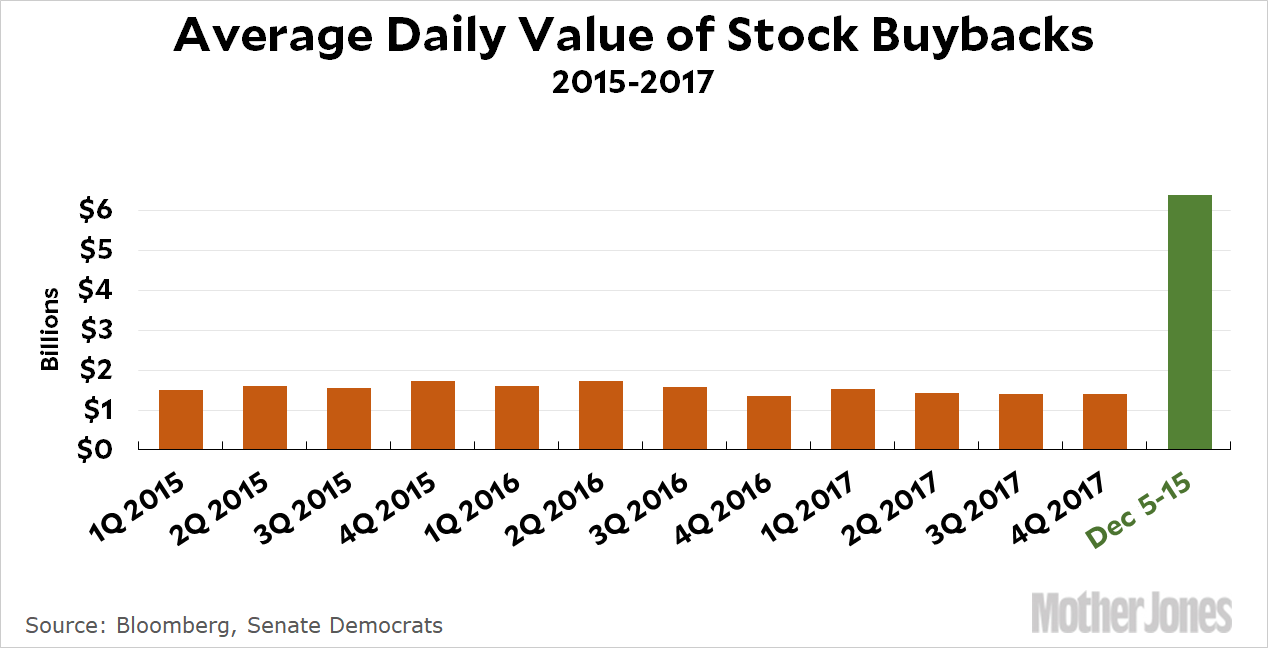
Corporate CEOs have already made it plain that a tax cut won’t prompt them to hire more or invest more. They already have lots of money, and if they wanted to expand they’d have already done it. Instead, the tax cut will go toward increased dividends and bigger stock buybacks, which mostly benefit wealthy shareholders.
In fact, according to Senate Democrats, they’re already making good on this promise. Over the past three years, stock buybacks have been pretty steady at a rate of roughly $1-2 billion per day. But ever since the Senate passed the tax bill, making its final enactment almost certain, stock buybacks have skyrocketed:
This does exactly nothing to help the economy or employ more workers. But it does make the rich even richer, and isn’t that the whole point?
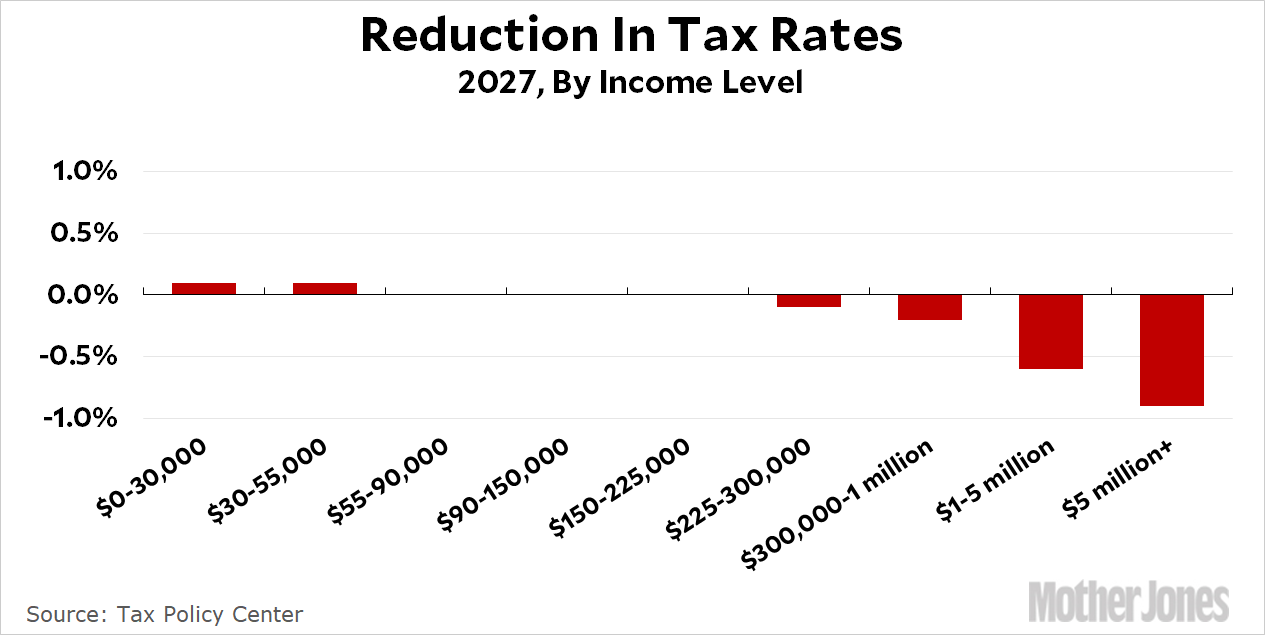
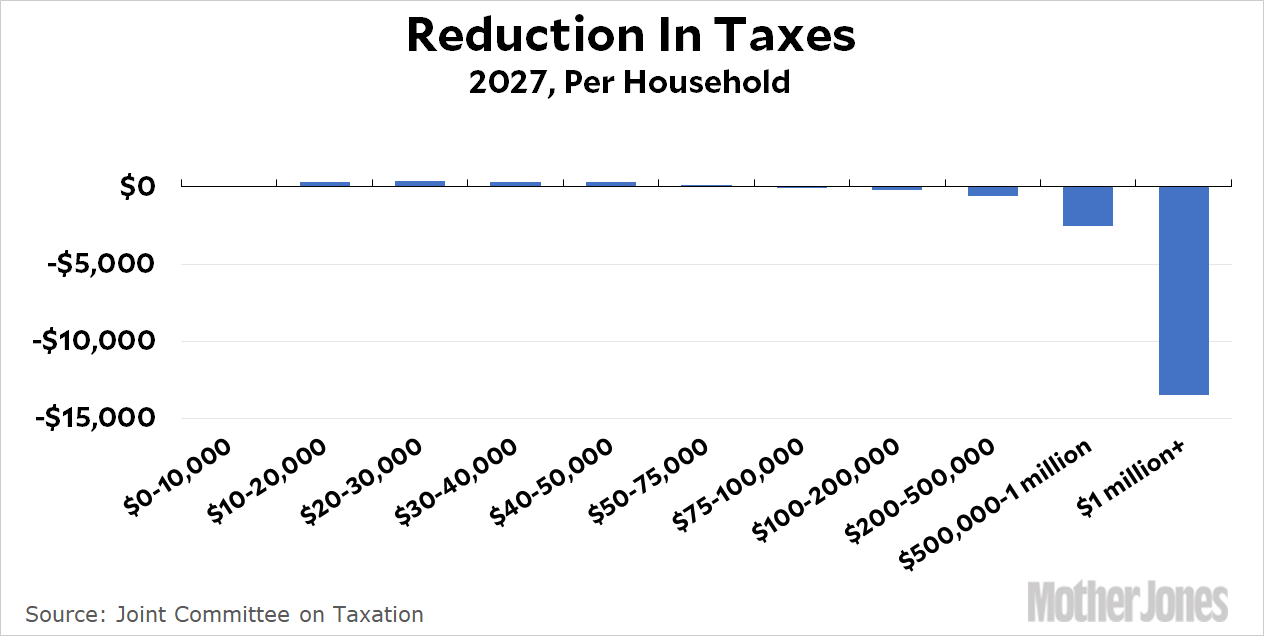
I know it’s totally unfair to point out what happens under the Republican tax bill in 2027 after the individual cuts expire. After all, Republicans say they don’t want them to expire, and we should all pay attention to what Republicans say rather than what they actually do. But I’m just an old dinosaur who thinks actions are more important than words. And regardless of what they may want in the secret recesses of their hearts, the bill they’re about to pass does this:
As the top chart shows, within a decade tax rates will go up for everyone making less than $55,000 and stay about the same up to $225,000. They’ll go down for everyone above that level, and they’ll go down the most for millionaires. This one is from the Tax Policy Center.
On the bottom, you can see how this affects households. Up to $75,000, households will pay several hundred dollars more each year in taxes. Those making over a million dollars per year will pay about $14,000 less. This is from the Joint Committee on Taxation.
But it doesn’t matter. These are the same numbers we’ve seen all along, and the fact that the middle class is getting screwed in service to tax cuts for the rich isn’t going to stop anyone. I sure hope Republicans pay a price for this almost unfathomable act of political cynicism.
I see that our story about Climategate is now online. You should read it! Here’s why Climategate is worth revisiting:
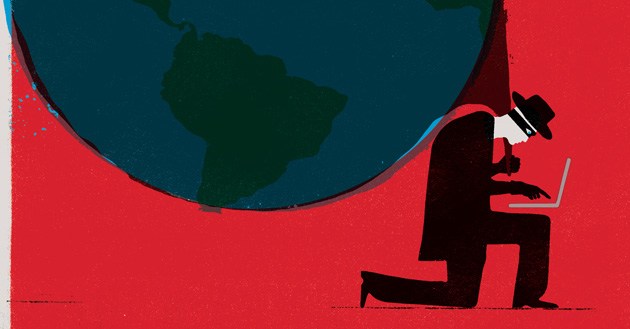
“If you were a Russian operative [and] pitching influence ops for the DNC, and somebody’s like, ‘Eh, I don’t know about that,’ literally you just turn around and go, ‘Look at how well it worked [with Climategate],’” former National Security Agency analyst Jake Williams tells Mother Jones in our new feature story about the parallels between the two hacks. “I wouldn’t necessarily say one influenced the other, but certainly it’s good proof that that’s a technique that works.”
It is, in fact, remarkable how strong the parallels are between the email hacking at the heart of Climategate in 2009 and the email hacking at the heart of Russiagate in 2016. It’s well worth refreshing your memory on Climategate, since it appears to be an early prototype for a kind of ratfucking that promises to get even more popular in the age of social media.
Remember Donald Trump’s promise to keep American jobs in America? Of course you do. No longer will we tolerate American companies sending jobs offshore thanks to stupid tax laws and unfair competition. Not on Trump’s watch, anyway.
There are three reasons, according to nonpartisan tax experts. First, a corporation would pay that global minimum tax only on profits above a “routine” rate of return on the tangible assets — such as a factory — that it has overseas. So the more equipment a corporation has in other countries, the more tax-free income it can earn. The legislation thus offers corporations “a perverse incentive” to shift assembly lines abroad, says Steve Rosenthal of the Tax Policy Center.
Second, the Senate bill sets the “routine” return at 10 percent — far more generous than would typically be the case….As a result, a U.S. corporation that builds a $100 million plant in another country and makes a foreign profit of $20 million would pay roughly $1 million in tax versus $4 million on the same profits if earned in the United States, says Rosenthal, who has been a tax lawyer for 25 years and drafted tax legislation as a staff member for the Joint Committee on Taxation.
Finally, the minimum levy would be calculated on a global average rather than for individual countries where a corporation operates. So a U.S. multinational could lower its tax bill by shifting profits from U.S. locations to tax havens such as the Cayman Islands.
….Companies also are likely to continue to locate valuable intellectual property overseas to pay a lower rate than what they would face in the United States, likely to be around 20 percent, analysts said. “The plan does not meaningfully reduce the incentives for companies to move their operations and shift their income overseas,” [says Rebecca Kysar, a professor at Brooklyn Law School]. “You could say it will make things worse.”
Terrific. This should come as no surprise, since the tax bill is designed to appeal to rich business owners who are in favor of offshoring production if it will make them more money. Still, you have to wonder. Has Trump yet done anything that’s likely to materially improve the job prospects of working and middle-class folks? I can’t think of anything.¹
¹Demolishing environmental rules doesn’t count. That’s popular with big business, but it’s unlikely to do anything for workers.
I am, obviously, out of touch with the bold new world of cryptocurrencies. According to the Wall Street Journal today, the biggest initial coin offering of the year is for EOS, which, it turns out, is not a coin at all. It’s not clear if EOS is even a product. Rather, it’s the open-source brainchild of block.one, which says that it “provides end-to-end solutions to bring businesses onto the blockchain from strategic planning to product deployment.” Here’s the elevator pitch:
Whatever. But back to EOS. What is it? Answer: it is an “operating system-like construct.” Will block.one be selling EOS? Answer: no, it will be released under an open source software license. After that, third parties can go to town on it. And what does EOS stand for? Answer: “We believe that EOS means different things to different people. We have received numerous amazing interpretations of what EOS stands for or what it should stand for so we have decided not to formally define it ourselves.”
So far this sounds like a parody. But it’s perfectly real, and it’s funded not by normal venture capital or anything else that gives investors any rights, but by the daily sale of tokens that are, explicitly, worthless: “The EOS Tokens do not have any rights, uses, purpose, attributes, functionalities or features, express or implied, including, without limitation, any uses, purpose, attributes, functionalities or features on the EOS Platform.” And just in case this disclaimer isn’t enough, you can’t buy them in the United States and block.one itself is registered in the Cayman Islands. Why take chances?
The Journal says block.one has raised $700 million this year and has a market cap of $4.5 billion. What they don’t say is that this is actually a market cap of 6.3 million Ethereum, which is allegedly worth about $4.5 billion. No actual dollars or yen or euros have changed hands here. So to summarize:
block.one will not be selling its primary product. In fact, it’s not really clear exactly what they will be selling.
EOS tokens provide neither an ownership share in block.one nor any claim on its earnings.
EOS tokens are layered on top of Ethereum, a cryptocurrency that may or may not have any actual intrinsic value.
Even in the heyday of pre-crash CDOs and synthetic CDOs and all their demon spawn, derivatives all had at least a notional connection to a real income stream of some kind. But EOS appears to be valueless all the way down. If this isn’t the behavior of a bubble, I don’t know what is.
Technically, this is true. A number of different studies have shown that the strongest predictor of a vote for Donald Trump was racial resentment.
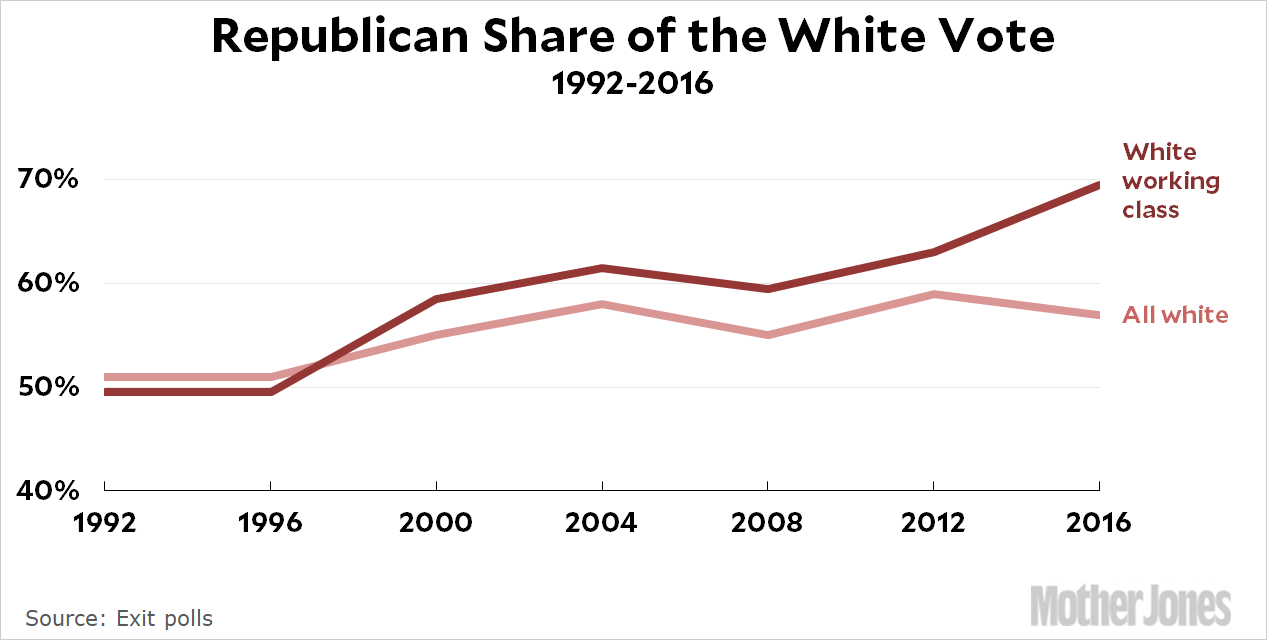
But in real-world terms these studies are meaningless. Racial resentment has been a growing predictor of votes for every Republican candidate for the past couple of decades. Donald Trump may have tried hard to move that needle, but there’s not a lot of evidence that he did. That leaves us with cruder measures that are frustratingly imprecise. Take a look at the white vote since 1992, for example:
Bill Clinton was the last Democrat to have much appeal to white voters. Since 2000, whites have ticked the box for Republicans at about the same rate in every election. Trump, in fact, did a little worse than Mitt Romney in 2012.
On the other hand, Trump did considerably better than Romney with white working-class voters. Unfortunately, this is hard to assess as well, since Republicans have been steadily increasing their share of the white working-class vote for the past five elections. As with the racial resentment correlations, the question is whether Trump helped drive this upward trend, or merely benefited from it? Since racial resentment among white men hasn’t changed much in decades, most likely it’s the result of increasing partisan polarization, something that Trump had nothing to do with.
As it happens, there is some evidence that racial resentment partially drove the results in a few specific places. The absolute numbers are small, but potentially pivotal given the oddities of the Electoral College. It’s also unquestionably true that Republicans as a whole demonstrated a surprisingly high tolerance for a candidate who was far more explicitly racist, sexist, and xenophobic than any in recent memory. That was disheartening, but it’s not evidence that racism actively drove the results of this election any more than previous ones.
Keep in mind that Trump actually did a little worse than models predicted based on fundamentals. This suggests that racism didn’t have an outsize effect in 2016. It had roughly the same dismal effect it’s always had. What’s more, if James Comey hadn’t released his infamous letter eleven days before the election, we wouldn’t even be talking about this. The fact that Comey did, in fact, release his letter, leading to Trump’s unexpected win, is hardly a good reason to not only hold this endless discussion, but to insist that it’s been settled.
Is bitcoin a good replacement for money? This is a popular question these days, but it’s poorly framed. “Money” should be thought of more as an adjective than a noun. That is, certain things are more moneylike than others. A dollar bill, for example, is more moneylike than a Krugerrand, which in turn is more moneylike than a corporate bond.
So what are the attributes that make something useful as money? Here’s a non-exhaustive list:
Not intrinsically useful¹
Easily transportable
Rare and not easy to counterfeit
Widely accepted
Liquid even during panics
Can pay taxes with it
Stable store of value
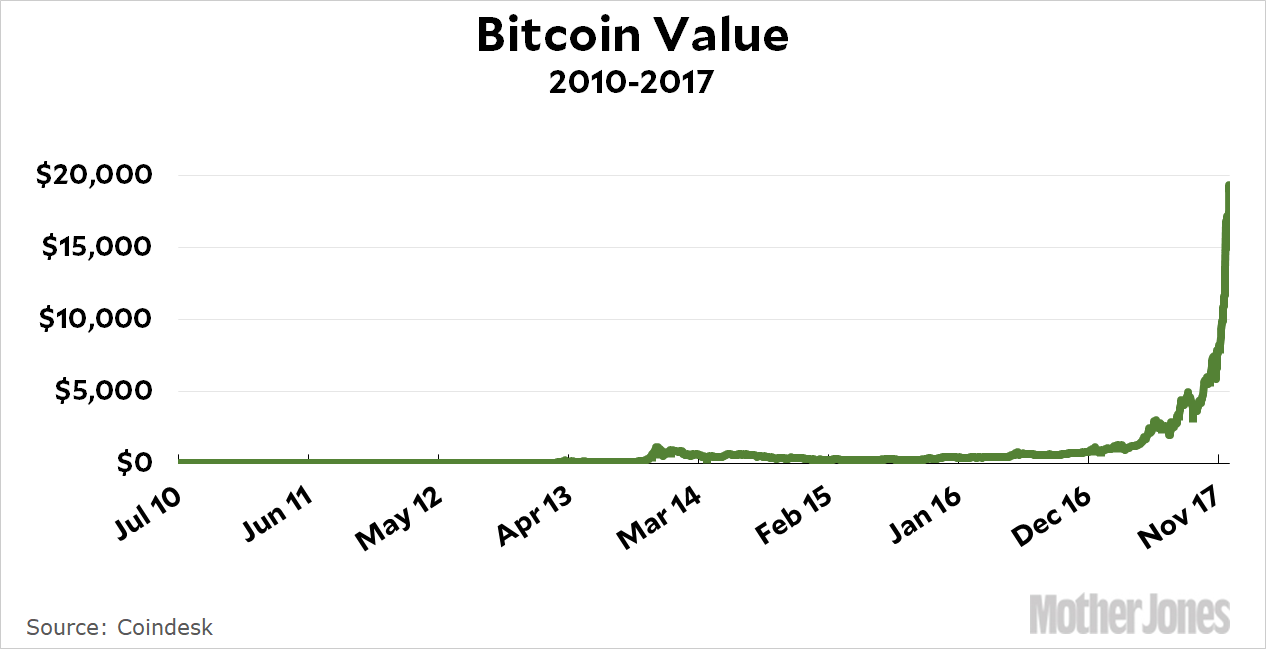
Bitcoin does well on the first three. However, it does poorly on the next four. It is not widely accepted. It has high transaction costs and hasn’t been tested during a financial crisis. No government accepts it for payment of taxes. And as its recent bubble-esque behavior demonstrates, it’s not especially stable:
Pay particular attention to #6 on the list of moneylike attributes. It’s often said that although the dollar is no longer backed by gold, it’s still a solid currency because it’s backed by the productive capacity of the United States and the integrity of the US government. And that’s true. Ultimately, though, it’s backed by the willingness of the US government to take dollars as payment of taxes. No matter how skeptical you may be of fiat money, you’ll still accept it if you know that, at the very least, you can pay your taxes with it. And if that’s true of you, it’s true of everyone else.
Unfortunately for Bitcoin, the first three items on this list are the least important. Old Masters fit the bill, for example. Ditto for meteorite fragments and dinosaur fossils. It’s the last four items that are really key attributes of money, and Bitcoin isn’t anywhere close to satisfying any of them.
For now, Bitcoin is just a commodity, like tulips or Tokyo real estate, and not even a very good one. At least tulips are pretty to look at. So if you feel like taking a flyer on it, go right ahead as long as you’re using money you can afford to lose. Just don’t do it because you think it’s going to replace dollars or euros anytime soon.
¹Chocolate, for example, would be a poor form of money because we would just eat it all. Ditto for salt, which has been a form of money in some civilizations—though not a very good one. The best money is something that has no particular value other than being money.
The Republican tax bill is massively unpopular. It polls at about 30 percent approval—the worst showing of any major bill in recent history—and doesn’t crack 50 percent even among Republicans. And yet, the GOP leadership is hellbent on passing it. What’s going on?
Bear with me for a bit. I have an idea of what’s going on, but it’s the endpoint of a story. Here it is.
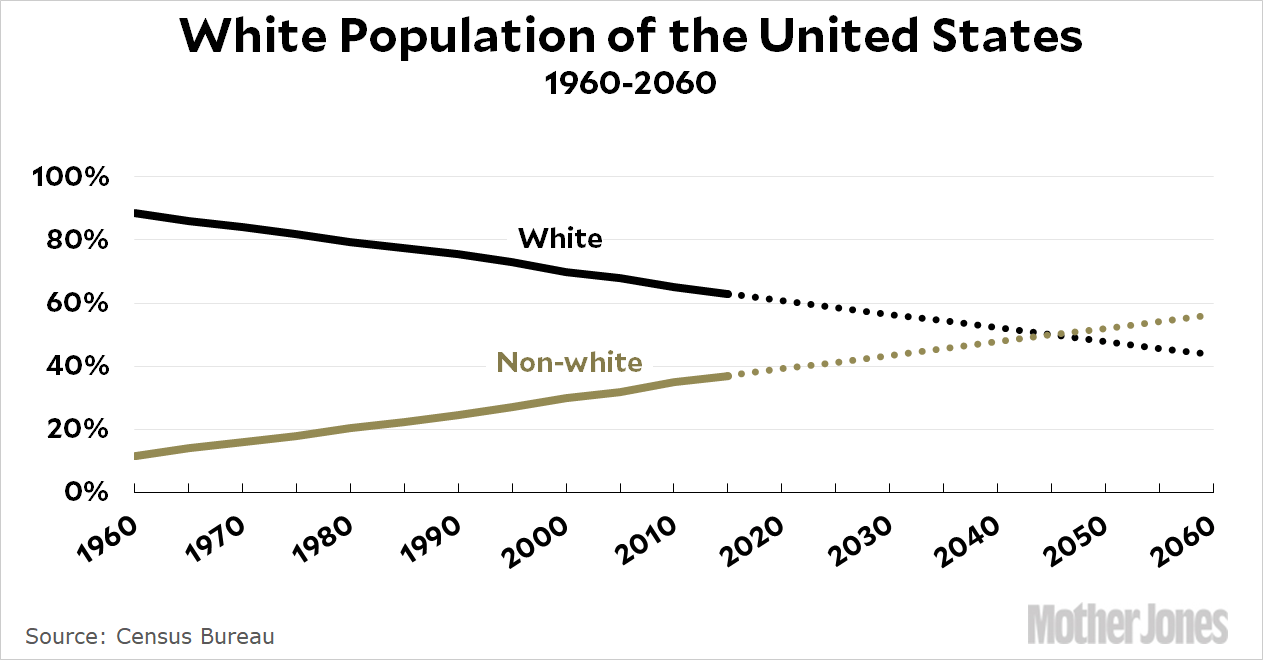
Beginning in the mid-60s, the Republican and Democratic parties consciously chose opposing long-term strategies. Democrats became the party of the marginalized, defining themselves in terms of civil rights, immigration, social justice, feminism, gay rights, and so forth. Republicans chose to become the party of whites and the party of the Bible Belt.
At first, this was mostly a matter of policy choices. Republicans opposed things like school busing and affirmative action and supported private schools. As those things gradually lost salience, they reached out for other, more process-oriented ways of leveraging the white vote. In the 90s it was pack and crack, which shoved black voters into a small number of congressional districts, leaving more white districts for Republicans to pick up. Karl Rove moved the ball forward with more sophisticated ways of driving white evangelical turnout. Fox News amped up its coverage of things like illegal immigration and black crime.
Over time, the returns from these strategies became smaller and smaller. The white share of the population wasn’t growing, so Republicans became desperate to pick up every possible crumb. Photo ID laws became a big push in the late aughts even though it’s unlikely they affected the vote by more than a percent or so. The post-2010 gerrymandering efforts were good for a dozen seats in Congress. The party got tougher on immigration. Republicans on the Supreme Court gutted the Voting Rights Act. But finally there was little left to do. They lost to a black man in two straight elections, and the 2012 post-election autopsy made it clear that Republicans needed to attract more of the non-white vote. This was based on some simple but brutal arithmetic: There was a limit to how much turnout they could squeeze from the dwindling share of white voters, and that meant they had to reach out to minorities, pass comprehensive immigration reform, and dial down the anti-gay rhetoric.
Republicans aren’t idiots. They can read a demographic report as well as anyone. They know their white base is shrinking and they know they’ve reached a critical point. The problem is that remaking their party is a long-term project, and while it’s happening they’re going to lose elections. It will take years to regain the trust of communities of color, and efforts to do so will alienate the whites who support them today. They could be in the wilderness a long time while this project is ongoing.
And so it never got off the ground. It was just too hard. It looked more and more as if Republicans would shamble slowly into minority party status for a long time as they struggled to remake themselves.
But then a miracle happened. Donald Trump pushed the envelope further than even the hardest-core Republican had dared in decades, appealing all but openly to white voters and shamelessly demonizing minorities. The Republican establishment didn’t support him initially, but he gained the nomination anyway so they made their peace. And he won. And Republicans won the Senate. And they held onto the House. Against all odds, they controlled the entire federal government.
But again: Republicans aren’t idiots. They recognize just how unlikely this victory was and they know it won’t repeat itself. Demographic trends won’t slow down and midterm elections always go against the party in power anyway. They’re probably going to lose unified control of the government in 2018, and even if they hang on they won’t make it past 2020. This is their last chance to control the levers of power, quite possibly for a decade or two.
That’s why they’re pushing an unpopular tax bill. That’s why they’re focused like a laser on confirming judges. That’s why they might even take on entitlement reform. They’re going to lose power shortly no matter what they do, so they’re trying to put their stamp on the future while they still have the chance.
And we respect that! But maybe you’re of a mind to support our work directly instead? We have until December 31 to raise the last $400,000 we need to keep our nonprofit newsroom running at full strength into 2026. Will you make a gift today?
We noticed you have an ad blocker on. Can you pitch in a few bucks to help fund Mother Jones' investigative journalism?
Billionaires own the media,
but they don’t own us.
At Mother Jones we know these aren’t conventional times, and they require unconventional coverage. That’s what deliver every day: fierce, independent journalism you can’t find elsewhere. Perhaps never in the history of our country has that been more necessary than now. But we can’t do it without reader support—your support. Please chip in today.
Billionaires own the media,
but they don’t own us.
At Mother Jones we know these aren’t conventional times, and they require unconventional coverage. That’s what deliver every day: fierce, independent journalism you can’t find elsewhere. Perhaps never in the history of our country has that been more necessary than now. But we can’t do it without reader support—your support. Please chip in today.