• Here’s How the Trump Tax Plan Will Affect Your Income

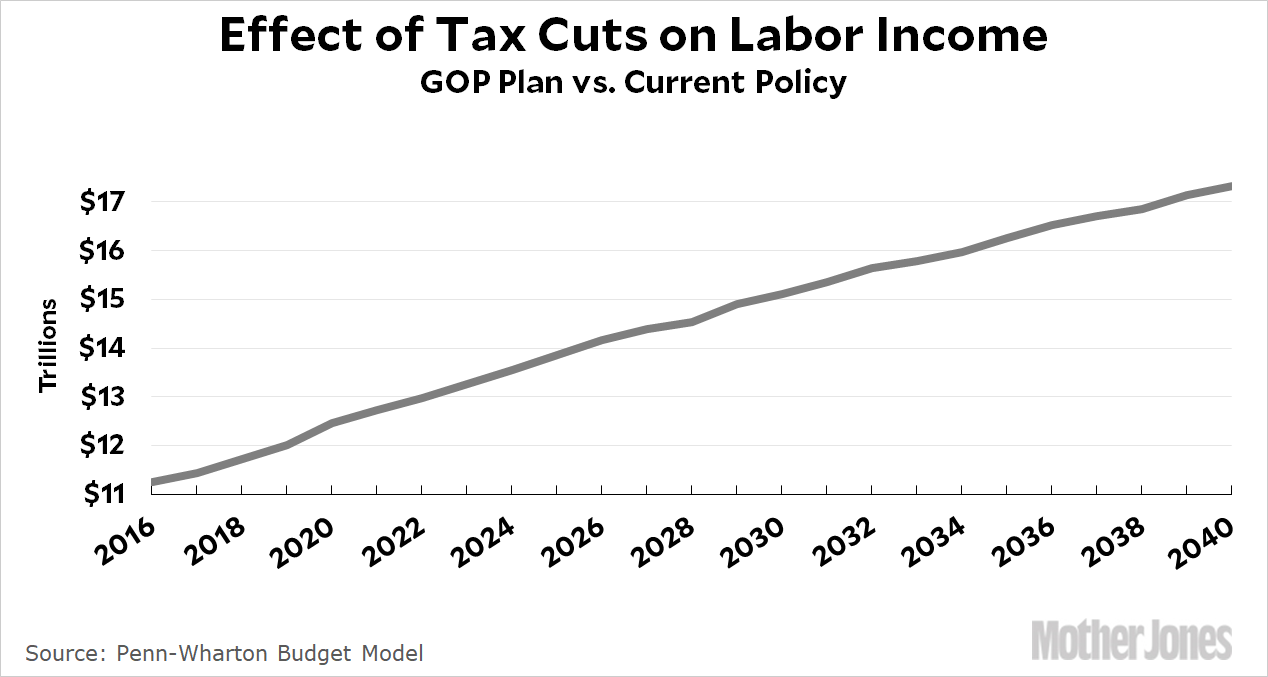
    The White House claims that its tax plan will result in a $4,000 wage increase for the average family. This is obviously preposterous, but there might be some wage gain. The question is how big it could be. Luckily, the highly respected Penn-Wharton Budget Model just released a simulator that allows you to choose different tax options and see what effect they have on things like GDP, wages, etc. I went ahead and chose all the options from the proposed Trump tax plan and got the results. Current policy is shown in gray. The changes due to Trump’s tax plan are shown in red:

    Don’t worry: you haven’t gone color blind. There are no differences. The model predicts that if you implement the whole plan, total labor income won’t change by a penny.¹

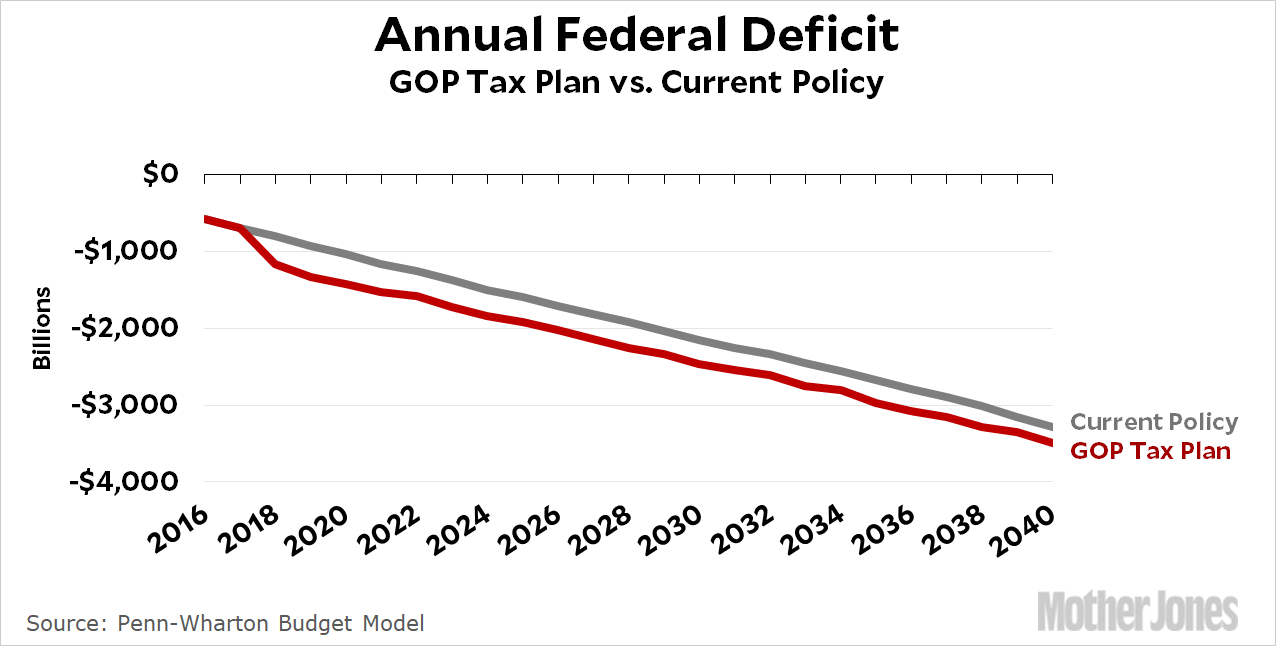
    But what about deficits? Here’s what the model says:

    That’s a cumulative increase of $7 trillion in the federal deficit. So the bottom line is that the tax plan doesn’t increase either wages or GDP, but does increase the national debt by about $7 trillion. Why are we doing this again?²

    ¹This is total labor income and says nothing about how it’s distributed. It’s possible that median wages will go down while the wages of CEOs will go up. Or vice versa. All we know is that the model predicts a total macro effect of zippo.

    ²Because it does reduce taxes on capital income for the rich. This might not have any effect on economic growth, but it does put more money in the pockets of the already wealthy. That’s what wealthy Republican donors paid for in the past election cycle, and that’s what they’re going to get.

  • Season 6 of “The Wire” May Star Trump Campaign Aide

    The hot gossip about the indictments issued today is this: Was George Papadopoulos wearing a wire? Papadopoulos is a small fish who was arrested in July, but his arrest was kept secret until today. Why? In a court filing, investigators said it was because they wanted to preserve Papadopoulos’s value as a “proactive cooperator”—a term of art that means the defendant will engage in some kind of undercover activity. Allahpundit lays out the basic theory:

    Imagine Papadopoulos phoning a former top Team Trump official in early August to say, “They’ve arrested me! I don’t know what to do! I think I should tell them everything and make a deal!” He might have been told no, no, no, stay calm, deny X, Y, and Z, we’ll make sure Mueller never finds our emails from the campaign. And meanwhile, unbeknownst to the target, Mueller’s recording the entire conversation on Papadopoulos’s end.

    Maybe! It’s best not to get carried away with this kind of stuff right now, but we all want to keep up to date on the latest lurid speculation, don’t we?¹

    ¹You don’t? Then why are you reading a blog on your lunch hour?

  • Lunchtime Photo

    I’m officially home and recovered from jet lag, which means that it’s time to start featuring some photos from Southern California again. No worries, though: I have dozens of Irish and British photos still in the queue, so the next few months will probably feature roughly equal numbers of American and non-American photos. For starters, though, here’s a balloon vendor keeping a close eye on her flock at Disneyland. It doesn’t get much more Californian than that.

  • A Different Take: Our Robot Hellscape Awaits Us

    As you all know, I think that intelligent robots will eventually take over all human work. The standard take on this—which I repeat in my recent article—is that even if this produces mass unemployment in the medium term, it will be great in the long term. No more work! We can all live in comfort, pondering philosophy and engaging in uplifting conversation. We will paint and read and admire nature. We will explore the planets and send generation ships to distant stars. It will be a golden age for humanity.

    Maybe, but it so happens that I don’t believe this. So just in case you’re not depressed enough by all things Trump, here are a few scenarios I actually consider more likely. Trigger warning: I’m not joking! I don’t have any special knowledge, of course, but I really believe that some of these things are pretty plausible. Conversely, I don’t believe the golden age stuff for a second. Without the pressure of needing to survive, the vast majority of humanity has very little ambition. We’re a lot more likely to watch dumb TV and play video games than we are to read Plato or study cures for cancer. In fact, it’s way worse than that.

    Here are a few possibilities. Note that for the purposes of this thought experiment, I’m assuming that we succeed in building strong AI that’s better and smarter than the smartest human being. That may or may not happen, but those are the rules of the game:

    1. We will all be illiterate. If robots are smarter than any human being, why bother sending our kids to school? Over time, I suspect this custom will fade out as it becomes clear that becoming educated doesn’t do any good. No matter how much you know, you’ll never know even a fraction as much as the most bog ordinary robot.¹
    2. We will lose interest in other people. One of the reeds that robot skeptics hang onto is the fabled human monopoly on empathy and social skills: robots may do all the braniac work, but they’ll never be able to comfort a child or provide a friendly face in a nursing home. I think this is nuts. Intelligent robots will be the greatest companions ever: infinitely patient, full of interesting gossip, and willing to do anything you want to do. Eventually we will mostly lose interest in having human companions at all. They’re just too much work.
    3. The end of sex. As a corollary to the above, robots will be better sex partners than humans, so reproductive sex will come to an end. For a while we’ll continue to create human babies artificially, but eventually we’ll stop bothering. The human race will die out about a hundred years later.
    4. Eternal life for the few. On the bright side, intelligent AI will likely cure cancer, develop infinite sources of green energy, and turn back climate change. But what if it also figures out how to extend human life indefinitely? This is obviously not feasible for everyone, which means that one way or another we’ll end up with a smallish cadre of the long-lived elect lording it over the rest of us. I don’t know how this would play out, but it seems bad.
    5. Endless war. One of the things human beings love to do is fight each other, and robots will make great fighters. It’s pretty easy to see how this could get quickly out of hand, with massive robot armies engaged in endless, brutal wars that never stop because robots can always build more robots to replace the ones who are destroyed.²
    6. Humans give up. This is actually the scenario I consider most likely. After a while, humans will finally be forced to accept that, yes, robots are so much smarter and more knowledgeable that we’ll never even come close to catching up with them. That literally leaves us with no purpose. Over time, we’ll get listless and depressed, stop having children, and eventually just die out of our own accord. This will take a little while, but probably only two or three hundred years. This might explain why we’ve never seen signs of life elsewhere in the universe. For biological life, the window of time between the invention of advanced technology (i.e., things that can be detected across long distances, like radio signals) and the end of the race is only a few centuries. Every few million years there’s a very brief spark of intelligent biological life and then it winks out.³ The odds of two of them happening at the same time is slim.

    There are loads of other possibilities, of course. You can play too! Note that I haven’t bothered including the truly apocalyptic scenarios where robots expand infinitely, impassively harvesting the entire earth for material to build more computing power. Nor the possibility that we’ll all dive into virtual realities and live out our lives forever as digital simulacrum maintained by the robots. I mean, come on. That stuff is pretty far out there, amirite?

    ¹If you insist on a bit of optimism, it’s also possible that robots will design brain implants that provide humans with, essentially, an instant education in everything. Humans still won’t be as smart as robots, but we won’t be illiterate. In fact, we’d be the most literate people ever in history.

    ²Why will we fight wars in an era of endless plenty? Beats me. But one thing humans will probably always be better at than robots is figuring out some reason to fight wars. Religion will do nicely. Or blind nationalism. Or just good old personal feuds. And keep in mind that even if basic resources are endless, there are still things like original Rembrandts and houses on the coast that will still be scarce. I don’t think we’ll have any problem continuing to figure out things to fight about.

    ³But what about robot intelligence? Won’t it stick around? Sure, but who know what they’ll do with no biologicals around to give them orders. Maybe they just keep milling around until their sun goes nova. Maybe they all switch off. Beats me. But I consider the infinite expansion hypothesis unlikely. Why? Because it hasn’t happened yet. Unless we’re the very first intelligence ever in the galaxy, digital intelligence that expanded forever looking for raw material would have eaten up the Milky Way long ago.

  • The Root of All Evil Is Leverage

    My plan, which I will probably jettison quickly if history is any guide, is to take a breather from the Manafort news for a little bit. Let it sink in, let other people dig into it, and then write more about it when it’s a little clearer what’s really going on. We’ll see if I can follow through on this resolution.

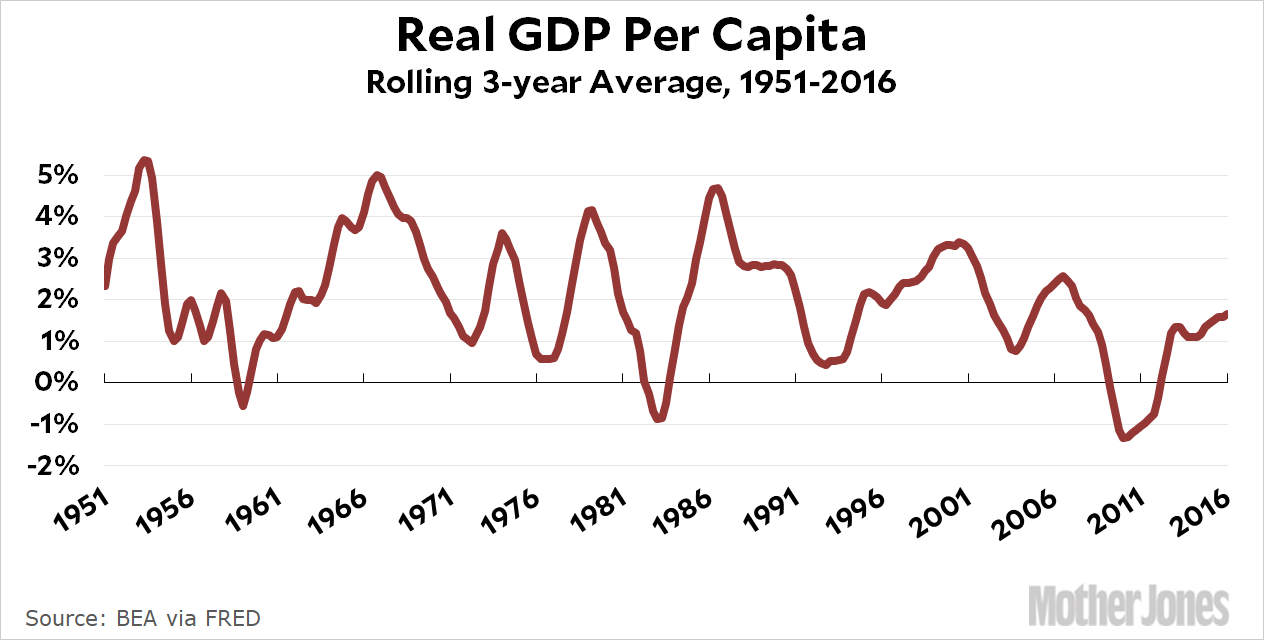
    As a starter, how about a post about economic booms and busts? I noted the other day that, in practice, the “Great Moderation” seems to have moderated booms but not busts:

    Around 1980, economic peaks dropped from growth rates of around 4 percent to around 2 percent, but downturns stayed about the same at 1 percent. I suggested this might be due to the Fed’s anti-inflation bias, but Alex Tabarrok points to a recent paper out of Denmark that instead puts economic deregulation at the forefront:

    It’s more than lower economic growth—expansions also last longer. It’s as if the booms have been smoothed over a longer period of time but not the busts.

    ….The authors argue that financial innovation made credit more easily accessible and easier credit led to more leverage. Leverage, however, has an asymmetric feature. When asset prices are up everything is golden, wealth is high and credit is easy because lenders are happy to lend to the rich. When asset prices decline, however, the economy takes a double hit, wealth is low and credit is tight. The net result is that booms are smoothed but busts become, if anything, even more violent.

    The theory is promising because it explains both the negative skewness and the great moderation. It’s also important because higher leverage, longer expansions and greater negative skew are new features of business cycles that appear across many developed economies as shown by Jorda, Schularick and Taylor in Macrofinancial History and the New Business Cycle Facts. In this paper Jorda et al. create new data series using over 150 years of data from 17 economies and conclude [that] “leverage is associated with dampened business cycle volatility, but more spectacular crashes.”

    Longtime readers know that leverage is probably my single biggest hot button when it comes to economic cycles. If I were Cato, my motto would be “Leverage delenda est.” So I am totally primed to believe this. The big question, of course, is whether it’s worth it. Do the longer upturns make up for the sharper downturns? I doubt it. Generally speaking, I would happily give up thousands of pages of financial regulations in return for a single-minded focus on restricting leverage in every part of the financial system. That includes bankers, hedge funds, home buyers, and everyone else. The road to hell is paved with leverage greater than 10:1.

  • Question of the Day: Why Did Paul Manafort Agree to Become Trump’s Campaign Manager?

    As a side note on the Manafort indictment, this is yet another example of the peculiar arrogance of powerful men in Washington. The poster child for this has long been Gary Hart, who famously dared reporters to follow him around when he was suspected of having an affair with Donna Rice. That ended badly.

    And now we have Paul Manafort. According to today’s indictment, he spent years engaged in a wide-ranging scheme of money laundering to the tune of $75 million. If you’ve done something like this, your best lifestyle choice is to stay very, very quiet. Attract no attention. Stay as far away as possible from reporters and FBI agents.

    So what does Manafort do? He signs on as campaign manager for the biggest, loudest, brassiest presidential campaign in recent history. Practically his first actions were related to defending Russia for a candidate who was already suspected of being a little too simpatico with Vladimir Putin. He was almost literally daring reporters to investigate him.

    Why? Do people like this figure that if they’ve gotten away with something for years, they’ll get away with it forever? Are they so smitten with their own brilliance that they can barely conceive of being outwitted by anyone else? Do they just not think at all? It is a mystery.

  • Trump Campaign Advisor Lied to FBI About Contacts With Russians

    More Russia news today:

    A Trump campaign policy advisor has pleaded guilty to lying to the FBI about his contacts with Russians who claimed to have “thousands of emails” on Hillary Clinton, in another charge filed as part of the special counsel investigation into the Trump campaign.

    George Papadopoulos, 30, of Chicago, has agreed to cooperate with the investigation of Robert S. Mueller III, according to a plea agreement unsealed on Monday. He pleaded guilty on Oct. 5 to making false statements to disguise his contacts with Russians whom he thought had “dirt” on Clinton. He was arrested in July as he got off a plane at Dulles Airport, court papers say.

    There sure were a lot of people connected to the Trump campaign who were eager to meet with Russians who claimed to have dirt on Hillary Clinton, weren’t there?

  • Home Builders Will Oppose Republican Tax Bill

    Donald Trump has promised that the Republican tax bill won’t touch the mortgage interest deduction. Property taxes will also remain deductible. That sounds like a bullet dodged for the homebuilding industry, right?

    Nope. They are opposing the bill:

    The plan nearly doubles the standard deduction, ends personal exemptions and likely repeals the deductions for state and local income and sales taxes. The combination would remove much of the incentive for the mortgage-interest deduction outside the highest-cost areas and could potentially hurt home prices.

    Here’s the deal. Itemizing only makes sense if your itemized deductions are bigger than the standard deduction in the first place. A bigger standard deduction means that for some people, there’s no incentive to itemize at all, and that includes itemizing the mortgage interest deduction. And that means there’s no extra incentive to buy a house because you’ll get to deduct the mortgage interest, thus saving money.

    So the homebuilding industry is opposed. Taxes are hard.

  • Paul Manafort Arrested for Fraud and Money Laundering

    Mark Reinstein via ZUMA

    Well, I was close. I guessed that Michael Flynn might be arrested today, and it turned out to be Paul Manafort. But he was my #2 choice, so I was close.

    There’s no real surprise here, just as there will be no surprise if eventually Flynn is charged too. Their misdeeds are pretty well known. So far, Donald Trump hasn’t offered up any claim that this is part of a witch hunt, though. I assume his strategy will be to claim that he barely knows the guy anyway.

  • Wanted: Conservative Takes on the Robot Revolution

    Roberto Parada

    It’s been interesting to read the feedback so far to my recent piece about artificial intelligence and robots. Four years ago, when I first wrote about it, I got a fair amount of pushback. This time around, virtually everyone who’s responded has been cheering me on. Is this what it feels like to be Donald Trump at one of his rallies?

    Why the change? One reason, I think, is the current economic climate: Trump has made job losses a huge national concern, and even though this has nothing to do with AI—since AI doesn’t exist yet—it’s made a lot of people more open to the possibility of future job losses from any cause. So that’s one piece. The much larger piece, though, is simply that the evidence for progress toward AI has gotten all but undeniable in the intervening years.

    Needless to say, this doesn’t mean that AI is a sure thing. All the trends and evidence available to us suggest it’s coming, but no one can ever know for sure how long a trend will last. Maybe we’ll hit a brick wall in 2020 and we won’t even get driverless cars, let alone the kind of AI that puts tens of millions of people out of work. It’s possible. I wouldn’t bet the ranch on it, but it’s possible.

    Still, some of the pushback has been interesting. The Robot Revolution isn’t fundamentally a partisan issue, but it’s certainly true that I think conservatives are ill-equipped to deal with it. Over at National Review, Andrew Stuttaford objects:

    This thoughtful piece on what ‘robots’ are going to do to employment by Kevin Drum might be published in Mother Jones (and it comes with quite a few Mother Jones flourishes), but take the time to read it, (very) stiff drink in hand.

    [Stuttaford then quotes a bit of my piece about how very few policy folks are talking about this, and offers an explanation.]

    That, I suspect, is because no one has any ideas that are, for now, politically palatable (Drum lists some policy options, all of which are—to use dully conventional labels—leftish, but they merit much more than a look, even if only to think through why they might be wrong—and what the alternatives might be).

    I’m not sure about “quite a few” MoJo flourishes. Maybe one or two. But why quibble? The reason I think conservatives will have a hard time with this subject is that, one way or another, the emergence of cheap and competent AI seems to demand some kind of wealth redistribution. Lefties are willing to accept this and then move on to how best we should do it. Conservatives just don’t like the idea in the first place. But is there any other class of solutions? I’m genuinely interested in hearing a conservative take on this, if there is one. Hell, I’m interested in hearing any take, as long as people are at least starting to think about it.

    Here’s another bit of pushback from Adam Ozimek:

    Surely if AI and robots are going to be transforming enough industries to cause mass unemployment, then this will include k-12 and college.

    AI will monitor human progress much better than a professor can, and they will be able to optimally tailor the curriculum and instruction method to the students to help them achieve their highest possible potential in the way that is the most complementary to machines or fills the optimal niches that robots can’t. This will include educating humans at a young age, and also retraining them.

    ….This is the paradox. If machines are going to be better than humans at everything, than this includes educating humans. So when you picture humans competing against these super smart machines, you have to include the super smart machines that will help humans achieve their maximum potential. It makes no sense to assume super smart machines competing against humans stuck in today’s human capital production function. That should give the biggest worriers a bit of optimism.

    I’m going to propose a, um, slightly different scenario tomorrow, but I certainly accept Ozimek’s argument on its own terms. That said, where’s the paradox? The finest education and upbringing will not turn a dullard into Einstein.¹ On a mass scale, it will almost certainly make society better and smarter than it is now, but the masses of people currently employed in unskilled and semi-skilled jobs are not suddenly going to become summa graduates of Harvard. And if we’re talking about a future where robots are already better than humans at everything, then forget it. Better education won’t make Joe Sixpack complementary to anything. Robots will be the complement to everything.

    For what it’s worth, I think arguments like this are always bound to fail. There are really only two basic parts to my case about AI causing mass unemployment:

    1. Current computing trends will more or less continue, and we will begin producing useable AI starting around 2025. Sure, that may be off by a few years in either direction, but it’s coming relatively soon.
    2. General purpose AI, by definition, will be able to fill any new jobs created by AI. This won’t be like the Industrial Revolution, where workers were uprooted but eventually got new jobs tending machines. There just won’t be any jobs that humans are better at.

    These are the soft points. If you want to argue against robots eventually taking all the jobs away, you need to persuasively argue that AI just isn’t going to happen any time soon. Moore’s Law is breaking down. IC technology is mature. We still have no idea what we’re doing. Plenty of experts are pessimistic about progress in AI. Etc. I address all this in my piece, but there are obviously reasonable counter-arguments to be made.

    Alternatively, you can accept that AI is coming, but somehow argue that there will still be “complementary” jobs for humans. This is a much harder argument to make, I think, but not impossible. Its most popular form is that robots will never have true human empathy, so there will still be plenty of jobs for folks with “soft” social and emotional skills. As it happens, I don’t buy this for a second. We humans are not only easily fooled in our social relationships, we practically beg to be fooled. In 20 or 30 years, robots are likely to be more loved than other humans. Still, this is an argument you can make.

    But that’s about it. Short of climate disaster or some kind of enormous revolution in which all the robots are destroyed around the world, these two things are all we need for mass unemployment to be only a couple of decades away. If you want to dispute that, these are the arguments you need to knock down.

    ¹I’d like to say that generations of experience with the upper classes demonstrates this pretty conclusively, but I guess that’s not quite right, is it? Upper-class twits may have been provided the finest, most personalized education imaginable, but it was education provided by other humans. Still.