• Gary Cohn Really, Really Wants to Cut Corporate Taxes

    Gary Cohn is eager to be part of the upcoming tax cut team:

    Poor Cohn. He’s getting flak for claiming there’s been no tax cut for 31 years. What he obviously meant to say was that the last big corporate tax reform was 31 years ago, which is true. The problem is that it’s not clear that either Cohn or Congress is really working on a big corporate tax reform right now. As Cohn says, they’re working on a tax cut. The tax reform of 1986 did cut the tax rate, but it also widened the base and was basically revenue-neutral.

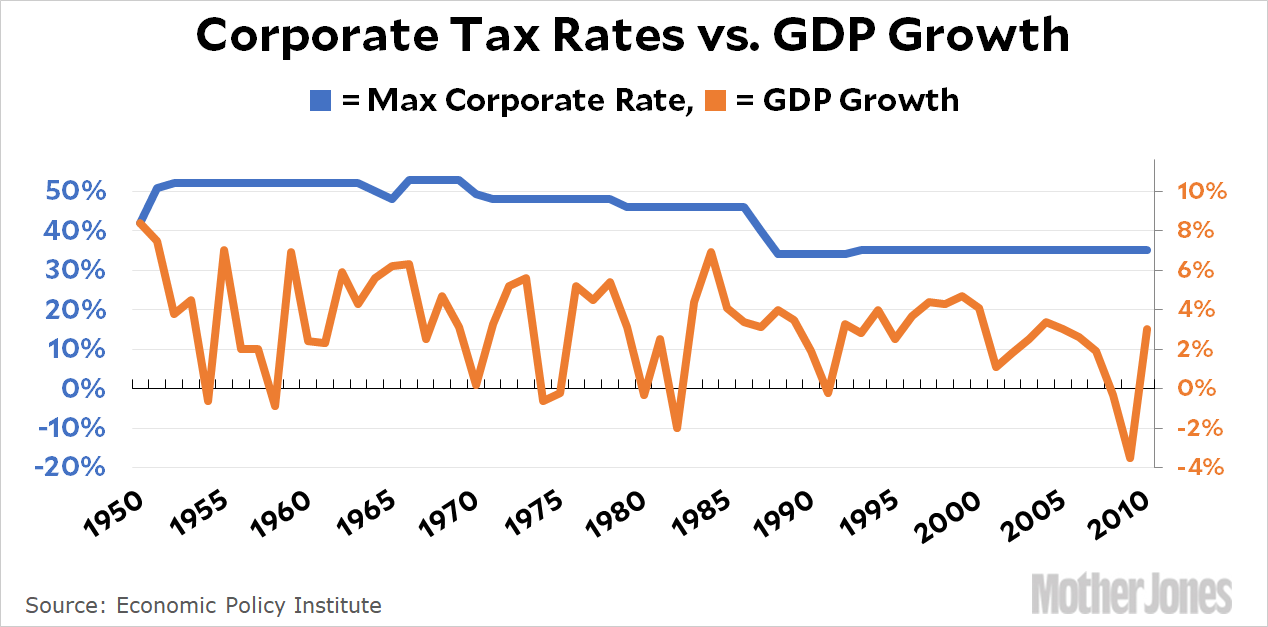
    So how long has it been since a big corporate tax cut? Pretty much forever. There’s never been one. Various small changes over time, combined with corporations getting more efficient at tax avoidance, have reduced effective tax rates, but that’s it. So Cohn really has a chance to make history. If he oversees a big corporate tax cut that’s not revenue neutral, he’ll be the first person in history to do it. That’s surely something a man can be proud of. After all, lower corporate tax rates are a surefire way to boost economic growth. Right?
  • Chart of the Day: Net New Jobs in August

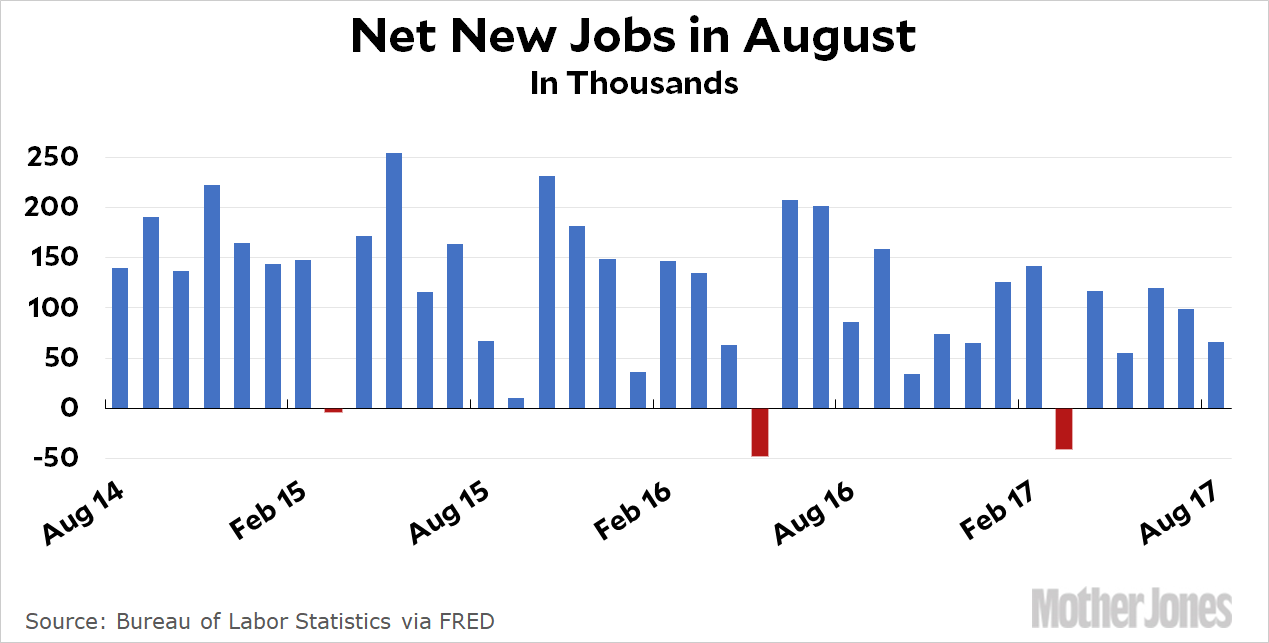
    The American economy added 156,000 new jobs last month, 90,000 of which were needed to keep up with population growth. This means that net job growth clocked in at 66,000 jobs. That’s pretty anemic, but August usually tends to be sort of an anemic month for job growth. The headline unemployment rate ticked back up slightly to 4.4 percent, all of it for bad reasons: the number of employed people declined and the number of unemployed people increased. But there was good news for some: the unemployment rate for high school dropout plummeted from 6.9 percent to 6.0 percent.

    Hourly earnings of production and nonsupervisory employees went up at an annual rate of 2.3 percent. Considering that inflation has been running around 0 percent all year, that’s not too bad.

  • Trump Cuts Obamacare Promotion By 90%

    Here’s the latest news from Trumpland:

    Last year, the officials said, the Obama administration spent about $100 million on educating Americans about their health insurance choices and urging them to enroll. This year, HHS will spend just $10 million. Additionally, HHS will nearly cut in half the funding for hundreds of navigator groups across the country who provide in-person assistance to people signing up for health insurance, making the grants conditional on how many people each group signed up last year.

    Why? Because fuck you, that’s why. After all, having spent the entire year confusing the hell out of everyone about what’s going on, there’s really no need for any kind of advertising or outreach, is there? “People are generally aware of Obamacare and the exchanges,” said an HHS flack who obviously couldn’t care less if anyone on the planet is aware of Obamacare. “They are aware of the products out there and aware they can sign up.”

    Of course, what most people are “aware” of is that the deadline for signups comes in January. It’s always been in January. But Trump has changed that to December because—well, same reason as before. And now he’s cut off the program that might warn people they’d better sign up a month earlier than they’re used to.

    But maybe the Trump administration has some better use for this money lined up. Right? Oddly, HHS didn’t mention that. I’m sure it was just an oversight.

    I wonder: do these guys think anyone actually believes them? Or do they just not care?

  • Spending on Recreation Has Been Increasing Since 2011

    Over at Wonkblog, Heather Long writes:

    Forget the soaring stock market. Here’s the real evidence the U.S. economy is getting better: Food stamp usage is down, and spending on entertainment — everything from Netflix to Disney World trips — is up. The average American household now spends more than $2,900 a year, a record high, on entertainment, according to data released Tuesday by the Labor Department. That’s a good sign the middle class is feeling better about how much money is in their piggy banks.

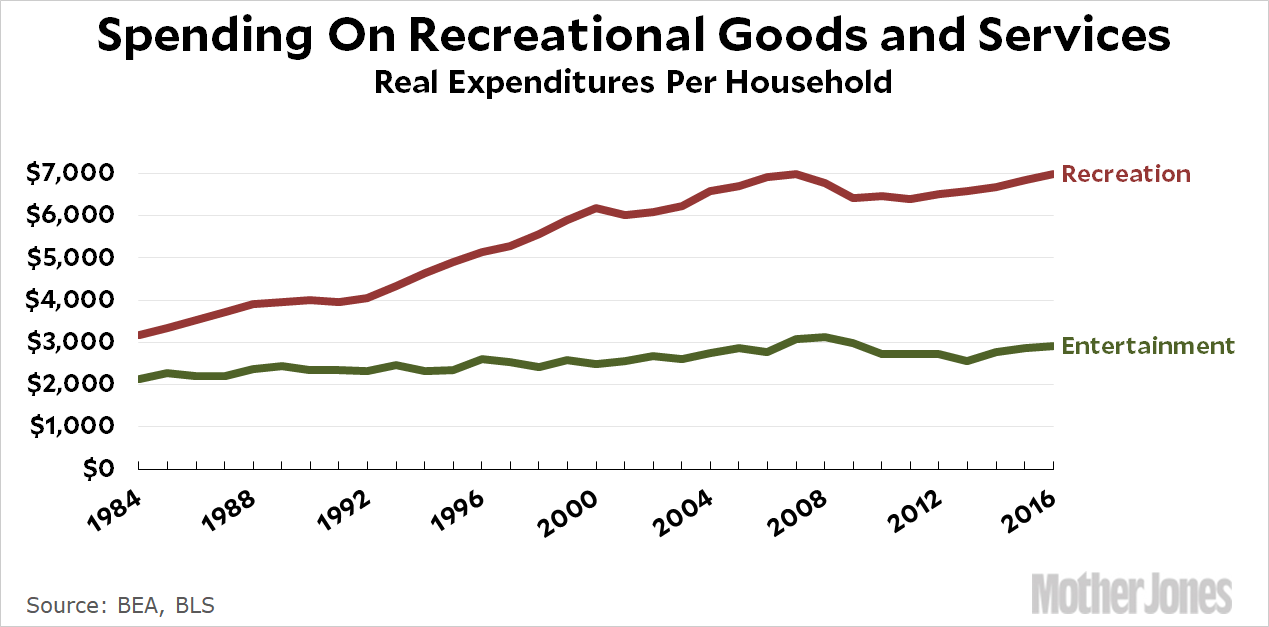
    The chart below is sort of an accident because I initially went to the wrong place for the data, but here is spending since 1984 for “entertainment” as defined by the BLS and for the broader category of “recreation” as defined by the BEA:

    Spending on recreation dropped for only two years during the Great Recession. Then it flattened, and it’s been rising steadily for five consecutive years. Spending on entertainment, however, dropped for five years, and has only been rising for the past three years. It has yet to return to its 2008 peak.

    I’m not entirely sure what to make of this. One thing, of course, is that if this is your metric for “real evidence” that the economy is getting better, then it’s been getting better for at least three years, and maybe for five. The other is that recreation rebounded sooner and stronger than entertainment. Why is this?

    • Recreation includes recreational vehicles. I’m not sure how that’s defined, but it’s a fair guess that not every recreational vehicle is truly used for recreation all the time.
    • Lots of entertainment these days is cheap (video games) or free (spending time on social media). This makes traditional entertainment like movies and concerts a tougher sell. However, it also means that this metric is not necessarily a good way to judge the economy.
    • Spending on recreation has gone up 120 percent since 1984 while spending on entertainment has gone up only 36 percent. Entertainment is just a slower-growing category.

    My best guess: Recreation is a better category to use, and it’s been on the rise since it bottomed out in 2011. There’s not much real news in the latest numbers.

  • That’s a Mighty Big Postcard, Mr. Ryan

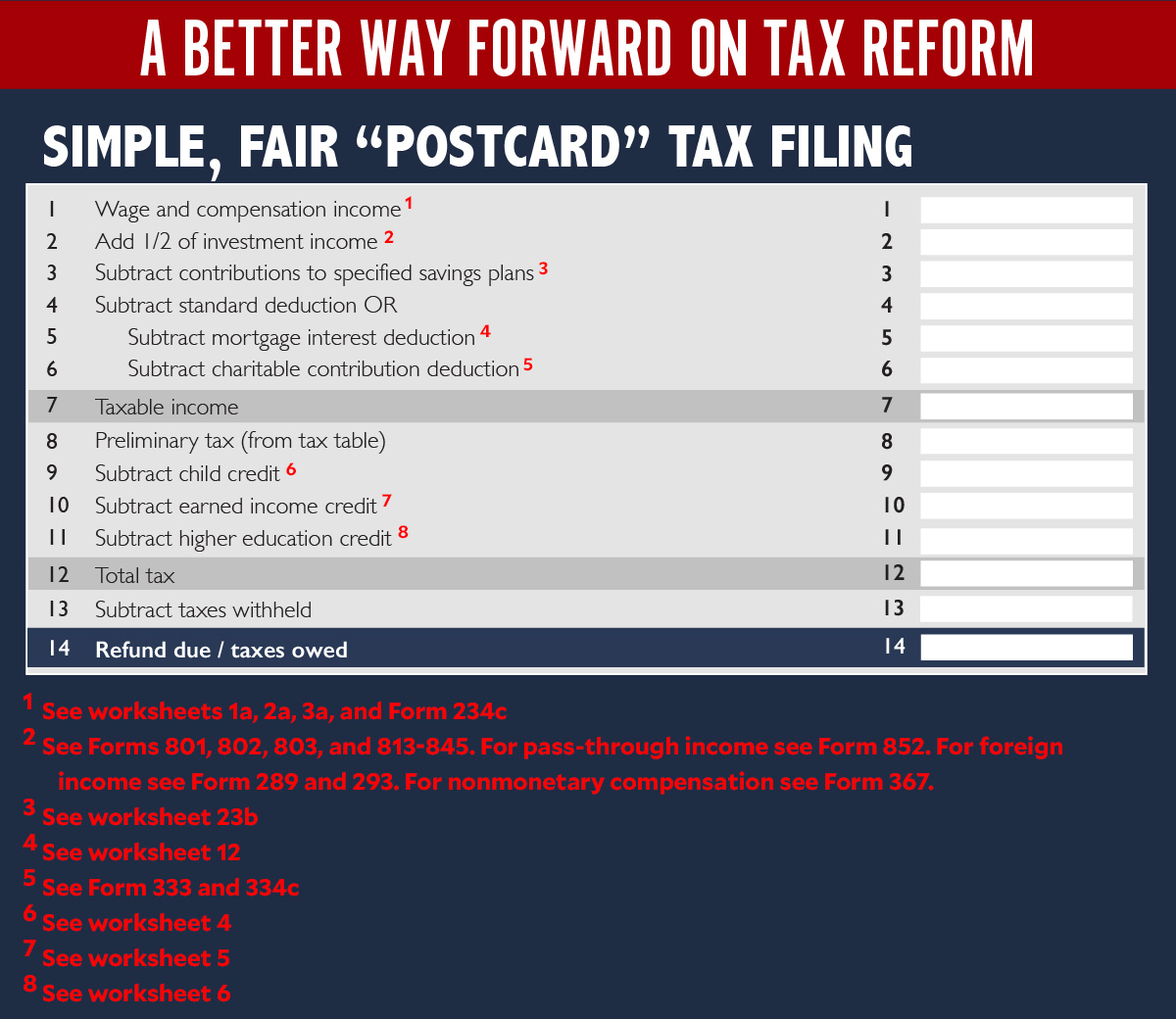
    Matt Yglesias has unkind words today for Paul Ryan’s alleged “tax return on a postcard.” As he notes, we pretty much already have this in the Form 1040EZ, which would fit on a postcard if it weren’t for added fluff like room for your name and address and spaces for you to sign at the bottom. If anything, though, I think Yglesias is too kind. Here is my annotated version of Ryan’s postcard:

    In other words, cut the crap. If you have simple wage income and take the standard deduction, your taxes are already postcard simple. For anyone else, the tricky part is calculating your income based on the rules passed by Congress and enforced by the IRS. Ryan’s postcard does nothing to change that, which means that in real life your postcard will be accompanied by dozens or hundreds of pages of additional worksheets, schedules, and references.

    But who cares, right? Honesty is for suckers these days.

  • FDA Approves First CAR-T Cell Therapy

    Johann Groder/APA Picturedesk via ZUMA

    Progress:

    The Food and Drug Administration on Wednesday approved the first-ever treatment that genetically alters a patient’s own cells to fight cancer, a milestone that is expected to transform treatment in the coming years….The therapy, marketed as Kymriah and made by Novartis, was approved for children and young adults for an aggressive type of leukemia — B-cell acute lymphoblastic leukemia….The treatment was originally developed by researchers at the University of Pennsylvania and licensed to Novartis. It was identified in previous reports as CAR-T cell therapy, CTL019 or tisagenlecleucel.

    Hooray! Let’s do multiple myeloma next! This therapy costs half a million bucks or so, but as long as someone else is paying for it I figure I’m worth it.

  • Lunchtime Photo

    Wildflower season is long over, but the miracle of photography allows us to enjoy it one more time. I wouldn’t say that the California poppy is the #1 reason to move here,¹ but a great big field of them in the spring might just change your mind. Or you could just visit during wildflower season, I suppose. Either way, it’s truly a delightful flower.

    ¹Other reasons include a better time zone; great weather; nobody cares what you wear to dinner; and we’re 2,500 miles away from Donald Trump.

  • Which Taxes Have Been Choking American Growth?

    President Trump today:

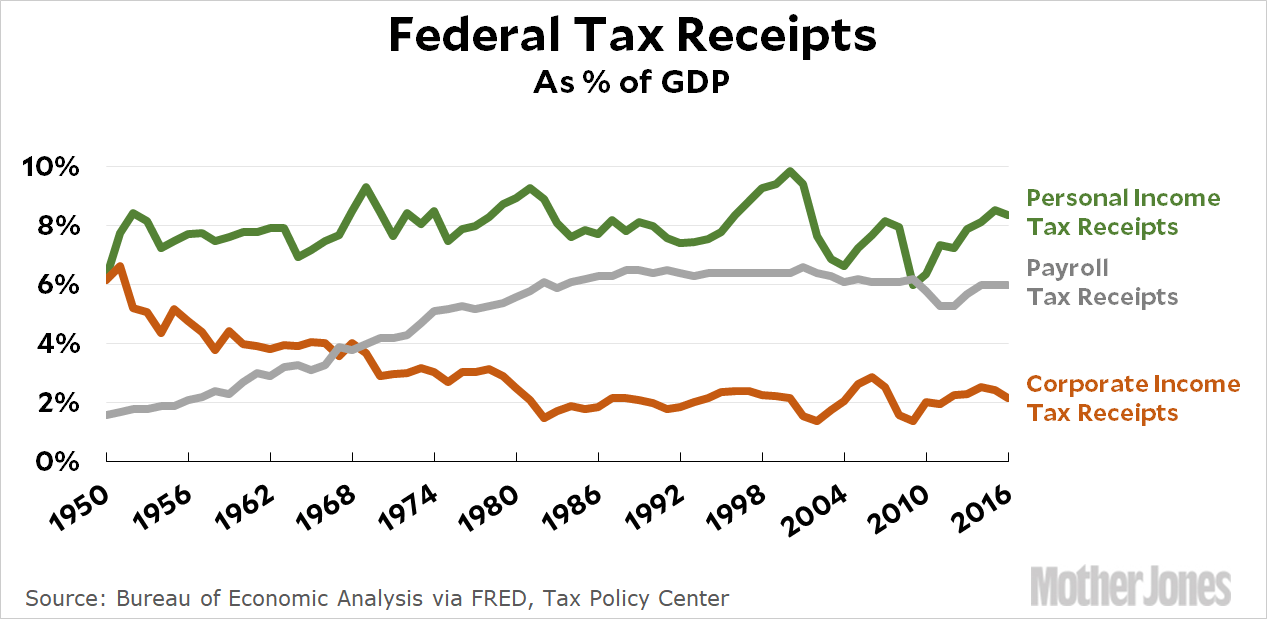
    Whether we “must” lower our taxes is a matter of opinion, I suppose. However, the question of how high our taxes are is a matter of fact. So here you go:

    Gee, I wonder which taxes Trump thinks “must” be lowered?

  • Respect the Parallelogram

    Here’s a tweetstorm that demands respect:


    And now the storm:

    • First: don’t disrespect geometry and don’t effin disrespect parallelograms – particularly IN a parallelogram…
    • The SIGN is a parallelogram (rectangle) as is the WINDOW. Structurally the building is held up with triangles & parallelograms…
    • The graphic software used to MAKE the sign contains maths that deals with vectors & hence PARALLELOGRAMS…
    • EVERY season is PARALLELOGRAM season if you live in a built environment or use technology. I’m bloody glad I learnt about parallelograms…
    • Imagine if I’d spent my time learning about taxes at school instead of parallelograms…
    • 1 it would all be out of date now & 2 be about the wrong country & 3 be so vague as to be irrelevant to my current life.
    • Oh & 4 be as dull as shit. Whereas geometry is truly amazing…
    • …now no offence to accountants in general. I admire all maths related disciplines & accountants are unfairly maligned as dull…
    • BUT don’t shit on a different field of maths for cheap laughs…
    • ‘But it is just a joke’ no it is a shitty joke that perpetuates a shitty idea: that only ‘useful’ maths is worth learning.
    • ‘Useful’ is a shitty standard for general education. Drama, literature, art, music we learn because they are good in themselves…
    • ‘Oh but STEM is different!’ No! Name a dinosaur – go on. I bet you can name several correctly with the right technical name…
    • …how come? Most people will never need to deal with actual dinosaurs. But we learn about them because they are FUN and weird & freaky…
    • People who succeed in maths & related areas find pleasure in maths. ‘Useful’ has its place but it is not as powerful as pleasure.
    • …and tying down a subject whose power is its abstractness with ‘useful’ means that it will always fail…
    • ‘When will I use this’ I don’t know because you haven’t lived your life yet!…
    • Anyway. Moral: don’t disrespect parallelograms.

    Quite so. The problem with parallelograms is that they’re a con. They tell you that finding the area is simple: it’s base · height. Easy peasy!

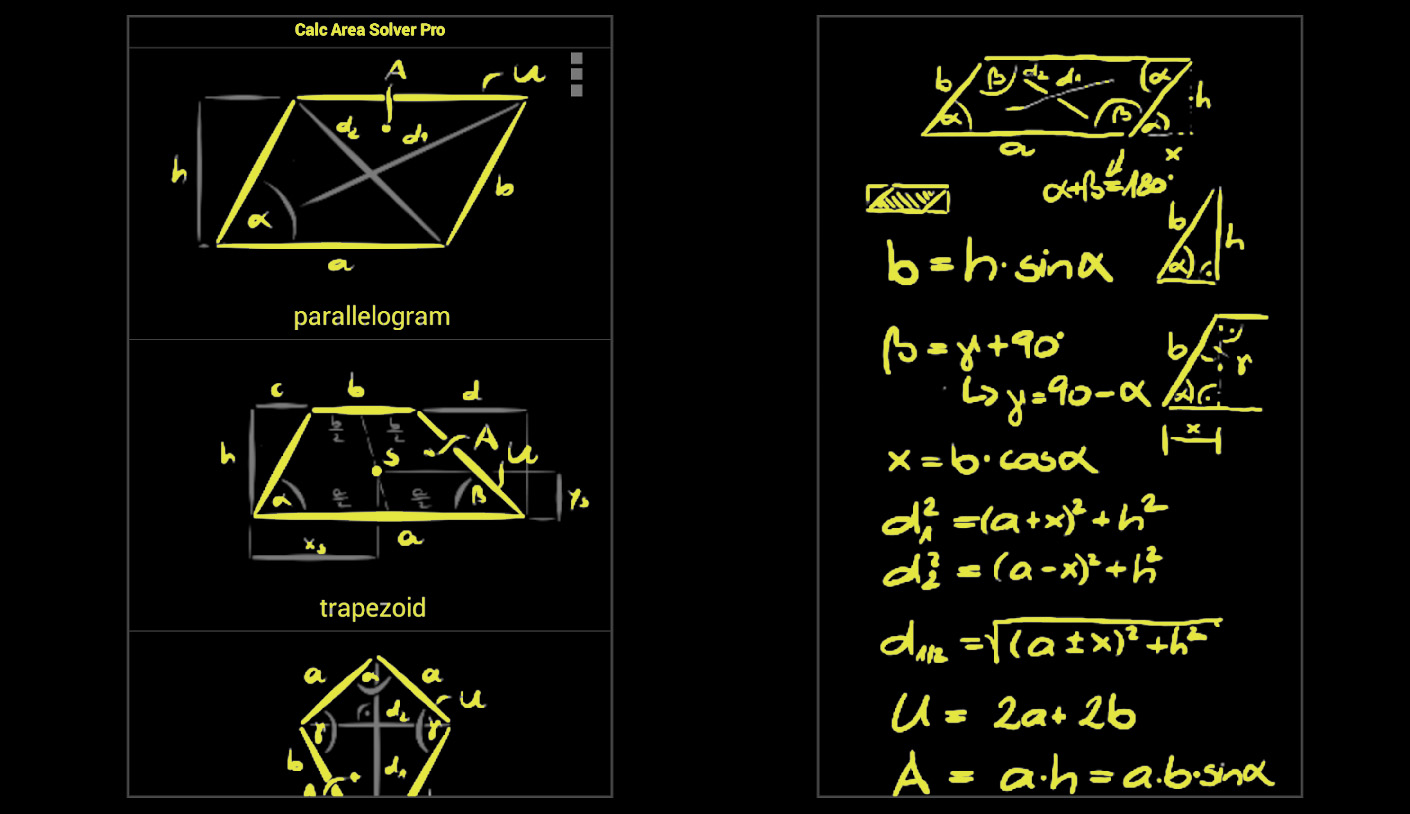
    But what’s the height? Crap. The length of the sides isn’t enough to figure that out. You need to know the angles too. And then you have to apply some trigonometry:

    So there you go: the area of a parallelogram is a · b · sin α. Greek letters! Blecch. So sure, respect the parallelogram, but only because such a simple looking thing requires more math than you’d think to figure it out.

    No worries, though. You’ll need it when you take physics anyway.