• Trump’s Trade Threats Aren’t Scaring Anyone

    Over at Wonkblog, Elizabeth Winkler says that Donald Trump’s trade threats seem to be working:

    Since January, G-20 countries have imposed 29 percent fewer protectionist policies than they did in the same period in 2016. And it’s not because the United States is playing nice: Since January, U.S. policymakers have imposed 26 percent more protectionist policies on its G-20 peers than during the same period a year before, according to the report.

    ….Caroline Freund, an economist at the Peterson Institute for International Economics, calls this a “backlash to the backlash against globalization.”…“If [Trump] is going to go on a trade rampage, they don’t want to attract extra attention by imposing new measures,” Freund said.

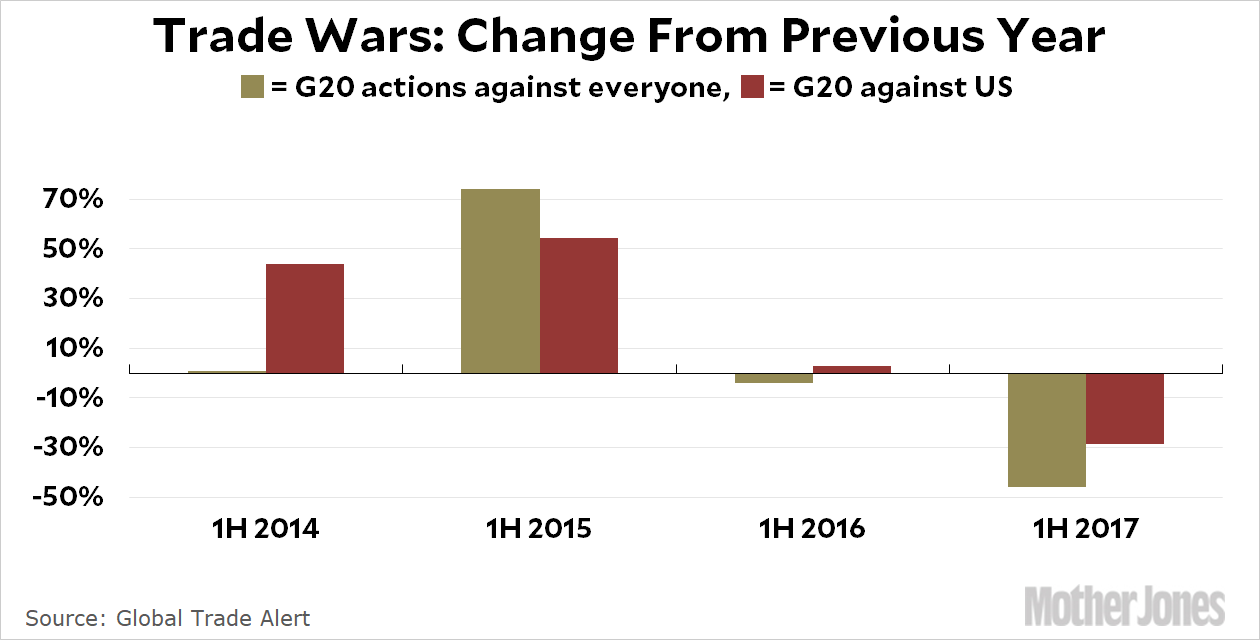
    Technically these figures are correct. But they’re pretty misleading. The other G20 countries have cut back on their trade actions against everybody in the G20, not just the US:

    In 2017 so far, G20 countries have cut back on protectionist activities against the US by 29 percent, but they’ve cut back against everyone else by 46 percent. Here’s how this translates: last year, only 9 percent of G20 protectionism was aimed at the US. This year it’s 12 percent.

    This suggests a harsher relative attitude toward the US this year, not a milder one. The real difference here is that the rest of the G20 is trying to cut back overall on protectionist activities while the US isn’t. But thanks to Trump’s threats, they’re not cutting back very much against the US. It doesn’t seem as if anyone is really all that afraid of him.

  • Which Is More Important? Trump’s Lies or Minor Errors Fact-Checking Those Lies?

    A couple of weeks ago, Kellyanne Conway denied that the Senate health care bill cut Medicaid. “These are not cuts to Medicaid,” she said. “This slows the rate for the future.”

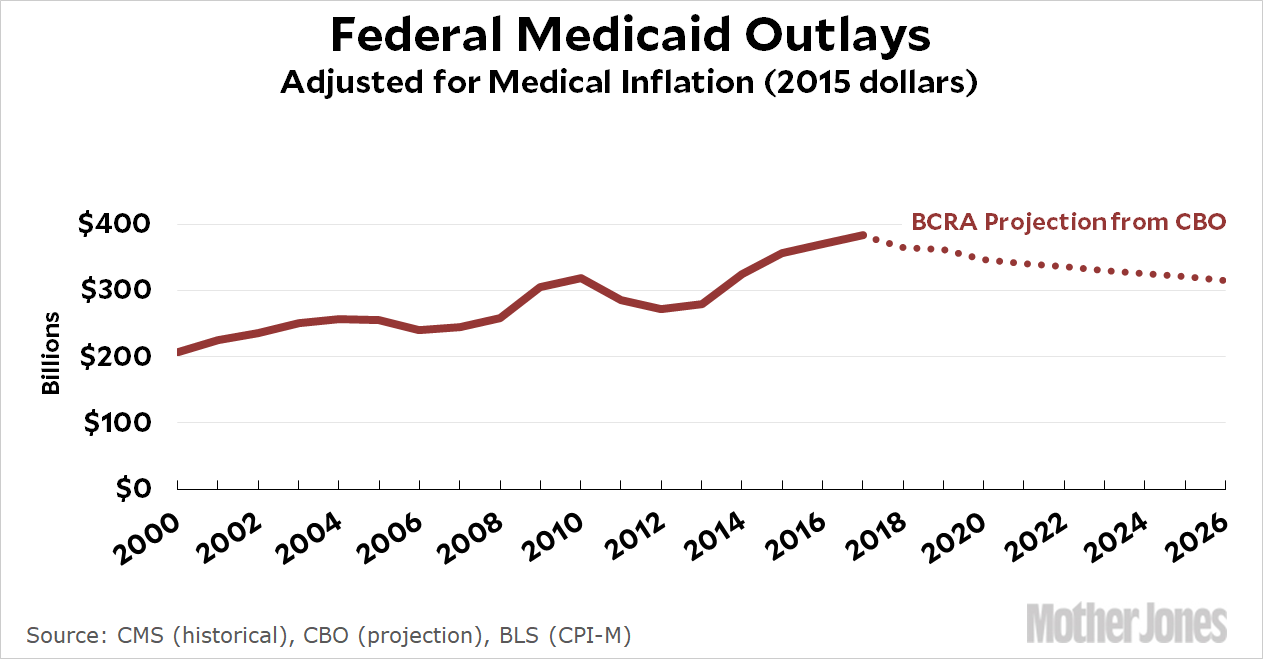
    This is the lamest, tiredest trope imaginable, and it’s flat-out false. In inflation-adjusted dollars—the only kind that honest people use—CBO estimates that the Senate bill cuts Medicaid spending by about 18 percent over the next decade. As a result, 15 million fewer people will receive Medicaid by 2026. That’s a cut by anyone’s definition.

    But Ramesh Ponnuru isn’t concerned about this. Instead, he’s mad at PolitiFact for saying that the Senate bill “rolls back who is eligible”—i.e., that it kills the Medicaid expansion in Obamacare. That’s not quite right: according to CBO’s analysis, the Senate bill gradually reduces the federal share of payment for Medicaid expansion from 90 percent to 57 percent. Because of this, “CBO expects that no additional states would expand eligibility.”

    This may seem like a thin distinction, but Ponnuru is so mad about it that he brought it up again today. “So far, no correction,” he says.

    Fine. PolitiFact got something wrong. They should correct the record. But I sure wish conservatives could work up the same level of indignation for an administration that flatly lies about Medicaid and a Republican bill that slashes Medicaid funding so much that it tosses 15 million poor people off the rolls. Instead, they’re busy concocting rickety arguments that Medicaid is “lousy” and then making pie-in-the-sky suggestions that we should use Medicaid money to help the poor buy private insurance instead. But they know perfectly well that’s not an option on offer, and never likely to be in any practical way. It’s just a way of soothing their consciences without any danger of supporting any actual real-world spending.

    Life is less about facts and figures than it is about priorities. Over the past few months, conservatives have pretty clearly shown us theirs.

  • Who’s Shopping Forged Documents to the Washington Press Corps?

    On May 9, Reality Winner, an NSA contract worker, downloaded a file that outlined details of Russian hacking efforts just before the 2016 election. On June 5, the Intercept published her file.

    But something interesting happened between May and June: someone used the Winner document as the basis to create a forgery of a different top-secret document that named a specific Trump aide who had colluded with Russia. This forgery was apparently shopped around to journalists, including Rachel Maddow, who described what happened on her show last night.

    So…who had access to the Winner file before it was published? Who’s peddling this stuff? Was it from a Trump opponent who meant it to be taken seriously but didn’t quite do the job well enough? Was it from a Trump supporter who hoped someone in the mainstream media would publish it and then look like a fool? Was it from someone in the intelligence community who wanted to sow seeds of doubt in news organizations that receive stolen documents? Good question! As Maddow mentioned, two other news organizations have had to retract stories recently based on problems with “sourcing.” This might be part of a concerted effort to discredit the media looking into the Trump-Russia connection.

    I will say one thing, though: Maddow compared this to the fake documents that CBS published about George Bush’s National Guard service. That’s a dead end. We have a pretty good idea of where those came from, and it wasn’t some part of the deep state. It was just an idiot with a grudge against Bush.

  • Chart of the Day: Net New Jobs in June

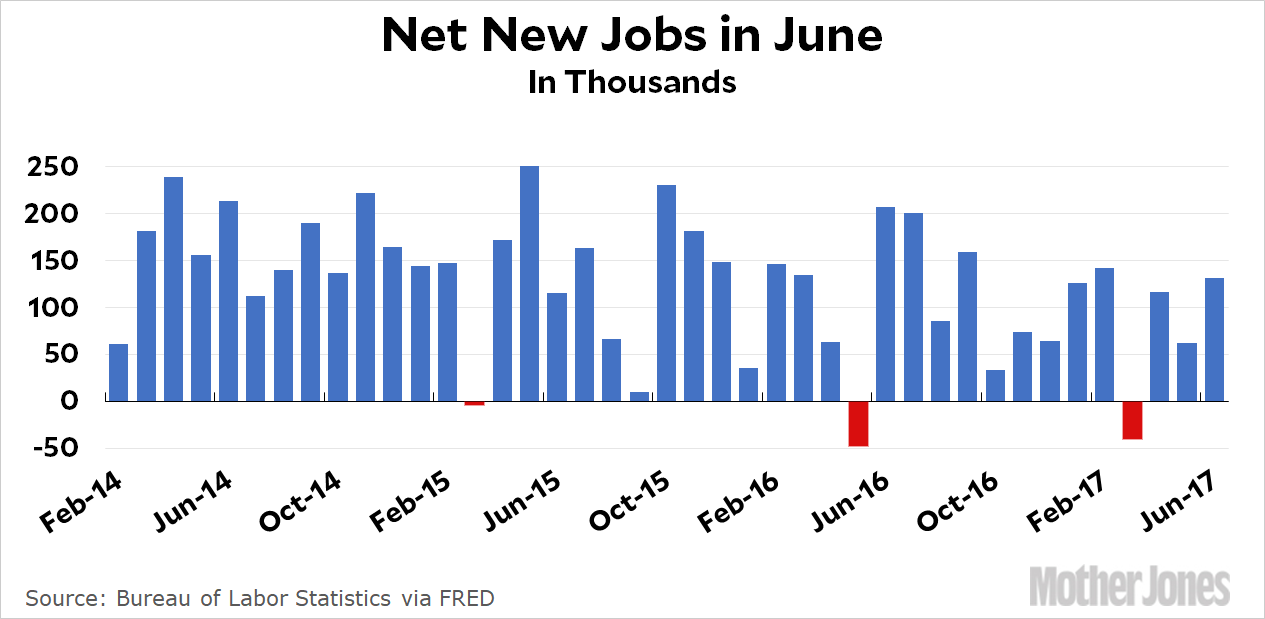
    The American economy added 222,000 new jobs last month, 90,000 of which were needed to keep up with population growth. This means that net job growth clocked in at 132,000 jobs. That’s a decent number, about equal to the average of the past three years. The headline unemployment rate ticked up slightly to 4.4 percent, but that’s probably because a lot of new grads entered the labor force in June and haven’t yet found jobs.

    Hourly earnings of production and nonsupervisory employees went up at an annual rate of 2.3 percent. Inflation has been declining for the past couple of months, so this represents a small increase on an annualized basis. Nothing to write home about, but at least it’s positive. All in all, this was a pretty positive report with no real downsides.

  • Judge Burns US Attorneys Using Excel Chart

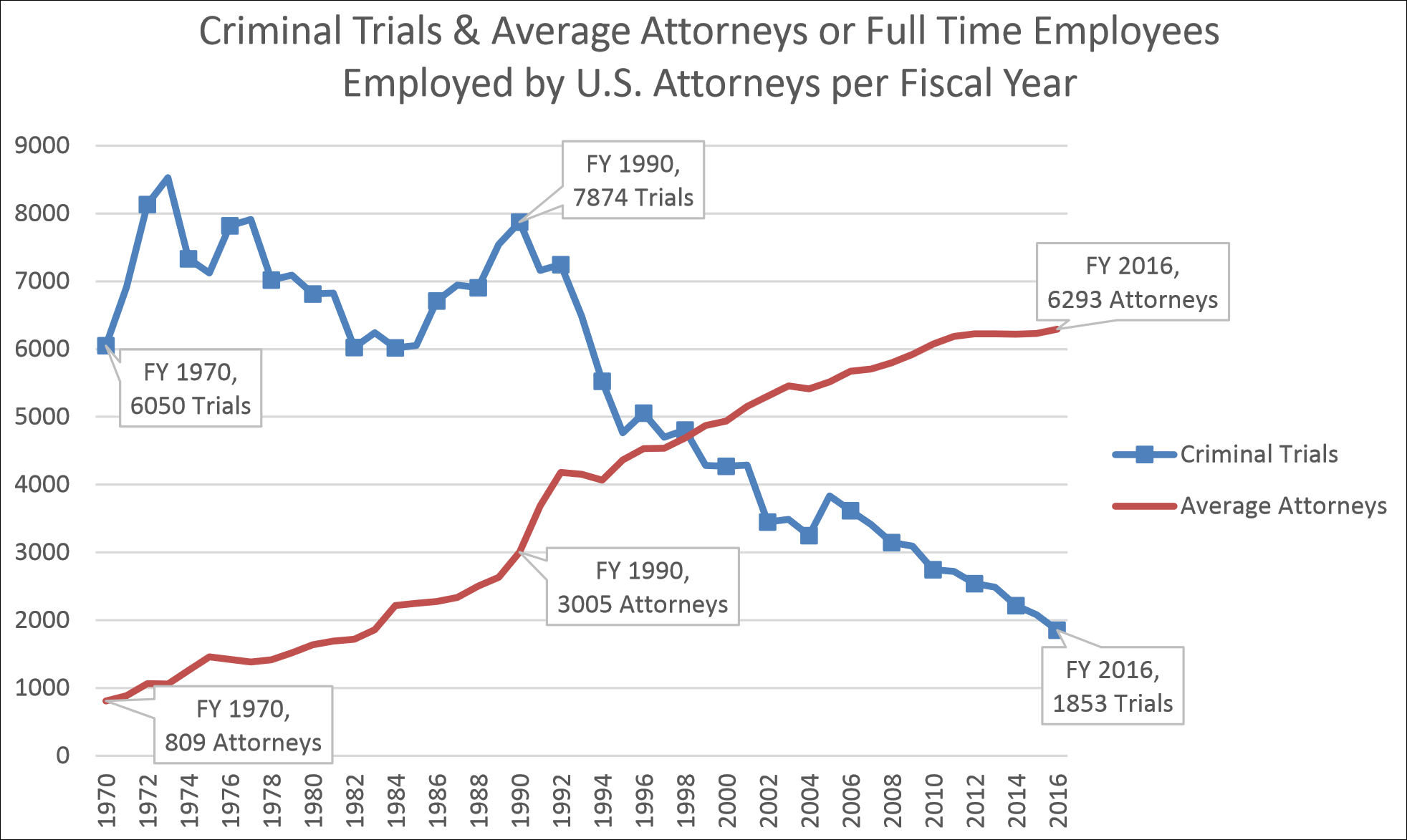
    Here’s something kind of awesome. Wonkblog’s Christopher Ingraham points us to a district court opinion that justifies its conclusion with a chart drawn in Excel:

    Is this common? I don’t think I’ve ever seen a chart in a judicial opinion before, but then, I don’t read a whole lot of judicial opinions. In any case, if this is a trend, I heartily approve.

    In case you’re wondering, Judge Joseph Goodwin used this chart to demonstrate that US attorneys are lazy bastards who make plea deals for everything and barely ever do the work of actually bringing someone to trial: “In FY 1973, each federal prosecutor handled over eight criminal trials on average. By FY 2016, the average number of criminal trials handled by each federal prosecutor plummeted to 0.29 trials.”

    For that reason, he rejected a plea deal in the case at hand. US attorneys are hardly overworked, he said, so let’s have a trial:

    The law is the law, and I am satisfied that enforcing the law through public adjudications focuses attention on the heroin and opioid crisis….A jury trial tells a story….Moreover, the attendant media attention that a jury trial occasions communicates to the community that such conduct is unlawful and that the law is upheld and enforced.

    ….The secrecy surrounding plea bargains in heroin and opioid cases frequently undermines respect for the law and deterrence of crime. The bright light of the jury trial deters crime, enhances respect for the law, educates the public, and reinforces their sense of safety much more than a contract entered into in the shadows of a private meeting in the prosecutor’s office.

    For the reasons stated, I REJECT the plea agreement.

    Does this make sense? Will it be upheld if it’s appealed? Beats me. But I love the chart. Good job, judge.

  • My 3-Step Plan to Fix Obamacare

    The prospects of the Senate health care bill are looking kind of grim these days, so Republicans have taken to taunting Democrats over Obamacare:

    This is followed by a series of personal versions of this tweet. Where’s your plan, Hillary Clinton? Where’s your plan, Joe Manchin. Etc.

    Sadly, nobody asked me for my plan, but I’m going to present it anyway. This is what bloggers do: demand that people listen to their ideas for curing the world’s ills whether they want to or not. Mine is a nice, simple, 3-step plan:

    1. Enforce the individual mandate and increase the penalty to 3.5 percent of income.
    2. Increase subsidies by 20 percent and extend them to 6x the poverty level.
    3. In areas where there are fewer than two insurers participating in the exchanges, make Medicaid available for the price of an average Bronze plan.

    This is not a wish list of everything that would make Obamacare better. It’s a minimum set of proposals that would keep Obamacare stable, reduce premiums, and fix its worst problems. That’s it.

    The point of item #1 is not to penalize poor people, it’s to get more healthy people into the system. Here’s a rough example of how this works:

    • Today: Net cost of Bronze plan for 27-year-old earning $30,000 after subsidy = $1,900. Noninsurance penalty = $700. Difference = $1,200.
    • New plan: Net cost after subsidy = $1,400. Noninsurance penalty = $1,000. Difference = $400.

    Today, the difference between buying insurance and paying the penalty is fairly large. This means that a lot of young, healthy people grit their teeth and pay the penalty because they don’t think they can afford an additional $100 per month. This is a huge loser on multiple levels: it makes people bitter; it destabilizes the insurance pool; and it puts more people at risk of catastrophic financial loss if they develop a health problem. But if you increase both the subsidies and the penalty, the difference is much less. For only $30 per month, most people will go ahead and buy the insurance.

    Item #2 makes insurance more affordable for everyone, and extends subsidies further into the working and middle classes. This is both the right thing to do and a political winner. Too many working-class families don’t benefit much from Obamacare even though their incomes are modest, and that should stop.

    Item #3 is a stopgap for areas in which there’s either no competition for insurance or no insurance available at all. My guess is that if we implement the first two items we’d barely need this, but it can’t hurt to have it around as a backstop.

    Of course, my plan would cost more. My horseback guess is that it would cost an additional $25 billion per year or so. Obamacare is currently under its initial budget projections, and this would put it a little over. That means no tax cut for the rich, which presumably makes it a nonstarter for Republicans. On the bright side, I don’t see any reason why we couldn’t include a few Republican ideas in this package too. More generous tax treatment of HSAs, more Medicaid flexibility for states, etc.

    This is all pie in the sky. But I’m pretty sure that it would work once the details were filled in. This isn’t rocket science. Beyond those details, the big selling point for Republicans is that it might make people happy enough that it kills off the movement toward single-payer. The selling point for Democrats is that it would provide better health care for millions of people. It’s a win-win.


  • Lunchtime Photo

    I have heard your pleas. You need something soothing today. So here you go: this is the Huntington Beach pier at sunset. It’s about the most soothing picture I have in my collection. And remember, it’s almost Friday. That means it’s almost almost the weekend.

  • Here’s How to Get Better TV Ratings Without the Hassle of Getting More Viewers

    If you want better ratings for your nightly news program, the logical approach is to attract more viewers with a better product. But that’s hard. An alternative is to figure out a way to have Nielsen ignore your broadcasts on days when viewership is low. But how? The Wall Street Journal explains:

    In a game largely sanctioned by TV-ratings firm Nielsen, television networks try to hide their shows’ poor performances on any given night by forgetting how to spell. That explains the appearance of “NBC Nitely News,” which apparently aired on the Friday of Memorial Day weekend this year, when a lot of people were away from their TVs….Hiding the May 26 program from Nielsen dramatically improved the show’s average viewership that week.

    ….The network needn’t feel defensive. ABC took its own ratings mulligan seven times during the 2016-17 season with “Wrld New Tonite.” CBS misspelled “The CBS Evening News” as the “CBS Evening Nws” 12 times this season.

    Nielsen may wink at this, but do advertisers? TV execs say the inflated numbers are used only for “publicity purposes,” but apparently that’s not quite true:

    “Networks never used to do this,” said Billie Gold, director of programming at ad giant Dentsu Inc. Now, she said, it has become the norm….Ms. Gold and other ad executives say they are frustrated with the detective work required to kick the tires on network viewer ratings. She said her clients are surprised by the difference between the number of eyeballs the networks claim and Ms. Gold’s tally, which accounts for the altered titles.

    I wonder if there’s something similar that bloggers can do to game their numbers? Hmmm.