• Here’s the Frame-by-Frame Footage of Trump’s Campaign Manager Grabbing Michelle Fields


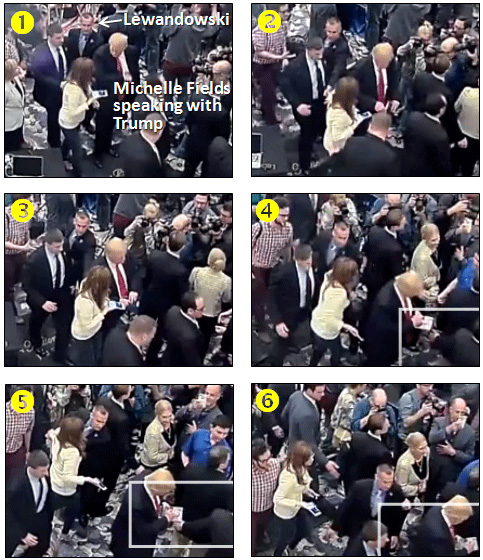
    In case you’re curious, here’s a frame-by-frame breakdown of security camera footage from the Donald Trump rally in Jupiter, Florida, on March 8. It shows Trump campaign manager Corey Lewandowski grabbing Breitbart reporter Michelle Fields in order to get her away from Trump:

    A few things are obvious here. First, Fields didn’t hallucinate anything, as both Lewandowski and Trump have implied. Second, Lewandowski did indeed grab Fields by the arm, just as she says. Third, Trump was already walking away from her at the time. Fourth, it doesn’t really look very serious. Fields is obviously a little nonplussed, but otherwise fairly unscathed.

    The whole thing is crazy. It’s a minor incident, and all Lewandowski had to do was give Fields a quick call to apologize for grabbing her in his haste to catch up with his boss. Incident over. But apparently that was out of the question. Team Trump never apologizes. Instead they went on the warpath and publicly accused Fields of being nothing but an attention-seeking fantasist.

    Yeah, this is definitely the team we need in the White House.

  • It Looks Like the Supreme Court Is Getting Ready to Rule Against Religious Objections to Contraceptive Coverage


    I might be missing something here, but the latest Supreme Court order in the Little Sisters of the Poor case seems kind of odd. As you’ll recall, the Sisters object to the idea of having to submit a form saying that they don’t want their health insurance coverage to include contraceptives. Their reasoning is that filling out a form is an affirmative act that will eventually lead to employees getting contraceptives, which they consider a sin.

    What to do? Today the Supreme Court noted the Sisters’ objections and asked both sides to submit briefs with alternative ideas:

    For example, the parties should consider a situation in which [the Sisters] would contract to provide health insurance for their employees, and in the course of obtaining such insurance, inform their insurance company that they do not want their health plan to include contraceptive coverage of the type to which they object on religious grounds. [The Sisters] would have no legal obligation to provide such contraceptive coverage, would not pay for such coverage, and would not be required to submit any separate notice to their insurer, to the Federal Government, or to their employees.

    At the same time, [the Sisters’] insurance company—aware that [the Sisters] are not providing certain contraceptive coverage on religious grounds—would separately notify [the Sisters’] employees that the insurance company will provide cost-free contraceptive coverage, and that such coverage is not paid for by [the Sisters] and is not provided through [the Sisters’] health plan. The parties may address other proposals along similar lines, avoiding repetition of discussion in prior briefing.

    The briefs are limited to 25 pages, but it sure sounds as if the government could submit a one-page brief that copies this language exactly and agrees that it sounds just peachy. For all intents and purposes, it seems like the Supreme Court is telling them to do exactly that and they’ll get a ruling in their favor. End of case.

    That’s a little unusual, isn’t it? That is, for the court to basically tell one of the parties, “say this and you win the case.” But that’s what it looks like, unless the Sisters manage to manufacture some kind of credible objection even to this.

  • American Amnesia: Three Cheers For the Mixed Economy!


    In American Amnesia, Jacob Hacker and Paul Pierson defend the mixed economy from the conservative apostles of pure market forces. One of the problems they identify with unchecked markets is externalities, the effects of private actions on others. The problems associated with externalities, they say, become greater as population increases and countries become more urbanized. For example:
    Consider one of the great health scourges of the mid-twentieth-century: lead. Exposure to lead was far greater in inner-city neighborhoods—less because of the prevalence of lead paint than because lead additives in gasoline accumulated in automobile-dense urban areas. The consequences were terrible. At the level experienced by kids in urban communities from the 1950s through the 1970s (the decade that saw the phaseout of leaded fuel), lead exposure causes substantial drops in IQ. It also diminishes impulse control. Substantial evidence now suggests that these effects may have played an important role in driving the epidemic of violent crime that began in the 1960s, as well as rising rates of teen pregnancy.

    Did they toss that in there just for me? I’d like to think so.

    Of course, it’s also a very good example of their thesis. Private actors had no particular reason to remove lead from gasoline, and market forces alone probably would never have eliminated it. It was government regulation, in response to research results that were largely government-funded, that got rid of lead in gasoline. That’s the mixed economy at work: private buyers and sellers created the basic market, with the government stepping in to regulate it for the common good. The result is better than a pure free market (which produces lead-poisoned kids) and better than socialism (which likely produces shortages of gasoline). For most of the 20th century, the mixed economy was a pillar of all advanced economies, including ours.

    But beginning in the 1980s, American conservatism took a turn away from paying even lip service to the mixed economy. Government regulation was bad, full stop. The free market was good. The less that government was involved in the economy, the faster the country would grow, benefiting everyone.

    Everyone who gets rich from an untrammeled economy, anyway. The rest of us get lead in our gasoline, pathogens in our food, the most expensive health care in the world, and a financial system so imperious that it can produce an economic collapse and then demand that it get bailed out. How did this happen? Hacker and Pierson follow the trajectory of the Republican Party since its radicalization began during the Reagan administration, and conclude that the GOP’s fealty to wealthy and powerful rent-seekers has been pretty successful:

    Those whose job it is to serve the public have more to do and less with which to do it. The same is not true of the private industries they are regulating….The typical public worker lives in a world of scarcity. The typical lobbyist lives in a world of abundance: lavish salaries, PR wizards, mercenary experts who can provide just the favorable finding or legislative language needed. No wonder the federal government has hemorrhaged talent.

    ….The root of the problem is simple: a growing mismatch between the enormous outside pressures on government—more and more organizations in Washington spending more and more to shape policy—and the weakened capacity of government to channel and check those pressures. “More than three decades of disinvesting in government’s capacity to keep up with skyrocketing numbers of lobbyists and policy institutes, well-organized partisans, and an increasingly complex social and legal context,” argue the political scientists Lee Drutman and Steven Teles, have created “a power asymmetry crisis.”

    Unregulated markets aren’t generally a big problem in small economies. In the United States, it wasn’t until the Robber Baron era of the late 19th century that underregulation became a serious issue. The backlash against the Morgans and the Rockefellers eventually produced the modern mixed economy, which served the country well for the rest of the century. But now, as Hacker and Pierson say, we’ve developed a sort of historical amnesia. A lot of Americans have forgotten both the bad old days and the government actions that made them better. All that’s left is a seething anger—stoked by a modern GOP dedicated to corporations and the rich—toward jack-booted government bureaucrats who prevent the economy from taking flight. Get rid of the regulators, and all will be well again.

    That might be true if we could also return to the America of the 1830s. But we can’t. The United States is bigger, more complex, and far more technologically advanced than it was two centuries ago, and there’s simply no plausible counterweight to powerful corporate rent-seekers other than government regulation. Like it or not, the mixed economy is the only way to run a modern country.

    Hacker and Pierson do a good job of telling both the history of the mixed economy as well as its more recent breakdown. If you’re already familiar with this story, there might not be much new here for you. For the rest of us, it’s as good an introduction as you’re likely to find.

  • Trump Campaign Manager Charged With Battery


    Well, this should be interesting:

    I have to admit that Lewandowski’s actions hardly seem to rise to the level of criminal battery, but what do I know? In any case, this should be another fine opportunity for Donald Trump to start whining about how the whole world is against him.

    Of course, a routine apology would have ended this tiff before it ever started. But that’s a lesson that Trump and his team will never accept.

  • Is the First National Bank of Cupertino Coming Soon to an iPhone Near You?


    Today the FBI announced that it had managed to unlock Syed Farook’s iPhone without Apple’s help. So that particular fight is over for now. But why was Apple so hellbent on refusing to help the FBI in the first place? Was it really because they’ve suddenly decided to become the white knight of consumer privacy and mass surveillance backlash? Maybe! Or maybe there’s more to it.
    Hold that thought for a moment and consider something else: Apple is sitting on a cash hoard of $150 billion that it seemingly can’t find a use for. Stock buybacks, acquisitions, R&D—those are all fine, but there’s no way these things can make much of a dent in a bankroll that’s this big and still growing. You need to think different—way different—to find a good use for that much dough. So what’s the plan?

    Charlie Stross has a suggestion. Although $150 billion might be a lot for an ordinary company, it’s a pretty modest sum if you’re thinking of capitalizing a bank. So maybe that’s what Apple plans to do with it:

    I’m going to assume you know what Apple Pay is: you use your iPhone, iPad, or Watch as a trusted, authenticated identity token in a shop to pay for stuff. It ties into your bank account and basically your phone swallows your debit and credit card.

    Ultimately the banks are going to discover—the hard way—that getting into bed with Apple was a bad idea….Apple is de facto an investment bank, right now: all it needs is a banking license and the right back end and regulatory oversight and risk management and it will be able to go toe-to-toe with the likes of Chase or Barclays or HSBC as a consumer bank, too.

    ….Here’s my theory: Apple see their long term future as including a global secure payments infrastructure that takes over the role of Visa and Mastercard’s networks—and ultimately of spawning a retail banking subsidiary to provide financial services directly, backed by some of their cash stockpile.

    The FBI thought they were asking for a way to unlock a mobile phone….[They] did not understand that they were actually asking for a way to tracelessly unlock and mess with every ATM and credit card on the planet circa 2030….If the FBI get what they want, then the back door will be installed and the next-generation payments infrastructure will be just as prone to fraud as the last-generation card infrastructure, with its card skimmers and identity theft.

    And this is why Tim Cook is willing to go to the mattresses with the US department of justice over iOS security: if nobody trusts their iPhone, nobody will be willing to trust the next-generation Apple Bank, and Apple is going to lose their best option for securing their cash pile as it climbs towards the stratosphere.

    It’s as good a guess as any, I suppose. When you outgrow the biggest normal business sector in the world, what’s left except to become a bank?

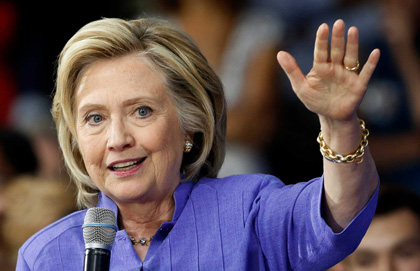
  • Hillary Clinton Is Fundamentally Honest and Trustworthy


    As we all know, millennials don’t care much for Hillary Clinton. That’s okay. I’m on the other side of that particular fence, but there’s plenty of room for honest differences about her views and whether they’re right for the country—differences that I don’t think are fundamentally rooted in age.

    But there’s one issue where I suspect that age really does trip up millennials: the widespread belief that Hillary isn’t trustworthy. It’s easy to understand why they might think this. After all, Hillary has been surrounded by a miasma of scandal for decades—and even if you vaguely know that a lot of the allegations against her weren’t fair, well, where there’s smoke there’s fire. So if you’re familiar with the buzzwords—Whitewater, Travelgate, Vince Foster, the Rose law firm, Troopergate, Ken Starr, Benghazi, Emailgate—but not much else, it’s only human to figure that maybe there really is something fishy in Hillary’s past.
    But many of us who lived through this stuff have exactly the opposite view. Not only do we know there’s almost literally nothing to any of these “scandals,” we also know exactly how they were deliberately and cynically manufactured at every step along the way. We were there, watching it happen in real time. So not only do we believe Hillary is basically honest, but the buzzwords actively piss us off. Every time we hear a young progressive kinda sorta suggest that Hillary can’t be trusted, we want to strangle someone. It’s the ultimate proof of how the right wing’s big lie about the Clintons has successfully poisoned not just the electorate in general, but even the progressive movement itself.

    I bring this up because I had to blink twice to make sure my eyes weren’t fooling me this morning. Jill Abramson has followed Bill and Hillary Clinton for more than two decades, first in the Washington bureau of the Wall Street Journal, then at the New York Times, where she eventually became Washington bureau chief (and even later executive editor). Her perch gave her an unrivaled view into Hillary’s actions. Here’s what she had to say today in the Guardian:

    I would be “dead rich”, to adapt an infamous Clinton phrase, if I could bill for all the hours I’ve spent covering just about every “scandal” that has enveloped the Clintons. As an editor I’ve launched investigations into her business dealings, her fundraising, her foundation and her marriage. As a reporter my stories stretch back to Whitewater. I’m not a favorite in Hillaryland. That makes what I want to say next surprising.

    Hillary Clinton is fundamentally honest and trustworthy.

    …Many investigative articles about Clinton end up “raising serious questions” about “potential” conflicts of interest or lapses in her judgment. Of course, she should be held accountable. It was bad judgment, as she has said, to use a private email server. It was colossally stupid to take those hefty speaking fees, but not corrupt. There are no instances I know of where Clinton was doing the bidding of a donor or benefactor.

    …I can see why so many voters believe Clinton is hiding something because her instinct is to withhold…Clinton distrusts the press more than any politician I have covered. In her view, journalists breach the perimeter and echo scurrilous claims about her circulated by unreliable rightwing foes.

    As Abramson suggests, there are times when Hillary is her own worst enemy. The decades of attacks have made her insular and distrustful, and this often produces a lawyerly demeanor that makes her sound guilty even when she isn’t. As a result, the belief in Hillary’s slipperiness is now such conventional wisdom that it’s almost impossible to dislodge. I just checked Memeorandum to see if anyone was discussing Abramson’s piece, and I was unsurprised to find that it’s gone almost entirely unnoticed.

    But the truth is that regardless of how she sometimes sounds, her record is pretty clear: Hillary Clinton really is fundamentally honest and trustworthy. Don’t let the conservative noise machine persuade you otherwise.

  • Weekly Flint Water Report: March 19-24


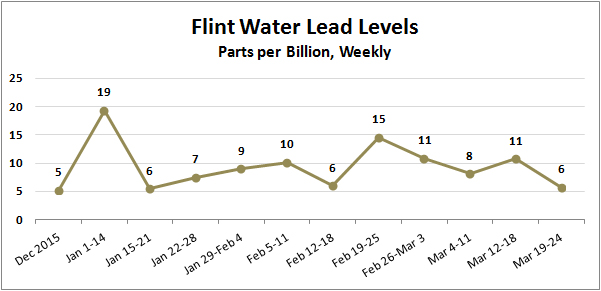
    Here is this week’s Flint water report. Apparently Michigan’s DEQ took Good Friday off, so testing results go through March 24 instead of March 25. As usual, I’ve eliminated outlier readings above 2,000 parts per billion, since there are very few of them and they can affect the averages in misleading ways. During the week, DEQ took 688 samples. The average for the past week was 5.72.

  • California Dives Into the Unknown With $15 Minimum Wage


    San Francisco and Los Angeles have already passed laws raising their minimum wages to $15 per hour. Now, in a victory for labor activists who were getting ready to put a $15 minimum wage on the ballot, the state is getting ready to  follow suit:

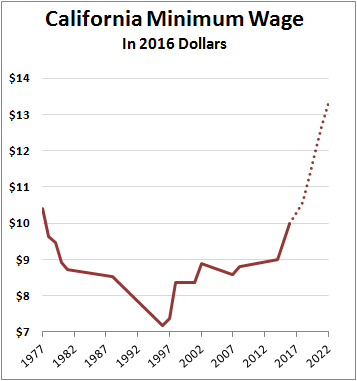
    According to a document obtained by The Times, the negotiated deal would boost California’s statewide minimum wage from $10 an hour to $10.50 on Jan. 1, 2017, with a 50-cent increase in 2018 and then $1-per-year increases through 2022. Businesses with fewer than 25 employees would have an extra year to comply, delaying their workers receiving a $15 hourly wage until 2023.
    Future statewide minimum wage increases would be linked to inflation, but a governor would have the power to temporarily block some of the initial increases in the event of an economic downturn.

    This would genuinely be terra incognita. The chart on the right shows the California minimum wage over the past 40 years, adjusted for inflation. An increase to $11 per hour in 2018 would return the state to slightly above its historical high point. Beyond that, however, the minimum wage goes far higher than it’s ever been.

    What effect will that have, especially in lower-wage areas outside the big cities? There’s no telling. It won’t be Armageddon, but it might not be entirely benign either. Small increases in the minimum wage seem to have little or no effect on employment, but this increase isn’t small, and it unquestionably gets us beyond merely catching up with past erosion in the minimum wage. A statewide minimum of $15 would be a brand new thing.

    Kansas recently tried out full-bore right-wing economics, and it’s pretty much been a disaster. Now liberals are getting their chance in California. Come back in a decade and we’ll find out if left-wing economics does any better.

  • In Trump Foreign Policy Interview, It’s a Blowout: David 23, Maggie 3


    On Friday, Donald Trump talked foreign policy for nearly two hours with David Sanger and Maggie Haberman of the New York Times. There’s not much point in reading it. It’s just Trump’s usual incoherent babble in expanded form. The only thing it demonstrates is that he can pretty much talk forever no matter how little he knows about something.

    But here’s an interesting little factlet. Trump addressed the reporters individually by name 26 times during the interview. Here’s the scorecard: Sanger 23, Haberman 3. And one of Haberman’s three was this:

    And — I’d love to ask David, Maggie, if he’s a little surprised at how well I’ve done. You know, we’ve knocked out a lot. We’re down to the leftovers now, from the way I look at it. I call them the leftovers.

    In this case, Haberman asks Trump a question, and Trump responds first by addressing Sanger, and then telling Haberman that he really wants to ask if Sanger is surprised at how brilliant his foreign policy knowledge is. The transcript notes that this was met by laughter, and I can only imagine just what kind of laughter it was.

    Anyway, take this for what it’s worth. Trump spent the entire interview practically slobbering over Sanger. Haberman might as well have been nonexistent for all the attention she got and the number of times Trump interrupted her to turn his attention back to Sanger. You may draw your own conclusions.

  • Hillary Email Scandal Continue To Be Dumb But Non-Scandalous


    Over at the Washington Post, Robert O’Harrow Jr. has a deep dive into the roots of Hillary Clinton’s email troubles. As near as I can tell, once you cut through the weeds it’s the story of a senior official who’s technically illiterate and didn’t want to change her email habits. Both Clinton and her inner circle of advisers were “dedicated [BlackBerry] addicts,” but apparently neither the NSA nor anyone else was willing to help them make their BlackBerries safe. So, like millions of us who have tried to stay under the radar of our IT departments, Hillary just kept on using hers, hoping that eventually everyone would forget the whole thing. In the meantime, she grudgingly obeyed rules that required her to leave her phone behind when she entered her 7th floor office, but used it everywhere else.

    That remains inexplicably dumb, but hardly scandalous. Nonetheless, we have this:

    The FBI is now trying to determine whether a crime was committed in the handling of that classified material. It is also examining whether the server was hacked. One hundred forty-seven FBI agents have been deployed to run down leads, according to a lawmaker briefed by FBI Director James B. Comey. The FBI has accelerated the investigation because officials want to avoid the possibility of announcing any action too close to the election.

    147 agents! To track down leads on one email server whose location and purpose have been known for two years. That’s crazy. It’s gotta be time for the FBI to either bring some charges or shut this thing down. Enough’s enough.