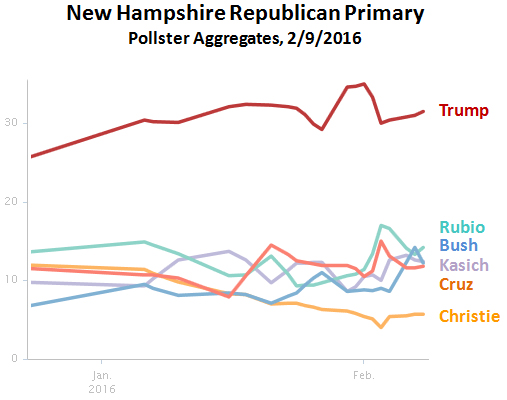
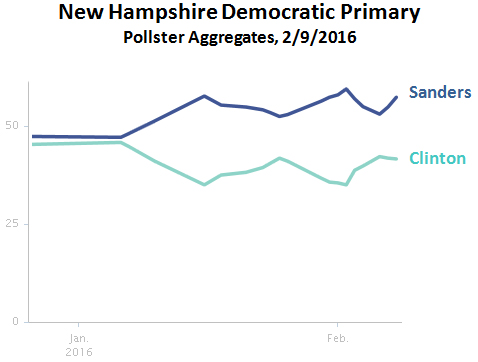
It’s our first primary of 2016! To get you in the mood, here are the final Pollster aggregates for the Republican and Democratic races. Trump and Sanders both look like easy winners, so all the action is for second place. If Clinton pulls within 10 points, she’ll probably declare victory and skedaddle down to South Carolina as fast as she can. The Republicans have a huge pileup in second place, so it should be quite the spectacle watching them all spin the results tonight.
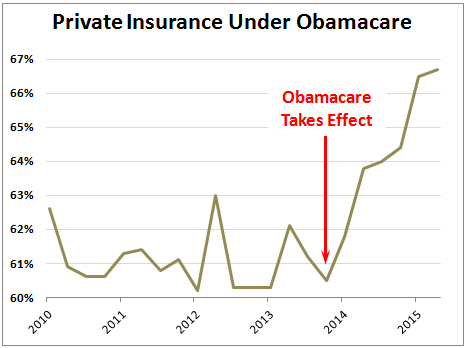
I’ve mentioned this in passing a couple of times, but it really deserves a short post of its own. We’ve heard a lot about Obamacare not meeting the original enrollment projections published by the CBO in 2010, but those aren’t the only projections that CBO published. They also predicted that Obamacare would lead to the loss of 8 million people from private insurance coverage by 2016.
But that didn’t happen. Thanks to Obamacare’s individual mandate spurring the purchase of individual coverage and its employer mandate spurring an increase in employer coverage, total private coverage increased by more than 16 million through the middle of 2015. The chart on the right tells the story. After four years of private coverage hovering around 61 percent of the population, it jumped up to 66 percent within the space of a single year.
Was this due to the economic recovery? Probably a bit of it. But the economy has been puttering along at about the same pace ever since 2012. The only thing that changed in the fourth quarter of 2013 was the introduction of Obamacare.
Bottom line: Obamacare may have missed CBO’s target for exchange enrollment by 7 million or so, but much of this is because it beat CBO’s target for private insurance by 24 million. This is great news all around since we’d always prefer having people insured by their employer rather than buying through the exchange. It’s better coverage and it costs the taxpayers less. On any measure you can think of, this is a huge and undercovered success story.
Oh hell, now I’m just starting to feel sorry for Marco Rubio. The whole Marcobot thing has apparently made him so self-conscious that he can barely even recite his stump speech anymore without getting flustered. Here he is delivering a line about values being rammed down our throats right after he’s just said it. There’s an almost poignant moment at 0:26 when Rubio suddenly realizes what he’s just done.
This reminds me of a Star Trek episode where Kirk uses some kind of sophomoric paradox to trick a computer into self destructing. That’s about what Chris Christie seems to have done to Rubio.
Nothing says “I care about poor people” like driving to a new housing project on a red carpet 2.5 miles long. Amirite? But this has a secret subtext: When Egyptian president Abdel-Fatah al-Sisi motored his way to a grand opening ceremony Saturday on a carpet this size, it was apparently a sign that the military is pleased with him. I guess the more they like you, the longer the carpet:
Brig Gen Ehab el-Ahwagy explained on several talk shows on Sunday night that the carpet was not purchased by Sisi’s administration and the same one had been used for more than three years for similar occasions.
“It gives a kind of joy and assurance to the Egyptian citizen that our people and our land and our armed forces are always capable of organising anything in a proper manner,” Ahwagy told the TV talk show host Amr Adeeb. “It is laid out in a way to beautify the general area, so it gives a good impression of the celebration that is being broadcast to the whole world.”
See? No big deal. And certainly no reason to postpone a speech warning that Egypt is in dire financial trouble and will soon have to stop subsidizing water and electricity bills for low-income families.
The world seems to be awash in teensy little pieces of social science research that are (1) possibly fascinating but (2) also possibly meaningless. Roberto Ferdman points us to one today that suggests winning makes you more likely to cheat in the future. The participants, as usual, are a small number of university students.
Our eager young test monkeys were broken into pairs and then competed in a task. The winners were determined randomly, though the participants didn’t know that. Then they went on to round 2, where they threw a pair of dice. The details are unimportant except for these: (1) the higher the throw the better, and (2) it was pretty easy to cheat since no one could see the dice except the thrower. The chart on the right shows the basic result. The average throw should be 7, and in the control group that’s what it was. In the test group, winners obviously cheated since their average throw was much higher than 7. Losers either didn’t cheat or, possibly, actually underreported their throws a bit.
Why? Who knows. The authors suggest that winning creates a sense of psychological entitlement, but: “We do not claim that a sense of entitlement is the only factor that accounts for dishonest behavior following a competition. Given the complexity of the situation under study and the variety of mechanisms that drive dishonest behavior, it is likely that other mechanisms also come into play.”
So…maybe this is interesting. Maybe it’s meaningless. Maybe the authors should have run this experiment a dozen times to see if the results hold up. I’m not sure. However, it seems perfectly suited for drawing sweeping conclusions about the American psyche1—maybe David Brooks can do something with this?—and that alone makes it worth writing about.
1Shhh. Don’t tell anyone the study was done at an Israeli university.
There’s not really any way of telling whether the Marcobot meme is hurting Marco Rubio. There was a little bit of polling yesterday, but not enough to show anything serious. Still, for what it’s worth, here’s the penultimate Pollster aggregate before tomorrow’s primary. Really, there hasn’t been a whole lot of movement at all over the past month or so. Rubio got a bit of a bump from his Iowa performance, but that’s about it. Tune in tomorrow for the exciting conclusion, after which we can all go back to forgetting New Hampshire exists.
Hillary Clinton has received a lot of campaign money from the financial industry over the years, and after she left the State Department she gave several lucrative speeches to Goldman Sachs and other big banks. As Michael Hirsh puts it, this has given her a reputation for being “more than a little cozy” with Wall Street.
But is she? The truth is that I haven’t paid much attention to this question. In terms of the presidential campaign, it’s pretty obvious that Bernie Sanders is a lot tougher on the financial industry than she is. The details of their plans don’t really matter. Sanders has practically made a career out of attacking Wall Street. As president, he’d make financial regulation a top priority; he’d appoint tougher watchdogs; and he’d use the bully pulpit relentlessly to call out Wall Street’s sins.
Still, what about Clinton? How cozy with the financial industry is she? I asked about this on Twitter over the weekend, figuring that all the Bernie supporters would give me an earful. But no such luck. Mostly they just told me that she had taken Wall Street money and given Wall Street speeches. The only concrete criticism was one that Elizabeth Warren made in 2004: that Clinton had changed her view on the bankruptcy bill after she accepted lots of Wall Street money to get elected to the Senate.
But that didn’t really hold water. She opposed the bill in 1999 because she wanted alimony and child-support payments to take precedence over credit card companies during bankruptcy proceeding. The bill passed anyway, but Bill Clinton vetoed it. In 2001, she brokered a compromise that gave priority to alimony and child support, and then voted for the bill. It didn’t pass at the time, and in 2005 her compromise was removed from the bill. She said then that she opposed it.
This is classic Hillary. Once George Bush was president, she had no way of stopping the bill—so she worked hard behind the scenes to get what she could in return for her vote. Love it or hate it, this is the kind of pragmatic politics she practices. But there’s no hypocrisy here; no change of heart thanks to Wall Street money (she supported the bill when it protected women and children and opposed it when it didn’t); and no real support for the financial industry.
What else? Clinton says she gave several speeches in 2007 warning about the dangers of derivatives and subprime loans, and introduced proposals for stronger financial oversight. Apparently that’s true. I’m not aware if she took a stand on the repeal of Glass-Steagall in 1999, but I don’t think this was responsible for the financial crisis and wouldn’t hold it against her either way. (And it was supported by nearly the entire Democratic Party at the time.) The CFMA did make the financial crisis worse, but Bernie Sanders himself supported it. Clinton voted for Sarbanes-Oxley, but everyone else did too.
Clinton has consistently supported increasing the minimum wage—though not to $15. She supported the Lilly Ledbetter Act. She supports higher taxes on the wealthy. She supported repeal of the carried interest loophole in 2007. The Boston Globe, after an extensive review of her voting record in the Senate, summed up her attitude with this quote from a lobbyist: “The financial sector viewed her as neutral. Not helpful, but also not harmful.” Citizens for Tax Justice gives her a generally favorable grade on financial issues.
The word “cozy” does a whole lot of heavy lifting in stories about Hillary Clinton and Wall Street. But what does it mean? Does she have an actual record of supporting Wall Street interests? By ordinary standards, is her current campaign proposal for financial regulation a strong one? (I’ve been impressed by her rhetorical emphasis on shadow banking, but it’s not clear just how far her proposals go in real life.) Has she protected financial interests against the Bernie Sanders of the world?
I think it’s safe to say that Clinton has hardly been a scourge of the banking industry. Until recently, her main interests were elsewhere. But if there’s a strong case to be made for “coziness,” I’ve failed to find it. Anyone care to point me in the right direction?
A few weeks ago I had lunch at my favorite diner and I asked what kind of oil they cooked their fries in. Corn oil, it turns out. But the owner of the place happened to be standing right there, and with no prompting he immediately grokked why I was asking:
Nobody makes fries the old way anymore. They used to be so good. These days—phhht. There’s no taste at all. But everybody got afraid of the health stuff, so it’s all vegetable oil now.
The fries at this place range from good to spectacular depending on the whims of the deep fryer, so it’s not impossible to get tasty fries from corn oil. Still, fries made in beef tallow—or a mixed oil that includes animal fat of some kind—are unquestionably better. So why hasn’t anyone picked up on this? There’s plenty of evidence suggesting that fries cooked in animal fat might be no worse for you than fries cooked in vegetable oil, and even if this is wrong there should still be a market for an “artisanal fries” menu item or some such. Upscale burger places are forever looking for ways to differentiate themselves for the foodie crowd, so why not this? I’d buy them.
It’s a mystery. Nobody should be afraid of some occasional fries cooked in animal fat. And if you are, nobody is going to take away your bland canola oil fries anyway. Someone needs to get on this bandwagon. Who will do it first?
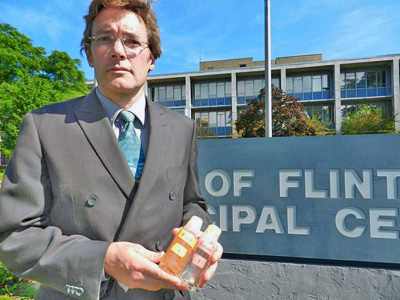
Marc Edwards, the Virginia Tech scientist who uncovered the lead poisoning in Flint, is absolutely brutal about the way funding priorities have corrupted academic science:
We’re all on this hedonistic treadmill — pursuing funding, pursuing fame, pursuing h-index — and the idea of science as a public good is being lost. This is something that I’m upset about deeply. I’ve kind of dedicated my career to try to raise awareness about this. I’m losing a lot of friends.
….Q. Do you have any sense that perverse incentive structures prevented scientists from exposing the problem in Flint sooner?
A. Yes, I do. In Flint the agencies paid to protect these people weren’t solving the problem. They were the problem….I don’t blame anyone, because I know the culture of academia. You are your funding network as a professor. You can destroy that network that took you 25 years to build with one word. I’ve done it.
….Q. Now that your hypothesis has been vindicated, and the government has its tail between its legs, a lot of researchers are interested.
A. And I hope that they’re interested for the right reasons. But there’s now money — a lot of money — on the table….The expectation is that there’s tens if not hundreds of millions of dollars that are going to be made available by these agencies….I hate to sound cynical about it. I know these folks have good intentions. But it doesn’t change the fact that, Where were we as academics for all this time before it became financially in our interest to help? Where were we?
….Q. When is it appropriate for academics to be skeptical of an official narrative when that narrative is coming from scientific authorities? Surely the answer can’t be “all of the time.”
I grew up worshiping at the altar of science, and in my wildest dreams I never thought scientists would behave this way….Science should be about pursuing the truth and helping people. If you’re doing it for any other reason, you really ought to question your motives.
Unfortunately, in general, academic research and scientists in this country are no longer deserving of the public trust. We’re not.
In academia these day—and especially in the hard sciences, which are expensive to support—funding is everything. To a large extent, at big research universities faculty members basically work on commission: they have to bring in enough money to pay their own salaries and bankroll their own labs. And when was the last time a salesman on commission badmouthed his own product?
On Twitter, the big outrage over the past few days has been the news that the corporate suits are planning to change the way your Twitter feed works. Instead of simply listing every tweet from your followers in real time, they’ll be rolling out an algorithm that reorders tweets “based on what Twitter’s algorithm thinks people most want to see.” This is something Facebook has been doing for years.
Power users are apoplectic, despite the fact that it’s not clear what’s really going on. A developer at Twitter hit back with this: “Seriously people. We aren’t idiots. Quit speculating about how we’re going to ‘ruin Twitter.'” Nor is it clear when this is really going to roll out. And the rumors suggest that it will be an opt-in feature anyway. Chronological timelines will still be around for everyone who wants them.
In any case, I’d suggest everyone give this a chance. Computer users, ironically, are notoriously change averse, which might be blinding a lot of us to the fact that chronological timelines aren’t exactly the greatest invention since the yellow first down line. Maybe we really do need something better. More generally, here are a few arguments in favor of waiting to see how this all plays out:
I’m a semi-power user. I don’t write a lot on Twitter,1 but I read it a lot. Still, I have a job and a life, and I don’t check it obsessively. And even though I follow a mere 200 people, all it takes is 15 minutes to make it nearly impossible to catch up with what’s going on. Being on the West Coast makes this an especial problem in the morning. A smart robot that helped solve this problem could be pretty handy, even for those of us who are experts and generally prefer a real-time feed.
One of my most common frustrations is coming back to the computer after a break and seeing lots of cryptic references to some new outrage or other. What I’d really like is a “WTF is this all about?” button. An algorithmic feed could be a useful version of this.
As plenty of people have noted, Twitter is a sexist, racist, misogynistic cesspool. There are things Twitter could do about this, but I suspect they’re limited as long as we rely on an unfiltered chronological timeline. Once an algorithm is introduced, it might well be possible to personalize your timeline in ways that clean up Twitter immensely. (Or that allow Twitter to clean it up centrally—though this obviously needs to be done with a lot of care.)
One of the most persuasive complaints about the algorithm is that it’s likely to favor the interests of advertisers more than users. Maybe so. Unfortunately, Twitter famously doesn’t seem able to find a profitable business model. But if we like Twitter, the first order of business is for it to stay in existence—and that means it needs to make money. This is almost certain to be annoying no matter how Twitter manages to do it. A good algorithm might actually be the least annoying way of accomplishing this.
Needless to say, all of this depends on how good the algorithm is. It better be pretty good, and it better improve over time.
So….stay cool, everyone. Maybe this will be an epic, New Coke style disaster that will end up as a case study in business texts for years. It wouldn’t be the first time. Then again, maybe the algorithm will be subtle, useful, and optional. I’ll be curious to try it out, myself.
1Arguments on Twitter are possibly the stupidest waste of time ever invented. Everything that’s bad about arguments in the first place is magnified tenfold by the 140-character limit. It’s hard to imagine that anyone other than a psychopath has ever emerged from a Twitter war thinking “That was great! I really learned something today.”
And we respect that! But maybe you’re of a mind to support our work directly instead? We have until December 31 to raise the last $400,000 we need to keep our nonprofit newsroom running at full strength into 2026. Will you make a gift today?
We noticed you have an ad blocker on. Can you pitch in a few bucks to help fund Mother Jones' investigative journalism?
Billionaires own the media,
but they don’t own us.
At Mother Jones we know these aren’t conventional times, and they require unconventional coverage. That’s what deliver every day: fierce, independent journalism you can’t find elsewhere. Perhaps never in the history of our country has that been more necessary than now. But we can’t do it without reader support—your support. Please chip in today.
Billionaires own the media,
but they don’t own us.
At Mother Jones we know these aren’t conventional times, and they require unconventional coverage. That’s what deliver every day: fierce, independent journalism you can’t find elsewhere. Perhaps never in the history of our country has that been more necessary than now. But we can’t do it without reader support—your support. Please chip in today.

 They also predicted that Obamacare would
  opening ceremony Saturday on a carpet this size, it was apparently a sign that the military is pleased with him. I guess the more they like you,
  higher the throw the better, and (2) it was pretty easy to cheat since no one could see the dice except the thrower. The chart on the right shows the basic result. The average throw should be 7, and in the control group that’s what it was. In the test group, winners obviously cheated since their average throw was much higher than 7. Losers either didn’t cheat or, possibly, actually underreported their throws a bit.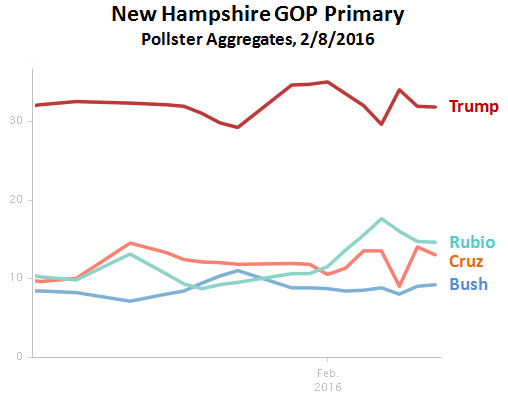
 stuff, so it’s all vegetable oil now.
 try to raise awareness about this. I’m losing a lot of friends.
 thinks people most want to see.” This is something Facebook has been doing for years.



