• Medicare Premiums Set to Soar for Small Group of Unlucky Seniors


    The New York Times reports today that Medicare premiums may soar next year even though inflation is low and medical costs have been relatively tame.

    Why? Well, Medicare actuaries predict that Part B spending is expected to go up a bit more than they initially projected, and premiums are supposed to cover one-fourth of spending. However, for 70 percent of Medicare recipients premiums are linked to Social Security benefits, which are not expected to rise at all thanks to low inflation. This means that the entire burden of paying for the increased spending will fall on the other 30 percent of Medicare recipients. For these people, premiums will rise $648 in 2016.

    That’s a lot of money for someone living on $15,000 per year. So what are we going to do about it?

    The cost of avoiding such big premium increases, $7.5 billion by some estimates, could be a problem for conservative Republicans. Aides to Mr. Boehner have told Ms. Pelosi’s staff members that the cost would have to be offset by savings elsewhere in the federal budget….Republicans worry that Democrats will depict them as waging a “war on seniors” if they do not go along with legislation to soften the effect of any premium increase, perhaps by using general revenue to plug the gap. A struggle over Medicare would add to fights expected this fall over legislation to raise the federal debt ceiling, prevent a government shutdown and keep money flowing for highway projects.

    In other words, the usual: we’ll squabble over it like small children and then eventually patch together some kind of half-assed solution after Republicans threaten to hold their collective breaths until their faces turn blue. That’s American exceptionalism, baby.

  • Health Update


    Just a minor bit of good news today. The worst side effect1 of my current chemo regimen is that it depresses my immune system. And sure enough, after I started taking it my neutrophil count dropped from 4300 to 2600 to 1800. If it keeps going down it’s going to start causing problems. But even though I’ve increased the dose of the chemo med, yesterday’s labs returned a neutrophil count of 1900, about the same as last month. So maybe it’s going to stabilize there. Hooray!

    Also: I feel fine. Energy is fine, sleep is fine, breathing is fine, and my back is (almost) fine. For the time being, everything is fine.

    1Assuming I don’t get one of those blood clots the big black box warns about, of course.

  • Four Questions Democrats Can’t Answer


    Here are four questions for Democrats that have no good answers:

    What are you going to do about Syria? There is no plausible way of making substantial gains in Syria without committing to a full-scale invasion. And even that might not work. Like it or not, the real answer is that none of the candidates are going to do much about Syria.

    How are you going to get a Republican Congress to cooperate with you? This isn’t going to happen in any big way. It just isn’t. There are some small-ball deals to be made, and even those are going to require a lot of grinding. Unfortunately this doesn’t make a very inspiring campaign message.

    How do we get Vladimir Putin to back off? The same way you get Donald Trump to stop talking: you don’t. We’re already doing nearly everything we can to pressure Putin short of going to war, and we’re winning. Putin is desperate for some kind of victory, and nothing is going to stop him from occasional military adventures that are showy and impressive on the surface but fall apart if you dig half an inch down.

    Why do you want to be president? The real answer is: to preserve Obamacare and prevent a Republican from appointing the next Supreme Court justice. Any other answer is just so much blah blah blah.

    This has been News You Can Use for your post-debate consideration.

  • High-Deductible Health Plans Don’t Seem to Encourage Price Shopping


    Sarah Kliff points today to a new paper that investigates the effect of high-deductible health plans. In theory, since these plans require people to spend more of their own money, it should motivate them to shop around for better prices. But that’s not how things turned out.

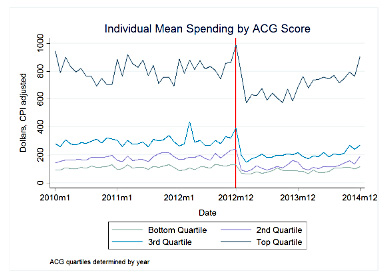
    The chart on the right shows what happened when a large firm forced all of its employees to switch from an insurance plan that provided free health care to a high-deductible plan. At first, spending on medical care dropped sharply. Over the next two years, however, it rose back nearly to its previous level. (Note: ACG is a predictive measure of sickness.) The switch to the HDP plan apparently caused a short-term shock, but over the longer term people needed whatever health care they needed. They might not have liked it, but they paid the higher prices.

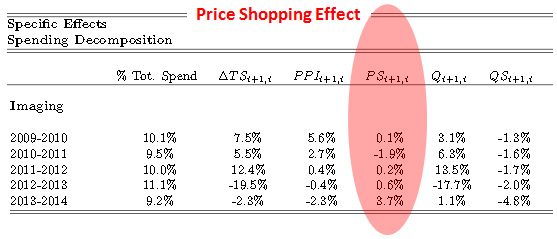
    Still, they did spend less for a while. But how much of that came from shopping for lower prices vs. simply consuming less health care? The firm provided employees with a price-comparison tool, which made it fairly easy to shop for better prices, but apparently it went virtually unused. The best evidence of this comes from spending on imaging services like X-rays and MRIs. These are commodity services, and patients aren’t likely to use a higher-priced service simply because they don’t want to switch doctors. An X-ray is an X-ray.

    But as the table below shows, price shopping accounted for barely any of the decrease in spending. Even for X-rays, most patients apparently just went wherever their doctors told them to go without shopping around at all. The researchers conclude:

    Consumers did not shift to cheaper providers, either immediately in the first year post-switch or afterwards in the second year….Price shopping is not an important component of the spending reductions resulting from the switch to high-deductible care.

    It’s possible, of course, that two years isn’t a long enough study period. Price shopping for medical care isn’t common, and it was especially uncommon at this firm, which had previously provided completely free health care. As usual then, more study is needed. But this is a pessimistic result for those who think that forcing consumers to pay for health care with their own money will motivate them to shop for better prices. It doesn’t seem to. Sarah Kliff has much more discussion of what this means at the link.

  • A Closer Look At Alabama’s Driver License Office Closures


    I haven’t paid a lot of attention to the outrage over Alabama’s closure of 31 driver license offices in 30 of its counties, but Bob Somerby says the prevailing liberal wisdom is a crock. The story is that Alabama closed offices in predominantly black counties as a way of making it harder for blacks to get driver licenses and thus making it harder for them to vote. (Alabama, naturally, has a photo ID requirement to vote.) But is that true?

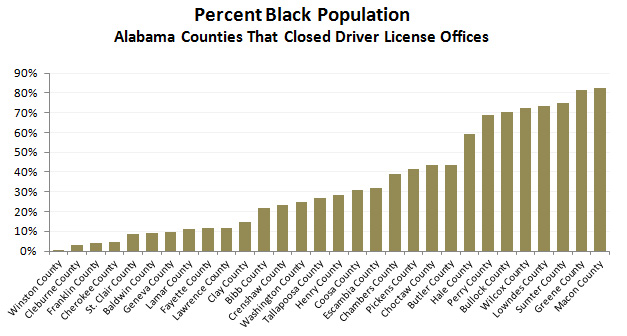
    Well, at great expense, the hardworking staff here totted up the black population of all 30 counties with closed offices. Here are the numbers:

    • Total population: 826,000
    • Total black population: 196,000
    • Percentage black population: 23.8%

    For Alabama as a whole, the population is 26.2 percent black. So it looks like Somerby is right. The black population of the affected counties is actually lower than it is for the whole state. If Alabama was deliberately trying to target blacks, they sure seem to have made a hash of it.

    Data here.

    POSTSCRIPT: There are other criticisms you can make, of course. Closing offices in small rural counties—many of which are majority black—makes it really hard to get a driver license since the nearest open office might be quite far away. At the same time, closing offices in places with very few people is also obviously sensible just in terms of constituent service. In any case, the overall impact doesn’t appear to be much heavier—if at all—on blacks than it is on whites.

  • New Study Says Sitting a Lot Won’t Kill You After All


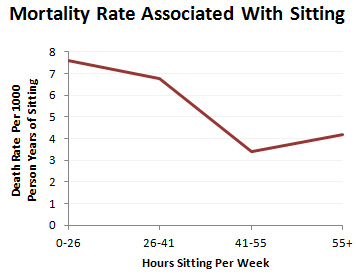
    Did you buy a standing desk because you heard that sitting too much would kill you? Or because you wanted to be like Don Rumsfeld? It doesn’t matter: a new study says sitting isn’t especially hazardous, and Rumsfeld shouldn’t be a role model for anything. The chart on the right shows the basic association between more sitting and more dying: none. Nor did it matter when the authors controlled for age, gender, employment grade, ethnicity, smoking status, alcohol consumption, fruit and vegetable consumption, BMI, physical functioning, or daily walking time. “There were no associations between any of the five sitting indicators at Phase 5 and all-cause mortality risk over the follow-up period in either model 1 or 2.”

    The authors say that their sample is fairly physically active, and “it is therefore possible that the higher than average energy expenditure in the current study may offer a degree of protection from any deleterious effects of high volumes of sitting.” In other words, don’t worry about sitting too much. Just get enough exercise, period. You’ll be OK.

  • Needed: Better Debate Moderators


    Ed Kilgore notes this morning that “the media appetite for naming a clear winner has fed a post-debate trend towards labeling HRC as a gigantic, titanic, overwhelming cham-peen.” True enough, and you can blame that on a sort of self-feeding bandwagon loop among the campaign press. Still, in this case I think it’s probably justified. Sure, O’Malley did OK, and so did Sanders, but let’s face it: Nobody cares much about O’Malley, and Sanders probably didn’t change the dynamics of the race in his favor despite a decent performance. What’s more, my own personal reaction is that Sanders made it even clearer than ever that he doesn’t really want to be president. He just wants to move the race to the left.

    But the fact that Hillary did well really does matter. She showed Democrats why they’ve always liked her in the past. She showed off her debating skills. She put to rest all the Benghazi/email nonsense. She almost certainly halted her slide in the polls. She basically made herself the inevitable winner yet again. Plus this:

    And that leads to the aspect of the debate that struck me apparently more than most observers: the exceptional hostility of the questioning from moderator Anderson Cooper, who seemed to be trying to defy expectations that he’d be less savage than Jake Tapper was in CNN’s GOP debate. Pretty quickly, Cooper became a stand-in for all the media folk trying to make the Democratic contest about emails and Benghazi! and “socialism,” and you got the sense the candidates and the immediate audience united in disdain for the superficiality of where the hosts wanted the discussion to go. The feral roar that greeted Bernie Sanders’ statement that Americans were tired of “hearing about [Clinton’s] damn emails”—followed by HRC shaking Bernie’s hand—was the signature moment of the night. And this wasn’t just some “gift” from Sanders to Clinton, as it was called by several talking heads last night. It was a party-wide rebuke to the MSM for how they are covering this campaign.

    I didn’t get the sense that Cooper was especially hostile. But Kilgore is right that debate moderators generally try to focus on superficial “toughness” instead of asking either genuinely tough questions or genuinely interesting policy questions. In a way, this is justified: you don’t want candidates to get away with just making stump speeches. You want to challenge them. You want to see how they perform under pressure. Unfortunately, when you take this too far it becomes obvious that you’re just desperately trying to gin up controversy for its own sake. Debate moderators need to understand that the show isn’t about them. It’s about genuinely digging out answers from candidates on subjects they might prefer to fudge. That’s genuine toughness. But that takes a deep knowledge of policy and the willingness to engage with it. That’s too often missing from these events.

  • We’re Live Blogging the First Democratic Presidential Debate of 2015


    This was a very collegial debate. There were a few shots taken, but not many, and the few that were taken were pretty mild. Is this because Democrats are nicer than Republicans? Is it because there’s no Donald Trump in this debate? No. I think it’s because no one on the stage truly believes they can beat Hillary Clinton. So why bother making enemies?

    Here’s how I think everyone did:

    Lincoln Chafee had an odd, stuttering style of speech, and failed to distinguish himself at all. His lame excuse for voting to repeal Glass-Steagall will haunt him. He needs to drop out.

    Jim Webb did better than Chafee, but also failed to distinguish himself. His main themes were China bashing and Wall Street bashing. But Hillary Clinton has a plenty tough reputation on foreign policy, and Bernie Sanders obviously has Webb beat on hating Wall Street. So what’s the point of voting for him?

    Martin O’Malley did pretty well. He has a nice affect, and he gave pretty solid answers, even if he did mention “a clean electric grid by 2050” a wee bit too often. He’ll probably improve his poll standing just by virtue of not imploding, but only by a little bit.

    Bernie Sanders was fine, but he didn’t say anything that would change anyone’s mind about him. If you want the most dovish candidate on foreign policy and the most hawkish candidate on Wall Street, he’s your man. But everyone knew that before. I don’t think he’ll lose any support, but it’s hard to see this performance gaining him any.
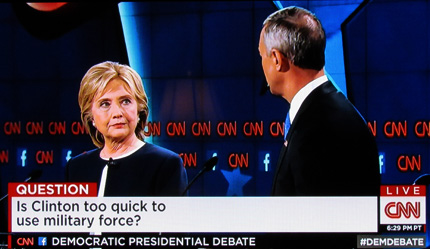
    Hillary Clinton was very polished. She obviously benefited from the reluctance of everyone else to really attack her, especially over the email server affair. She scored a few points against Sanders, but they were done lightly enough to draw a useful contrast without making her seem nasty. I don’t think she made any mistakes, and she came across as reasonable and well briefed. She benefited from the obvious fact that others on the stage respected her and the audience liked her. There was very little focus on her negatives (the email server, Benghazi, trustworthiness, etc.). At the very least, this will keep her poll numbers from sliding any further. My guess is that she’ll gain a little ground.

    Overall, it’s hard to see this debate changing the dynamics of the race by much. There were no big blunders, no memorable zingers, and no sharp attacks. FWIW, I’ll predict a small bounce for Clinton and O’Malley, and that’s about it.

    Transcript here.


    Soon this space will be filled with lively banter about the first Democratic debate of the year. Come back a little before 8:30 Eastern and the festivities will begin.

    10:55 – It’s fun question time! What enemy are you most proud of? Chafee: coal lobby. O’Malley: the NRA. Clinton: health insurance companies, drug companies, Iranians, Republicans. Sanders: Wall Street. Webb: the enemy soldier who wounded me.

    10:49 – Sanders: The only way to get things done is by having millions of people come together. Meh. But there’s no real answer to the question of how to get Republicans to cooperate about anything, so I suppose it’s as good an answer as any.

    10:46 – Clinton not willing to take a stand on legalizing marijuana. Wants to wait and see how things work out in Colorado and Washington.

    10:45 – Sanders says he “suspects” he would vote for Nevada initiative to legalize recreational marijuana.

    10:43 – Some good Republican bashing from Clinton. Lotsa cheers. It’s only Rs who say we can’t have nice things. Everyone else agrees.

    10:39 – Everyone wants to address climate change except for Jim Webb, who prefers a bit of China bashing instead.

    10:29 – What’s the one Obama policy you’d change? Chafee: end the wars. O’Malley: rein in big banks. Clinton: I’d be female. Wants to “build on” Obama’s successes. Sanders: need to make government work for all of us, not just millionaires. Webb: less executive authority.

    10:17 – Hillary: Republicans suck on immigration.

    10:15 – There’s been very little in the way of even weak attacks on other candidates. It’s not quite a lovefest, but close.

    10:08 – Chafee is defending his vote to repeal Glass-Steagall by saying he had just entered the Senate and his father had died. OMG.

    10:07 – Minnows like Webb should stop whining about not getting enough time. If it were up to me, he wouldn’t even be on the stage.

    10:03 – Clinton obliquely refers to shadow banking again. Would love to hear more detail about that.

    10:02 – Clinton “went to Wall Street” in 2007 and told them to “cut it out.” I guess that didn’t work.

    10:01 – Clinton talks about shadow banking. Good for her. Not sure what she’d actually do about it, though.

    10:00 – O’Malley wants to reinstate Glass-Steagall. That’s a weak idea for reining in big banks.

    9:58 – Cooper is now just inviting candidates to give a 1-minute version of their stump speeches.

    9:52 – Cooper: “Do you want to respond?” Clinton: “No.” I guess that shows how much she cares about Lincoln Chafee.

    9:49 – Sanders naturally agrees with Clinton. Nobody wants to give the Benghazi committee any legitimacy. “Let’s talk about the real issues.” Huge cheers. Hillary and Bernie practically hug each other.
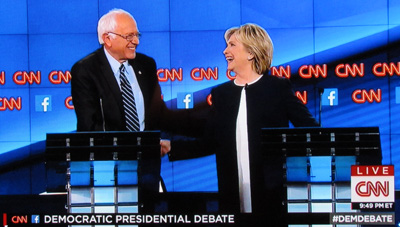
    9:46 – Clinton: the Benghazi committee is just a partisan attempt to bring down her poll numbers. Big cheers.

    9:44 – What is the biggest threat to America’s national security? Chafee: chaos in the Middle East. O’Malley: nuclear Iran. Clinton: nuclear weapons. Sanders: climate change. Webb: China, cybersecurity.

    9:38 – O’Malley: we need better humint. Yeah, yeah. Everyone wants better humint. How do you plan to get that?

    9:34 – Webb is really eager to denounce China. He probably could have waited.

    9:32 – Clinton: “I’m in the middle here.”

    9:26 – Hillary’s response to voting for Iraq war: Obama values her judgment. Interesting attempt to tie herself to Obama, who’s pretty damn popular in this hall.

    9:23 – Sanders: Syria is a “quagmire in a quagmire.” I’d probably add one more quagmire to that, but he has the right idea.

    9:21 – Chafee wants to talk to Wayne LaPierre in order to “find common ground” on gun control. Good luck with that.

    9:16 – Hmmm. Hillary was pretty tough on Sanders’s stand on gun control. A sign of things to come?

    9:11 – O’Malley’s speaking style is oddly warbly.

    9:07 – Cooper after asking Sanders about democratic socialism: “Anyone else on this stage not a capitalist?” Hillary barges in. She loves Denmark and small businesses, but hates rising income inequality.

    9:04 – Sanders: “We need to learn from Denmark, Sweden, and Norway.”

    9:02 – “Some people say you’re….” This is the worst possible kind of question. Vague and trivially easy to answer. Hillary is having no problem with accusations of flip flopping.

    8:59 – I guess we’re all agreed: the middle class is really important.

    8:48 – Chafee: “I have high ethical standards.” Good to know.

    8:43 – Is it just me, or was that a pretty bad rendition of the national anthem? Just me, I suppose.

    8:38 – Is this intro meant to be a parody?

    8:36 – Marian won’t be joining me tonight. She’s watching the ballgame instead. Smart.

    8:35 – I think this debate is scheduled to last two hours, but I don’t know for sure. Apparently it’s a state secret. But I read a few items saying that CNN had decided to cut it from 3 hours to 2.

    8:32 – ZOMG, Joe Biden appeared in the background a couple of times in Obama’s prerecorded message! What does it mean?

    8:28 – Wolf says that President Obama might watch some of the debate!

  • Yes, Americans Have Become More Ideologically Polarized (Since 1994)


    Over at the Monkey Cage, political scientists Seth Hill and Chris Tausanovitch argue that despite what it looks like, the American public hasn’t actually gotten more polarized over the past 50 or 60 years. Lawmakers have, but ordinary citizens haven’t.

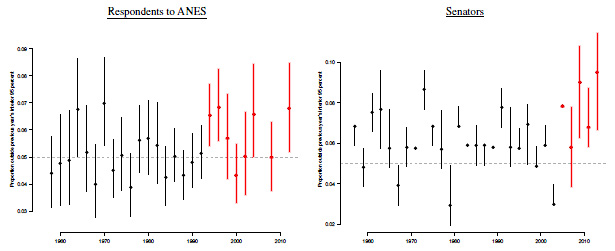
    But I’m not sure their own data backs this up. Unfortunately, the chart I want to talk about is a little complicated, so bear with me. The authors measure polarization by looking at answers to questions on the American National Election Studies survey, which is conducted every two years. In the chart below, they look at what percentage of respondents are as extreme as the most extreme 5 percent from the previous survey. If it’s 5 percent, then nothing has changed. If it’s 6 percent, then the relative number of extremists has gone up. Here’s the chart:

    The thing to notice is that these changes are cumulative because each year is measured relative to the previous survey. Take a look at the left-hand chart, which measures the polarization of ordinary people. Just by eyeballing and adding up the differences from 5 percent,1 I get a cumulative change of +0.7 percent between 1956 and 1992. That’s a change of +0.02 percent per year, which is virtually nothing.

    But if you add up the years between 1994 and 2012 (in red), you get a cumulative change of about 6.6 percent. That’s a change of +0.4 percent per year.

    For senators, the story is a little different. They’ve been getting steadily more polarized all along, but in 2004 the changes get much bigger, with no low points and certainly no negative points.

    But it’s ordinary people that I want to focus on. The authors look at the entire period from 1956-2012 and see little evidence of increased polarization. I think this misreads things. There’s little evidence of consistently increasing polarization through 1992. But starting in 1994, which coincides with the Gingrich revolution, polarization gets steadily stronger. (For some reason there’s no data for 2006 and 2010, but I suspect those are years of increasing polarization anyway.) It may be true that Congress has gotten even more polarized than the public—partly because of ideological sorting and partly because politicians tend to take politics more seriously—but ever since 1994 the public has indeed been getting more polarized too.

    1This is not the right way to measure cumulative change, but it’s good enough to make my point. I think you’d see the same thing if you did the arithmetic correctly.

  • Here’s What to Really Expect in Tonight’s Democratic Debate

    Kevin E. Schmidt/ZUMA


    I assume you all know this by now, but the first Democratic debate is tonight. It starts at 8:30 pm Eastern on CNN, and I gather that it’s scheduled to go two hours. It was originally going to last three hours—which is flatly insane—but apparently CNN got an earful after the endless slog of the last Republican debate and decided to take pity on us all.

    So what can we expect? Really expect? My guesses:

    • The highest polling candidate will be in the center and the lowest polling candidates at the edges. Fox News seems to have set a permanent precedent here.
    • Hillary Clinton will of course get a question or 10 about her email server. She’ll give a standard scripted reply, and the others will all shuffle around nervously when asked to respond. They’d love to take a shot at Hillary, but they’ll be reluctant to look like they’re stooges for Republican conspiracy theories.
    • Bernie Sanders will be asked if he’s really a socialist. Sigh.
    • Jim Webb and Lincoln Chafee will both be asked some version of “Why are you here?” This is actually a fair question since neither seems to be running a serious campaign and neither has even the slightest chance of winning.
    • There will be some kind of question about Joe Biden. Everyone will insist that they love Joe and have nothing but the highest regard for him.
    • There will probably be some kind of question that dutifully inventories all the conservative complaints about Obamacare and asks what the candidates are going to do about them.
    • They’ll be asked about Syria, of course. This is an unsolvable problem,1 so no one will offer up anything worthwhile.
    • Hillary will get asked if Bill is a problem for her.
    • We’ll be treated once again to a “fun” question. God only knows what it will be. Favorite song? Craziest Republican? Person they’d like to see on the 10 ruble note?

    Anyway, I’ll be liveblogging it. The thought fills me with dread, but I know that when the time comes, I’ll be there. I’ll hate myself for it, but I’ll do it.

    1We are opposed to Assad, ISIS, and all the al-Qaeda supported rebel groups in Syria. This is bipartisan, not something unique to President Obama. This means the only groups we support are “moderate” Syrian rebels who are willing to fight ISIS, not Assad. As near as I can tell, such groups basically don’t exist and never have.