Overall crime fell to an all-time low in Long Island’s Suffolk County last year….The 19,877 crime incidents reported in 2016 were down 5.7% from the previous year’s 21,076 crime incidents and represented the fewest since the department began tracking them in 1975….Violent-crime incidents, including murder, rape, robbery and aggravated assault, fell by 10.9%.
Crime in Long Island’s Nassau County fell to its lowest level in at least 50 years, according to statistics released Thursday….The Nassau County Police Department said the 26,153 crime incidents reported in 2016 were down nearly 2% from the previous year. Major-crime incidents, including murder, rape, robbery and assault, fell 9%.
And here is Donald Trump today speaking in Long Island:
Peaceful Long Island neighborhoods have become “blood-stained killing fields,” says @POTUS. “They’re animals.” pic.twitter.com/IJPbfWAfqj
I’m all in favor of taking down the MS-13 gang, although this is something that’s been a priority for many years already. But no, despite the presence of MS-13 on Long Island, it’s not a blood-stained killing field. In fact, it’s a pretty safe place that can boast of an all-time low crime rate. Trump, as usual, is just being Trump.
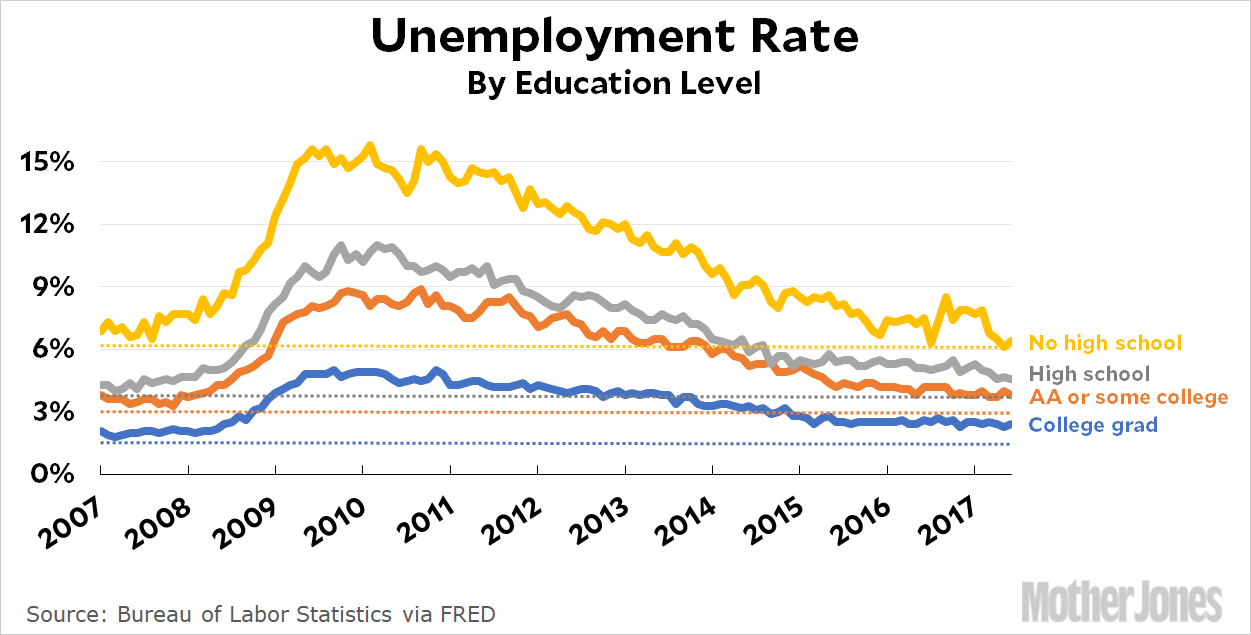
This shows the unemployment rate by education level starting at its low point in 2007 and going through today. For high school dropouts, unemployment is now the same as it was at the top of the housing boom. However, unemployment for everyone else is still about half a point higher than it was in 2007. This suggests that despite the headline unemployment rate being at its 2007 low, there’s still some labor slack in the system.
So how is it that the headline number is the same as it was in 2007 but its constituent parts are higher? It’s all about demographics and disaggregation. There are more college grads and high school grads than there were ten years ago, and they bring down the overall number. However, if you disaggregate, you find that we still have a little ways to go before we truly reach 2007 levels. If you’re interested, there’s more about how disaggregation works here.
I don’t imagine this will make Mitch McConnell feel any better, but McCain, Murkowski, and Collins didn’t kill health care reform. They just put it out of its misery a little sooner so the Senate could move on to other things.
If the skinny repeal bill had passed, the Senate would have spent the next month or two in negotiations with the House. I doubt they could have come up with anything that met the parliamentarian’s requirements and was still acceptable to the House, but maybe they could have. If they did, the result would have inevitably been even more horrendous than the bill that had already failed 43-57. There’s virtually no chance a conference bill could have passed the full Senate.
The last week has made it clear that Obamacare repeal was doomed. John McCain probably understood that and did McConnell a favor by killing it now. I don’t imagine McConnell sees it that way, though.
I was too pessimistic about Obamacare. The Medicaid expansion — despite Roberts and the evil Republican governors — was very good. The insurance regulations that applied across the board (coverage, pre-existing conditions, etc.) were very good. The exchanges still suck — private insurance is very expensive and not so fun to have and the subsidies are not generous enough and the magic competition doesn’t exist and poor people really wish they were just a bit more poor so they could get that sweet sweet medicaid — but for many people barely affordable shitty insurance is preferable to no insurance at all.
I don’t want to pretend that the exchanges are wonderful. They started off with a crash (remember that?). The subsidies fade out at too low an income. In some areas there aren’t many providers. The website can be difficult to navigate. The low metal levels have deductibles and copays that are too high.
And yet, this still deserves some pushback: Exchanges account for half of Obamacare. Roughly speaking, Medicaid expansion covers about 10 million people and the exchanges cover about 10 million people. At low incomes, the cost of insurance is extremely modest. For the poor, silver plans with CSR subsidies cover about 90 percent of medical expenses, which makes them more generous than most of the single-payer systems we admire so much in the rest of the world. The average subsidized cost of insurance on the exchanges is probably similar to what people in other countries pay in taxes for their universal systems, and the income limits on premiums prevent most people from suffering sticker shock when insurance carriers raise prices. Navigators help people choose the best coverage in their region.
Is it perfect? Nope. Does it suck? Nope. Overall, it’s pretty good. Sure, I’d prefer something simpler, but given the realities of the American health care system, private insurance is what we have to work with. If politics is the art of the possible, Obamacare does a pretty damn good job of delivering what’s possible.
Unfortunately, it turns out there is one fatal problem with the exchanges: they can be sabotaged pretty easily by Republicans. Doing this is so unnecessarily cruel to the poor and working class that I can hardly blame Democrats for not foreseeing this problem, but there you have it. Sabotaging Medicaid is hard, but sabotaging the exchanges is easy. And Republicans have given every indication that this is exactly what they plan to do. Their bitterness over a successful law that helps 20 million people is seemingly without bounds.
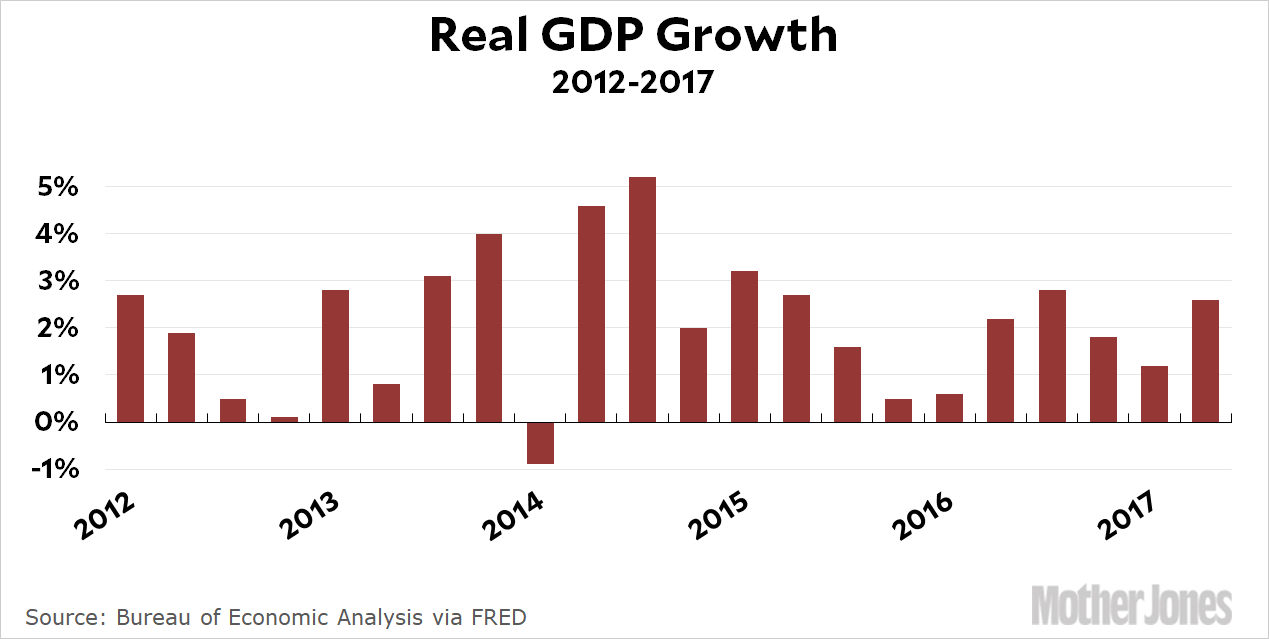
The economy grew 2.6 percent in the second quarter of 2017, slightly better than the average of 2.1 percent over the past four years. Federal expenditures contributed more than usual, especially increases in defense spending. Overall, however, there’s not much of a story here. It’s a decent reading, but the big picture is that the American economy continues to do OK, but not great.
The Senate has voted down the skinny repeal bill. John McCain joined Susan Collins and Lisa Murkowski as no votes, and the bill went down 49-51.
So now what? I’m not sure anyone knows. Maybe yet another bill? That doesn’t seem likely. Most likely, Obamacare repeal is dead and it’s now time to begin Operation Sabotage. One way or another, Republicans are hellbent on taking health coverage away from millions and I don’t think anything is going to stop them.
UPDATE: Mitch McConnell has just delivered a bitter speech, declaring that it’s “time to move on.” It doesn’t sound like he has any stomach for another go-round on health care. Next up are budget bills and tax reform.
Diet health care is here! The New York Times reports that Mitch McConnell has finally released his “skinny repeal” bill, and it has six provisions:
Repeals the individual mandate.
Repeals the employer mandate.
Allows states to waive Obamacare’s essential benefits.
Expands Health Savings Accounts.
Delays the medical device tax.
Forbids payments to Planned Parenthood and increases funds for community health centers.
What’s the deal here? Didn’t the Senate parliamentarian already rule that #3 and #6 don’t pass muster in a reconciliation bill and can’t be included? What am I missing? Is there some small change in wording that makes the “skinny repeal” versions of these things more directly related to taxes and spending?
Also, is this revenue neutral? #4 and #5 cost money. #3 and #6 do nothing. So are they assuming that repealing the mandates will save money? It certainly reduces the number of people who will buy insurance, which means that federal subsidies go down. On the other hand, repealing the mandates also causes premiums to go up for everyone else, which means that federal subsidies are increased. Do we know how that pencils out? Can this bill be passed without a CBO score to clear this up?
Nothing matters, I guess. Maybe tonight’s vote is, yet again, “procedural.” If so—and I can’t quite get a straight answer about that—I guess they can put anything they want in the bill. Except for one thing: several senators are worried that if this passes, the House might double-cross them. Instead of using it as a placeholder for negotiation, they might just vote on the thing and pass it into law. Paul Ryan could have cleared this up with a definitive statement this afternoon, but instead he delivered a waffly statement. There’s no honor among Republicans, I guess.
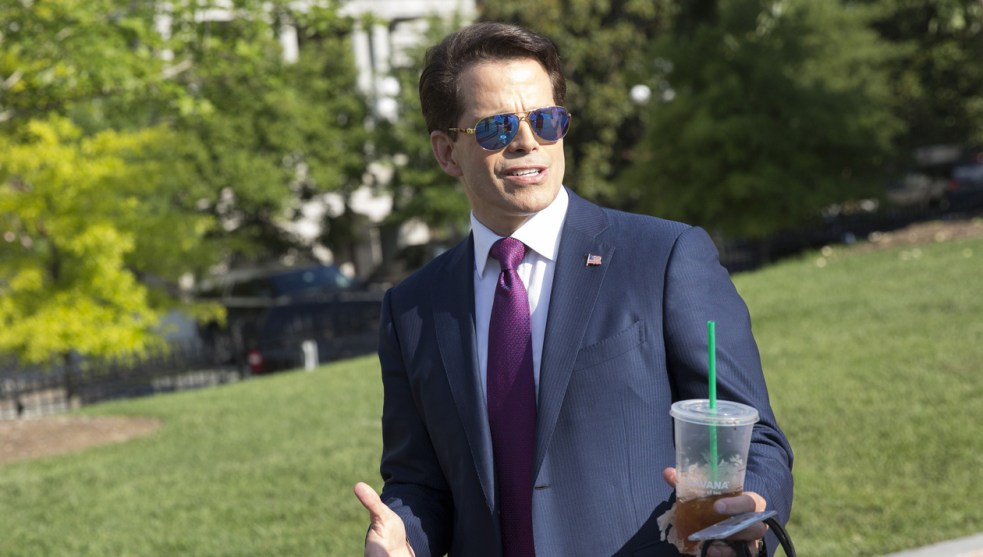
Remember when Sarah Palin came along? She was insane, but eventually her influence waned and we all breathed a sigh of relief. But then along came Donald Trump: even more insane, and he got elected president. But that’s not all. Now we have Anthony Scaramucci, Trump’s new director of communications. He might be the craziest of the lot.
Last night, Scaramucci called New Yorker reporter Ryan Lizza out of the blue to complain bitterly about Lizza’s routine tweet that Scaramucci had broken bread that evening with Trump, Sean Hannity, Bill Shine, and Melania Trump. Lizza posted the blow-by-blow today:
Who leaked that to you?” he asked. I said I couldn’t give him that information. He responded by threatening to fire the entire White House communications staff. “What I’m going to do is, I will eliminate everyone in the comms team and we’ll start over,” he said….“You’re an American citizen, this is a major catastrophe for the American country. So I’m asking you as an American patriot to give me a sense of who leaked it.”
In Scaramucci’s view, the fact that word of the dinner had reached a reporter was evidence that his rivals in the West Wing, particularly Reince Priebus, the White House chief of staff, were plotting against him….The issue, he said, was that he believed Priebus had been worried about the dinner because he hadn’t been invited. “Reince is a fucking paranoid schizophrenic, a paranoiac,” Scaramucci said. He channelled Priebus as he spoke: “ ‘Oh, Bill Shine is coming in. Let me leak the fucking thing and see if I can cock-block these people the way I cock-blocked Scaramucci for six months.’ ”
This is bugeye nuts, and it just gets weirder. There’s no point in summarizing; you need to click the link and read it for yourself. Then this morning, while Lizza was on CNN talking about the Scaramucci call, Scaramucci himself called in. He spoke with Chris Cuomo about many things, including his delusional belief that Priebus had also leaked financial information about him, and the FBI should investigate it:
CUOMO: So should the FBI or DOJ be investigating who leaked your disclosure form?
SCARAMUCCI: I don’t know. I don’t know.
CUOMO: Well, you talked to them about it, right?
SCARAMUCCI: You know why I like bringing up to the Department of Justice or the FBI, because people who have done things that are wrong, it makes them nervous, Chris. I haven’t done anything wrong so I am not nervous at all. But when people do things wrong and you mention the FBI and Department of Justice — I told the President this morning, when the iceberg hits the boat, the rats start flying up from steerage, right, because the water comes in in steerage. So, when you mention the FBI and Department of Justice, you watch how the rats lift in the boat—
Again, you really have to read the whole thing to get just how nuts it is. Or you can read Josh Marshall’s amusingly annotated version. But Scaramucci is more than just nuts. Here he is at his first press briefing a few days ago:
He’s the most competitive person I’ve ever met….He sinks 30-foot putts.
This is mostly being treated like a joke. It’s the Kim Jong-Il-ization of the president: He sets world records at Scrabble! He once hit a home run off Sandy Koufax in a pickup game! He swam to Staten Island in less than an hour!
But this is not a joke and it’s not a mistake. It was deliberate. And that’s a bigger deal than anyone is letting on. Transcripts are not supposed to be “revised” after the fact. Official White House transcripts record exactly what the person said, regardless of “what they meant to say.” Every White House has abided by that rule, including Trump’s.
Until now. And guess who’s ultimately in charge of transcripts? The White House communications director. Anthony Scaramucci. It might be wise not to fully rely on White House transcripts any more.
When politicians are working on a new policy, you’d normally expect to get a short statement of principles first, followed later on by a document that fleshes things out a bit more. Finally, as a last step before actual legislation, you’d get a white paper that outlines specific details of the new policy.
Obviously we didn’t get that from Republicans on health care, and we’re not getting it on tax reform either. As the Wall Street Journal points out, we’re getting just the opposite:
Top congressional Republicans and the Trump administration agreed to drop a plan to tax imports and exempt exports as part of their strategy to rewrite the U.S. tax code….Dropping the idea was part of a broad statement of principles released by Republicans for tax policy on Thursday.
….The new document included less detail than the president’s campaign plan, the House GOP’s June 2016 blueprint or the one-page offering from the White House in April. For instance, it makes no mention of a specific corporate tax rate or rates for individuals. It also doesn’t mention staples of GOP plans such as a higher standard deduction or estate-tax repeal, perhaps a sign that the statement doesn’t cover the breadth of where the party may yet go.
The entire statement is about the length of a blog post, and the single paragraph that actually talks about principles is less than 200 words long:
Above all, the mission of the committees is to protect American jobs and make taxes simpler, fairer, and lower for hard-working American families….We also believe there should be a lower tax rate for small businesses so they can compete with larger ones, and lower rates for all American businesses so they can compete with foreign ones. The goal is a plan that reduces tax rates as much as possible, allows unprecedented capital expensing, places a priority on permanence, and creates a system that encourages American companies to bring back jobs and profits trapped overseas….While we have debated the pro-growth benefits of border adjustability, we appreciate that there are many unknowns associated with it and have decided to set this policy aside in order to advance tax reform.
There you have it. Lower taxes for hardworking Americans, lower taxes for business, and the ability for businesses to write off 100 percent of their capital expenses in a single year. Also, the border adjustment tax is dead.
Now here’s the interesting part:
The goal is a plan that…places a priority on permanence….Our expectation is for this legislation to move through the committees this fall, under regular order.
Translated into English, this means that Republicans don’t want a ten-year tax cut like George Bush’s. They want a permanent tax cut. The problem is that with the border adjustment tax out of the picture, there’s nothing to balance the tax cuts and no way to make their tax bill revenue-neutral. It’s going to increase the deficit,¹ and that means Republicans can’t use reconciliation, as they’re doing with health care. It has to be passed under regular order, and bills require 60 votes under regular order. That means they need to corral at least eight Democratic votes in the Senate.
And yet, so far they’ve done exactly zero to get Democrats on board. The whole plan is being put together by the Big Six: four Republican members of Congress and two Republican members of Trump’s administration. So what are they planning to offer Democrats in order to get their support for this budget-buster of a bill? Anything? Or just more bluster about how Dems are obstructionists blah blah blah? We’re all eager to find out, aren’t we?
¹Demonstrating once again—as if we needed it—that Republicans only care about the deficit when a Democrat is president and the topic is spending money on the poor.
As our week drifts toward its end, a nice peaceful sunset is in order. This is an electric pylon right off the 405, a few hundred yards from my house. It just goes to show that even the ugliest artifacts of human technology can become beautiful if the sun is setting behind them.
And we respect that! But maybe you’re of a mind to support our work directly instead? We have until December 31 to raise the last $400,000 we need to keep our nonprofit newsroom running at full strength into 2026. Will you make a gift today?
We noticed you have an ad blocker on. Can you pitch in a few bucks to help fund Mother Jones' investigative journalism?
We’re halfway there, but time’s running out.
With only days left in 2025, we've made real progress toward our $400,000 goal—the funding we need to keep our nonprofit newsroom running at full
strength. But to close the remaining $200,000 gap before December 31, it will take a huge surge in reader support. Whether you've given before or this is your first time, your contribution right now will matter. Will you help us get there?
We’re halfway there, but time’s running out.
With only days left in 2025, we've made real progress toward our $400,000 goal—the funding we need to keep our nonprofit newsroom running at full
strength. But to close the remaining $200,000 gap before December 31, it will take a huge surge in reader support. Whether you've given before or this is your first time, your contribution right now will matter. Will you help us get there?