• Donald Trump Had a Very, Very Private Meeting With Vladimir Putin

    Bloomberg TV

    Um, what?

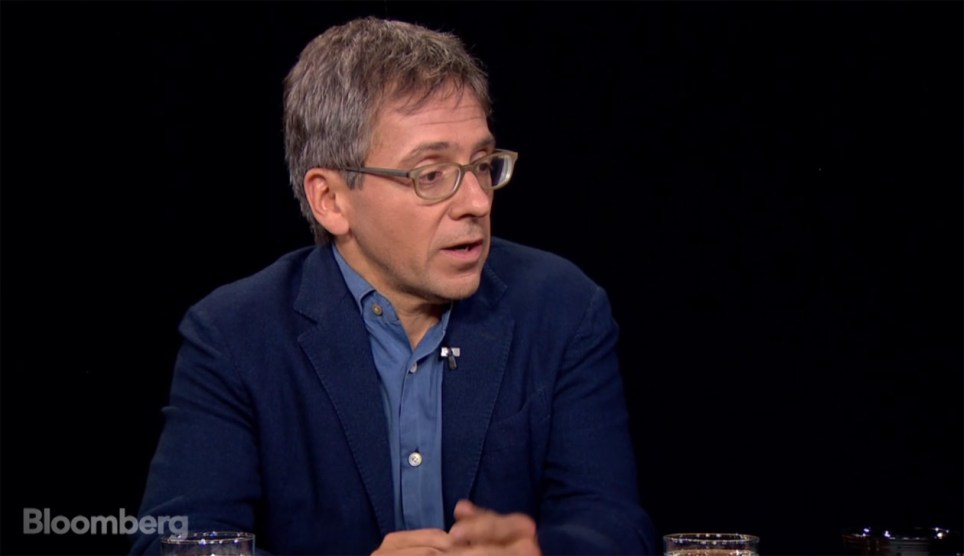
    President Trump held a second, informal meeting with Russian President Vladimir Putin on the sidelines of the Group of 20 summit in Hamburg earlier this month, according to Ian Bremmer, the president of the international consulting firm Eurasia Group….Trump spoke with the Russian leader for roughly an hour, joined only by Putin’s translator. The meeting had previously gone without mention by the White House.

    Two things. First, if Trump were really a decent negotiator, he would have insisted on not even having Putin’s interpreter present. Putin speaks perfectly good English.

    Second, what the fuckety fuck fuck? A meeting with only Rex Tillerson present wasn’t enough? Trump had to have another meeting with literally no other American in the room? What does he have to say to Putin that he’s afraid of anyone hearing him say?

    Bremmer’s full interview with Charlie Rose about the Trump-Putin meeting is here.

  • Lunchtime Photo

    This lovely little flower is a Zauschneria, named after Johann Baptista Josef Zauschner. It’s also known as a California fuchsia or a “hummingbird flower.”

    This is a strangely difficult flower to photograph. There are loads of them along my normal morning walk, and I keep taking picture after picture of them. For some reason, though, the pictures always look—what? Kind of cartoony. There’s not much sense of depth, and the petals look like they’ve just been colored in. It’s odd.

    But this one turned out pretty well, and I like the framing of the two flowers in the background. However, the real reason I’m putting this up today is that I’m tired of Zauschnerias. I keep taking pictures of them, and I’ll probably keep doing it forever until I post one. Now that I have, I can stop.

  • New Research Quantifies the Emotional Energy Bound Up in Twitter Mobs

    Based on my experience, supplemented by careful and rigorous record-keeping, I have constructed an equation that describes the amount of emotional energy contained in various forms of impersonal nastiness:

    In English: One nasty phone call is the equivalent of 50 nasty emails or 2,500 nasty tweets. Basically, a nasty tweet is all but meaningless. The bandwagon effect is so powerful on weak minds, and the effort required is so minuscule, that an outraged tweet is equivalent to only a tiny fraction of a nasty phone call. Nasty emails are somewhere in between. Keep this in mind if you ever get a barrage of nasty tweets.

  • The 8th Man Has Been Identified!

    There were eight people in Don Jr.’s infamous meeting with a Russian attorney who had promised him “information that would incriminate Hillary” as part of  “Russia and its government’s support for Mr. Trump.” But so far we only have seven names. Who was the mysterious eighth man? The LA Times has the story today:

    Donald Trump Jr.’s controversial meeting with a Russian lawyer in June 2016 was attended by a California businessman born in the former Soviet republic of Georgia, according to two people familiar with the meeting.

    Irakly “Ike” Kaveladze, a 52-year-old businessman from Huntington Beach, was the eighth individual at the controversial meeting, The Times has learned. His identity had not previously been revealed.

    ….Kaveladze “was asked to attend the meeting purely to … make sure it happened,” said [his attorney]. “He literally had no idea what the meeting was about until he showed up right before.” Kaveladze has been contacted by prosecutors working for special counsel Robert Mueller, who is investigating possible coordination between the Trump campaign and the Russian government, according to Balber, who said his client was “cooperating fully,” with investigators.

    Huh. So Kaveladze was asked to attend to make sure the meeting happened, but had no idea what the meeting was about. I’m not sure that makes sense. In what way did he “make sure” the meeting took place?

    All very strange. I suppose Robert Mueller will figure it out in another year or so.

  • With Trumpcare Dead, Will Republicans Move On to Sabotaging Obamacare?

    We now have three Republican senators who oppose a clean repeal of Obamacare, so Mitch McConnell’s spiteful parting shot over the failure of Trumpcare is officially dead too. There will be no Republican health care bill for at least the next two years.

    The big question now is what Republicans will do instead. They’ve made it clear that what they want to do is sabotage Obamacare so that it will blow up and they can blame Democrats for its failure. They have two main strategies for undermining Obamacare:

    • Refuse to pay the CSR subsidies to insurance companies. This amounts to about $8 billion per year, which is used to reduce deductibles and copays for low-income workers. If it goes away, insurance companies will have to make up for it with big premium increases.
    • Refuse to enforce the individual mandate. Donald Trump can’t literally remove the mandate from the books, but he can tell the IRS not to enforce it. If that becomes official policy, lots of young, healthy people will forego insurance, knowing that there’s no penalty to pay. This will destabilize insurance pools, which insurance companies will have to make up for by increasing premiums.

    These two things will not kill Obamacare. They will not cause a death spiral. They will not cause a mass exodus from the program. In fact, most people won’t even notice anything has happened, since their premiums are capped at a percentage of their income. As premiums go up, their subsidies will go up too, and they won’t pay any more than before.

    However, it will hurt middle-class families who make too much money to qualify for subsidies. They’ll see a 20-25 percent increase in their premiums, and they’ll have to pay the whole tab. And that’s after already swallowing a 25 percent premium increase last year.

    Are Republicans willing to do this to their middle-class base? Normally I’d say no. That’s crazy. But these are crazy times, and Trump seems to have no qualms about adopting policies that mostly cause pain for his own supporters. “Let Obamacare fail,” he said today. “I’m not going to own it.”

    So Republicans might really do it, and then try to lay the blame on Democrats. I don’t think that will work outside of the Fox News bubble, but maybe that’s enough. Stay tuned.

  • Fed Report Says Tuition Increases Hurt Later Homeownership

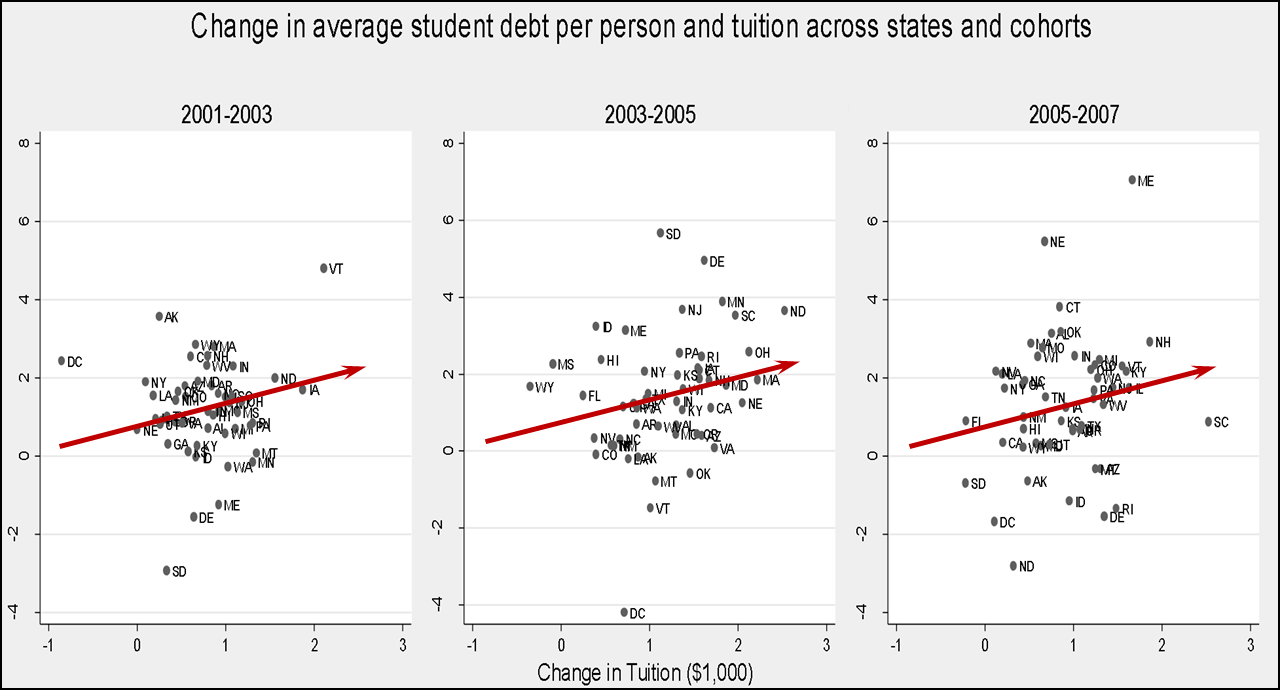
    Zaid Jilani of the Intercept points me to an interesting Fed study on the effect of rising university tuition.  The authors make use of the fact that tuition has been rising at different rates in different states, and conclude that rising tuition has no effect on university enrollment. Young people continue to go to college at the same rate as always, and they rack up higher student debt to do it:

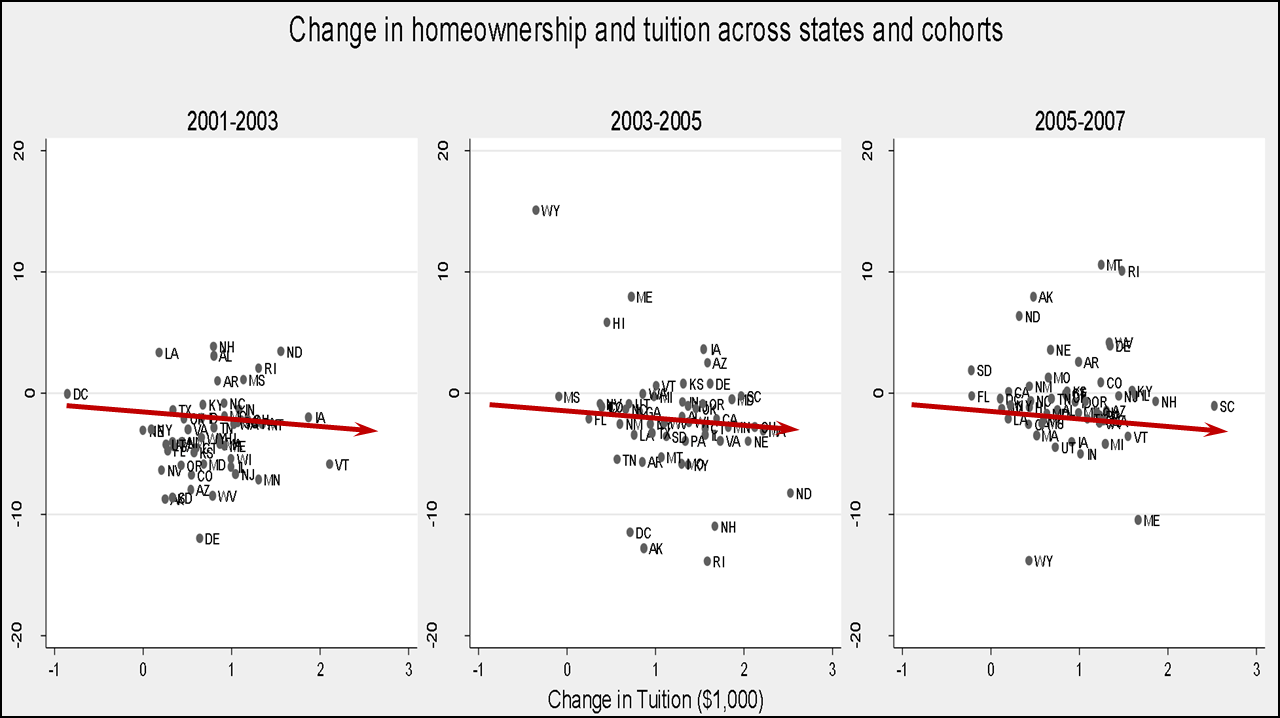
    I assume this comes as no surprise to anyone. Next they compare tuition increases by state to homeownership rates six years later. Guess what?

    As tuition and student debt go up, homeownership rates go down. The authors say that a $1,000 increase in college tuition and fees leads to a 0.24 percentage point decline in the homeownership rate for college students later in life (ages 28 to 30). Thus, the $3,578 increase in tuition from 2001 to 2009 is responsible for a decline of about 0.84 percentage points in homeownership rates among college students from 2009 to 2015. That’s about a tenth of the total decline.

    A different analysis suggests the effect may be even bigger: 0.48 percentage points for each $1,000 increase in college tuition. That comes to 2.74 percentage points, which is about a third of the total decline in homeownership rates.

    In other words, tuition increases can explain somewhere between a tenth and a third of the decline in homeownership among those with some college education. On net, this may not be a good deal for states:

    The results suggest that states that increase college costs for current student cohorts can expect to see a response not through a decline in workforce skills, but instead through weaker spending and wealth accumulation among young consumers in the years to come….These states, on average, can expect both weaker starter housing markets and more “boomeranging” adult children to follow. The evidence points to a final policy opportunity to stimulate youth homeownership over the long run: funding state higher education.

    I suppose the next step would be to take these estimates and plug them into a model that projects state economic growth and tax receipts. That would tell us, on net, if tuition increases help or hurt state and local budgets.

  • Paul Ryan Wants to Cut the Domestic Budget Nearly in Half

    House Republicans unveiled their budget plan today:

    The House plan envisions major cuts to federal spending over the coming decade, bringing the budget into balance by relying on accelerated economic growth to boost revenue. Under the House plan, defense spending would steadily increase over 10 years while nondefense discretionary spending would decline to $424 billion — 23 percent below the $554 billion the federal government is spending in that category this year.

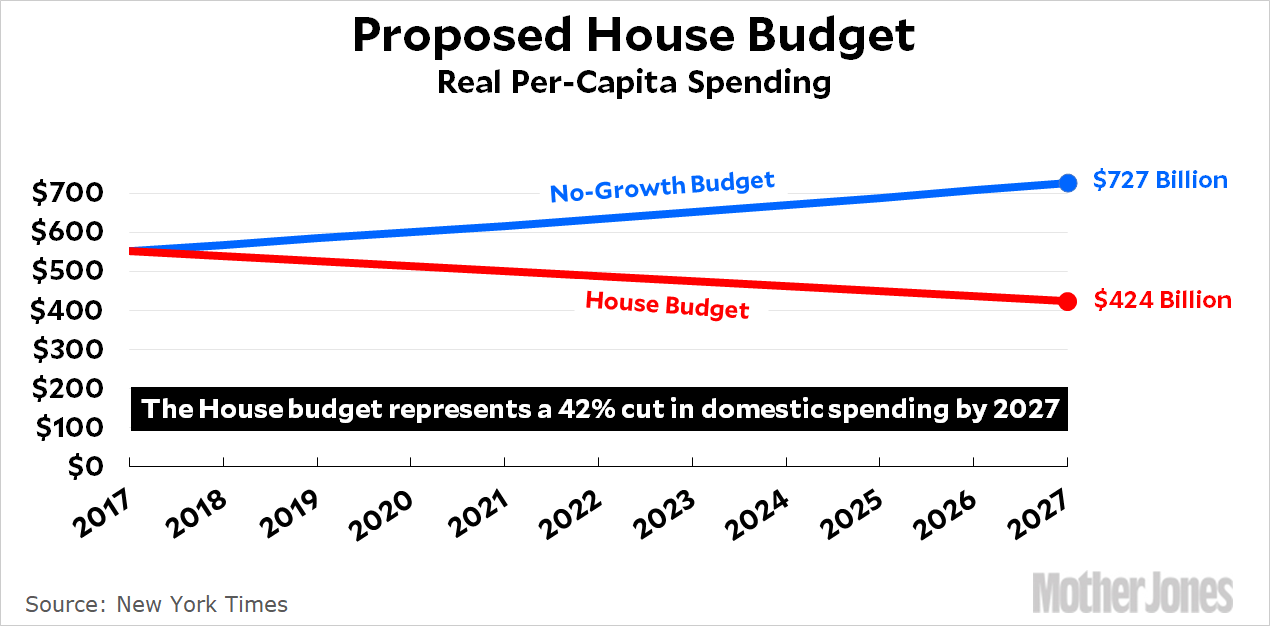
    That sounds bad. But it’s even worse. As always with this stuff, you need to adjust for inflation and population growth. Here’s what that looks like:¹

    At $554 billion, the domestic discretionary budget is currently $1,705 per person. Just to keep up with inflation and population growth, that needs to grow to $727 billion by 2027. Instead, Republicans want to cut it to $424 billion.

    That’s not a reduction of 23 percent, it’s a reduction of 42 percent. The House budget would decimate spending on national parks, education, food assistance, housing, basic research, transportation, law enforcement, the EPA, and more.

    Why? In order to fund a big tax cut for the rich. Like it or not, the combination of PAYGO and reconciliation rules force Paul Ryan to pretend to pay for his tax cut. But rosy economic assumptions and dynamic-scoring pixie dust only get him so far. He can only get the rest of the way by slashing spending on everything except defense.

    By 42 percent. Remember that number.

    ¹I assumed inflation of 2 percent per year and population growth of 2.5 million per year.

  • Donald Trump Is In a Huff Over Iran

    Morteza Nikoubazl via ZUMA

    The New York Times reports that President Trump is unhappy about keeping the Iran deal in force:

    At an hourlong meeting last Wednesday, all of the president’s major security advisers recommended he preserve the Iran deal for now. Among those who spoke out were Secretary of State Rex W. Tillerson; Defense Secretary Jim Mattis; Lt. Gen. H. R. McMaster, the national security adviser; and Gen. Joseph F. Dunford Jr., the chairman of the Joint Chiefs of Staff, according to an official who described internal discussions on the condition of anonymity. The official said Mr. Trump had spent 55 minutes of the meeting telling them he did not want to.

    But I don’t want to! Wah!

    Come on, Donald. Buck up. If you want to lie about whether Iran has stuck to the deal, then just tweet out the lie and kill the treaty. If your advisers don’t like it, too bad. You’re the president. You can do anything you want, even if every single person you hired thinks you’re an idiot.

    Anyway, the sense I get is that Trump will now treat the Iran deal the same way he’s treating Obamacare: he’ll do his best to sabotage it. I think we can look forward to a series of provocations designed to provoke some kind of response from Iran that Trump can use as a pretext for killing the deal. He can’t get any of the money back, of course, because Iran’s assets have already been unfrozen. So Iran will have its money and they’ll be free to develop a nuclear weapon if they want to—all without having to go to the trouble of breaking the treaty themselves.

    Welcome to the world of Donald Trump, master negotiator.

  • Mitch McConnell Is Offering Up a Eulogy for Trumpcare

    With Trumpcare dead, Mitch McConnell says he will now schedule a vote on a clean repeal of Obamacare:

    In a strategy facing long odds, the majority leader said the Senate would instead vote “in coming days” on a bill the chamber passed in late 2015 to unravel most of the ACA, which former President Barack Obama vetoed in January 2016….But many Republican senators have balked at this strategy, saying they wouldn’t feel comfortable rolling back the ACA without being able to tell their constituents what would supplant it. Mr. McConnell’s new tactic likely represents his desire to wrap up and move on from a bruising fight

    This is just political theater. The 2015 bill would repeal the funding for Obamacare, which would indeed destroy it. However, all the insurance industry regs would stay around, as would protections for pre-existing conditions. Insurers would still be required to cover all the essential benefits of Obamacare, and people with expensive conditions would all be allowed to sign up for coverage at the same price as anyone else. This combination would destroy the individual insurance market. Every insurer in the country would withdraw, which would affect everyone with individual insurance, not just the folks who got it through Obamacare.

    Even in the GOP’s current fallen state, there are at least three Republican senators who would vote against this.