Rachel Maddow/Flickr
The Supreme Court will hear oral arguments on SB 1070, Arizona’s controversial immigration law, on Wednesday. Here are three tidbits to keep in mind:
There are four separate provisions at issue. The Ninth Circuit Court of Appeals prevented four parts of Arizona’s SB 1070 immigration law from taking effect:
- A provision compelling police to question the immigration status of individuals they suspect are undocumented
- A provision allowing police to arrest such individuals without a warrant
- A provision making it a state crime to work without authorization
- A provision making it a state crime for immigrants to walk around without their federal papers (hence why detractors refer to SB 1070 as Arizona’s “papers please” law)
“It’s conceivable that the court could rule for the federal government on some sections and for Arizona on others,” says Omar Jadwat, a senior staff attorney with the American Civil Liberties Union’s Immigrant Rights Project. “We believe all four sections are unconstitutional.”
Only eight justices will be ruling on the case. Justice Elena Kagan has recused herself from the SB 1070 case because she worked on it during her time as solicitor general. That means that if the Democratic appointees vote to strike down the law and manage to peel off one conservative, the high court will be left with a 4-4 tie. If that happens, the lower court ruling will stand, but it will only have “persuasive,” rather than “binding” authority over courts in other jurisdictions. Other courts have to consider the lower court’s “persuasive authority” ruling but won’t have to reach decisions that fit with its conclusion.
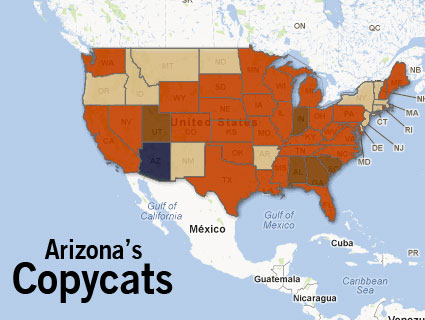
In the case of a tie, “the court won’t issue an opinion—it’ll affirm the provision below, which means all four provisions will continue to be suspended,” Jadwat says. “There won’t be an opinion like you usually get in a case, because there won’t be a majority for any particular view.” But if this case ends in a tie, there’s no guarantee a sequel will: Kagan probably won’t have to recuse herself from future challenges to state laws that have used SB 1070 as a model.
The government’s argument has nothing to do with racial profiling. Despite some rhetorical acknowledgements of the law’s problematic racial context, the Obama administration declined to include racial profiling in its challenge of the law, relying instead on the argument that Arizona has unconstitutionally usurped the federal government’s authority on immigration. (Organizations have filed friend-of-the-court briefs arguing that the law will lead to racial profiling.) Article I of the US Constitution says Congress has the authority to “establish a uniform rule of naturalization.” In previous rulings, the court has held that “Congress’ power over immigration is plenary, meaning complete, as long as it doesn’t violate any other constitutional principles,” explains Adam Winkler, a law professor at UCLA. Arizona is arguing that SB 1070 actually complements federal law, rather than interfering with it.
“The federal government’s policy on immigration is to focus on serious crimes, in part because of a lack of resources,” Winkler says. “Arizona’s policy will force the federal government to expend resources enforcing the immigration law in ways the federal government does not wish to do.”