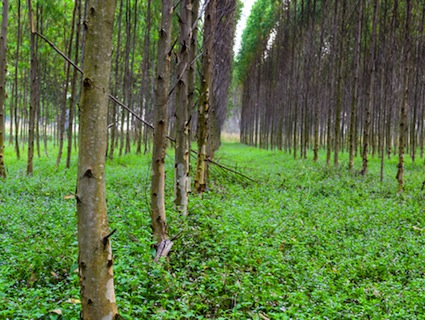
A eucalyptus plantation in Thailand. <a href="http://www.shutterstock.com/cat.mhtml?lang=en&search_source=search_form&version=llv1&anyorall=all&safesearch=1&searchterm=eucalyptus+farm&search_group=&orient=&search_cat=&searchtermx=&photographer_name=&people_gender=&people_age=&people_ethnicity=&people_number=&commercial_ok=&color=&show_color_wheel=1#id=121988359&src=b97119cc1afc91e49f341779fdbe4c7a-1-2">Shutterstock</a>
Biofuels have a variety of drawbacks. They jack up the price of food, making life hell for the urban poor in the global south, while also pushing small-scale farmers off of land and into misery, as I wrote yesterday. They may contribute to, rather than reduce, greenhouse gas emissions, because they provide incentives to plow up carbon-trapping old forests.
Turns out they can also make you sick. Certain fast-growing trees used for biofuels in Europe can also “increase concentrations of ground-level ozone, resulting in millions of tonnes in crop losses and an additional 1,385 deaths per year,” reports Climate News Network, teasing out the results of a recent study (abstract here) by a UK research team published in Nature Climate Change. The ozone in the upper atmosphere is a good thing—it “filters out dangerous ultra-violet sunlight.” But at ground level, ozone is a “toxic irritant” that makes people wheeze and can be life-threatening for vulnerable populations. When it wafts into fields where crops are grown, ground-level ozone also “causes more damage to plants than all other air pollutants combined,” the US Department of Agriculture reports.
The authors offer a few solutions to mitigate the problems they identify:
The Lancaster team suggest that the unwelcome consequences could be mitigated by the choice of coppice trees genetically engineered to reduce isoprene emissions—one genetically modified poplar has already been tested under laboratory conditions—or by the choice of other biofuel crops such as grasses, or by shifting biofuel production away from densely populated areas and highly productive cereal land.
I have another suggestion: Use farmland to grow food, and focus energy policy on techniques that benefit the environment: conservation, efficiency, and green technologies like wind and solar.