• Afghanistan


    AFGHANISTAN….Nir Rosen is not optimistic about Afghanistan’s future:

    There are too many symptoms of Afghanistan’s decline to inventory, but the roads are an easy place to start, a clear sign of the shrinking zone of order that now barely reaches beyond the outskirts of Kabul.

    ….In Kabul I met with western diplomats, security experts, former Mujahideen commanders, former Taliban officials, NGO representatives, and senior officials at the UN; many of the westerners have been in the country since the US invasion, some for more than a decade. They are committed, in various ways, to supporting the government led by Hamid Karzai, the efforts at development and reconstruction, and the coalition campaign against the resurgent Taliban — and none would speak candidly without remaining anonymous, since their private assessments are, to a person, “incredibly bleak,” as one said.

    ….As I saw on the road to Ghazni, the Taliban have succeeded in essentially cutting off Kabul from the rest of the country. The road southwest to Kandahar was lethal. “The Kabul to Ghazni road is gone,” a British intelligence officer told me, “the Ghazni to Gardez road is exceedingly bad, the Wardak road is sh***, the Jalalabad road is sliding. The ambushes have become routine.”

    Via Andrew Sullivan.

  • The Greening of America


    THE GREENING OF AMERICA….Over at Gristmill, Gar Lipow explains how we can reduce carbon emissions in the United States by 95%. Answer: it will take both regulation and carbon pricing:

    Making the unrealistic assumption of zero technical breakthroughs in efficiency or renewable technology, the total cost of a complete transition to 95 percent (or better) emissions-free energy in the U.S. would be about $1.7 trillion annually….From a social standpoint, total paybacks would be $600 billion a year more than this, meaning in the 20th year, the economy would grow $600 billion more per year net than without such investments.

    ….The particular subsidies I projected start at around $275 billion annually, average to $365 billion a year for the first 20 years, and peak at $475 billion annually in the 20th year. They drop back to $275 billion a year in the 21st year, as the renewable industries mature and can get by without further subsidy.

    ….Because this post is about public investment and regulation, I concentrated mainly on this topic. But putting a price on emissions is not optional. To the extent public investment is more palatable than such pricing, it does allow it to be delayed. We can, if we have to, completely eliminate emissions in the building and power generation sectors without such pricing, eliminate most emissions in transportation, and a significant percent even in industry. But there is no way, except via an emissions price, to capture most possible savings in industry. There are just too many efficiency means we don’t know about in advance. Similarly, even in transport it is really hard to see how to reduce emissions in shipping and air travel without an auctioned permit system.

    Without commenting on Lipow’s exact figures, I think this is exactly right. The scale of the task ahead is so huge that there’s no single approach that will do the job all by itself. Straightforward regulation and investment are often the most efficient way of getting things done if we already know what to do, while carbon pricing via cap-and-trade provides both an additional broad push in all these areas while also providing incentives to find new ways of doing things. Properly designed, it also provides a revenue stream to help pay for green improvements and to keep the cost of those improvements from hitting the poor at a disproportionate rate.

    I haven’t gone through this myself, but if you’re curious about Lipow’s methodology, he’s posted all the details here in an Excel spreadsheet and invited comments. Head on over if you want to dive more deeply into the numbers.

  • How to Break a Terrorist


    HOW TO BREAK A TERRORIST….“Matthew Alexander,” an interrogator who rejected torture in favor of “showing cultural understanding and using good old-fashioned brainpower to tease out information,” and managed to bag the leader of al-Qaeda in Iraq, Abu Musab al-Zarqawi, in the process, writes about his experience:

    I learned in Iraq that the No. 1 reason foreign fighters flocked there to fight were the abuses carried out at Abu Ghraib and Guantanamo. Our policy of torture was directly and swiftly recruiting fighters for al-Qaeda in Iraq….How anyone can say that torture keeps Americans safe is beyond me — unless you don’t count American soldiers as Americans.

    After my return from Iraq, I began to write about my experiences because I felt obliged, as a military officer, not only to point out the broken wheel but to try to fix it. When I submitted the manuscript of my book about my Iraq experiences to the Defense Department for a standard review to ensure that it did not contain classified information, I got a nasty shock. Pentagon officials delayed the review past the first printing date and then redacted an extraordinary amount of unclassified material — including passages copied verbatim from the Army’s unclassified Field Manual on interrogations and material vibrantly displayed on the Army’s own Web site. I sued, first to get the review completed and later to appeal the redactions. Apparently, some members of the military command are not only unconvinced by the arguments against torture; they don’t even want the public to hear them.

    Alexander’s book, How to Break a Terrorist, hits bookstores tomorrow. Sounds like a good read.

  • In Which I Eat My Hat


    IN WHICH I EAT MY HAT….Barack Obama will be announcing his foreign policy team on Monday. David Sanger reports on their mission:

    All three of his choices — Senator Hillary Rodham Clinton as the rival turned secretary of state; Gen. James L. Jones, the former NATO commander, as national security adviser, and Robert M. Gates, the current and future defense secretary — have embraced a sweeping shift of priorities and resources in the national security arena.

    The shift would create a greatly expanded corps of diplomats and aid workers that, in the vision of the incoming Obama administration, would be engaged in projects around the world aimed at preventing conflicts and rebuilding failed states.

    ….Whether they can make the change — one that Mr. Obama started talking about in the summer of 2007, when his candidacy was a long shot at best — “will be the great foreign policy experiment of the Obama presidency,” one of his senior advisers said recently.

    The adviser, who spoke on the condition of anonymity because he was not authorized to speak publicly, said the three have all embraced “a rebalancing of America’s national security portfolio” after a huge investment in new combat capabilities during the Bush years.

    That’s good to hear. If they’re successful, it would be a triumph of common sense in an era that’s seen precious little of it in the national security arena.

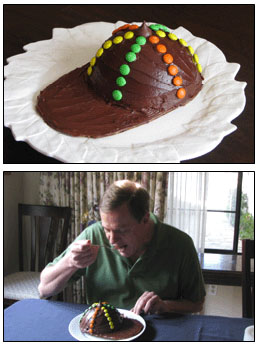
    On another note, you may recall that I promised to eat my hat if Hillary Clinton agreed to be Obama’s Secretary of State, and let no one say I’m not a man of my word. Marian made me a chocolate cake in the shape of a baseball cap, I decorated it with M&Ms, and then this afternoon I chowed down on it. Promise made, promise kept.

  • Holiday Shopping


    HOLIDAY SHOPPING….The National Retail Federation passes along some holiday cheer today:

    More than 172 million shoppers visited stores and websites over Black Friday weekend, up from 147 million shoppers last year.

    Shoppers spent an average of $372.57 this weekend, up 7.2 percent over last year’s $347.55. Total spending reached an estimated $41.0 billion.

    We seem to have an arithmetic breakdown here. My calculator says this weekend’s numbers come to $64 billion, compared to $51 billion last year. That’s a 25% increase.

    That seems implausible to me. On the other hand, it also seems implausible that 172 million times $372.57 equals $41 billion. So what’s going on?

    POSTSCRIPT: For what it’s worth, the NRF’s methodology is to survey a bunch of people in an online poll and ask them how much they’ve spent this weekend. Every news outlet in the country reports the NRF numbers as gospel, but frankly, this approach strikes me as so dubious that I wonder if their numbers would mean anything even if they could get their arithmetic straight. It sure doesn’t jibe with the report of Wachovia analyst John Morris, who told the New York Times that “there was definitely more elbow room” in stores this year; or with ShopperTrak, which told them that sales increased only 3 percent on Friday; or with the numbers provided by Marshal Cohen of the NPD Group, who told them that Friday foot traffic was down 11 percent and the “shopping bag count” (whatever that is) was down 24 percent compared with last year. Very fishy, no? I blame the War on Christmas.

    UPDATE: In comments, big truck notes that in the fine print NRF says that their 172 million number “includes same consumer shopping multiple days.” So maybe there were 110 million actual human beings spending $372 each, which would net out to $41 billion. However, applying the same logic to last year’s numbers still produces a 20% increase in total dollars spent this year ($41 billion vs. $34 billion), which seems wildly implausible. Why on earth does anyone take these figures seriously?

  • *Vortices


    VORTICES….Via Mark Kleiman, researchers at the University of Michigan have created a wave-based system for generating electricity called VIVACE, or “vortex-induced vibrations for aquatic clean energy”:

    The new device, which has been inspired by the way fish swim, consists of a system of cylinders positioned horizontal to the water flow and attached to springs. As water flows past, the cylinder creates vortices, which push and pull the cylinder up and down. The mechanical energy in the vibrations is then converted into electricity.

    ….A “field” of cylinders built on the sea bed over a 1km by 1.5km area, and the height of a two-storey house, with a flow of just three knots, could generate enough power for around 100,000 homes….The scientists behind the technology, which has been developed in research funded by the US government, say that generating power in this way would potentially cost only around 3.5p per kilowatt hour, compared to about 4.5p for wind energy and between 10p and 31p for solar power. They say the technology would require up to 50 times less ocean acreage than wave power generation.

    ….”If we could harness 0.1 per cent of the energy in the ocean, we could support the energy needs of 15 billion people. In the English Channel, for example, there is a very strong current, so you produce a lot of power.”

    Well, why not? Vortex-induced vibrations generated enough power to destroy the Tacoma Narrows Bridge in 1940, so why not get something useful out of it?

    Of course, claims like these pop up constantly, and there’s no telling how well VIVACE will work until there’s been a real-world test. That will happen next year, when the boffins plan to set up a small prototype in the Detroit River designed to generate 3 kilowatts of power. No word yet on an ocean floor test.

  • China’s Economy


    CHINA’S ECONOMY….The Chinese leadership is worried:

    Chinese President Hu Jintao warned at a weekend meeting of the Communist Party’s elite Politburo that China is losing its competitive edge as international demand for its products is reduced, according to official state media reports Sunday.

    China’s growth rate has been forecast to be about 9 percent in 2008, down from 11.9 percent the year before and close to the 8 percent that economists say China must maintain in order to keep the labor market stable.

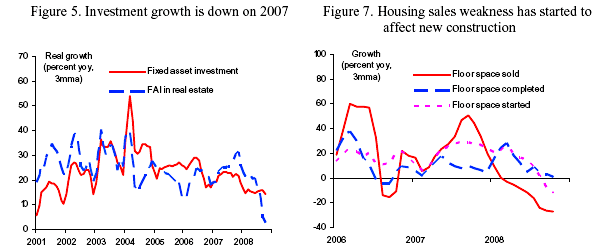
    For more, see Brad Setser’s gloss on a recent World Bank report, which suggests that China’s actual problems have been domestic up until now (falling wages and tanking real estate investment) but will indeed start to become export based next year. Regardless, the end result is that China will be buying up even more Treasury debt than ever over the next few years. That’s probably a good thing in the short term, but not so good in the long term.

  • Cassandra Update


    CASSANDRA UPDATE….Yesterday I asked for names of people who had given early warning of the global financial meltdown. Not just people who foresaw the housing bubble, mind you, but people who figured out some of the other problems that made a bursting housing bubble into a worldwide catastrophe and were banging the drums about them. Unfortunately, nearly all the answers came in one of three buckets: (a) Nouriel Roubini, (b) people warning about the housing bubble, or (c) people writing in 2006 or 2007.

    However, there were a few plausible suggestions for analysts whose warnings went beyond the housing bubble and who did it earlier than 2006, including Peter Schiff, Tanta at Calculated Risk, Mish at Global Economic Analysis, Doug Noland at PrudentBear, and Brad Setser. Martin Wolf provides a few more possibilities here. I don’t know enough about their early work to say for sure that these folks were all early and accurate critics of more than just the housing bubble, but they seem to be likely suspects.

    On the other hand, commenter Commenterlein offers a counterpoint:

    Most of the people listed above recognized that there was some form of housing bubble (at least in some markets), but most of them (imho ex-ante correctly) focused on the U.S.’ external balance (i.e., current account deficit) as the main problem. Hence the crisis most economists predicted was a rapid depreciation of the dollar, associated with a massive and pain-full shift of employment from the non-tradeable sectors (i.e., housing) to the tradeable ones.

    Bottom line: I have not yet found anyone who predicted that a house price decline would lead to a complete loss of confidence in the financial sector and a massive credit crunch taking down institutions all over the world with essentially no (direct) exposure to the US housing market. And as much as I love Roubini, perpetually predicting the end of the world for ever changing reasons just isn’t that useful.

    The current account deficit was, of course, a routine topic of concern among economists, but as Commenterlein points out, a dollar depreciation crisis isn’t the crisis we actually got. In fact, just the opposite: we’re practically in a T-bill bubble right now. That may yet change, causing us even more problems, but so far lack of demand for U.S. debt from the Chinese or anyone else just hasn’t been a factor in the world’s financial problems.

    Tell you what, though: let me ask a much simpler question, since asking “who got it right?” is obviously a little tricky. Back in April 2004 the SEC voted to loosen the capital rules for the five biggest Wall Street investment banks. In retrospect, this was a very bad idea indeed, and it was a bad idea for precisely the reasons that have caused our financial problems to become so dire: it allowed leverage to skyrocket unsustainably and lending standards to deteriorate.

    So here’s my question: Did anyone object to this at the time? The New York Times identified one person who objected, an Indiana consultant named Leonard Bole, and one SEC commissioner who at least asked questions, Harvey Goldschmid, but that’s it. Anyone else? This may have been an obscure ruling to people like you and me, but I’ll bet it wasn’t all that obscure to people who follow Wall Street closely, and I figure anyone who truly knew what was coming would have sounded a warning about it in 2004 or 2005. Did anyone?

    UPDATE: In comments, Ole nominates fellow Dane Jakob Brøchner Madsen, who, according to a Google translation of epn.dk, “has been proclaimed the country’s most pessimistic economist.” However, even Madsen admits, “I knew well that the system was rotten. But not that it was so rotten.”


  • Outliers


    OUTLIERS….Should I pick up a copy of Malcolm Gladwell’s Outliers and give it a read? I’m sort of disinclined to for two reasons. First, I read Blink this year and was surprised at how bad a book it was. Even at a slim 200 pages, I’d say that a good half of it was unrelated to its putative subject. Second, I gather that the subject of Outliers is that there’s a considerable amount of luck involved in becoming successful. But is that something that really needs an entire popular book? It seems like one of those topics that’s so obviously true that it hardly bears a detailed dissection.

    But then again, maybe it’s not quite so obvious as I think. Has anybody read it? Do you recommend it, maybe as something to put on my Christmas list?