• Iraq SOFA Update


    IRAQ SOFA UPDATE….This took longer than I expected, but the Iraqi cabinet has voted almost unanimously to approve the latest draft of a security agreement that governs the continued presence of U.S. troops:

    All but one of the 28 cabinet ministers who attended the two-and-a-half-hour session voted for the agreement and sent it to Parliament for consideration

    ….The draft approved Sunday requires coalition forces to withdraw from Iraqi cities and towns by the summer of 2009 and from the country by the end of 2011. An earlier version had language giving some flexibility to that deadline, with both sides discussing timetables and timelines for withdrawal, but the Iraqis managed to have the deadline set in stone, a significant negotiating victory. The United States has around 150,000 troops in Iraq.

    ….In a crucial development, Grand Ayatollah Ali al-Sistani, the most influential Shiite cleric in Iraq, indicated on Saturday that he would support whatever decision is arrived at in Parliament as representative of the will of the Iraqi people. Shiite officials who met with the ayatollah said eh found the latest draft acceptable, if not perfect.

    Approval by parliament is likely to follow fairly quickly. This is good for the Iraqis, who really do need the U.S. presence for a little while longer; good for George Bush, who’s getting a slightly longer timetable than Barack Obama would have negotiated; and good for Obama, since this essentially makes his decision to withdraw into a bipartisan agreement. After all, conservatives can hardly complain about Obama following a timetable that was negotiated and approved by Bush. Obama has enough on his plate already, and taking this issue off the table ought to be a considerable relief to him.


  • The South


    THE SOUTH….For many years, the Democratic Party controlled the agenda of American politics and Southerners controlled much of the Democratic Party. So the South had enormous political influence.

    Later, most Southerners switched to the Republican Party, but by then it was Republicans who controlled the agenda of American politics. So the South still had enormous political influence.

    As of January 20th, however, the Democratic Party will control the American political agenda once again. But Southerners are still Republicans, which means that their political influence will be nearly nonexistent.

    In other words, for the first time since Reconstruction, the South will be almost completely shut out of national power. There are still a few liberal Southerners who belong to the Democratic Party, of course, but the reactionary, traditionalist South is, for the time being, nearly powerless. They will not control anything, their caucus is a discredited rump, and their influence will be negligible. There is no reason to fear them or to care what they think. Their power to filibuster, itself guttering and only barely alive following the 2008 election, will be all they have left.

    This is the first time this will be true in well over a century. So say it again: The South will have essentially no influence over the course of American politics for the next eight years. We live in momentous times.

  • The Housing Bust


    THE HOUSING BUST….Matt Ygelsias says it’s not really the housing bubble that’s responsible for our economic woes:

    Even though the deflation of a housing bubble would lead to economic problems, it’s just not the case that “the economic crisis” (as folks have taken to calling it) was primarily caused by the rise and now fall of an asset bubble in the housing sector. Such bubbles and their collapse are problematic, but also somewhat banal. We had one just a few years back when the dot-com stock bubble collapsed. That provoked a recession and the loss of a lot of paper wealth in the stock market, but there was no crisis. There was no crisis because the big movers and shakers of the finance world didn’t build a giant house of cards built on the assumption that tech stocks would continue to rise in value indefinitely. Some people made bad bets along those lines, of course, but nothing close to the scale of what we’ve seen recently.

    And the essence of the crisis is right there. Not in the deflation of the bubble as such, but in what was done on top of the bubble with leverage and so forth so as to create a situation so precarious that credit markets were on the verge of total collapse a little while back.

    Superficially, this seems plausible. In the U.S., the dotcom bust destroyed about $7 trillion in wealth, while the housing bust has destroyed (so far) about $5 trillion in wealth. So it seems like the difference in effect must be due to all the derivative speculation piled on top of the housing bubble.

    There’s a lot to that, but it’s not the whole story. The housing bust really is different for several reasons:

    • Dotcom wealth was mostly held by individuals and funds. Mortgage debt is mostly held by banks, and when it disappears it causes massive capital losses in the banking system. Those losses (again, so far) appear to be about half a trillion dollars or so, but half a trillion dollars in lost bank capital reduces lending capacity by $5-10 trillion or so. The lost capital causes bank failures and a loss of trust in the system, while the reduced lending capacity causes a huge credit crunch, something that just didn’t happen during the dotcom bust.

    • Dotcom wealth was fairly transitory. Most of it was built up over the space of 18 months or so and was lost just as quickly. What’s more, a lot of it was in the hands of rich people and venture funds, so its loss hit a relatively narrow segment of the population and thus had a substantial but not catastrophic effect on spending.

      Conversely, housing wealth is spread very widely among ordinary consumers, many of whom were using their homes as ATM machines. When that got cut off, it hit consumer spending hard. Additionally, housing wealth for most people is psychologically far more permanent and far more important than a brief spell of prosperity caused by a stock market bubble. So even beyond the direct shutdown of the HELOC ATM, the wealth effect from the housing bust has been more damaging to consumer spending than the dotcom bust.

    • Unlike the dotcom crash, which was fairly self-contained, the housing crash has precipitated a stock market crash all its own. I’m cheating a little bit here since part of this is a result of all the side bets and financial manipulation, but at least part of it is purely a result of the housing bust. So add on another $4-5 trillion in wealth effect problems directly attributable to the housing bust.

    • The dotcom crash came at the end of a period of broadly rising wages. The housing crash came at the end of a period of broadly stagnant wages. So even if the housing crash had been just a housing crash, it still would have affected the U.S. economy more severely than the dotcom bust.

    • The dotcom bust was ameliorated by the rise of the housing bubble. This time, there’s no other bubble in sight. It’s just a pure crash.

    That said, there’s no question that all the side bets and opaque financial instruments that swirled around the housing bubble made it far worse than it would have been all by itself. But even without all that stuff, it still would have been different. Not only did it affect consumers much more directly, but within the banking system housing and mortgages simply have a far bigger and more important role than equities,

    Further comments and corrections are welcome since my usual caveat applies here: I’m still trying to figure all this stuff out, and I haven’t managed to do it yet. What else am I missing?

  • Sweat Shops


    SWEAT SHOPS….For some reason the blogosphere is alive today with talk of teachers unions and tenure. I don’t really have much of a dog in this fight, but here’s an email a teacher sent to Andrew Sullivan:

    I cannot stress enough that the success of our school is in large rooted in the fact that there is no teachers’ union presence here.

    Teachers at my public charter school, including myself, routinely put in 12 hour days. We spend the time perfecting lessons, tutoring students, grading work, and working with families. We do it because we are dedicated to our jobs and want to close the achievement gap.

    I hear this kind of thing a lot, but look: this isn’t a weakness of unions, it’s what they’re for. Whatever faults teachers unions may have — protecting incompetents, fighting accountability, and resisting merit pay among them — insisting on an 8-hour day isn’t one of them. What’s more, punishing hours aren’t a broad-based answer to our educational problems anyway. There are some teachers, at certain stages of their careers, who may be willing to put in 12-hour days in service of the greater good, but there aren’t 3 million of them. And there’s no reason there should be. This isn’t charity work, after all. It’s a job. Maybe there are other union demands that are objectionable in one way or another, but demanding a 40-hour work week for a position that pays roughly a median salary is hardly some kind of thuggish big labor cramdown.

  • Striped Pants-Suit Update


    STRIPED PANTS-SUIT UPDATE….Martha Raddatz of ABC News reports that Barack Obama really does want Hillary Clinton to be his Secretary of State:

    A source with knowledge of the transition process describes the meeting as not a hard offer. Obama is more cautious than that….He said that he knew how much she cared about health care but said there are other challenges, and wanted to reach out to her about secretary of state.

    ….Obama does not want to be seen as being rejected by her, but it is “hers to turn down,” one source put it.

    If this is really true, I’m astonished. Since when do sitting senators give up their seats to become Secretary of State? Muskie did it at the tail end of his career, but I can’t think of anyone else. It’s crazy. Hillary can basically be senator for life if she wants, and we’re supposed to believe that she’d give that up for a cabinet post that probably won’t last more than four or five years?

    And why would Obama feel like this was a great idea? I don’t believe for a second this business about him being afraid that Hillary will sabotage his legislative agenda. She wouldn’t. And anyway, presidents have to deal with powerful interest groups all the time, including senators with agendas of their own. The Obama-Hillary relationship wouldn’t be anything new or unusual.

    As for Hillary allegedly seeing this as a steppingstone toward another run in 2016, I can only say: huh? I mean, who was the last person to use Foggy Bottom as a springboard to the presidency? Thomas Jefferson? John Quincy Adams? Give me a break. No Secretary of State for over a century has used it as a way to move up the political ladder.

    Plus you’d have Bill and all his globetrotting to contend with too. The whole thing is crazy. I guess that doesn’t mean it’s impossible, but I’ll eat my hat¹ if it turns out to be true.

    ¹Note to the literal: I don’t own a hat. However, if I turn out to be wrong, I’ll eat a chocolate cake shaped like a hat. If you provide the cake.

  • Friday Cat Blogging – 14 November 2008


    FRIDAY CATBLOGGING….A couple of weeks ago I mentioned that my mother had procured a new kitten from a local shelter. She named her Lily, and keeps her inside the house. A couple of days ago, though, she looked outside and Lily was under the car in the driveway. But how did she get there? Cat teleportation?

    No. My mother opened the door and the cat under the car zipped into the house, ran into her arms, and started purring. But it wasn’t Lily at all. It was a clone.

    Then, a couple of hours later, there was some meowing at the front door. So my mother opened the door and discovered an orange kitten, who zipped inside and started purring.

    Perhaps you can guess the rest of this story? There’s no telling where they came from, but these two are obviously littermates, obviously friendly and accustomed to living with people, and took over my mother’s house within minutes. Right now they show no signs of going away, so Mom has bowed to the inevitable. The black-and-white one is named Ditto, and the orange one is named Tillamook. On Thursday night all four of her cats slept in the bed with her. “I woke up kind of sleepy,” she told me. Today, the new kittens are tearing around the house, knocking things over, and fighting my mother for every scrap of food she tries to eat. Things are getting lively in Garden Grove these days.

  • Bailing Out GM


    BAILING OUT GM….The basic argument against bailing out GM (and Ford and Chrysler) is fairly simple: They’re dinosaurs who can’t compete, don’t make good cars, have a terrible corporate culture, and will never get better. If we’re willing to bail out companies like these, where will the bailouts stop?

    The basic argument in favor is also fairly simple: Even if all that stuff is true, and even if in normal times we’d let them die, right now we’re on the edge of a truly catastrophic recession. Killing them off, along with the 2-3 million jobs they support, could be just the catalyst that turns a catastrophic recession into a full-blown depression. We’d be cutting off our economic noses to spite our free market faces.

    But would Chapter 11 reorganization really be all that terrible? Maybe not. Maybe the companies would shed a few jobs, but in the end come back leaner and stronger. That’s an argument that strikes me as persuasive, but what if it turns out that Chapter 11 isn’t an option? Jon Cohn explains:

    In order to seek so-called Chapter 11 status, a distressed company must find some way to operate while the bankruptcy court keeps creditors at bay. But GM can’t build cars without parts, and it can’t get parts without credit. Chapter 11 companies typically get that sort of credit from something called Debtor-in-Possession (DIP) loans. But the same Wall Street meltdown that has dragged down the economy and GM sales has also dried up the DIP money GM would need to operate.

    That’s why many analysts and scholars believe GM would likely end up in Chapter 7 bankruptcy, which would entail total liquidation.

    If this is true, it probably tips the scale in favor of a bailout — especially given the cost, quality, and labor reforms that all three automakers have already put in place over the past few years. Maybe. For now, I’m just passing this along, but I’ll keep my eye out for anyone else either confirming or debunking the Chapter 7 scenario.

  • Green Energy


    GREEN ENERGY….Riffing off a piece by Dave Roberts about gasoline taxes (politically hard and not very effective, he says), Ezra Klein muses about carbon pricing:

    There’s no doubt that market signals are powerful. But I think there’s fair concern over whether they’re enough. The next issue of The American Prospect will feature a Nordhaus and Shellenberger piece arguing that liberals have locked themselves into a peculiarly conservative frame in which they presume that the swift deployment of market forces can provide a proportional response to the dangers of carbon emissions, when in fact this is the sort of national threat that calls for a heavier dose of central planning and coordinated efforts.

    ….I’m not sure where I fall on all this, and it’s not clear that investment is in tension with pricing, but as someone versed in the history of health reform, it’s not hard to imagine a scenario in which the environmental movement launches a massive campaign for a gas tax or carbon pricing that ends in total failure, and five years later everyone wishes they had seized the moment to fight for huge investment expenditures instead. What Roberts is arguing, in effect, is that the harder thing might well not be better here, and if he’s right, that’s an important and unintuitive point.

    I just wrote a long piece about carbon pricing which will probably appear in the magazine in a few months (lead times are tough in this business), and my frame was “Ten Things You Need to Know about Cap-and-Trade.” One of those ten things was “It’s not a panacea,” and I think that’s the right way to think about this. A broad-based carbon pricing regime is almost certainly one of the backbones of an effective energy policy, something that encourages conservation, motivates utilities to switch to green energy sources, and provides a revenue stream for research and investment. That’s why it’s worth writing about. But just like a human backbone, it’s nowhere near enough all by itself. If you want cars to get higher mileage, you can do it a lot more efficiently by increasing CAFE standards. If you want better mass transit, you need direct government action to fund and operate it. If you think carbon eating trees are feasible, then you need a federal R&D program to investigate it, since private industry has no incentive to care about such things.

    Still, all that said, price signals work. They aren’t the whole answer by a long way, but they work. Raise the price of carbon steadily over the years and it will amplify every other program you put in place. Solar and wind will become more competitive, everyone will be motivated to drive cleaner cars and drive them less, utilities will be motivated to really find out if carbon sequestration is possible, and private industry will have increased incentives to turn basic R&D (from the feds) into actual green energy sources for the real world.

    As Dave says, “We need to start thinking at the scale of the problem.” It’s beyond enormous. We need all this stuff, and the sooner the better.

  • Chart of the Day Year – 11.14.2008


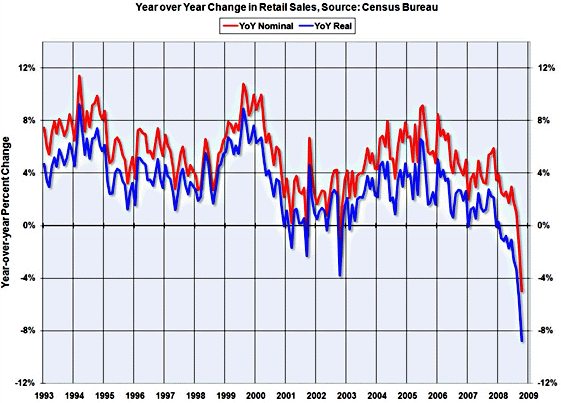
    CHART OF THE DAY YEAR….Consumer spending has fallen off a cliff:

    Dragged down by plummeting automobile sales, retail sales fell by a record amount in October, the Commerce Department reported on Friday.

    ….Sales of cars and auto parts plunged 23.4 percent from last year, the Commerce Department said….Sales of furniture and home-furnishings fell by 13.5 percent compared with 2007, the latest report said, and Americans also spent less money at retailers who sell home electronics, appliances and sporting goods, books and clothes.

    The chart below, from Calculated Risk, shows the numbers adjusted for inflation (in blue). Those are the ones that count. Just as it’s ridiculous to say that “spending at gasoline stations dropped sharply,” as if that’s meaningful (people didn’t buy less gasoline, after all, they merely benefited from lower prices), it’s also ridiculous to claim that overall retail sales were down 4.1% from last year when they were really down nearly 9%. Like it or not, that’s a much better indication of how much actual stuff people were buying. (Or not buying, in this case.)

    Anyway, Paul Krugman’s $600 billion stimulus is looking better all the time. I’m still unsure what to think about an auto industry bailout (though leaning against), but the argument against a broad fiscal stimulus is pretty much nonexistent now. Congress needs to get moving.