• Obama’s Constitution


    OBAMA’S CONSTITUTION….I don’t expect to hear anything about this stuff soon from the Obama team, but I hope they don’t put off for too long making some explicit statements about:

    • Domestic surveillance/warrantless wiretapping

    • Guantanamo

    • Torture policy/adherence to Geneva conventions

    • Signing statements

    • Military tribunals

    Let’s call this the “shredding the constitution” file. Or, more hopefully, the “putting the constitution back together” file. The first two items in particular are going to be especially tough for Obama. He’s almost certainly going to be told in no uncertain terms by men wearing dark suits and penetrating stares that the wiretapping program has produced reams of actionable intelligence and that cutting it back will endanger American security. And those sentiments won’t stay private. They’ll be leaked to plenty of friendly reporters if Obama orders the program modified anyway. We can expect some major political firestorms over this.

    Guantanamo, if anything, will be even harder. I’m not talking here about Guantanamo the place. The prison itself can be pretty easily moved elsewhere. I’m talking about Guantanamo the problem: namely, what do you do with the remaining detainees there? Battlefield conditions being what they are, it’s almost a certainty that the evidence against many of the prisoners — including some of the genuinely dangerous ones — is far too weak to withstand any kind of dispassionate tribunal. But if that means some of them get released, where do they get released to? Kansas City? It’s not as if there’s another country in the world that will take them, after all.

    But we can’t keep surveilling American citizens forever and we can’t continue to keep prisoners locked up based merely on rumors and hearsay (or confessions extracted by torture). I don’t expect Obama to clean this stuff up on his first day in office, but here’s hoping that the constitutional law professor doesn’t wait too long. It would be nice to have our country back again.

  • Viva Obama


    VIVA OBAMA….Great moments from the annals of debate prep:

    For the second debate, a town-hall format, Obama was told to be careful to hold the mike by his side — not straight up in his lap — when he sat down. The same instructions had been given to John Kerry four years ago. It wasn’t hard to persuade the candidates to mind the advice, said an aide; all you had to do was show them a video.

    Roger that.

  • Raw Data


    RAW DATA….Via Steve Benen, Steve Waldman says that Obama has shrunk the God gap:

    Obama got 43% of weekly church-goers vs. 55% for McCain. In 2004, Bush got 61% vs. 39% for Kerry. What this means is that Bush beat Kerry by roughly 27 million among weekly churchgoers, and McCain beat Obama by only 15 million — a stunning 12 million person shift.

    Hold on a second. I made a pain in the ass of myself over this subject in 2004, and I’m going to do the same thing this year.

    First things first. In 2004, Kerry lost to Bush nationwide by 2.4 percentage points. In 2008, Obama beat McCain by 6.3 percentage points. That’s a swing of about 9 points nationwide, which means that any group that also swung by 9 points in Obama’s favor was doing nothing except following the national trend.

    So how about those churchgoers? They went from -22 for Kerry to -12 for Obama. That’s a swing of ten points, almost identical to the nationwide swing in Obama’s favor. Weekly churchgoers just didn’t do anything unusual, which means there’s no reason to think that Obama did anything special to appeal to them. More than likely, they voted for him in larger numbers this year for the same reason as everyone else: they were tired of Bush, tired of Republicans, and trusted Obama more in tough economic times. There’s really no justification for a special narrative to explain those 12 million extra voters.

    But as long as we’re on the subject, which groups did Obama do especially well with? That is, which groups did he swing by margins substantially more than 9 points? Based on the 2004 and 2008 exit polls, here are the groups that swung in disproportionate numbers this year:

    • Income $200,000 or more (+34)

    • First-time voters (+33)

    • No high school (+27)

    • Latinos (+27)

    • 18-29 year olds (+25)

    • Under $15,000 (+21)

    • Full-time workers (+19)

    • Urban (+19)

    • Non-gun owners (+18)

    • Non-religious (+16)

    • Parents with children under 18 (+16)

    The swing in first-time voters (which overlaps heavily with 18-29 year olds) and Latinos was especially stunning. Also worth noting, just because they’re such obvious swing groups, are Obama’s large gains among moderates (+12) and the unmarried (+14).

    And which groups did Obama do substantially worse with than his overall national trend? Here they are:

    • Gay/lesbian (-11)

    • Last minute voters (-8)

    • Union members (0)

    • “Other” religions (0)

    • Gun owners (+2)

    • White women (+4)

    • 45-59 year olds (+4)

    Gays and last-minute deciders are the only groups where Obama performed worse than Kerry. The other five are groups where he did better than Kerry, but not by as much as he did with the country as a whole.

    I don’t have any special narratives or analysis to offer for any of this. Maybe later. For now, it’s just raw data for your noodling pleasure.

  • Kevin Drum Smackdown Watch


    KEVIN DRUM SMACKDOWN WATCH….Felix Salmon says we shouldn’t be demonizing credit default swaps as the source of our recent financial turbulence. Earlier this morning I said I wasn’t so sure about that. Today Salmon responds, and he starts out strong:

    Add Kevin Drum to those who think that a bit of CDS demonization is not such a bad thing at all. Unfortunately, he’s a bit shaky on the facts….

    Sigh. Story of my life when it comes to the credit crisis. Salmon’s response is too long to excerpt, so click the link and read it. I find it disturbingly persuasive, especially this part, which is something I’ve been wondering about too:

    It’s not surprising that CDS desks haven’t lost a lot of money, because CDS, like all derivatives, are a zero-sum game.

    Well, yeah, what about that? Mortgage losses are absolute: if a homeowner defaults, then the noteholder loses a lot of money and nobody else makes any. But derivative trades always have two sides, so if banks have lost jillions of dollars on derivative speculation then there ought to be a whole lot of people licking their chops right now in anticipation jillions of dollars in gains. But as Salmon says, that doesn’t seem to be the case. So maybe that means there aren’t a lot of losses?

    So….I dunno. As always, it bugs the hell out of me that there’s so much disagreement even about things that strike a layman like me as fairly basic. I mean, recently the Minneapolis Fed published a paper saying that the credit markets were actually in fine shape, and a few days later the Boston Fed published a paper saying they were all wet. Hell’s bells. A bunch of Fed economists can’t even agree on something as basic as whether credit is contracting? WTF?

    In the same way, I guess we really don’t know how big the losses have been in derivative speculation related to the subprime crash — which, of course, isn’t a bad argument for making derivative trades a little more transparent in the first place. In the meantime, though, I’d sure like to hear some other experts respond to Salmon’s points about the CDS market. His arguments seem well formed to me, but then, if I was wrong once I could be wrong again, couldn’t I? Are there any finance gurus out there to dive into this?

  • Social Conservatism


    SOCIAL CONSERVATISM….David Frum on the future of the Republican Party:

    Since 1988, Democrats have become more conservative on economics — and Republicans more conservative on social issues. College-educated Americans have come to believe that their money is safe with Democrats — but that their values are under threat from Republicans. There are more and more college-educated voters.

    So the question for the GOP is: Will it pursue them? This will involve painful change, on issues ranging from the environment to abortion. It will involve even more painful changes of style and tone: toward a future that is less overtly religious, less negligent with policy, and less polarising on social issues.

    Greg Mankiw on why McCain lost the youth vote:

    Recent conversations I have had with some Harvard undergrads have led me to a conjecture: It was largely noneconomic issues. These particular students told me they preferred the lower tax, more limited government, freer trade views of McCain, but they were voting for Obama on the basis of foreign policy and especially social issues like abortion. The choice of a social conservative like Palin as veep really turned them off McCain.

    Ross Douthat is right to warn that Mankiw’s students are hardly a representative sample, but I’ll bet he’s basically correct anyway. Four years ago the big post-election meme was a warning that Democrats needed to get more socially conservative, but that didn’t happen and they won anyway. Social liberalism is actually (surprise!) pretty popular.

    On the other hand, there’s certainly a place in America for an economically conservative party. Republicans have gone overboard on this during the past decade, but they might be able to get by with only a modest course correction on this score. The financial meltdown won’t last forever, after all. On social issues, though, they’re doomed if they continue to hitch their future to the hard edged conservatism of their evangelical base. They’ve mostly won the battle on guns, but on issues like abortion, stem cells, gay rights, immigration, and the environment (which most people view as a lifestyle issue, not an economic issue) I don’t see how they survive if they don’t moderate their positions fairly dramatically. The GOP is in danger of permanently losing an entire cohort of the electorate if they continue to be perceived as a party in thrall to xenophobes, bluenoses, and tent revival preachers. They created James Dobson; now they need to tame him.

  • The Great Persuader….Part 2


    THE GREAT PERSUADER….PART 2….Yesterday I argued that although Barack Obama had campaigned on a platform of “change,” he hadn’t really campaigned on a platform of specifically progressive change — and because of this, he might have missed a chance to really move public opinion in a liberal direction. As an example, I suggested that the public face of his economic policy “was almost entirely based on tax cuts, a distinctly conservative notion.”

    Over at RBC, Andy Sabl demurs:

    Obama, as most readers of this blog probably know, ran on repealing the Bush tax cuts for those earning more than $250,000 a year, and using the revenue raised by doing that to give a tax cut to everyone earning less than $200,000….This is, quite simply, the core of left-liberalism: straight-up redistribution.

    ….Obama did a great job during the campaign of re-framing the Reaganite meme that spending is simply bad and tax cuts simply good — that spending “costs the taxpayers money” while tax cuts “let you keep more of your money.” Repeatedly, especially in the debates, Obama used, and made stick, the language that tax cuts for the wealthy “cost” money that we as a country need for urgent purposes.

    This is an interesting counterpoint, but one that’s hard to resolve because it’s difficult to know what message people were really reacting to. My guess is that most low-information voters were reacting solely to Obama’s surface message, which was clear as day: “Tax cuts for me! Hooray!” Via email, Andy agrees, but says, “My point was not that the tax proposal sounded redistributive but that it was redistributive: if Obama were able to get it through Congress, that itself would be a huge progressive victory.”

    Maybe so. I need to noodle on this some more. For one thing, the empirical evidence is unclear: large majorities of voters thought both Obama and McCain would end up raising taxes regardless of what they said, so maybe most people just tuned this message out completely. What’s more, although I originally thought the “share the wealth” attacks at the end were gaining a bit of traction, the tracking poll numbers over the final week suggest that, in fact, they had no effect at all.

    So….I’m not sure. Taxes have been hated since the dawn of time, so that’s a tough place to make a big progressive stand in the best of times. But it’s a worthwhile conversation. For a long time Obama’s fans have been saying that he’s a guy who can sound more centrist than he is, which makes him a very electable candidate. And obviously that turned out to be true. Now we get to find out if it also gives him a platform to become a persuasive cheerleader for a public turn to progressivism. We’ll see.

  • Center Right, Center Left


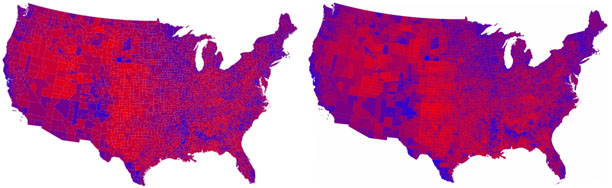
    CENTER RIGHT, CENTER LEFT….Just in case you’re curious, here’s the difference between a center right country and a center left country. If you squint, you can see it.

    In the end, 90% of Republicans voted for McCain and 90% of Democrats voted for Obama — almost exactly the same as the 2004 election. The difference? Independents got bluer by about eight points compared to four years ago. The Republican Party lost the middle everywhere, and as a result the map got slightly bluer everywhere too.

  • CDS Demonization


    CDS DEMONIZATION….Are credit default swaps a major villain in the global banking meltdown? Felix Salmon, responding to a piece by Nathaniel Baker, says no:

    How do we know this? Well, just look at the magnitude of the exposures that Baker is talking about. Back in January, Bernstein Research analysts totted them up, and came to the conclusion that Lehman’s unsecured exposure to triple-A counterparties in general — not just the monolines — was $4 billion: large, but certainly not large enough to bring down a bank with a balance sheet of over $600 billion. Bear Stearns’s exposure was smaller still, just $330 million. What fraction of that exposure eventually turned up on the banks’ income statements as a mark-to-market loss? That I don’t know, but it’s not necessarily very large: remember that AIG’s troubles only really snowballed after Lehman and Bear had gone under — and AIG was by far the largest triple-A writer of CDS.

    Salmon thinks the “CDS demonization meme” is dangerous, but I’m a little confused on this score. It’s a little hard to get a handle on an exact figure, but within the U.S. banking system total losses on subprime mortgages themselves probably total around half a trillion dollars. That’s a helluva lot of money, but it’s nowhere near enough to crash the system. That can only happen if the losses are magnified several times over via derivative losses.

    Now, Salmon’s point is that the CDS market is only a small portion of the total OTC derivative market. And that’s a fair point. But in a previous piece, Salmon wrote this:

    I had lunch yesterday with Shane Akeroyd of Markit, and he had a more sophisticated take on what we’re seeing. The problem isn’t CDS specifically or even derivatives in general, he said: the problem is that the world had an enormous amount of leverage, and all that leverage is now being unwound at once. Do CDS make it easier to firms to lever up? Yes — but if CDS hadn’t been around, some other instrument would have been found which had the same effect.

    Well — OK. Maybe bankers would have found some other way to lever up. But in the event, Akeroyd is saying, they used CDS. So why then is it unfair to say that CDS exposure was a huge driver of the financial meltdown?

    Salmon’s larger crusade is to defend derivatives in general, and CDS in particular, as useful devices when they aren’t abused, but it’s not clear to me that this is especially controversial. The question is, how should they be regulated in the future to ensure that they aren’t abused? I agree that leverage itself should be the primary target of regulatory reform, but surely, under the circumstances, some reasonably strict trading rules on derivatives of all kinds will end up being part of that. Leverage is a hard thing to get at directly, after all, and we’re going to need to attack it from a variety of directions. A bit of CDS demonization might not be a bad place to start from.

    UPDATE: More here, including a response from Salmon.

