
• McCain’s Headwinds


    McCAIN’S HEADWINDS….Via Ezra, Matt Taibbi and Byron York have an IM conversation for New York magazine:

    B.Y.: I’ve just finished an article for National Review — the actual magazine — about the headwinds McCain faces. I was going to look at three, and then I started to list them. I stopped at ten. New Gallup numbers out today show that George W. Bush’s job approval rating remains at 25 percent, while his disapproval rating has ticked up to 71 percent. How hard is it to succeed a two-term president of your own party who is at 25-71? We don’t know because it’s never been done.

    M.T.: Yeah, that’s a damned shame, too. I feel really badly for the guy. I suppose you think the media coverage is also a headwind?

    B.Y.: Actually, I did not list media coverage among the headwinds. I listed the succeed-a-two-term-president problem, the right-track/wrong-track problem, the Republican-Democrat-enthusiasm gap problem, the Republican-Democrat-I.D.-gap problem, the financial meltdown, Iraq, Republican gloom on Capitol Hill, Obama’s fund-raising advantage, and McCain’s historical problems with the GOP base.

    M.T.: But all of those “headwinds,” or almost all of them, are the direct result of McCain having supported policies that are now unpopular. There is absolute justice in his facing a “headwind” from the financial meltdown, from the unpopularity of the Iraq war, and so on. How is that a “headwind”? That’s just self-created unpopularity.

    The rest of the conversation is even more entertaining as York tries to insist that Fannie Mae and CRA are the real causes of the credit crisis. Live by the smear, die by the smear.
  • Gamma Quadrant Update


    GAMMA QUADRANT UPDATE….What’s that, you say? Barack Obama is palling around with terrorists? That is so last week. Here’s a more recent tour of the Gamma Quadrant:

    One: Bill Ayers really wrote Obama’s book, Dreams From My Father. Two: Obama had an underage, gay affair with a pedophile. Three: It’s entirely possible that Obama was involved with bombing the South African rugby team while he was at Columbia in the 80s. Four: Obama, Bill Ayers, and Jeremiah Wright (via a chain of associations too Rube Goldbergesque to summarize) were engaged in a conspiracy to teach Pan-African “cultural nationalism” to Chicago schoolkids during the 90s. Five: Obama was having an affair with one of his fundraiser babes in 2004 until Michelle found out and banished the woman to a “little Caribbean island.”

    There’s no evidence yet that Obama was actually the secret love child of Malcolm X, but I’m sure we’ll find it soon enough if we just keep digging.

  • Playing Pattycake?***


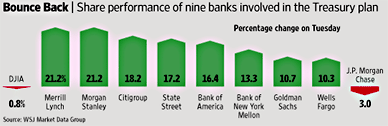
    PLAYING PATTYCAKE?….The stock market was down today, but shares in banks that got capital infusions yesterday are up, up, up. The LA Times reports:

    Investors’ verdict on the Treasury’s $250-billion plan to buy stakes in banks: They love it.

    That may make taxpayers even more suspicious about these deals. If there was supposed to be some pain involved for shareholders in this partial nationalization, it’s not showing up in the stocks. Of the nine big banks expected to get the largest cash infusions, most saw their shares surge today — the third straight advance — even as major market indexes slipped.

    Sure, maybe this means less than meets the eye. Maybe the details don’t matter, and investors just figure bailout = good and therefore it’s time to buy. But check out this tick-tock from the Wall Street Journal about how yesterday’s meeting at the Treasury Department went:

    A final deal between regulators was hashed out in Mr. Paulson’s office Sunday afternoon….The top bankers were then told to show up for a meeting Monday at 3 p.m., but were given few details. Expecting an uproar over the plan, government officials secretly planned to break off the first meeting, giving CEOs time to vent, talk to their boards, clear their heads, and reconvene at 6:30 p.m.

    In Mr. Paulson’s call with Morgan Stanley’s Mr. Mack, the CEO asked the Treasury secretary the reason for the meeting, according to people familiar with the matter. Mr. Paulson responded, according to a person familiar with the matter: “Come on down, we’ll tell everyone at the same time,” adding, “I think you’ll be pleased.”

    ….U.S. officials argued the plan represented a good deal for the banks: The government would be buying preferred shares, and thus wouldn’t dilute their common shareholders. And the banks would pay a relatively modest 5% in annual dividend payments.

    The meeting ended at about 4 p.m. By 6:30 p.m., all of the [term sheets] had been turned in and signed by the CEOs. No second meeting was held.

    It sure doesn’t sound like the bankers put up much of a fight, does it? They’ve shown precious little willingness to sacrifice for the common good before now, so my guess is that they decided this was indeed a pretty good deal. Count me among those taxpayers who are more suspicious about this deal than I was yesterday.

  • The Revolution Lives


    THE REVOLUTION LIVES….Conservatives have been mostly at sea over the banking crisis, and I figure one of the reasons is that even modern movement conservatives have been unable to argue with a straight face that the solution to a systemic global credit crisis is the right wing’s usual economic cure-all: tax cuts. This isn’t entirely true, of course, as we saw a couple of weeks ago when the wingnuts in the Republican Study Committee held up the bailout bill because they thought that eliminating the capital gains tax ought to be a part of the package. Still, that one desultory effort aside, there’s just been no way to plausibly pretend that extending the tax cut revolution was a serious answer to preventing financial meltdown.

    Until now! Check out my abridged version of John McCain’s latest economic plan:

    Lower Taxes On….Suspend Tax Rules That….Accelerate The Tax Write-Off For….Reduce Capital Gains Taxes For….Eliminate Taxes On….

    There’s nothing like that old time gospel, is there? You name a problem, and the answer is tax cuts for the well-off. For more detail and less snark, Robert Gordon and James Kvaal have you covered here.

  • The Recession Cometh


    THE RECESSION COMETH….Atrios points us to the latest from Nouriel Roubini, the Cassandra of the banking crisis:

    Nouriel Roubini, the professor who predicted the financial crisis in 2006, said the U.S. will suffer its worst recession in 40 years, causing the rally in the stock market to “sputter.”

    “There are significant downside risks still to the market and the economy,” Roubini, 50, a New York University professor of economics, said in an interview with Bloomberg Television. “We’re going to be surprised by the severity of the recession and the severity of the financial losses.”

    The economist said the recession will last 18 to 24 months, driving unemployment to 9 percent, and already depressed home prices will fall another 15 percent. The U.S. government will need to double its purchase of bank stakes and force lenders to eliminate dividends to save them from bankruptcy, Roubini added.

    This actually sounds about right to me. Another round of recapitalization strikes me as at least a 50-50 probability; forcing banks to suspend dividends sounds like a painful but necessary move; and there’s really no question that we’re headed into a fairly deep recession. In fact, what really surprises me is that it’s only in the past week or so that newspapers have stopped running fatuous headlines along the lines of “Is U.S. Slipping Into Recession?” Of course the U.S. — and the rest of the world — are slipping into recession. Frankly, I think that’s been obvious for months, but certainly nobody sentient could have doubted it anytime after mid-September.

    And my arcane concerns about the current account deficit notwithstanding, massive stimulus is pretty obviously the right fiscal response to this now that monetary policy has been mostly played out. Along those lines, check out Steve Teles for some good ideas on what a stimulus package should look like. “Right now the Democrats are in danger of doing the obvious,” he warns, “which will be bad economics, bad government, and bad politics. Someone needs to get them thinking bigger.” Get to work, blogosphere!

  • The Coming Conservative Backlash


    THE COMING CONSERVATIVE BACKLASH….In today’s column, David Brooks is already predicting a conservative backlash against upcoming liberal overreach. Sheesh. Can we please have our liberal overreach first? I’m looking forward to it.

    Personally, though, I’m skeptical. I hope I’m just being my usual pessimistic self, but I’m skeptical anyway. Take this from Ezra Klein, for example, about the new Paulson bailout plan:

    The liberals were right. Not the Democrats. The liberals. They were right that deregulation had gone too far….They were right that government intervention on a massive scale was needed to stabilize the capitalist system. They were so right, in fact, that Hank Paulson and George W. Bush couldn’t hold the line, and will now sign into law the most profoundly socialist measure this country has seen since the 1930s.

    Maybe. And this is basically what prompts Brooks to predict a social democratic renaissance hellscape, which will eventually degenerate into….something….and then produce an inevitable backlash.

    But, really, is this bailout the most profoundly socialist measure this country has seen since the 1930s? In a technical sense, maybe it is (though conservatives would probably argue the case for Medicare), but I have my doubts that it’s a harbinger of social revolution. The government isn’t nationalizing banks, after all. They’re taking what amounts to roughly 20% nonvoting stakes. And my guess is that in a couple of years, when the markets have settled down, they’ll sell those stakes off and everything will return to normal. Hopefully it will be a more tightly regulated normal, but it won’t necessarily have an enormous impact beyond the financial sector.

    I hope I’m wrong about this. I’d like to see the social democratic renaissance that Brooks is so itchy about. But although I know that comparisons to Japan and Sweden aren’t really fair since both countries are already pretty socially democratic compared to ours, it’s still the case that massive bank failures in those countries in the early 90s didn’t fundamentally change their characters. I have my doubts that it will happen here, either, unless Barack Obama turns out to be a far more dynamic leader than I expect him to be. I sure hope he proves my skepticism wrong, and if he does I’m perfectly willing to accept the conservative backlash in 2024 that goes along with it. We could get a lot done in the meantime.

  • Troopergate II: The Reckoning


    TROOPERGATE II: THE RECKONING….After earlier promising to cooperate fully with the Alaska legislature’s probe of Troopergate (because she had “nothing to hide,” natch), Sarah Palin pulled a 180 after her vice presidential nomination and denounced the probe as an obvious partisan witch hunt. Instead, she wanted the state personnel board to investigate. So how’s that working out? Michael Isikoff reports:

    Some Democrats ridiculed the move, noting that the personnel board answered to Palin. But the board ended up hiring an aggressive Anchorage trial lawyer, Timothy Petumenos, as an independent counsel. McCain aides were chagrined to discover that Petumenos was a Democrat who had contributed to Palin’s 2006 opponent for governor, Tony Knowles. Palin is now scheduled to be questioned next week, and the counsel’s report could be released soon after. “We took a gamble when we went to the personnel board,” said a McCain aide who asked not to be identified discussing strategy. While the McCain camp still insists Palin “has nothing to hide,” it acknowledges a critical finding by Petumenos would be even harder to dismiss.

    I’m sure Scooter Libby sympathizes. I’ll bet he didn’t expect Patrick Fitzgerald to conduct a real investigation either. Stay tuned.

  • Your Salary in 2016


    YOUR SALARY IN 2016….Due to the vagaries of print magazine lead times, my swan song at the Washington Monthly is only now hitting newsstands across the globe. It’s part of a package called “The Stakes,” and the question put to me and a bunch of my fellow contributing editors (that’s the title you get when you’re a Monthly alum) was how things would change over the next eight years depending on who wins the election. The subjects include China, the courts, healthcare, broadband infrastructure, and all the other wonkiness that the Monthly is famous for. And me? No mushy predictions here, my friends. My focus was on economic fundamentals, and at the end of my piece my conclusion was blunt:

    Democrats really are better for the economy than Republicans, and it really does seem to be related to differences in their economic programs. Given that, then, I’ll make this prediction: If Barack Obama is elected president, the economy over the next eight years will be better than if John McCain is elected. In fact, I’ll go further and put some hard numbers to that prediction. Here they are:

    Click the link to get firm dollar figure forecasts for 2016 for both McCain and Obama. Plus an explanation of where they came from. Email it to all your Republican friends!

    And if you want to read all the other essays, you can find them here. Enjoy.

  • The New Paulson Plan


    THE NEW PAULSON PLAN….Yesterday I had a couple of questions about the Treasury’s plan to recapitalize America’s banks. One question was, which banks would get help? Big ones? Little ones? The answer, it turns out, is all of them:

    One central plank of these new efforts is a plan for the Treasury to take approximately $250 billion in equity stakes in potentially thousands of banks, according to people familiar with the matter….Treasury will buy $25 billion in preferred stock in Bank of America, J.P Morgan and Citigroup; between $20 billion and $25 billion in Wells Fargo; $10 billion in Goldman and Morgan Stanley; and between $2 billion and $3 billion in Bank of New York Mellon and State Street.

    Second question: did the banks themselves pressure Paulson into doing this? Apparently not:

    Not all of the banks involved are happy with the move, but agreed under pressure from the government.

    The justification for forcing all the big banks to participate is that if only a few banks got help, then they’d be instantly stigmatized as failures and no one would do business with them. So it’s better to force everyone to recapitalize, thus keeping everyone’s relative solvency a secret.

    I get the reasoning, but I wonder if it really makes sense? After all, isn’t part of the point of this exercise to figure out which banks are really worth saving and which ones aren’t? And should we really be wasting money on banks that don’t need help? As part of the plan the Fed is also guaranteeing new debt, and it seems as if that, combined with sufficiently large capital injections, would make the rescued banks pretty sound. Plus there’s this:

    While the Treasury wants to put money into banks, its main goal is to attract private capital. To make sure private investors aren’t scared away, the Treasury is expected to structure its investment on terms favorable to the banks and will inject capital in exchange for preferred shares or warrants, these people said, a move that is designed to not hurt existing shareholders.

    If they’re forcing good banks to take government cash, this is actually reasonable. And if we do it for some banks, I guess we have to do it for all of them. But that means we’re also in the business of rescuing shareholders of bad banks. Why?

    I dunno. I guess I’ll wait for the experts to weigh in and set me straight. The whole thing sounds a little squirrelly, though. I can’t help but think that aiming the money more tightly at bad banks and driving harder bargains in the process would have been a better idea.

    UPDATE: Brad DeLong is thrilled with the plan. Hilzoy has some concerns.

