
• Regulation Followup


    REGULATION FOLLOWUP….British prime minister Gordon Brown, everyone’s hero of the financial moment, talks about reform:

    “Sometimes it does take a crisis for people to agree that what is obvious and should have been done years ago can no longer be postponed,” the British prime minister, Gordon Brown, said in London in a speech calling for the adoption of a new Bretton Woods-style agreement among major countries. “We must now create the right new financial architecture for the global age.”

    I mentioned a few days ago that I’d been noodling about this, and I certainly think there’s value in talking about specifics: imposing transaction fees on financial trades, tightening up mortgage rules, requiring that credit default swaps be traded on an open exchange, and so forth. But the big picture always seems to come back to two things:

    • Task central banks with paying more attention to asset bubbles. Alan Greenspan famously thought we should just let bubbles inflate away and then deal with the aftermath as best we can, but events of the past decade really don’t make that seem like such a great idea anymore. What’s more, this piece of the puzzle probably doesn’t even require drastic regulation. It’s not a matter of trying to get rid of bubbles completely, after all, but of trying to keep them just a wee bit more under control. If we had managed to restrain the housing bubble by even 20% or so, for example, that might very well have made the difference between tough times and global crisis. At the very least, central banks should refrain from throwing fuel on the fire, and should try to persuade government actors to do the same. Combine that with some modest monetary brakes when bubbles are plainly out of control, and we could avoid a lot of future trouble.

    • Regulate leverage everywhere, not just in the formal banking sector. This is probably even more important. If the subprime bubble had been our only problem, it probably would have meant systemwide losses of half a trillion dollars or so. Maybe a trillion. That’s nothing to sneeze at, and all by itself it would very likely have led to a few big bank failures, some big losses in the stock market, and a nasty recession. But that’s merely a disaster. It was the additional leverage from derivative trading based on the underlying loans that turned a disaster into a global meltdown.

      Figuring out how to fix this is a gargantuan task that’s several light years above my pay grade. Simple financial leverage is straightforward enough, but effective leverage hidden in complex debt instruments, often off balance sheet, makes this a regulatory nightmare. Realistically, I suppose it probably needs to be some kind of extension of Basel II with more scope and more bite, but one way or another, after years of talking about the dangers of stratospheric leverage but taking very little actual action to rein it in, something has to be done. If we’re looking for work for all the rocket scientists who have been let go from their Wall Street jobs recently, this might not be a bad place to start.

    So who should be our go-to guys on this subject? It seems like liberals were caught sort of flat-footed by the Paulson bailout plan, which made it difficult (though, in the end, not impossible) to quickly sell Congress on a different strategy. This time around, when the conversation starts, it would be nice to have some coherent strategies already on the table from people we trust. Any suggestions?
  • New Trade Theory and Me


    NEW TRADE THEORY AND ME….I’ve never really paid attention to the breakthroughs in trade theory for which Paul Krugman is most famous as an economist, but Alex Tabarrok explains it this way:

    Consider the simplest model [of New Trade Theory]….In this model there are two countries. In each country, consumers have a preference for variety but there is a tradeoff between variety and cost, consumers want variety but since there are economies of scale — a firm’s unit costs fall as it produces more — more variety means higher prices. Preferences for variety push in the direction of more variety, economies of scale push in the direction of less. So suppose that without trade country 1 produces varieties A,B,C and country two produces varieties X,Y,Z. In every other respect the countries are identical so there are no traditional comparative advantage reasons for trade.

    Nevertheless, if trade is possible it is welfare enhancing. With trade the scale of production can increase which reduces costs and prices. Notice, however, that something interesting happens. The number of world varieties will decrease even as the number of varieties available to each consumer increases. That is, with trade production will concentrate in say A,B,X,Y so each consumer has increased choice even as world variety declines.

    Increasing variety for individuals even as world variety declines is a fundamental fact of globalization.

    The reason this caught my eye is that it turns out I’m a disciple of New Trade Theory and I didn’t even know it. Last year I wrote a piece for Mother Jones about media consolidation, and even though it made me feel like a bad liberal I said that I had never been much bothered by it. Why? Because even though the absolute number of news outlets might have declined thanks to globalization, I personally had access to many more news sources than I did 30 years ago. I called this a “paradox,” but apparently it’s actually now conventional trade theory. So, like Monsieur Jourdain, who had been speaking in prose for forty years without knowing it, it looks like I’ve been a Krugmanite for mumblety-mum years without realizing it. I guess I should get out more.

  • Treason Watch


    TREASON WATCH….Did Barack Obama try to persuade Iraqi leaders to delay a security agreement with the United States? Even Republican witnesses say he did no such thing during a meeting in Baghad, but how about during a June phone call with Iraq’s foreign minister? Apparently not then either:

    The statement by Iraqi Foreign Minister Hoshyar Zebari refutes a recent published report and a statement by Republican vice presidential candidate Sarah Palin that Obama tried to influence Iraqi politicians negotiating with the United States to score political points.

    Obama “never, ever discouraged us not to sign the agreement,” Zebari said. “I think this was misrepresented, and I have clarified this case in a number of interviews back in the United States recently.”

    The ball’s back in your court, wingnuts — though I guess you’ve already moved on to “Bill Ayers ghostwrote Obama’s book” nutbaggery, haven’t you? Must be hard typing while wearing a straitjacket, though.

  • Econ 101


    ECON 101….Commenting on Paul Krugman’s Nobel Prize, Matt Yglesias complains about the parlous state of public knowledge of economics:

    In the public debate, my sense is that “economics” tends to be understood as mostly comprising a series of very simple models indicating the desirability of laissez faire (make it more expensive to hire workers by raising the minimum wage and the level of employment will go down — supply and demand, economics 101, QED) that leave it somewhat puzzling as to how this is even a field in which people do PhD-level research.

    Actually, I think Matt gives the peeps too much credit here. For vast swathes of the public, their knowledge opinions about economics are approximately limited to (a) low taxes are good for the economy, (b) foreigners are taking away our jobs, and (c) Social Security is doomed. Frankly, Econ 101 would be a big step forward.

  • Paulson’s Record


    PAULSON’S RECORD….Ezra Klein has an eminently fair and nonshrill critique here of Henry Paulson’s handling of the ongoing credit crisis. I’ll just add one thing. Paulson’s reluctance to push the trigger on capital infusions for banks is understandable, even if it was wrong, but his resistance to having even the power to recapitalize banks is genuinely weird. After all, before the latest phase of the crisis hit, Paulson and Bernanke had spent months urging banks to raise private capital to weather the storm. Both men knew perfectly well that bank capitalization was an issue. And before he introduced his version of the bailout bill, Paulson had twice previously bowed to reality on government takeovers and recapitalizations, first in the case of Fannie and Freddie, and second in the case of AIG.

    Given all this, his continuing resistance to the idea is difficult to fathom. His caution can perhaps be written off to background and ideology, but not his flat rejection of even being given the authority. I’m not sure what the explanation is.

  • What’s the Problem?


    WHAT’S THE PROBLEM?….In response to a Paul Krugman post about the Treasury wasting time implementing a capital infusion program for distressed banks, a commenter wrote:

    They still don’t know why banks don’t trust enough to lend commercial paper.

    If it’s balance sheet issues then unloading toxic debit will work.

    If it’s a need to de-leverage then a capital infusion is required.

    But if it’s trust then we need regulation of and a change in management at the banks.

    And if it’s fear of credit default swaps, or other essentially incalculable obligations, then they need to be unwound and banned, at least the incalculable or morally hazardous ones, going forward.

    My guess is that all four of these are issues, but it’s the last one that keeps me up at night (metaphorically speaking, anyway). If CDS losses turn out to be the biggest problem — and potentially, at least, they seem to be responsible for far bigger losses than the underlying subprime losses themselves — then even a big capital infusion might not make much of dent in the credit crisis. But how do we find out?

    And here’s another thing to be curious about. When Gordon Brown announced his capital infusion plan, Britain’s four biggest banks apparently took him up on his offer almost immediately. But what about America’s biggest banks? Have they been putting out feelers? Burning up the phone lines begging Paulson to get off his ass and offer them a deal? Or what? And which American banks are in weak enough shape to want fresh capital at (presumably) punitive prices? All of them? A few big ones? Lots of little ones? Wait and see, I guess.

    UPDATE: That should have been “Nobel prize winning economist Paul Krugman’s post.” Apologies for the error.

  • Obama’s Ads


    OBAMA’S ADS….Politico reports on Barack Obama’s fundraising:

    One official close to the campaign said that September’s fundraising haul set a new record, surpassing the $66 million Obama raised in August. Another aide, asked about the campaign’s take, would only describe it: “big.”

    How big is “big”? Well, big enough that I’ve actually seen a few Obama ads myself. In California. I guess maybe they were national ad buys, but I don’t think so. And I can hardly remember the last time I saw a presidential campaign bothering to advertise in California. (Maybe for a few days in 2000 when Karl Rove was having delusions that Bush might win here? That’s all that comes to mind.)

    Anyway, I don’t quite know what this means, but Obama must really have money to burn if he’s buying ads here in the Golden State.

  • Sunday Bonus Catblogging – 10.12.2008


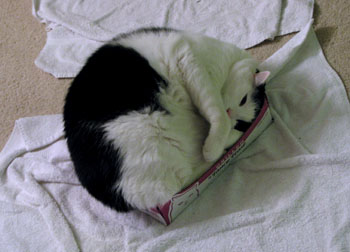
    SUNDAY BONUS CATBLOGGING…. There’s too much tension and stress this weekend over our ongoing financial tsunami. What’s needed is some bonus catblogging to explain in layman’s terms how we got into this mess.

    In today’s installment, Inkblot demonstrates graphically what happened to our banking system. Like the titans of our financial industry, last night he became convinced that the answer to all his problems was increased leverage. With enough leverage, along with some positive thinking, he was sure he could fit himself into the box lying on the floor. And he almost did it. Unfortunately, he eventually found himself forced to deleverage his position, at which point the box went kablooey and he needed to be bailed out. Sort of like our banks. Lesson learned?

  • Quote of the Day – 10.12.08


    QUOTE OF THE DAY….From IMF chief Dominique Strauss-Kahn, commenting on the financial crisis:

    “Intensifying solvency concerns about a number of the largest U.S.-based and European financial institutions have pushed the global financial system to the brink of systemic meltdown.”

    If he means “largest” literally, he’s talking about Citi, Chase, and BofA. I wonder if he’s talking literally?

    Also: why only U.S. and European banks? How are things going in Asia and Australia? How have they managed to avoid the contagion?

