• Security Agreement Update


    SECURITY AGREEMENT UPDATE….From Juan Cole:

    Al-Hayat reports in Arabic that its sources in Baghdad say that the al-Maliki government will sign off on a security agreement with the Bush administration “within days.” The report says that Grand Ayatollah Ali Sistani has assured the government that he will accept the agreement if it can pass parliament. Pundits are debating how likely the measure is to get through the Iraqi legislature, with some denying it has a chance and others saying it will sail through.

    Cole suggests this might be an attempt at an “October surprise,” but I don’t really see that. It’s been in the works for months, everyone knows it’s been in the works for months, and even if it passes the Iraqi parliament it’s hardly election-changing news anyway. I’m surprised it’s taken as long as it has, but my guess is that the delay has been of a fairly mundane variety.

  • Tracking the Markets


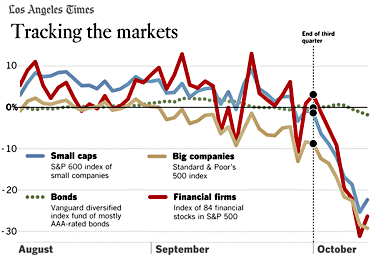
    TRACKING THE MARKETS….Am I the only one who finds this chart that I adapted from today’s LA Times a little puzzling? Yes, financial stocks are down a bit more than either big caps or small caps, but shouldn’t they be down a lot more?

    As usual, maybe I’m just missing something here. But if our banking system is systemically undercapitalized; if the global financial system is close to meltdown; and if the solution is likely to include massive share dilution from a federal government equity injection, shouldn’t financial stocks be sucking really, really hard? Can someone enlighten me?

  • Troopergate Finale


    TROOPERGATE FINALE….I read most of the Branchflower report on Troopergate last night, but the MSM seemed to be doing a fine job of reporting the results all its own so I never got around to posting about it. The basic story, of course, revolves around Todd and Sarah Palin’s crusade to get their ex-brother-in-law, Mike Wooten, fired from his job as a state trooper, and their efforts to get Alaska’s Commissioner of Public Safety, Walt Monegan, to do the firing. Most of this story is pretty well known already. However, Time’s Nathan Thornburgh points out the aspect of the report that struck me as the most remarkable:

    The result is not a mortal wound to Palin….But the Branchflower report still makes for good reading, if only because it convincingly answers a question nobody had even thought to ask: Is the Palin administration shockingly amateurish? Yes, it is. Disturbingly so.

    The 263 pages of the report show a co-ordinated application of pressure on Monegan so transparent and ham-handed that it was almost certain to end in public embarrassment for the governor.

    ….Monegan and his peers constantly warned these Palin disciples that the contact was inappropriate and probably unlawful. Still, the emails and calls continued — in at least one instance on recorded state trooper phone lines.

    The state’s head of personnel, Annette Kreitzer, called Monegan and had to be warned that personnel issues were confidential. The state’s attorney general, Talis Colberg, called Monegan and had to be reminded that the call was putting both men in legal jeopardy, should Wooten decide to sue. The governor’s chief of staff met with Monegan and had to be reminded by Monegan that, “This conversation is discoverable … You don’t want Wooten to own your house, do you?”

    Monegan pointed out to a steady stream of people that (a) Wooten was protected by civil service and there was nothing more that could be done since he’d already gone through a formal disciplinary procedure, and (b) any conversation about Wooten was discoverable in court if Wooten ever got tired of being hounded and decided to file a civil suit. And yet the contacts kept coming and coming and coming — and coming and coming. And Branchflower documents them in painful detail. It’s all quite remarkable.

    In fact, here’s the part that really puzzles me: what exactly did Todd and Sarah Palin hope to accomplish? Surely they knew perfectly well that Monegan was right: he couldn’t have fired Wooten even if he wanted to. And they must also have known that even if Monegan were replaced, any replacement would quickly check into the situation and report back the same thing. Wooten had already been disciplined, and unless something new cropped up there was simply nothing that anyone could do to force him out of his job. In fact, the Palins’ efforts probably made it nearly impossible even to reassign Wooten since it would so obviously have been politically motivated. It was a completely futile crusade they were on.

    So what were they thinking? Or were they?

  • Banks


    BANKS….Justin Fox on the “shadow banking system”:

    And another thing: If you borrow short and lend long, you’re effectively a bank. It’s becoming ever less clear to me what justification there is for nonbank borrow-short-lend-long-institutions other than regulatory arbitrage.

    Brad DeLong responds:

    Not just “effectively” a bank. You are a bank. Not until the twentieth century did we have organizations that borrowed short and invested long that did not call themselves “banks.” The emergence of non-bank banks has always been the result of attempts at regulatory arbitrage.

    So what’s the answer? What should our 21st century definition of “bank” be for regulatory purposes? Any entity that invests other people’s money in any way? That can’t be right, can it? Or can it?

  • Dialing it Down


    DIALING IT DOWN….OK, credit where it’s due. After watching his campaign events turn into increasingly ugly free-for-alls, John McCain has apparently decided that enough’s enough. Ana Marie Cox reports on his latest rally in Minnesota:

    But then something weird happens: He acknowledges the “energy” people have been showing at rallies, and how glad he is that people are excited. But, he says, “I respect Sen. Obama and his accomplishments.” People booed at the mention of his name. McCain, visibly angry, stopped them: “I want EVERYONE to be respectful, and lets make sure we are.”

    The very next questioner tried to push back on this request, noting that he needed to “tell the American the TRUTH about Barack Obama” — a not very subtle way, I think, to ask John McCain to NOT tell the truth about Barack Obama. McCain told her there’s a “difference between record and rhetoric, and I plan to talk about his record, respectfully… I don’t mean that has to reduce your ferocity, I just mean it has to be respectful.”

    And then later, again, someone dangled a great big piece of low-hanging fruit in front of McCain: “I’m scared to bring up my child in a world where Barack Obama is president.”

    McCain replies, “Well, I don’t want him to be president, either. I wouldn’t be running if I did. But,” and he pauses for emphasis, “you don’t have to be scared to have him be President of the United States.” A round of boos.

    And he snaps back: “Well, obviously I think I’d be better. “

    Of course, this is kind of the best of both world: Crazy base-world gets to bring up Ayers and whatever else, really, and he gets to say, “Be respectful.” But I think he means it.

    UPDATE: Indeed, he just snatched the microphone out the hands of a woman who began her question with, “I’m scared of Barack Obama… he’s an Arab terrorist…”

    “No, no ma’am,” he interrupted. “He’s a decent family man with whom I happen to have some disagreements.”

    Good for him. Now I wonder if he can get the same message out to Sarah Palin?

  • Friday Cat Blogging – 10 October 2008


    FRIDAY CATBLOGGING….I’ve still got a lot on my mind today, but I guess that’s true for all of us, isn’t it? So let’s call it a week anyway and spend the rest of the day winding down and admiring our cats instead. They deserve it.

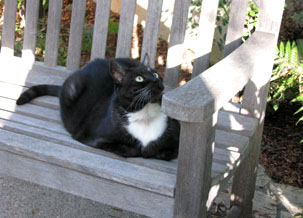
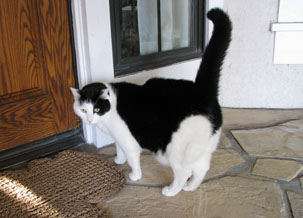
    Today we have action shots. Sort of. On the left, what is Domino looking at? A bird? A plane? Superman? No: it was a bird after all. To be precise, a hummingbird flitting around the garden for her occasional amusement. On the right, you’ll notice the extreme bushiness of Inkblot’s tail. I’m not entirely sure what caused it, but circumstantial evidence suggests he took note of a neighborhood dog and came charging around the corner to run into the house. Thus the tail. He knows perfectly well that the back door is open, of course, but he’d rather have somebody open the front door for him instead.

    We are currently suffering from a cat food liquidity crisis, and it’s now time for resolute action to prevent it from turning into a cat food insolvency crisis and causing full blown feline panic. So I’m off to the store. Have a good weekend, everyone.

  • “William F. Buckley’s Son Says He Is Pro-Obama.”


    “WILLIAM F. BUCKLEY’S SON SAYS HE IS PRO-OBAMA”….Christopher Buckley explains why he’s not writing his endorsement of Barack Obama in his usual column at the back of National Review, the magazine his father founded:

    My colleague, the superb and very dishy Kathleen Parker, recently wrote in National Review Online a column stating what John Cleese as Basil Fawlty would call “the bleeding obvious”: namely, that Sarah Palin is an embarrassment, and a dangerous one at that. She’s not exactly alone. New York Times columnist David Brooks, who began his career at NR, just called Governor Palin “a cancer on the Republican Party.”

    As for Kathleen, she has to date received 12,000 (quite literally) foam-at-the-mouth hate-emails. One correspondent, if that’s quite the right word, suggested that Kathleen’s mother should have aborted her and tossed the fetus into a Dumpster. There’s Socratic dialogue for you. Dear Pup once said to me sighfully after a right-winger who fancied himself a WFB protégé had said something transcendently and provocatively cretinous, “You know, I’ve spent my entire life time separating the Right from the kooks.” Well, the dear man did his best. At any rate, I don’t have the kidney at the moment for 12,000 emails saying how good it is he’s no longer alive to see his Judas of a son endorse for the presidency a covert Muslim who pals around with the Weather Underground. So, you’re reading it here first.

    The modern GOP is the party of Newt Gingrich, Tom DeLay, Karl Rove, George Bush, Dick Cheney, John McCain, and Sarah Palin. It’s not just off the rails. It doesn’t even know where the rails are anymore.

  • “Off With His Head!”


    “OFF WITH HIS HEAD!”….Steve Benen describes the ugliness of the Republican Party’s recent rallies and campaign events:

    The McCain campaign has deliberately been whipping the angry, far-right Republican base into a frenzy. That includes increasing frequency of “Hussein” references, but it also includes looking the other way while campaign supporters exclaim “treason!,” “terrorist!,” and “kill him!” during official rallies.

    On Wednesday, during a McCain harangue against Obama, one man could be heard yelling, “Off with his head!” On Thursday, Republicans erupted when an unhinged McCain supporter ranted about “socialists taking over our country.” Instead of calming them down, McCain said the lunatic was “right.”….Slate’s John Dickerson described the participants’ “bloodthirsty” tone.

    The danger here is not mobs of violent Republicans marching through the streets. The danger is that John McCain is setting us up for a repeat of the 90s, an era that conservatives to this day have never been willing to come to grips with. If the looney-bin right decides to treat President Obama as not just an opposition leader, but as a virtual enemy of the state, as they did with Bill Clinton, it’s going to be a very, very long eight years. Whatever grownups are left in conservative-land really need to step up to the plate soon before their movement goes even further off the rails than it already is.

  • Selling War


    SELLING WAR….Want to learn more about Randy Scheunemann, John McCain’s crazy top foreign policy advisor? The one responsible for marketing Ahmed Chalabi and the Iraq war to a gullible media? And tutoring Sarah Palin in neocon nutbaggery? Sure you do. Laura Rozen’s got you covered here.

  • Trading Derivatives


    TRADING DERIVATIVES….Megan McArdle on the banking crisis:

    One of the smarter ideas I’ve heard for trying to prevent this sort of thing next time around is putting derivatives on exchanges. Most derivatives are traded over the counter, in part because US bankruptcy law encourages it: as I understand it, derivative counterparties don’t have to get in line with the others, but can seize any collateral they can get their hands on.

    Exchange trading enhances transparency, by making it clear what’s out there and roughly who owns it. It also moves the clearing risk to the exchange; while exchanges do fail, they do so much less often than financial firms, and if intervention is needed, they provide a centralized locus for any private or public action.

    I’ve been noodling over a list of regulatory changes that ought to be on the table for the next administration, and this is one of them. Credit default swaps, in particular, should be registered like any other security and traded on public exchanges. This wouldn’t make them 100% safe (stock markets have bubbles and busts too, after all), but it would certainly make them a lot safer.

    On the other hand, I’d like to hear an argument for even allowing CDOs to exist in the first place, whether they’re publicly traded or not. It’s one thing to chop up securities into different tranches that appeal to different classes of investors — that’s just marketing — but with very rare exceptions the overall yield of such an instrument should be nearly the same as the yield of the underlying securities themselves. A little less, in fact, since you have to factor in additional administrative costs. But the fundamental idea behind modern CDOs is exactly the opposite: not merely that they’re providing a bit of convenience or regulatory arbitrage, but that if you bundle up a bunch of securities and then chop them up in specific ways, they’ll be magically worth much more than the underlying securities themselves. Much more. But this violates a basic law of economics. We’d prosecute for fraud anyone selling a perpetual motion machine, and I’m not sure why CDOs are really any different. Done properly, the market for CDOs ought to be small and sleepy, barely worth anyone’s attention. If it gets non-sleepy, that means it’s becoming fraudulent. So maybe it’s just not worth having at all?

    Needless to say, I have no idea how you’d go about banning a particular class of security. And I suppose it’s possible that the underlying problem is with the rating agencies, not the CDO packagers — though real life being what it is, I suspect that’s a distinction without a difference.

    In any case, I’d like to hear the argument. Why should we allow the sale and marketing of CDOs at all?