• Chart of the Day – 12.17.2008


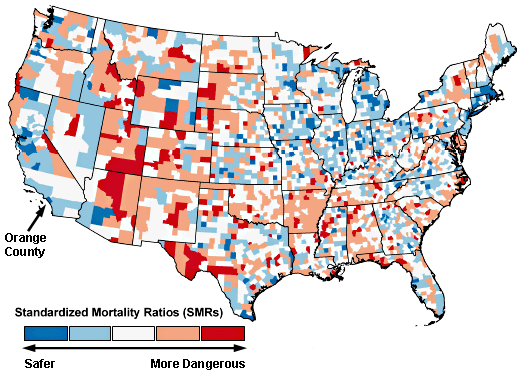
    CHART OF THE DAY….From “Spatial patterns of natural hazards mortality in the United States,” this map shows where you’re most likely to die from natural disasters. (Data is from 1970-2004.) As you can see, my hometown of Orange County is one of the safest places in the country, despite its worryingly close proximity to the San Andreas fault. You see, although you may think that earthquakes are dangerous, it turns out they are a mere rounding error when it comes to dying at the hands of nature’s awesome wrath. By far the biggest causes of death by natural disaster are cold weather, hot weather, lightning, flooding, and tornadoes. Earthquake deaths are so microscopic they don’t even get a category or their own.

    On the other hand, we’re still waiting for the Big One out here. This map could change color at any time.

    (By the way, just eyeballing this, it looks to me like Massachusetts is the safest state in the union. Connecticut and Rhode Island are pretty good too. Who knew?)

  • Public Works


    PUBLIC WORKS….California is on the verge of cancelling hundreds of public works projects because it can’t sell the revenue anticipation bonds needed to continue financing them:

    Road, levee, school and housing construction projects throughout California are on the verge of being halted or delayed, as state officials prepare to shut off their financing in the most drastic fallout yet from California’s cash crisis.

    Officials plan to meet today to freeze financing on these projects and about 2,000 others, including park improvements, environmental restoration and repairs to state prisons.

    ….Lockyer told legislators last week that halting public-works projects would have a ripple effect through California’s economy, costing private companies $12.5 billion and eliminating 200,000 jobs.

    Let me just say up front that California’s problems are largely of our own making. If the rest of the country has zero sympathy for us, I don’t really blame them.

    Still, this is a national problem, not just a local one. And if infrastructure spending is good stimulus, but the problem is that it takes a long time to get it up and running, then surely, at a minimum, you wouldn’t want to lose a single dollar of infrastructure spending that’s already in progress. Especially when the immediate problem has been caused by the freezing of the credit markets more than by California’s fiscal recklessness. TARP to the rescue?

  • Person of the Year


    PERSON OF THE YEAR….In a shocking surprise, Time has named Barack Obama their person of the year. Yawn. I would have voted for one of those cheesy group picks, in this case “America’s mortgage bankers and Wall Street rocket scientists.” I mean, if touching off the 21st century version of the Great Depression doesn’t make you person of the year, what the hell does it take?

    Runners up were Henry Paulson, Nicolas Sarkozy, Zhang Yimou, and, in a tremendous diss to poor old John McCain, Sarah Palin. Feh. Tina Fey would have been a more deserving choice.

  • Arne Duncan on the Court


    ARNE DUNCAN ON THE COURT….I don’t know anything about Arne Duncan’s actual views on education, but what you’re really thirsting for is some insight into his hoops skills, right? So here you go, courtesty of reader JT, who was friendly with the basketball coach at University High three decades ago and ended up played pickup games with the 16-year-old Duncan in the University High gym:

    On Sunday afternoons, John would open the UHigh gym to his friends and his team….It was there that I ended up playing against and with Arne Duncan and then watching him play in UHigh games.

    Arne was a very intelligent (Doh!) and very unselfish basketball player. If I recall rightly, he was the tallest player on the team, but he was also the best ball-handler. He had a good jump shot, but he was slow and not extremely quick. What he did have, however, was outstanding court vision. If you were going to be open off a cut, or a break out, he would see it before it occurred and get you the ball in position to do something with it.

    Indeed, I recall John complaining that Arne was TOO unselfish. He was by far the best shooter on the team, and most of his teammates could not do enough with the ball when they got it.

    I have no idea what, if anything, this means. Does outstanding court vision translate into awesome bureaucratic infighting skills? Does great ball handling mean he knows how to handle the teachers unions? Speculate away!

  • Out of Iraq


    OUT OF IRAQ….Barack Obama visited an elementary school today and chatted with the children. From the pool report:

    Then he told the kids he was opening the floor to questions, and proceeded to take more than double the number of questions than he took at his press conference….One child ask him about iraq and he said he plans to have troops home in.a year and a half.

    This is good to hear. Obama wouldn’t lie to a bunch of fourth graders, would he?

  • Median Wages


    MEDIAN WAGES….So let’s assume that we manage to stabilize the economy sometime soon via whatever combination of stimulus spending, tax cuts, and bailouts you think is best. What’s next? Where will demand come from to get the economy moving normally again? Paul Krugman comments:

    I find it useful to compare U.S. spending in recent years with spending in the mid-90s, when things seemed much more sustainable. What changed? Well, we had bloated housing investment and bloated consumer spending. Meanwhile, nonresidental investment as a percentage of GDP was about the same in 2007 as it was in 1996.

    So what offset the consumer/housing boom? A vastly increased trade deficit. And that suggests that a return to normalcy would involve getting savings up, housing spending down, and a combination of more exports and less imports.

    I think the big thing I’d add to that is growth in median incomes. One way or another, there’s really no way for the economy to grow strongly and consistently unless middle-class consumers spend more, and they can’t spend more unless they make more. This was masked for a few years by the dotcom bubble, followed by the housing bubble, all propped on top of a continuing increase in consumer debt. None of those things are sustainable, though. The only sustainable source of consistent growth is rising median wages. The rich just don’t spend enough all by themselves.

    The flip side of this, of course, is that rich people are going to have to accept the fact that they don’t get all the money anymore. Their incomes will still grow, but no faster than anyone else’s.

    How do we make this happen, though? I’m not sure. Stronger unions are a part of it. Maybe a higher minimum wage. Stronger immigration controls. More progressive taxation. National healthcare. Education reforms. Maybe it’s just a gigantic cultural adjustment. Add your own favorite policy prescription here.

    This isn’t just a matter of social justice. It’s a matter of facing reality. If we want a strong economy, we can only get it over the long term if we figure out a way for the benefits of economic growth to flow to everyone, not just the rich. This is, by far, Barack Obama’s biggest economic challenge. Until median wages start rising steadily and consistently, we haven’t gotten ourselves back on track.

  • Torture


    TORTURE….Responding to Andrew Sullivan, Reuel Marc Gerecht defends his defense of torture:

    I take it from your post that if you had been confronted on 7 September 2001 with a captured Khalid Shaykh Muhammad or Abu Zubaydah and you knew that a major, mass-casualty terrorist strike was about to go down in the United States, and you had plenipotentiary authority for the nation’s security, you would not have used any physically coercive techniques against the gentleman? Okay, but I do believe that moral men can go the other way, and I strongly suspect that the vast majority of Democrats and Republicans elected or appointed to high office would go the other way.

    ….Would that the Clinton and the Bush administrations — especially the Bush administration — had started a public discussion of what we do with holy warriors who live to slaughter thousands….You might not like what America’s legislature would have decided (Andrew, what was your position on this in 2001/2002?), but it would have carried the approval of more of the American people’s representatives.

    Sadly, I suspect that Gerecht is right: if torture had been put to a vote back in 2001, it would have passed. The language would have been prettied up, of course, but the intention would have been clear enough and the public would have approved. Even today, I’m pretty sure that a majority of Americans are basically OK with torture as long as it’s mostly kept out of sight and they can go about their business.

    But even for torture apologists like Gerecht, I wonder how far they’re willing to go. He must know that over the past few years we’ve tortured a steady and sizeable stream of people who were either decidedly small fish or else just completely innocent. How many of those people is he willing to brutalize on the slim chance that once, someday, we’ll just happen to have someone in our custody who knows about a terrorist plot scheduled for tomorrow and can be successfully tortured into giving it up in time? Dozens? Hundreds? Thousands? Where exactly does he draw the line?

  • Taxes of the Rich and Famous


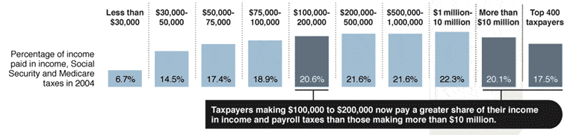
    TAXES OF THE RICH AND FAMOUS….Ezra Klein is doing tax wonkery over at his place, and I can’t let him have all the fun. So just for the record, here’s a look at effective federal tax rates in general:

    Not very progressive! Add in state and local taxes and it would look flatter still. And just to remind everyone of exactly what that “Top 400 Taxpayers” segment at the far right looks like, here are the pinkos over at the Wall Street Journal to explain it to you:

    The top 400 taxpayers have greatly increased their share of individuals’ income since the mid-1990s. The group accounted for 1.15% of total income in 2005….more than twice as large as its 0.49% share a decade earlier.

    ….The average federal income-tax rate for the group was 18.23%….well below the average income-tax rate of nearly 30% back in 1995, when Bill Clinton was in the White House.

    So there you have it. The top 400 taxpayers, a group so rich and elite that I’d need scientific notation to properly represent their proportion of the population, have doubled their share of income in the past decade or two but have decreased their tax burden by nearly half. Nice work! As you can see, Warren Buffett wasn’t exaggerating when he said his secretary paid a higher tax rate than he does. If she pays more than 18% — not exactly a tough hurdle when you figure that payroll taxes already account for about 8% of that — she probably does.

    UPDATE: So how do the rich do it? Jonathan Stein interviews David Cay Johnston here to find out.

  • Arne Duncan for Ed Secretary


    ARNE DUNCAN FOR ED SECRETARY….It’s odd, but possibly the most contentious appointment Barack Obama has in his portfolio is someone to head up the Department of Education. The war on the left between the “reformers” and the “everyone elses” in the ed world makes battles over Afghanistan or bailing out GM look tepid by comparison, and apparently Obama decided he didn’t really want to pick sides. Dana Goldstein comments on Obama’s pick of Arne Duncan, the latest in his almost unbroken series of senior staff needle-threading exercises:

    Duncan is one of the only prominent education leaders in the country who signed both the Broader, Bolder and the Education Equality Project manifestos. Duncan, a longtime Obama friend and adviser, has shown particular interest in early childhood education, a major part of Obama’s education and anti-poverty agenda. And he sends his own kids to Chicago public schools. Here’s hoping he’ll live in the city when he moves to D.C. and continue his family’s track record of support for the public system.

    ….Any pick of an actual superintendent to head the Department of Education, as opposed to a governor relatively ignorant of the nitty gritty of education debates, is a move by Obama in the direction of serious, hands-on reform. That’s good news, I think, for those of us — regardless of ideology — who hope education will become a first tier issue under the Obama administration.

    I guess so — though Rod Paige was a superintendent too, and that didn’t do much to make education a first tier priority in the Bush administration beyond passing NCLB.

    There’s something a little surreal about all this, though. At the risk of sounding like an idiot TV talking head, I’m beginning to wonder if Obama plans to appoint anyone who’s even the teensiest bit controversial to his senior staff. (And no, Rahm Emanuel very decidedly doesn’t count. Give me a break.) There’s something sort of oppressively bland about this entire exercise, and I say that as someone who’s about as personally bland as you could ever hope to meet. Still, while I may be all for technocratic competence, I can’t help but feel that No-Drama Obama could use an appointment or two whose only purpose is to mix things up a little and piss off the right people. Who will be his Harold Ickes?

  • Oil Exploration


    OIL EXPLORATION….Dan Drezner is puzzled by news that that the oil majors are cutting exploration projects:

    So, let me see if I have this right:

    1. If oil prices are sky-high, the energy sector explains that it will be slow to develop new fields, because exploration requires massive fixed investments and no one knows what the price of energy will be 5-10 years from now;

    2. If oil prices are low, the energy sector explains that it is unprofitable to develop new fields because… energy prices are low.

    Seriously, am I missing something here? Given lag times and the natural propensity to consume more of something when prices are low, doesn’t it make sense to “drill, baby, drill” when the price of energy is low?

    High oil prices do spur extra exploration, but not by as much as you’d expect. And while uncertainty about future oil prices is certainly part of the problem, I doubt it’s a major one: generally speaking, everyone knows which direction oil prices are going in the long term, and it’s the opposite of “down.”

    No, the underlying issue here is that there really aren’t that many great places left to explore. Last week, for example, Lesley Stahl of 60 Minutes did a breathless segment on Saudi Arabian oil exploration that would have done credit to a nine-year-old. She went out to Shaybah, a drilling project that’s been three decades in the making, and spent ten minutes gushing over the almost impossible odds the Saudis overcame to get the project up and running. 135 degrees in the shade! Hundreds of miles from nowhere! One hundred million cubic feet of sand! 400 miles of pipeline! Oil that didn’t want to flow! Storage tanks with roofs that move!

    But she never asked the one question she should have: if Saudi Arabia really has as much easily extractable oil as they say they do, why are they building projects like Shaybah? Why not just sink a few holes into the easy stuff instead?

    Almost certain answer: because there isn’t any easy stuff left. It’s either Shaybah or nothing. And that’s pretty much the story in the rest of the world too. There just aren’t any easy sources of oil left. It’s almost all in desolate wildernesses, deep underwater, in polar regions, or locked up in tar sands. And just to make it worse, projects to extract this stuff are risky too. At least half will come up dry after tens of billions of dollars worth of test drilling.

    This is why oil companies are so eager to open up the American coast to drilling. There’s not really very much oil there in the big scheme of things, but at least it’s relatively easy to get to. In the rest of the world, the easy pickings are gone, and the appetite for sinking vast sums to get what’s left just isn’t always there. Like it or not, we’re running out of oil. Spending money on alternatives is looking like a better and better bet to everyone, including even the oil companies.