
From Barack Obama, explaining the value of diplomacy and talk:
“What I do believe is that if we are engaged in speaking directly to the Arab street, and they are persuaded that we are operating in a straightforward manner, then, at the margins, both they and their leadership are more inclined and able to work with us….And if there are a bunch of 22- and 25-year-old men and women in Cairo or in Lahore who listen to a speech by me or other Americans and say: ‘I don’t agree with everything they are saying, but they seem to know who I am or they seem to want to promote economic development or tolerance or inclusiveness,’ then they are maybe a little less likely to be tempted by a terrorist recruiter.”
This is exactly the right formulation, and gives the lie to the endless cavalcade of right-wingers who like to pretend that Obama is some kind of foreign 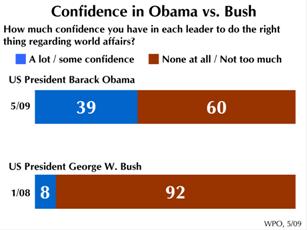 policy naif who’s convinced he can persuade the world’s terrorists and despots into laying down their arms by the power of sweet talk alone. As he’s made clear many times before, though, he’s not. He knows perfectly well that what he’s doing will take a lot of time and will work, at best, “at the margins.” It will reduce the recruiting power of terrorists a bit, it will reduce the intransigence of Middle Eastern governments a bit, and it will reduce the general hatred of American foreign policy a bit. But add up the bits over several years, and they can make a real difference.
Still, there’s no question it’s a long-term project. A recent PIPA poll, for example, shows that the Egyptian public is way more enthusiastic about Obama than about Bush. But click the link for more and you’ll see that their view of U.S. goals in the Middle East is every bit as negative as it’s ever been. This is going to be the work of many, many years.
 Yesterday the blogosphere was crammed with charts showing that if the rise in healthcare costs is reduced by 1.5 percentage points a year, then long-term healthcare costs would be a lot lower than current projections. That’s hard to argue with, but what I kept wondering is, how are healthcare costs going to be reduced 1.5 percentage points a year? The Council of Economic Advisers produced the charts, so
 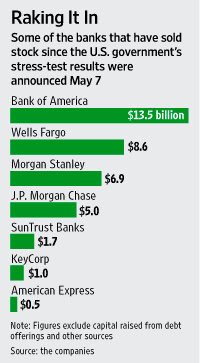 A few days ago I wrote that I was hopelessly confused about what was going on with the economy. Here’s Exhibit A: I thought it was a fantasy to expect banks to raise lots of private capital after the stress tests were completed, but apparently
  I just got back from the optometrist with my first pair of bifocals. (Thanks, Ben!) Progressives, actually, and I guess these things take some getting used to, don’t they? I stopped in at the market on my way home, and when I moved my head around while looking down an aisle I felt like I was watching a bad student film project from the 60s. Weird. But I suppose my neurons will eventually adjust and trick me into thinking that everything is OK. Or will they? I actually don’t wear my glasses very much, so it might take a while for my brain to figure out the new order of things. We’ll see. In the meantime, hopefully I’ll be able to watch TV and do a crossword puzzle at the same time once again.
 President Obama has taken a surprisingly hard line on expansion of Israeli settlements in the West Bank, but what’s even more surprising is how little pushback he’s gotten so far from Israel’s supporters in the U.S.
 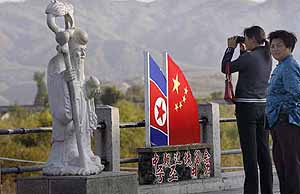 It’s true, as Anne Applebaum says, that China is the only country in the world with any real influence over North Korea. So why do they put up with Kim Jong-il’s antics? The usual answer is that they’re afraid of pushing too hard lest his regime collapse and send millions of refugees streaming across the border into Manchuria. Applebaum, however, speculates that that isn’t it at all.



