
A couple of days ago I wrote about Britain’s proposed super-tax on big bank bonuses. Today, via , I see that it would work a little differently than I thought:
Banks will be charged a 50 percent tax on 2009 bonuses of more than £25,000, or $40,800. It will be imposed on the pool of bonuses paid by a bank, rather than individual payments, and it will be paid by the bank — not by the recipient of the bonus. It will take effect immediately and will affect banks’ 2009 profits.
For what it’s worth, I like this approach better than an individual tax because it gets more directly at what the immediate outrage is. Basically, the banking system was about to go under last year as a result of its own folly and was rescued by the government. With a couple of exceptions, however, instead of outright nationalizing the weakest banks, the rescue plans in both Britain and the U.S. were aimed at boosting bank profits and letting them earn their way back to solvency. You can argue about whether this was the right approach or not, but it’s the approach we took. Given that, it makes sense to give banks a strong incentive to retain their outsize earnings and use them to strengthen their balance sheets instead of paying out huge bonuses to their traders and executives.
Of course, this also puts paid to the whole idea that the tax might be a human rights violation. Unless you want to argue that a bank has human rights. Do you?

 But drug reimportation has lots of Republican supporters too, including Olympia Snowe, David Vitter, Chuck Grassley, and John McCain.
  Joe Lieberman’s latest excuse for not supporting a public option is that it would pay lower prices to hospitals, which would then make up the difference by charging higher prices to everyone else.1 This is called “cost shifting,” and this morning I got a timely email from Austin Frakt telling me that there was some handy new high-quality research from Vivian Wu on exactly this question. Is Lieberman right?
 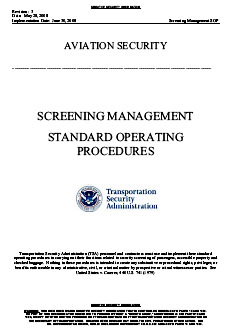 As you all know, the Transportation Security Administration mistakenly posted a copy of its screening manual a few days ago, providing access to lots of interesting little nuggets about how they operate. The manual was supposed to have sensitive portions blacked out, but as in so many previous cases, the people who did it didn’t realize that
  Ever since, participants have been trying to figure out how to salvage things, and today Jonathan Pershing, the Obama administration’s deputy special climate change envoy, took his crack at the spin machine.
 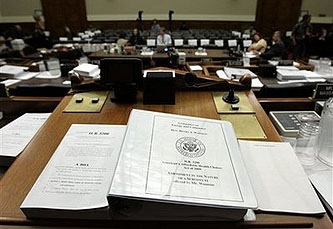 On an ABC news segment about healthcare tonight, Jonathan Karl said, “Democrats in the Senate are more optimistic on this than I have seen them in a long time.” Why? Because they think they’ve struck a deal that can get 60 votes. Most reports I’ve seen agree on the basics,



