Get your news from a source that’s not owned and controlled by oligarchs. Sign up for the free Mother Jones Daily.

Matea Gold and Jordan Steffen of the LA Times do yeoman work today trying to show that women were an outsize part of the Democratic loss last week:

“I think women just did not see an economic narrative that was meaningful to them,” said pollster Celinda Lake. “It really has to speak to the kitchen table. It can’t just speak to banks and Wall Street.”

During a year when the economy was the dominant concern in the electorate, single women were likely to feel those pressures even more acutely. “Unmarried women are the most economically vulnerable group, particularly if they have children,” said Anna Greenberg, a Democratic pollster. “While there has been a lot of discussion in this recession about men and manufacturing jobs, it still is the case that unmarried women are the poorest. If they feel their concerns aren’t being addressed by Obama and the Democrats around the economy, it sort of makes some sense there was a decline.”
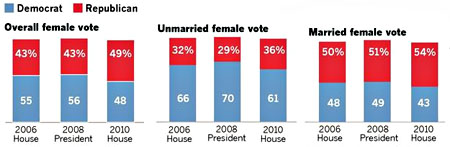
This kind of thing pisses me off. One of the reasons I do a biannual review of the exit polls is precisely to head off this kind of nonsense. Not that Gold and Steffen had to read my post to figure out what was going on: their own chart shows that nothing special was happening among women. Overall, Republicans did about 7-8 points better than in 2006. Among women, they only did 6 points better. Among unmarried women, they only did 4 points better. Among married women, they only did 4 points better. In other words, women were more loyal than average to Democrats this cycle. They switched in lower numbers than most other groups. Far from feeling economic pressures “more acutely,” they apparently felt them less acutely by a small margin.

But stories need narratives, whether they’re correct or not. “Nothing special happening among women” might be accurate, but I guess it doesn’t make a very good headline.


From the desk of Mother Jones CEO, Monika Bauerlein...

Newsrooms can be funded in many ways. One of the most controversial (and volatile) ways is by a for-profit corporation or a billionaire owner. We see it across the headlines on a weekly basis: the claw backs in public media, the gutting of The Washington Post, the bending over backwards to appeal to Trump and his allies.

But not here.

When Mother Jones first started publishing 50 years ago, our founders made a critical decision: to be a reader-supported nonprofit. They knew that no corporate owner would be interested in a muckraking newsroom; they also knew that no muckraking newsroom would be interested in following the agenda of a corporate owner.

And so, we’ve been reader-funded for half a century. We rely on contributions from our readers—readers like you—whether it’s $50, or $15 a month, or whatever fits your budget. People give what they can, and every donation makes a difference for our newsroom, which has grown tremendously—in size and reach and renown—since its inception in 1976.

You may be wondering: What does it take to publish an investigation? And what does my donation actually fund? The answers are one and the same: It takes people, resources, and time. And that’s what your donation funds directly.

Every donation Mother Jones receives from readers fortifies our newsroom, whether we’re covering underreported scandals out of Washington, DC, or the most important news of the day. And right now, each donation will be doubled because of our $50,000 match. So when you make a donation—$5, $50, any amount—it’ll go twice as far.

Your support keeps us going. If you’re able, donate today.

Thanks for reading.

—Monika

From the desk of Mother Jones CEO, Monika Bauerlein...

Newsrooms can be funded in many ways. One of the most controversial (and volatile) ways is by a for-profit corporation or a billionaire owner. We see it across the headlines on a weekly basis: the claw backs in public media, the gutting of The Washington Post, the bending over backwards to appeal to Trump and his allies.

But not here.

When Mother Jones first started publishing 50 years ago, our founders made a critical decision: to be a reader-supported nonprofit. They knew that no corporate owner would be interested in a muckraking newsroom; they also knew that no muckraking newsroom would be interested in following the agenda of a corporate owner.

And so, we’ve been reader-funded for half a century. We rely on contributions from our readers—readers like you—whether it’s $50, or $15 a month, or whatever fits your budget. People give what they can, and every donation makes a difference for our newsroom, which has grown tremendously—in size and reach and renown—since its inception in 1976.

You may be wondering: What does it take to publish an investigation? And what does my donation actually fund? The answers are one and the same: It takes people, resources, and time. And that’s what your donation funds directly.

Every donation Mother Jones receives from readers fortifies our newsroom, whether we’re covering underreported scandals out of Washington, DC, or the most important news of the day. And right now, each donation will be doubled because of our $50,000 match. So when you make a donation—$5, $50, any amount—it’ll go twice as far.

Your support keeps us going. If you’re able, donate today.

Thanks for reading.

—Monika

We Recommend

Latest

Sign up for our free newsletter

Subscribe to the Mother Jones Daily to have our top stories delivered directly to your inbox.

Get our award-winning magazine

Save big on a full year of investigations, ideas, and insights.

Subscribe

INDEPENDENT. BECAUSE OF YOU.

Mother Jones has no billionaires calling the shots—just readers like you making fearless reporting possible

Donate