• Philly Fed Says Business Outlook Has Plummeted

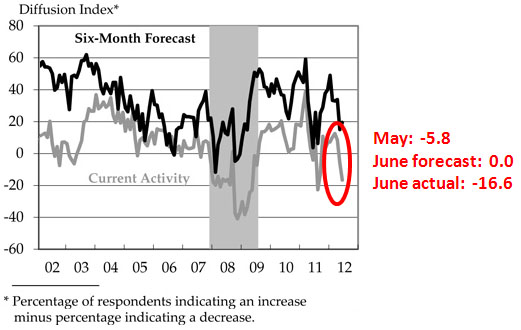
    Joe Weisenthal points us to the Philadelphia Fed’s monthly Business Outlook Survey, which he terms a “disaster.” Here’s what the Philly Fed says:

    The survey’s indicators for general activity, new orders, shipments, and average work hours were all negative this month, suggesting overall declines in business….Nearly 40 percent of the firms reported declines in activity this month, exceeding the 22 percent that reported increases in activity. Indexes for new orders and shipments also showed notable declines, falling 18 and 20 points, respectively.

    Presumably Ben Bernanke and the other Fed governors knew this yesterday, when they met and decided not to do much about the economy. Perhaps they were swayed by the fact that the future outlook remained “positive.” Perhaps they don’t think there’s anything more they can do. I don’t know.

  • Today’s High School Grads Are Just as Good as Yesterday’s

    Tyler Cowen recommends a post from Steve Postrel attempting to explain why students are willing to pay ever higher amounts for a college degree. Unfortunately, it starts like this:

    Typical graduate business school education has indeed become less rigorous over time, as has typical college education. But typical high school education has declined in quality just as much. As a result, the human capital difference between a college and high-school graduate has increased.

    If anyone wants to present some evidence that high school education has declined over the past 30 years, I’m all ears. But as far as I know, there isn’t any such evidence because it isn’t true. I’m willing to buy the idea that there are specific things that high schools don’t do as well as they used to — though if you have examples please provide some real evidence that they’re true! — but overall? Most of the data I’ve seen suggests that today’s high school grads know at least as much, and occasionally even more, than high school grads of the past.

  • The One-Sided War Against Obamacare


    Abby Goodnough of the New York Times explains why misinformation and fear of Obamacare is increasingly widespread. It’s the money, stupid:

    In all, about $235 million has been spent on ads attacking the law since its passage in March 2010, according to a recent survey by Kantar Media’s Campaign Media Analysis Group….Here in the suburbs of Philadelphia, which, according to the Campaign Media Analysis Group, is one of the top five media markets for ad spending against the health care law, it is apparent how such messaging is playing out. (The other top markets are Orlando, Fla.; Tampa, Fla.; Pittsburgh; and Denver, all in swing states.) In interviews with about two dozen residents who were mostly opposed to the law, certain worries, resentments and dark predictions about it came up time and again.

    By contrast, only $69 million has been spent on pro-Obamacare ads, most of it bland public-service spots from HHS. Add to that the fact that most Democrats seem petrified of actually defending the law, and it’s no surprise that the Fox News portrayal of Obamacare has been steadily gaining ground. That’s what happens when you slink into a corner when the other guys declare war.

  • Surprise! Paul Ryan Wants to Cut Taxes on the Rich

    UPDATE: This post originally said that the analysis in the linked report came from the Tax Policy Center. That was an error on my part. It’s actually a report from the chairman’s staff of the Joint Economic Committee, which relied in part on a previous analysis from TPC. I’ve corrected the post throughout. Apologies to all, especially TPC, for the mistaken attribution.


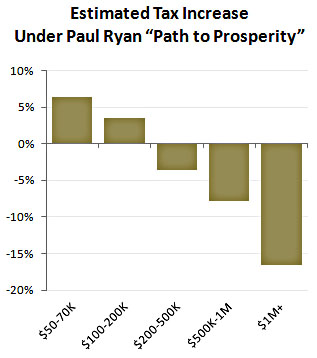
    The Joint Economic Committee released an analysis today of the tax implications of Paul Ryan’s “Path to Prosperity,” based partly on work from the Tax Policy Center, and you will be unsurprised at their conclusions. The chart on the right, a rough conversion from JEC’s raw numbers into percentages, tells the tale: if you’re part of the middle class, your taxes will probably go up. If you’re rich, your taxes will go way, way down.

    Ryan and his fans will say that this analysis is unfair because they’ve never released any details about which tax expenditures they plan to eliminate to make up for their reductions in the base tax rate. And it’s true: they haven’t. But that’s pure politics: they know perfectly well that eliminating deductions and tax credits is wildly unpopular, and if they actually fessed up to these details, even the most ardent tea partier would suddenly become a pitchfork-wielding foe of Ryan’s plan.

    Still, Ryan’s reduction in tax rates costs about $4.5 trillion over ten years, and there are only so many places you can make up that kind of dough. So JEC made some educated guesses about what deductions would have to be cut, and then gamed out the net effect of the whole thing. If Ryan had the courage to release his own plan, it would differ in detail from the JEC estimate, but probably not by a lot. The JEC numbers are almost certainly in the right ballpark.

    In any case, if Ryan thinks this is unfair, all he has to do is release a plan of his own that can be scored in the normal way. The fact that he consistently refuses to do so tells you all you need to know about how serious he really is about this stuff. Answer: not at all.

  • A Conservative Suggests We Raise the Capital Gains Tax


    James Pethokoukis asks:

    Should we eliminate corporate income taxes and raise capital gains taxes?

    Hmmm. I’m guessing he thinks the answer is no. But wait! Maybe not:

    I have already suggested that Mitt Romney propose axing the corporate tax. Combining that with an increase in the capital gains tax—a tax hike on Romney himself—might be a doable compromise….How about this: A top tax of 28%—back to where it was in 1986 under bipartisan tax reform and close to Obama’s Buffett Rule—on all income along with an elimination of corporate income taxes? Any takers? Any suggested modifications?

    Although I’m not ready to jump on this specific bandwagon quite yet, I’d be willing to talk. There are a bunch of practical problems with eliminating the corporate income tax, but it’s possible they could be overcome. As for the 28% top rate — well, let’s just take that as an opening bid. I doubt you could lower it that much. In fact, I’m not sure you could lower it at all, since higher taxes on investment income might not make up for the loss of corporate income tax revenue. What’s more, capital gains and dividend taxes are going to be raised automatically at the end of the year if the Bush tax cuts aren’t extended, so offering to raise them now isn’t really much of a concession.

    Despite all that, I continue to think this has possibilities. The corporate income tax isn’t just insanely complicated, it’s also impossible to prevent it from becoming an endless honeypot of corporate subsidies and payoffs. Getting rid of it entirely is probably the only way to put an end to this.

    Politically, the biggest problem with this proposal is that once the corporate income tax is gone, it would be gone forever. It’s just too hard to bring it back to life. Conversely, reducing the capital gains tax is simplicity itself. So a likely outcome of all this is that the corporate income tax would go away, and ten years from now we’d be back to the same old low rates on capital gains and dividends because — oh, you know the drill. High investment taxes are hurting capital formation, punishing the job creators, stifling investment, crushing the economy, blah blah blah.

    Still, it’s worth a conversation even if it is pie in the sky. I’d be pretty interested in seeing some neutral revenue and distributional analysis of the whole thing.

  • Fast and Furious Inanity Reaches New Heights

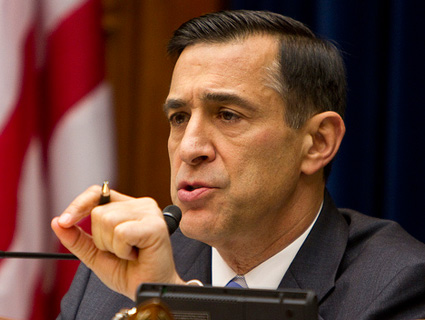
    GOP attack dog and media hound Rep. Darrell Issa (R-Calif.)<a href="http://www.flickr.com/photos/darrellissa/6511655279/in/set-72157628419181479">Darrell Issa</a>/Flickr


    I’m pretty sure I’ve never blogged anything about the Fast and Furious program, which has long struck me as a fairly ridiculous invented controversy that Republicans care about only because (a) it involves guns, and (b) it involves the Obama administration. Darrell Issa, one of the GOP’s star attack dogs, more or less admitted the fever swamp origins of tea party outrage over Fast and Furious when he told Sean Hannity that Obama was using the program to “somehow take away or limit people’s Second Amendment rights.”

    Sigh. Nonetheless, the latest round of responses from Attorney General Eric Holder is troublesome. Issa has been demanding piles of documents from Holder for months, and Holder has been declining for months to produce them. Issa is now threatening to hold Holder in contempt of Congress, and yesterday Holder met with Issa to make one last offer, which Issa declined:

    Holder said after the brief session that Issa rejected his proposal to allow the committee to “review” the documents first, predicting that it would persuade them to not go ahead with the contempt vote.

    Today, the White House asserted executive privilege to justify withholding the documents. Is this legitimate? It might be, but if the documents are truly covered by executive privilege, it’s a little hard to believe that Holder was willing to let the committee “review” them yesterday. Something doesn’t add up.

    On the flip side, of course, it’s a little hard to understand why Issa wouldn’t take him up on the deal if he was sincerely interested in understanding what happened. After all, he could always restart the contempt proceedings if the review didn’t convince him to back down.

    Conclusion: This whole thing is completely ridiculous, just a pointless piece of political theater. I shall now try to return to my previous policy of ignoring it. Anybody got a problem with that?

  • Needed: Development Reform in California


    The Los Angeles city council has unanimously approved a plan to allow higher density construction around metro stations and bus routes in Hollywood, and wealthy residents in the nearby Hollywood Hills aren’t happy about it. So naturally they’re threatening to sue the city for “failing to conduct an adequate environmental review.” As Matt Yglesias points out, this has become sort of an all-purpose vehicle for halting any development that happens to personally annoy people with the money to bring long and expensive court cases:

    This is a splended example of a serious and growing problem in California—spurious bad faith environmental review. There’s no real environmental issue here at all except for the fact that at the margin building a denser urban form in LA will reduce pressure to sprawl outward. Landowners in an adjacent neighborhood just don’t want to allow more people to enjoy the virtues of Southern California living. It’s their perogative to be jerks about this if they want to, but it’s disastrous to have environmental regulations become a free-floating pretext for anyone to stop anything. You can’t build a greener economy without building some stuff—new sources of power, new transmission lines for the electricity, different kinds of transportation infrastructure, houses and shops near that infrastructure—but too many states’ environmental policies are just generically supportive of the status quo.

    This affects ordinary development, of course, but it goes beyond that. Solar and wind installations face the same problem. The LA-San Francisco bullet train is facing the same problem. A new subway extension through Beverly Hills is facing the same problem. I don’t know for sure about other states, but in California at least, this reached epidemic proportions years ago. It’s all but impossible to build anything that’s opposed by rich people or rich interest groups.

    The flip side of this, though, is that buried inside all of the nonsense, the complaining groups sometimes have some legitimate beefs. Without access to a sympathetic court, builders would routinely run roughshod over perfectly sensible rules, submitting environmental reviews that merely go through the motions and fail to address genuine problems. This is most common in poorer areas of the city that don’t have the resources to fight back against sandbagging developers.

    I don’t know enough about this stuff to offer up any kind of solution, but it sure seems like we need one. These fights can last years and kill off valuable development right along with the crap. Can anybody point to some reasonable reform proposals that might streamline development in California and elsewhere without turning the state over to development interests lock, stock, and barrel?

  • How Americans Feel About Foreign Policy

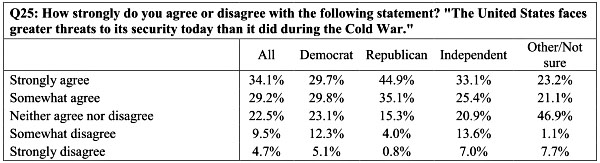
    Dan Drezner points us to a new poll on American attitudes toward foreign policy conducted by Dartmouth professor Benjamin Valentino. It’s got plenty of fodder in it, but Dan points in particular to question 25:

    A full 80% of Republicans think we face worse threats today than we did during the Cold War. Hell, even 60% of Democrats agree with this. I submit to you that American foreign policy has no chance of regaining its sanity until those numbers turn around.

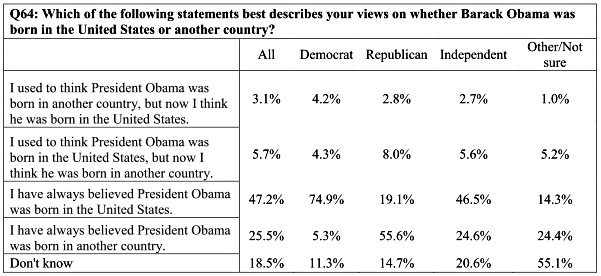
    In other news, there’s also question 64:

    I submit to you that the conservative movement in America has no chance of regaining its sanity until these numbers turn around.

  • Republicans, Hypocrisy, and the Individual Mandate

    Ezra Klein is arguing today with Peter Suderman and Reihan Salam about conservative support for the individual mandate. The question is: why have conservatives flip-flopped? Why did they mostly support it 20 years ago but now unanimously agree that it’s the biggest threat to economic liberty since Das Kapital? Pure cynicism? Motivated reasoning? A genuine change of heart?

    My answer: none of the above. Back in 1993, I’d say that Republican preference ordering on healthcare reform looked roughly like this:

    So what’s a Republican to do? The answer is obvious: choose whichever option is the best one available at the time. If Clinton’s plan looks like it might pass, you support the next best alternative: private insurance with a mandate. If private insurance with a mandate is on offer, you once again support the next best alternative: nothing. There’s not really anything mysterious about this. You don’t need to resort to cynicism, motivated reasoning, or even a genuine change of heart to explain it. You merely need to realize that political actors — both liberals and conservatives — will always fight for the best deal they can get. If you offered me Obamacare, I’d take it, but that doesn’t mean I’d give up fighting for what I really want. Likewise, after conservatives defeated Clintoncare, I wasn’t surprised that they didn’t just rest on their laurels, but kept on fighting for what they really want

    Suderman suggests that something similar has happened with Democrats and mid-90s proposals for premium support as a way of reining in Medicare spending. I think his case is a little weak here — premium support never really had much liberal support in the first place, and the version on offer recently by Paul Ryan that Democrats opposed bore little resemblance to the original proposal anyway — but he still has a point. And the explanation for the liberal shift is much the same as it was for conservatives and the mandate.

    This is politics, and there’s nothing really very shocking about it. If you can cut a deal, that’s great, but you shouldn’t expect that either side will take it as the final word. In fact, you should expect just the opposite: that both sides will continue fighting to change the deal in their own favor.

    As it happens, I think that Paul Ryan’s most recent version of premium support for Medicare isn’t too bad. Given where we are right now, I could imagine it being one side of a negotiation that produces something decent. But even if we came to an agreement, I’d pretty shortly be out there promoting a genuine national healthcare plan that would make it obsolete. Would that be treachery on my part? Of course not. It would just mean I took my half a loaf and then dived right back into campaigning for the other half. Would anyone else do differently?

    POSTSCRIPT: None of this means that hypocrisy doesn’t play a role in the politics of the mandate. As Adam Serwer notes today, Antonin Scalia is probably Exhibit A here.