• Why Obama Is Having Trouble With His Bain-Bashing Message


    The Obama campaign has had a few missteps recently thanks to high-profile surrogates declining to join in on the Bain-bashing message that’s central to Obama’s message. So why does Obama persist in bashing Mitt Romney’s years as a private equity manager at Bain? Why not choose some other line of attack? Because, says Ezra Klein, the Obama campaign has a fantastically sophisticated program for judging which messages resonate with voters, and what resonates with voters are attacks on Bain Capital. Unfortunately, Obama has more than just voters to contend with:

    The problem that I don’t think the Obama campaign anticipated, or has even really known how to deal with, is that the message voters want is not the message political elites want. Top Democrats, who have friends and funders in the private-equity community, need to defend their allies. Pundits and reporters know people in these worlds, pride themselves on being above superficial populism, and so tend to bristle at ads featuring laid-off workers who blame Bain. And then there’s Wall Street itself, which is plugged into the media, has a lot of money, and thus can make its voice heard. That’s the thing about hitting the powerful. The powerful can hit back.

    The good news for Obama, I think, is that Democratic Party elites will fall in line once they figure out that Bain bashing works. Sure, you’d just as soon not piss off your rich friends, but hey. Politics is politics. Nothing personal, you know? See you on the links in December.

    What’s more, contra Ezra, I think this stuff does matter. He’s right that the state of the economy is by far the biggest factor in this year’s election, and if the economy tanks too badly then nothing Obama does will matter. But there’s no longer anything Obama can do about that. All he can do is hope that the economy will be just good enough to keep things close, and as long as things are close all he needs is to pick up two or three more points of support. If his Bain-bashing message gains him those points, it will indeed be almost nothing. Two points out of a hundred! That wouldn’t even show up in the statistical noise of a poli-sci election model!

    But it would also win the election for him. Statistically, it might be invisible. In the real world, it could be the difference between victory and defeat.

  • Chart of the Day: Spain Is Doomed

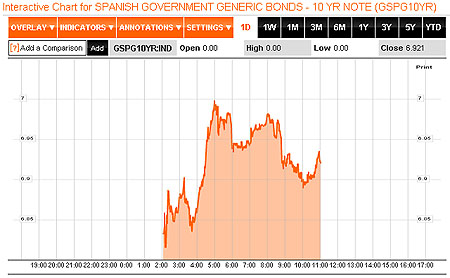
    The EU bailout of Spain’s banks is a mere four days old and investors have now completed the raspberry they gave it on its first day. Yields on Spanish bonds shot up not just past 6 percent, which happened within hours of markets opening on Monday, but have now touched 7 percent, closing today at 6.92 percent. Clearly, the end is near. But that’s not all! Despite today’s news, Germany says it’s had enough:

    The German chancellor warned that there were no “miracle solutions” to the eurozone crisis, even as the yields on benchmark Spanish 10-year bonds climbed above 7 per cent, a level seen as unsustainable by analysts.

    …Underscoring how the European crisis is causing contagion in some of the continent’s largest economies, Italy’s borrowing costs jumped sharply at an auction of €4.5bn of bonds.

    …German policymakers have argued that even Europe’s leading economy is not capable of assuming responsibility for the debts of all its partners. Instead they are seeking negotiations towards a “fiscal union” that would bind the members’ budgets closer together.

    Remember that 11th-hour rescue I was talking about last week? Well, Europe’s come-to-Jesus moment is now looking terrifyingly imminent. Hopefully, Angela Merkel’s tough talk is aimed mainly at the Greeks, who hold another round of elections this weekend, and will soften up next week. If not, who knows? The clock is very definitely ticking away.

  • Belief in Climate Change Is On the Way Back Up

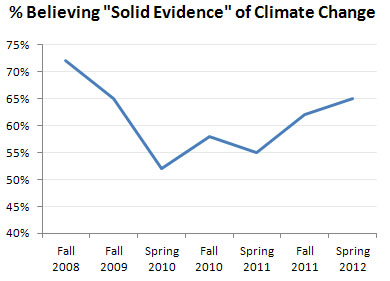
    Climate Progress points us to some good news today. The latest Brookings poll on climate change shows that belief in global warming has continued to rebound from its recent lows. Acceptance of climate change still isn’t as high as its post-Inconvenient Truth peak, but at least progress is being made. Broken down by party affiliation, both Democrats and Independents are stronger believers than in 2010, while Republicans remain mired at the same low levels as always.

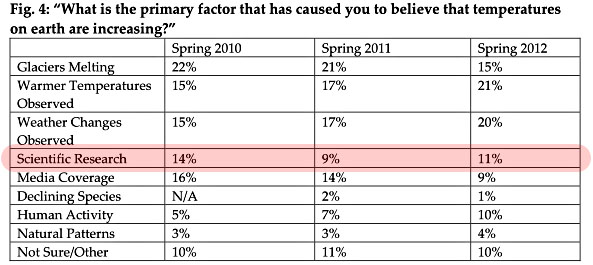
    But the rest of the news isn’t so good. It would be nice to think that people are being swayed by the increasing torrent of scientific evidence about climate change, but it ain’t so. As the table below shows, only 11% of respondents say that scientific research is the main reason for belief in climate change. The most popular reason by far is personal observations of weather and warmer temperatures. And in a followup question, 68% of respondents said recent mild winters have had a large effect on their views.

    Conclusion: liberals need to stop nattering on about the latest research. It may gall us to do it, but anecdotal evidence (mild winters, big hurricanes, wildfires, etc.) is probably our best bet. We should milk it for everything it’s worth.

  • What Do Jamie Dimon’s Cufflinks Tell Us About the Financial-Industrial Complex?

    JPMorgan Chase CEO Jamie Dimon testified before Congress today about his bank’s gigantic trading losses a few weeks ago, and the gist of his testimony was — well, something or other. Basically, nobody laid a glove on him, and Republican senators in particular practically genuflected in his presence. No sir, nobody’s thinking about regulating you any more than you already are! Wouldn’t dream of it!

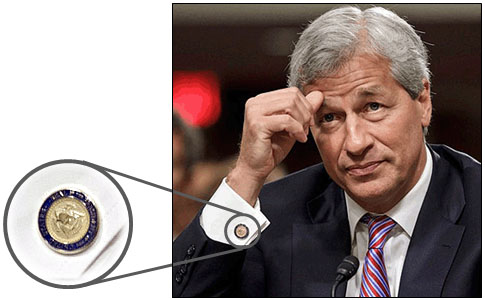
    Or something like that. But the real news that has the chattering classes chattering was Dimon’s fashion accessorizing. It seems that he was wearing presidential cufflinks, and nobody thinks this was just an offhand decision as he dashed out of his mansion this morning. But the question is, what message was he trying to send? There are several possibilities:

    • Don’t fuck with me. The president has my back.
    • Give it up, GOP. I still support Obama no matter how much you suck up to me.
    • Hey Obama. See these? Don’t take them for granted.

    But maybe he meant something else entirely. We need to engage in some Dimonology here. Help me out.

  • Who Reports on the Reporters?

    President Obama is raising less money this year than he did in 2008. Quelle disaster! But wait: during the first half of 2008 Obama was in a tightly contested primary contest. This year he’s running unopposed. So it’s not very surprising that the pace of fundraising is a little less frenetic this time around

    In any case, this is what a couple of political scientists told BuzzFeed’s Rebecca Elliott when she called them to talk about Obama’s money woes for an article she was working on. But apparently that didn’t make a very good story, so their comments never made it into the final piece. Jonathan Bernstein wonders if public complaints about this kind of behavior will change the way reporters operate:

    You know, lots of us (by which I mean both political scientists and anyone who has expertise and gets on reporters’ dial lists) have had the experience of being interviewed as “experts”, only to find that what a reporter really wanted was to find someone to say something the interviewer believed, but needed someone “objective” to say. That’s a well-known phenomenon. What happens, however, when those experts choose to report on that interaction — and have an easy way to do so that the rest of their “expert” class will see? Or perhaps not that version, but the one where the reporter calling you doesn’t seem to know the basics, or the one where, as in the example above, the reporter ignores everything you said and writes the same story she intended to write.

    And not only that (after all, email lists uniting expert communities go back more than 20 years), but the combination of twitter plus blogs is something that the expert community use that the reporters interested in those experts can see, too. In other words, there’s now a risk that if you consult experts, you’ll wind up getting a blast of negative publicity both in that expert community and among your peers in the press.

    I’m actually surprised this doesn’t happen more often. After all, as Jonathan points out, the existence of blogs and Facebook and Twitter and listservs makes it pretty easy for interviewees to chat about their interactions with the press. But it doesn’t actually happen all that often. I can think of several possible reasons for this:

    • The vast majority of interactions with reporters are pretty boring and not worth writing about.
    • Writing about a reporter interviewing you might sound a little conceited (“Look Ma, I’m being interviewed!”).
    • Or it might make you sound like a rube. Sophisticates take this stuff in stride.
    • Or it might make you sound like a bellyacher.
    • Maybe most reporters do a good job and there’s not really much cause for complaints in the first place.
    • Sources don’t want to risk not getting calls in the future, and dishing on reporters might get you blacklisted.

    What else? Is this kind of thing likely to increase? If it does, will it make much difference? Or will it just become the new normal and nobody will really care?

  • Iceland: Probably Not a Model for the Rest of the World

    Paul Krugman links today to an FT Alphaville post noting that Iceland, which suffered the biggest banking crisis in the world in 2008, is doing relatively well these days. He credits Iceland’s “heterodoxy” for producing a “not-so-terrible post-crisis outcome.”

    That’s fair enough, but before everyone breaks out in Iceland fever I think it’s worth pointing out a couple of things. First, Iceland has about the population of Bakersfield. So when they made foreign creditors take most of the losses in the wake of their banking failure, the rest of the world could afford to let it happen. There were no systemic risks involved. Also worth noting: the Icelandic krona got devalued a lot. In 2008 a euro bought 90 krona. Today it buys 160 krona. That means imports are a lot more expensive than they used to be. And state spending, although it went up in krona terms, was cut sharply in real terms. Iceland isn’t really an anti-austerity poster child.

    Iceland is certainly an interesting example of how to handle a financial crisis, and there may even be some lessons there for the rest of us. But I’d be pretty cautious about those lessons. What worked for Iceland doesn’t necessarily scale up to work for the rest of the world.

  • Healthcare Reform Turns Out To Be a Pretty Good Deal

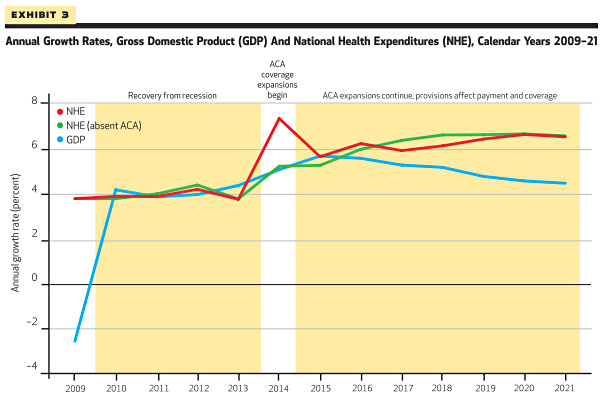
    Researchers at the Centers for Medicare and Medicaid Services have produced new estimates of national healthcare spending with and without healthcare reform. Here’s the key chart, showing projected growth rates over the next decade:

    Take a look at 2021. The red line is projected spending growth on healthcare. The green line is projected spending growth if we hadn’t passed healthcare reform. Do you see a difference? I don’t.

    Now, there are two conclusions you can draw from this. First, this report suggests that healthcare reform isn’t likely to rein in spending growth much. That’s the bad news. Second, it suggests that healthcare reform isn’t likely to cost very much. That’s the good news. Over at the LA Times, Noam Levey runs the numbers from the report and concludes that total national healthcare spending in 2021 without ACA comes to $4.72 trillion. With ACA it comes to $4.78 trillion. For that tiny amount — a difference of roughly 1% — about 30 million more people will have healthcare coverage. Pretty good deal, eh?

  • National Security and the Education of Barack Obama

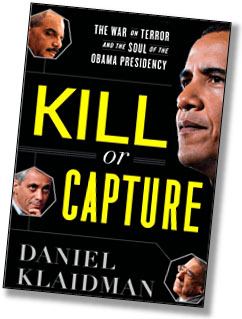
    Are civilian courts just a bunch of featherweights who can’t be trusted to try the al-Qaeda terrorist suspects imprisoned at Guantanamo? You’d think so if you listened to conservatives fulminating about it. But in Kill or Capture, Daniel Klaidman tells an interesting story. It takes place in the spring of 2009, while the debate over civilian trials was in high gear, and stars David Raskin, chief prosecutor of the New York Southern District Court’s terrorism unit, and one of his deputies, Adam Hickey:

    It was while poring over thousands of secret documents pertaining to the Guantanamo detainees that Hickey made a stunning find: for years, it turned out, the military had been secretly recording the conversations of the 9/11 conspirators, including those of Khalid Sheikh Mohammed. Every day, KSM was allowed to spend time in the prison yard mingling with other detainees. His conversations were intercepted by military spies and mined for intelligence.

    ….Raskin immediately understood the importance of the discovery. If KSM had talked openly about his role in 9/11, those statements would be among the most powerful evidence prosecutors could bring before a jury. They would be entirely voluntary statements, making them almost certainly admissible in court.

    ….The existence of secret recordings was surprising enough. But what Hickey told Raskin next was mind-boggling. Despite the potential gold mine the recording represented, military prosecutors had decided not to use the evidence. Not only that, they refused to even listen to the recordings. They worried that the intrusive means by which the evidence was obtained might not pass muster with their judges. The tribunals were barely four years old and largely untested. With practically no case law built up to guide lawyers, they were reluctant to take any chances. In short, despite their reputation as less restricted, in this case military tribunals were more difficult venues for prosecutors.
    Fascinating, no? Perhaps we could have trusted civilian courts after all.

    By the way, this is the second excerpt I’ve posted from Klaidman’s book, but I haven’t said much about the book itself. Generally speaking, it’s about the evolution of Barack Obama: how a guy who apparently was sincere about changing Bush-era policies regarding Guantanamo detainees and military tribunals ended up changing almost nothing. The book dives deeply into the conflicts between Obama’s advisors, most of them between the hawkish wing led by Rahm Emanuel (which Emanuel dubbed “Tammany Hall”) and the dovish wing led by Greg Craig and — usually — Eric Holder (“the Aspen Institute”). Obama was in the middle, and in Klaidman’s telling he was basically on the side of the Aspenites at first but eventually, and fitfully, ended up siding with the Tammany clique.

    Why? Partly because the Aspenites didn’t understand the politics of national security very well and got outplayed. Partly because congressional opposition to transferring Guantanamo detainees to the mainland was simply too rabid. Partly because no one was ever able to offer Obama an alternative to Guantanamo and military tribunals that was both practically and politically feasible. Klaidman portrays Obama as uncomfortable with these decisions to this day, but no longer willing to reopen them. The politics are just too toxic.

    On other subjects, Obama’s motivations were different. For example, he took a liking to drone attacks pretty quickly, seeing them as a much more precise method of killing al-Qaeda leaders than the alternatives. Drones, to Obama and his national security team, were attractive precisely because collateral damage from drone attacks tended to be far less than that from high-altitude bombing or military raids. As for the targeting of Anwar al-Awlaki, the American-born cleric who led the al-Qaeda franchise in Yemen, Klaidman reports that it wasn’t even a very close call. Because Awlaki was an American citizen, the decision to target him for assassination produced withering criticism in the liberal community (including some from me), but Klaidman says that the evidence of Awlaki’s terrorist activities was so voluminous and so chilling that Obama quickly agreed to put him on the kill list. Even Harold Koh, the liberal conscience of the State Department, was “shaken” after he spent hours in a secure room reviewing the evidence. “Awlaki wasn’t just evil,” Koh concluded, “he was satanic.”

    And so the drone strikes continue and Guantanamo continues to be open and detainees are being tried in military tribunals. Obama isn’t willing to halt U.S. attacks on al-Qaeda completely — he takes the blowback argument seriously but doesn’t consider it decisive — and drones are the most effective way of carrying them out. He’d like to close Guantanamo, but Congress won’t allow detainees to be transferred to the U.S. and other countries don’t want them. And if you can’t bring detainees to the mainland, military tribunals are your only option.

    I’m not vouching for Klaidman’s reporting here, and I’m not endorsing the Obama team’s judgments. But whether you approve of Obama’s approach or not, Kill or Capture does a pretty good job of explaining how the arguments unfolded and how the policies evolved. Recommended.