• Chart of the Day: Kicking the Can Now Works for Only a Few Hours in the Eurozone

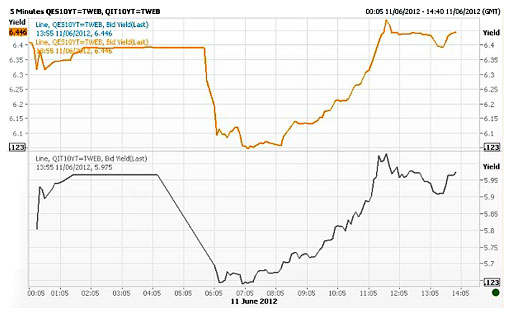
    The chart below comes via Brad Plumer, and it shows bond yields in Spain (orange) and Italy (gray). As you can see, when markets opened on Monday after this weekend’s bailout of Spanish banks, yields settled down to about 6%. Hooray! But instead of a few months — or at least a few weeks — of relief before everyone got jittery again, this time we got only a few hours. By noon, yields were well above 6% in Spain and touching 6% in Italy.

    It’s pretty obvious that after four or five go-arounds in the eurozone crisis, financial markets just aren’t impressed with stopgap measures anymore. Not even for a short time.

    So much has been written about the eurozone crisis, both by me and by others much smarter than me, that it feels pointless to write about it again. The eurozone needs more fiscal consolidation, it needs more transfers from rich to poor countries, it needs to stop running persistent internal trade deficits, and it needs to abandon austerity in the short term. All of these things are politically nearly impossible, and yet, they’re the only solution aside from a crackup. The financial markets are now making it clear that they’ve figured this out and won’t be bought off with anything less.

  • Do You Give Money To Panhandlers?

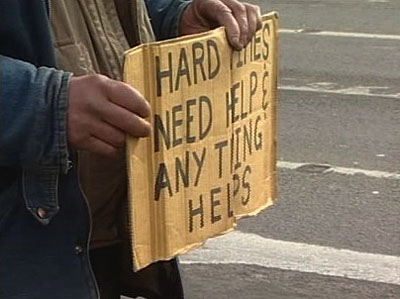
    New York magazine has a regular feature where they ask various luminaries a short list of questions and print the answers. The questions are always the same, and one of them is “Do you give money to panhandlers?” Here are the answers from their past year’s worth of interviews:

    • I used to all the time. Now it’s 50/50.
    • You know, I try not to, but sometimes you should. So sometimes I do.
    • Yes.
    • From time to time….But it’s very capricious.
    • Not always.
    • On subways. It’s not like a rule or anything: only subways. It’s just I’m always very distracted on the street.
    • Always.
    • Yes, unless they are clearly high or wasted.
    • Only when my kids (ages 7 and 4) are with me.
    • Sometimes — it’s on a case by case basis, but I always give my leftovers away.
    • Seldom. But always to those Mexican musicians on the 3 train.
    • Sometimes.
    • Yes.
    • Yes. I give money, food, to whoever.
    • Musicians and street performers almost always. Panhandlers sometimes.
    • Depends — it’s case by case.
    • Yes.
    • All the time.
    • Yes, sometimes.
    • Yes.
    • Depends on the panhandler.
    • When they play instruments. Not like, every time I see a musician I’ll give them money, but usually if I give to panhandlers it’ll be if they’re playing an instrument.
    • Yes, and all buskers on principle.
    • Yes.
    • Always.
    • Only if they entertain me.
    • Yes, but I often feel I choose the wrong ones.
    • Occasionally, but never to those in expensive down jackets, new boots, and designer jeans.
    • Yup!
    • Sometimes.
    • Why not?
    • Yesss, I cant help it. I always feel deep inside that one day that could be me.
    • Almost always.
    • I do, not all the time, but I do.
    • I choose to share food, water, and a smile.
    • I give them money if I find them entertaining and not annoying.
    • I do. Who doesn’t need a little help now and then?
    • Yes.

    This is, obviously, only a cross section of New Yorkers who range from well-off to rich. Still, I draw two conclusions from this. First, panhandlers would all have houses in the suburbs and buskers would all be millionaires if everyone here were telling the truth. Second, nobody is willing to just flat-out admit in a public forum that they don’t give money to panhandlers. Marla Maples (“I choose to share food, water, and a smile”) and Randy Cohen (“I try not to”) come the closest. Discuss.

  • Friday Cat Blogging – 8 June 2012

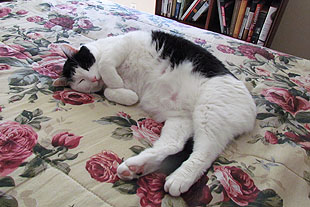
    This has been a tough blogging week for me. The news has been slow, I’m still feeling inexplicably jetlagged, and I’m annoyed by my inability to come to grips with all the latest news about drone strikes and what I think about them. So catblogging is more than normally welcome today. On the left, we see the shadow silhouette of Domino as she perches herself on the table in front of a window. On the right, Inkblot is obviously still trying to recover from the trauma of spending two weeks in a kennel. He seems to be coming along pretty well, no?

    Enjoy your weekend, everyone. I promise that next week will be better.

  • Obama’s Big Stick on Healthcare Reform


    This doesn’t strike me as very big news, but congressional Republicans have apparently released copies of some emails that were exchanged between the White House and the pharmaceutical industry during negotiations over the healthcare reform bill. Here is Peter Baker of the New York Times:

    On June 3, 2009, one of the lobbyists e-mailed Nancy-Ann DeParle, the president’s top health care adviser. Ms. DeParle sent a message back reassuring the lobbyist. Although Mr. Obama was overseas, she wrote, she and other top officials had “made decision, based on how constructive you guys have been, to oppose importation on the bill.” Just like that, Mr. Obama’s staff abandoned his support for the reimportation of prescription medicines at lower prices…. 

    “There was no way we had the votes in either the House or the Senate if PhRMA was opposed — period,” said a senior Democratic official involved in the talks, referring to the Pharmaceutical Research and Manufacturers of America, the drug industry trade group.

    Republicans see the deal as hypocritical. “He said it was going to be the most open and honest and transparent administration ever and lobbyists won’t be drafting the bills,” said Representative Michael C. Burgess of Texas, one of the Republicans on the House Energy and Commerce subcommittee that is examining the deal. “Then when it came time, the door closed, the lobbyists came in and the bills were written.”

    Some of the liberals bothered by the deal-making in 2009 now find the Republican criticism hard to take given the party’s long-standing ties to the pharmaceutical industry. “Republicans trumpeting these e-mails is like a fox complaining someone else raided the chicken coop,” said Robert Reich, the former labor secretary under President Bill Clinton. “Sad to say, it’s called politics in an era when big corporations have an effective veto over major legislation affecting them and when the G.O.P. is usually the beneficiary.”

    This is all stuff we’ve known for years, and the new emails don’t seem to add an awful lot other than a bit of detail. The spin the Times puts on this is that it’s unusual because Obama had denounced Big Pharma so strongly during the 2008 campaign, but this strikes me as painfully naive. Attacks like this are usually done precisely to get public opinion on your side and soften up your opponents so they’ll be more likely to deal once you’re in office. As Baker writes of the negotiations themselves, “The White House depicted in the message traffic comes across as deeply involved in the give-and-take, and not averse to pressure tactics, including having Mr. Obama publicly assail the industry unless it gave in on key points.”

    Right. And these are exactly the kind of hardball tactics that most liberals think Obama should engage in more often. It is, if you like, Obama acting a bit like LBJ. Perhaps, if Republicans had been genuinely willing to cooperate on healthcare and provide Obama with a few more votes, this sort of thing might not have been necessary. But they weren’t, so it was.

  • Obama: Private Sector is “Doing Fine”

    Zeke Miller provides us with the meme of the day:

    President Barack Obama offered up a gift to Republicans Friday morning, declaring “the private sector is doing fine,” at a White House press conference.

    “Where we are seeing weaknesses in our economy, had to do with state and local government, often times cuts initiated by governors or mayors who are not getting the kind of help that they have in the past from the federal Government, and who don’t have the same flexibility as the federal government in dealing with fewer revenues coming in,” Obama continued, calling on Congressional Republicans to take steps to help local and state governments create jobs.

    Needless to say, Republicans have pounced on Obama’s suggestion that the private sector is “doing fine.” Here’s the Romney campaign:

    The 23 million Americans who are struggling for work are not ‘doing fine.’ Job creators and small businesses are not ‘doing fine.’ The middle class is not ‘doing fine.’ Etc.

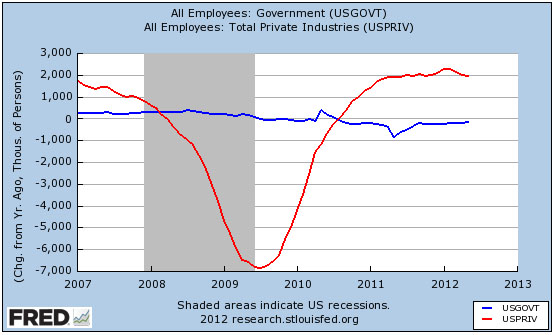
    There’s no question that Obama left himself wide open to this attack. It’s an unusual gaffe from someone who’s usually more careful with his words. Still, whether Republicans like it or not, Obama is more right than wrong. The private sector may not be “doing fine,” but it’s doing OK. Meanwhile, the public sector continues to struggle badly, shedding jobs and cutting back on spending, and this has been a big contributor to our anemic recovery. Paul Krugman has the charts on spending here, and I’ve got the chart on employment below. As you can see, the private sector has indeed rebounded from the depths of the recession and is now adding two million jobs per year. That’s not great, but it’s not terrible. The public sector, conversely, started cutting jobs even before the stimulus money ran out and is now shedding about 200 thousand jobs per year. That may be good for conservative small-government ideology, but it’s a significant drag on an already fragile economy.

  • In Defense of the Fax Machine

    The Washington Post reports today that even as the fax machine is consigned to the dustbin of history in most of the world, it remains popular in Japan. Here are the basic stats:

    As of March, according to Japan’s Cabinet Office, fax machines could be found in 59 percent of Japanese homes. (That penetration rate, after climbing for years, has peaked in the past five years.) Coming up with a similar number for the United States would require a “polite fiction,” said Jonathan Coopersmith, a Texas A&M University associate professor and an expert on the history of the facsimile.

    Really? I have a fax machine in my home. Two of them, in fact. That’s because, like millions of other people, Marian and I both have multifunction devices connected to our computers, and those multifunction devices include a fax machine. Perhaps the difference is that I actually have mine connected to a phone line, while most people don’t bother.

    But I’m curious about that. I have mine connected because (a) a phone cord came with the device, so it costs me nothing, and (b) I actually use it once in a while. But most people are sort of agog about that. Use a fax machine? Good God, man, that’s just embarrassing. Why not carve out your message on a piece of granite and have a team of oxen haul it to its destination?

    But every once in a while, it’s still necessary to send a copy of something to someone. Just yesterday we faxed over a counteroffer on a piece of property we’re trying to sell. The alternative is to scan the document and email it, but that’s actually more work than just faxing. So why is the humble fax machine held in such contempt? Isn’t it still occasionally a useful device to have around? And since for most of us who use multifunction devices it’s free, why not use it?

    I open this burning question to you, my loyal readership. What am I missing here?

  • Regulatory Uncertainty vs. Economic Uncertainty


    Jared Bernstein:

    I’ve avoiding adding my voice to the uncertainty chorus—the idea that what’s holding back growth and hiring is uncertainty about the future of health care, tax, or environmental policy. It’s neither what businesses themselves say nor what economic theory would dictate as the cause of the current slump—that would be weak demand for their goods and services. Show me a business person who would leave profits on the table because of what might happen to health care reform in 2014 and I’ll show you a business person who will soon be busted.

    But I’m coming around. Reading Fed speeches this week, looking at the upcoming fiscal slope and debt ceiling fights, watching Europe bumble along, and just trying to read the economic tea leaves—“uncertainty” is a pretty good word to describe the way a lot of people are probably thinking and feeling about the current economy right now.

    I get what Jared is saying, but I wish he hadn’t said it quite this way. There are two kinds of uncertainty here: regulatory uncertainty and economic uncertainty. Conservatives complain about the former regularly, but there’s simply no evidence that regulatory uncertainty is, or ever has been, a significant issue for American businesses. In fact, all the evidence says exactly the opposite.

    Economic uncertainty is a whole different thing, and there’s really nothing here to come around on. That’s been holding back investment and hiring for a long time, and it’s always been one of the strongest arguments in favor of further fiscal and monetary stimulus. And the primary argument, as Jared suggests, is that it’s good insurance. The upside is pretty strong, since the global economy is weak and full of risks, but the downside is negligible. There’s virtually no risk to being more aggressive with either fiscal or monetary policy for the next couple of years. Interest rates are low, inflation is well controlled, and hiring still hasn’t picked up. There’s essentially zero chance of overheating. The fact that we’ve continued along our current tight-spending/tight-money path anyway is just plain crazy.

  • Lie of the Day: Romney on Obamacare

    From Mitt Romney, telling a friendly audience about a disturbing passage from Noam Scheiber’s The Escape Artists:

    In this book he says that there was a discussion about the fact that Obamacare would slow down the economic recovery in this country and they knew that before they passed it. But they concluded that we would all forget how long the recovery took once it had happened, so they decided to go ahead. The idea that they knowingly slowed down our recovery […] is something which I think deserves a lot of explaining.

    You know, I expect political candidates to bend the truth a fair amount. Maybe I don’t like it, but it’s the way the game is played and it’s the way the game has always been played.

    But Romney’s willingness to flat-out lie is singular. Usually presidential candidates leave that kind of thing to surrogates, so they have deniability if they’re called on it. Personally, they limit themselves to cherry picking and semi-defensible twisting of reality. After all, a plain lie is so very unpresidential.

    But Romney doesn’t much seem to care about that. I guess he’s figured out that something like this works on the campaign trail but isn’t a big enough deal to ever attract any national attention. So why not?

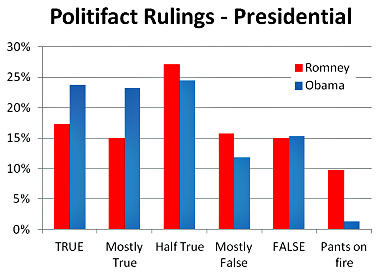
    In any case, Jon Chait has chapter and verse of the truth here if you’re interested. The chart comparing flat-out whoppers between Romney and Obama comes from one of Andrew Sullivan’s readers.

  • There are More Insomniacs in America Than You Think


    Austin Frakt writes today that you don’t have to be fretfully pacing the house all night to fit the definition of an insomniac. It’s a lot simpler than that:

    Consistent difficulty in falling or staying asleep that causes problems during the day is all it takes to be an insomniac. That can mean instead of getting, say, 7 hours of sleep each night, one gets only 5 or 6 a handful of nights a week. That can happen, for example, if you devote 7 hours to sleep but it takes you 30 minute to fall asleep and then you wake up in the night and can’t return to sleep for another 30 minutes or more. You’re still getting a lot of sleep, just not quite what you need. The key is that it has to be problematic for daytime function or the cause of distress. There are tons of people who only sleep 5 or 6 (or fewer) hours many nights of every week. But if they’re not upset by it and they function fine, they’re not insomniacs.

    On the flip side, many insomniacs actually function very well most days and have nights of decent sleep. I am (was) one of them. It’s not like I was up at all hours every night, which is what I think many people assume insomnia must be. I bet a lot more people are insomniacs than are willing to admit. I also bet a lot of people could sleep better with a little help. Next week, I’ll report on my recovery.

    By this definition, I’m pretty clearly an insomniac. Possibly I have been for years, but certainly for the past six months or so. And the past week has been gruesome. It’s like having permanent jet lag: I wake up every morning at about 3 am and then toss and turn the rest of the night. Maybe I get an hour or two more sleep, maybe not, and I spend the entire morning bleary-eyed. I’m pretty sure my blogging has remained coherent during this period, but then, I’d hardly be the best judge of that, would I?

    I sure wish I knew what’s going on. Nothing in particular happened late last year, when this all started, and in the past I’ve never had any jet lag traveling west. Still having it after a week is ridiculous.

    So I, for one, look forward to Austin’s report next week. It would be nice not to feel cottonheaded all day long.

  • No, Healthcare Reform Was Not a Mistake

    Ezra Klein takes on the conventional wisdom that President Obama made a mistake by spending so much time on healthcare reform in 2009 instead of “focusing on the economy.” Exhibit A is the calendar:

    The stimulus bill passed in February 2009. Most of its spending was scheduled for 2010 and 2011. Health care reform passed in March 2010. That is to say, the bulk of the health care debate took place in 2009 — before the stimulus had really begun its work. If Obama hadn’t done health care, he would have needed to be doing something else between February 2009 and March 2010. Some people seem to think that “something else” could have been passing more stimulus bills. I find it very hard to believe that Congress would have greenlighted further stimulus before the $800 billion stimulus bill they’d just passed began spending out.
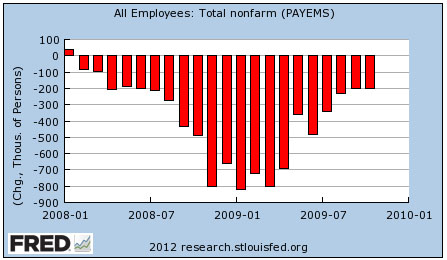
    The smart version of this criticism has always focused on October 2009, when Democrats had a filibuster-proof majority in the Senate and there were some early warning signs that the economy might be faltering. But Ezra is right. Take a look at the chart on the right, which shows new employment figures through October 2009. It shows steady improvement. At the moment in time when Obama supposedly should have been pressing for more stimulus, our primary sign of economic health was looking pretty good. And it would continue to look pretty good for the next six months. It wasn’t until the second half of 2010 that employment growth started to falter.

    So what are the odds that Congress would have passed a second stimulus in the fall of 2009? About zero, I’d say. Using reconciliation, which would have allowed a stimulus bill to pass the Senate with 50 votes, was off the table because the Senate had previously decided to approve budget reconciliation instructions that included only healthcare and education. This means that a new stimulus bill would have required every single Democratic vote to pass, and that just wasn’t in the cards. The awkward truth is that Obama simply didn’t lose anything by spending time on healthcare during the summer and fall of 2009.

    A better criticism is a simpler one: the original stimulus was too small. But even here, the problem is raw numbers. Obama needed a couple of Republican votes to win passage in the Senate, and one of those votes, Olympia Snowe, had already demanded reductions in return for her support. There was no feasible way to pass a bigger package.

    But is there an even better criticism to be made? I think there is. Although Obama didn’t have the leverage to get more stimulus spending even if he’d wanted it, he could have done more on the housing front. A full-court press on cramdown would have been a good start, and serious pressure on Fannie Mae and Freddie Mac to support principal reductions would have made a difference too. This, I think, is easily the biggest mistake the Obama administration made during 2009. Focusing some serious attention on debt overhang, especially in the key areas of California and Florida, was quite feasible and would probably have made a noticeable difference in keeping the recovery on a stronger track.

    But even here, this was a plain and simple mistake, not something that slipped through the cracks because they were spending too much time on healthcare. Tim Geithner just didn’t like the idea of pressing harder on the mortgage relief front, and Obama went along. Healthcare reform had nothing to do with it.