• Chris Hayes, Social Distance, and the Tyranny of Personal Experience

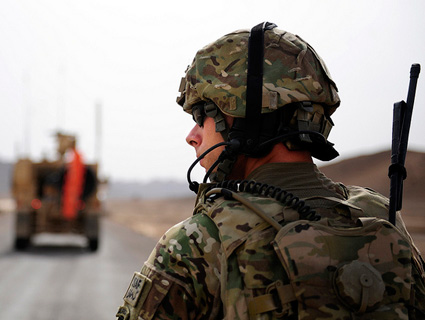
    <a href="http://www.flickr.com/photos/soldiersmediacenter/7248329464/in/photostream">US Army</a>/Flickr

    I don’t have a whole lot to add to what’s been said by Conor Friedersdorf, Peter Beinert, and Michael Tomasky about the Chris Hayes flap. My instinct is to say nothing in the hopes that it fades quickly, but since it’s still being debated, I guess I might as well weigh in.

    I would guess that anyone who knows my work knows that I’m not one who thinks that Hayes said anything untoward. He’s an intellectual who hosts an unusually thoughtful show on week-end mornings for people who like to watch unusually thoughtful conversation on TV. I feature a segment or two every week on my blog and have touted his new book numerous times. This week, most of the discussion centered on the social distance between the realities of war and the people back home and between those who are part of military culture and those who aren’t. His comments about “heroism” were a small part of the entire conversation, all of which was extremely respectful.

    And this, I think, explains Hayes’ apology. I suspect that it was less the response he got from the right-wing noise machine, which is inevitable at some point for any public liberal, than the average families who were upset by his comments once the flap blew up and they heard about them. It seemed to prove his point about social distance and he felt the need to address that. (And in my opinion he did that with humanity and humility, which is what we’ve all come to expect from him.)

    But it does raise a question in my mind about “social distance.” Chris apologized saying that he “sounded like a typical out-of-touch pundit seeking to discuss the civilian-military divide and the social distance between those who fight and those who don’t, I ended up reinforcing it, conforming to a stereotype of a removed pundit whose views are not anchored in the very real and very wrenching experience of this long decade of war. And for that I am truly sorry.” I’ve always thought this “social distance” was a useful thesis, helping to explain why the Villagers are so out of touch with the average person. But what I hadn’t reckoned with until now is a sort of tyranny of “walking the walk” that results once you acknowledge it.

    All citizens have a right and an obligation to participate fully in American civic life. If we are now going to say that those who haven’t “walked in the shoes” of whomever is directly affected by a policy are not sanctioned to have an opinion, we are essentially saying that we are only responsible to ourselves rather than the body politic. It becomes a fragmented sort of social responsibility in which we substitute experience and expertise for democratic participation. And the truth is that Hayes may have a social distance from those in the military, but he was speaking for plenty of those who don’t.

    I’ll just give you one example: Brandon Friedman:

    Brandon Friedman is a writer, veteran, and civil servant. He is the author of the combat memoir The War I Always Wanted and currently serves as the Director of Online Communications for the United States Department of Veterans Affairs. Friedman is a Fellow with the Truman National Security Project.

    Here’s what he said on twitter in regards to Hayes’ comments: Or, you could listen to retired Colonel Andrew Bacevich. Or my right wing career military father (and veteran of two wars) who winced at all the reflexive “thank you for your service” comments that became the vogue after the Iraq invasion.
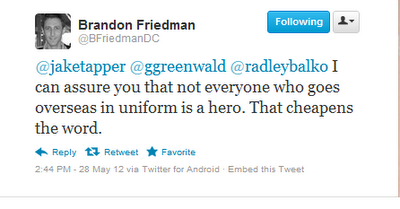
    Hayes may have “social distance” from military culture but he didn’t say anything that plenty of veterans don’t say every day. He wasn’t speaking from the perspective of a wealthy Villager who pretends she is just an ordinary WalMart shopper who speaks for Real Americans when she demands “sacrifices”—he really was speaking for millions of Americans. Unfortunately, we are rapidly turning into a society in which the only people who are not subject to the bludgeon of “military correctness” is the military. And that’s not healthy.

    A democracy becomes very weak when dissent from the conventional wisdom or sacred ritual can be shouted down simply because the person who’s doing it hasn’t “walked the walk.” Its success depends upon the people being able to make decisions about many policies with which they have no personal experience or affect people from whom they are socially distant. Moreover, it’s important that they do so. For instance it’s necessary to have the perspective of women on the issue of combat or of men on the issue of abortion or of any number of contentious subjects which may not personally affect us but which affect our country and our countrymen. It’s a mistake to completely outsource your opinions to “experts” or those who are personally involved. (Look what’s happened with banking regulation…)

    Ironically, Chris Hayes’ example shows that in an odd way, acknowledging the “social distance” that makes many elite pundits and analysts out of touch with average Americans may just be leading to a different sort of elitism. And judging from his body of work, I’m fairly sure that’s the last thing he intends to do.

    Heather Digby Parton is guest blogging this week while Kevin Drum is on vacation.
  • Mitt Romney Wants the Biggest Military Ever, Regardless of Cost

    <a href="http://www.marines.mil/unit/2ndmlg/PublishingImages/Story%20Images/FWD%2009%20OIF/090303-M-8605-004.jpg">US Marine Corps</a>


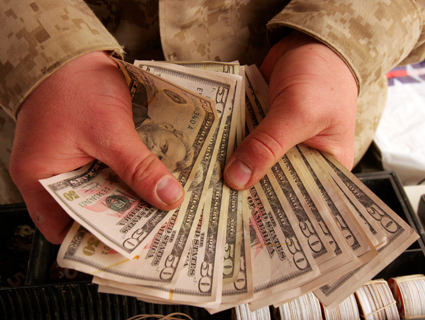
    Mitt Romney wants a bigger government, so long as its the kind with more guns and fewer social programs.

    “We have two courses we can follow: One is to follow in the pathway of Europe, to shrink our military smaller and smaller to pay for our social needs,” Romney told a San Diego crowd of some 5,000 on Monday outside the Veterans Memorial Center and Museum. “The other is to commit to preserve America as the strongest military in the world, second to none, with no comparable power anywhere in the world.”

    Notice the obligatory reference to Europe. In the parlance of the modern-day right, Europe means several things: weakness, socialism, un-Americanism. Europe is not so much a swear-word as it is a sneer-word.

    Notice also the implication that in order to pay for “social needs” Romney believes we would have to cut military spending. This is an odd admission, remarkable for its honesty. In a country so hostile to raising revenue in order to pay for social programs or military adventures, we either need to cut defense spending or continue to pile on debt. That or dismantle the welfare state entirely, a venture too many conservatives these days unthinkingly support—even while fear-mongering about Medicare spending cuts during the healthcare debate.

    Either way, Romney not only wants a bigger military, he wants the biggest, most amazing military the world has ever seen, regardless of cost. This declaration is meant to differentiate Romney from the current “European” Obama administration, even though defense spending has risen to record levels under the current president.

    According to a recent survey from Gallup, Romney already has the veteran vote wrapped up, leading Obama by double-digits among the country’s military vets. One thing the right has done very well is paint Obama as a weak military leader despite his successes, which include (but are not limited to) killing Osama bin Laden and overthrowing the Libyan regime. Whether one agrees or disagrees with Obama’s foreign policy, painting him as weak or dovish is dishonest at best.

    But we’ve learned by now that honesty is no more one of Romney’s virtues than small government is a desired end-goal of the right. In that sense, Romney is exactly the man for the job, a nominee the Republican party truly deserves.

    Erik Kain is guest blogging while Kevin Drum is on vacation.

  • Are Negative Campaigns Good for Democracy?


    “POLITICS, n. A strife of interests masquerading as a contest of principles. The conduct of public affairs for private advantage.” ~ Ambrose Bierce, from The Devil’s Dictionary

    Ambrose Bierce’s Devil’s Dictionary may have been largely tongue-in-cheek, but he stumbled upon plenty of hard satirical truths. Certainly politics brings out the worst in people, and it brings out the very worst in our political leaders. In a democracy, this is on constant, gaudy display, becoming only more pronounced in the Fox News era, in which “organic” grassroots movements like the Tea Party are fertilized by talk radio and cable television and the blogosphere.

    This year’s Republican primary was politics at its best, or ugliest, depending on how you look at it. Hardly even bothering to masquerade as a “contest of principles,” the GOP primary was more a contest in who could speak the language of the right most fluently, and who could run the furthest with each talking point. And, in the end, who was deemed most electable by likely GOP voters.

    Citizens United has allowed more money than ever to trickle into American electioneering, making this primary season one of the dirtiest and most revealing in years. President Obama was able to sit idly by and let the GOP nominees do the negative campaigning for him. Unsurprisingly, despite the negativity directed at Mitt Romney by his opponents, Romney emerged as the party’s presumptive candidate.

    There’s a tension between the ugliness of politics, especially in the 24-hour news era, and the benefits to voters that this ugliness provides. For one thing, our political leaders are rarely angels. We sometimes pine for an age in which politics were not so bloody, but whether or not this Utopia ever existed, it’s hard to imagine that such a thing would benefit voters.

    Politics is the apportioning of power without violence. In a stable, rule-based democracy it is ideally the apportioning of power without bribery, corruption, or the threat of violence. But it is still fundamentally about power, and the haves almost always come out on top. We’d like to think that democracy gives the little guy a shot, but even in the most progressive democracies, the scales inevitably tip toward those with wealth and power. One of the only things the have-nots have going for us is the ability to see the ugly underbelly of our political contenders in such garish detail during campaign season.

    All of which is to say that, the uglier an election becomes, the more human and fallible our politicians become. This is a good thing. We don’t simply elect these people to office; we grant them vast power, including on life and death matters. The more we glimpse of our leaders’ shortcomings, the better prepared we are to grapple with their failings once in office—and the less surprised we should become when those leaders take advantage of the power they’ve been loaned.

    “Any American who is prepared to run for president should automatically, by definition, be disqualified from ever doing so,” Gore Vidal once said. And surveying the Republican field this past primary season was evidence enough that Vidal was on to something. This paradox drives the mad dance of American politics, where the weight of necessary evils presses down on us like gravity.

    This is also my fumbling attempt at an introduction post. I’ve been blogging about politics for years now, mainly at the blog The League of Ordinary Gentlemen, but also at places like Balloon Juice and True/Slant. I am a liberal, a pessimistic progressive, and a bit of a romantic. This is fitting, I think, since politics are romantic and pessimistic all at once. I’m also extremely grateful to everyone here at Mother Jones, and to Kevin Drum in particular, for having me on to guest blog while Kevin is on vacation. More to come.

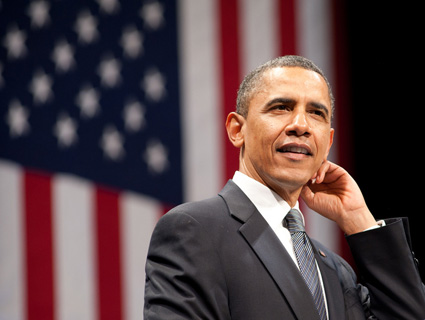
  • Why Obama Is in for a Very Tough Reelection Fight

    Obama at a San Francisco campaign rally in 2011<a href="http://www.flickr.com/photos/barackobamadotcom/5655674841/">Barack Obama</a>/Flickr


    I will never understand why political campaigns think it’s helpful to telegraph their plans in public, but here’s the obligatory “inside the Obama campaign strategy” piece by John Heileman in New York magazine. To the extent it isn’t spin, it’s quite interesting, and since so much of it is unflattering, I’d have to guess that’s most of it.

    The campaign principals (much like the administration itself in the first two years) are as convinced as ever that when it comes to brilliant strategy, they are the toppermost of the poppermost and show a level of confidence that borders on hubris. What seems to have changed since the last time around is that they are very, very worried about money.

    As the piece reveals, the 2008 tale of the plucky campaign with its starry-eyed volunteers collecting its vast sums in $5 increments from school children and grandmas was pretty much a myth. They did break records for small donations, but the Obama campaign, like all presidential campaigns, collected most of its money from big donors—and Wall Street in particular. (As bank robber Willie Sutton said, “That’s where the money is.”) This time the Masters of the Universe are having themselves a monumental pout because the president hurt their feelings a couple of years ago when he called them fat cats, and so they’re giving more of their money this time to their soul brother Mitt Romney.

    And unfortunately, the traditional liberal fat cats aren’t giving in nearly the amounts they expected, partially because the campaign, as is its wont, prematurely declared victory by touting its own fundraising prowess and telling everyone they were going to raise a billion dollars. Now all the rock stars and heiresses are saying, “Why do you need my measly quarter million?” (Also the super-PAC culture is much smaller on the left for a lot of reasons, including that the 2008 Obama campaign instructed big donors not to give to outside groups.) Still, they do expect to eke out a billion or so, while the Republicans will raise 50 percent more. Dear God.

    Nobody knows what effect the tsunami of cash that’s about to crash on contested states will have on the voters. As David Axelrod says: “We’re actually about to test the limits of what money can do in politics, because there’s gonna be so much of it concentrated in so few states. The real question is, at what point is so much too much?” Those of you who live in those states should probably just plan on recording your favorite shows or reading a lot of books for the next few months. It’s not going to be pretty.

    The campaign is placing its hopes on a couple of electoral-college strategies and demographics (the big new thing in Democratic circles) and intense fearmongering about the other side. Although that’s a much punier vision than the soaring promise of hope and change, I find it refreshingly realistic. It’s rooted in a realization that, in my opinion, came much too late.

    Here’s Heileman describing how that happened:

    The previous eight months had been hell for Obama. After the self-­described “shellacking” his party suffered in the 2010 midterm elections, the president had sought to find a way to work with Republicans, to reestablish the post-partisan métier that animated his election. “For the first part of the year, he played what was largely an inside game,” says Obama’s longtime counselor David Axelrod. “The ideas being (a) maybe we can reason with the Republicans and come to some rational conclusions, and (b) maybe people really wanted to see cooperation. But that obviously didn’t work.”

    Not just obviously, but screamingly so, as evinced by the reckless Republican brinkmanship over the debt ceiling and the collapse of the grand bargain on deficit reduction that Obama labored long to fashion with John Boehner. By the time the president took off for vacation to Martha’s Vineyard, recalls a senior White House official, “he was as frustrated as I’ve ever seen him.” Most irritating to Obama was the portrayal of him, on the right and left alike, as a terminally weak leader. “We found ourselves in the worst possible situation,” says ­Pfeiffer, “in which Republicans and some Democrats were using the same talking points to describe the president. That’s a moment of great political peril.”

    Indeed it was. And while it may be impolite to point out how daft that entire strategy was, let me be rude: It was clear from the beginning of his term that the Republicans would not cooperate. They said it out loud and demonstrated it over and over again. It didn’t take the “shellacking” and its aftermath to understand their obstructive pattern. In the end, all that eight months of “outreach” did was shift the debate so far to the right that Democrats now consider it a victory if they can get the top 1 percent to throw in some tip money in exchange for slashing the social safety net.

    I can understand why the White House might have gone that way. At the time the entire political media establishment was talking about the glory of being “the only grown-up in the room” and had visions of a Barack and Boehner version of their cherished Tip ‘n Ronnie trope. If the White House was listening to them during that period it’s entirely possible they thought this was a legacy moment.

    Be that as it may, the campaign says the president learned his lesson just in time for the election and now he feels “liberated.” Certainly his rhetoric is sharper. What’s clear from this article is that Obama Campaign 2.0 is sure it is in for a very tough fight. Obviously the economy is the most important factor, and it seems they are just hoping to limp over the finish line on that one. The die was cast on that some time ago. The rest will be sound and fury. What remains to be seen is if it signifies anything important about a second term.

    Speaking of which, has anybody heard anything about an agenda for that second term?

    Heather Digby Parton is guest blogging this week while Kevin Drum is on vacation.
  • It’s Hard Out There for a Harvard Alum

    Somewhere in the Northeast.<a href="http://www.shutterstock.com/cat.mhtml?lang=en&search_source=search_form&version=llv1&anyorall=all&safesearch=1&searchterm=Harvard&search_group=#id=47943157&src=db1a6ce591e065a6e5ef8ff7db80975c-1-1">Pincasso</a>/Shutterstock.com


    Harvard graduates often tell acquaintances they “went to school in Cambridge” and the Boston Globe is on it:

    She does not like dropping the H-bomb, which is how Harvard students and alumni describe the moment they use the name of their university.

    It’s a loaded word. And everyone who has ever been a student at Harvard University – the school minted about 7,000 new graduates this month – is acutely aware of the perils of using it. They have been through it many times, seen the bomb explode in different ways. Each has an approach, goals for how it should go off.

    When confronted with questions about their education, many elect simply for a kind of dodge, the most famous being the Boston method. “I went to school in Boston.” Sometimes it’s “near Boston.” Or perhaps even “Cambridge.’”

    Harrowing. The Globe cites examples which purport to show a Harvard connection backfiring—including the Massachusetts Senate race—and asks about a handful of alumni to explain why they refrain from dropping the H-bomb at all cost.

    One thing the piece neglects to point out, though, is that telling someone “oh, I went to a small little academy on a river near Somerville” is somewhere between 50 and 100 times more annoying than simply telling someone you went to Harvard. I’m not sure what it is that Harvard grads expect will happen if they reveal the true source of their diploma—people will faint, the skies will open, Nazis—but generally speaking, people can handle it.

    Well, most people.

    Tim Murphy is filling in while Kevin is on vacation.

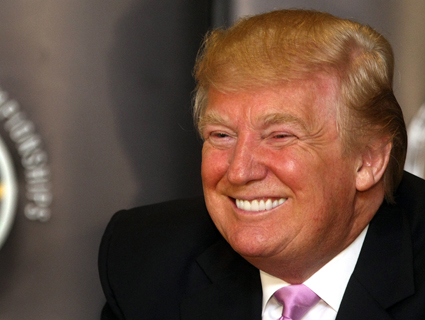
  • Quote of the Day, Part II: “I’ve Been Known as Being a Very Smart Guy”

    Donald TrumpMike Stocker/Sun-Sentinel/ZumaPress.com

    Donald Trump is still talking:

    “I never really changed—nothing’s changed my mind,” Trump told CNBC, reassuring that his birtherism is as rock solid as it was last year when he briefly led Republican primary polling. “And by the way, you know, you have a huge group of people. I walk down the street and people are screaming, ‘Please don’t give that up.’ Look, a publisher came out last week and had a statement about Obama given to them by Obama when he was doing a book as a young man a number of years ago in the ’90s: ‘Born in Kenya and raised in Indonesia.'”

    “I’ve been known as being a very smart guy for a long time,” he said.

    Can we get Politifact on this?

    My colleague Adam Serwer has a term for the DC/New York media fixation on substance-free nontroversies as a way of filling dead air between now and election day: Dumbgeist. President Obama “spiking the football” on the Osama bin Laden raid: Dumbgeist. Hillary Rosen waging a war on moms: Dumbgeist. Democratic politicians with ties to the financial services industry defending the financial services industry: Dumbgeist.

    Mitt Romney’s bromance with Donald Trump (they’re holding a fundraiser in Las Vegas) certainly fits the bill. The GOP nominee’s refusal to condemn Trump’s racist conspiracy theorizing—actual quote: “You know, I don’t agree with all the people who support me, and my guess is they don’t all agree with everything I believe in”—is pretty weak, as far as these things go. But it’s worth noting that we in the media also brought this upon ourselves by taking Donald Trump seriously at around this time last year, hanging on his every word, and dutifully writing up his adventures (guilty!). Trump’s political commentary was never anything more than a free media strategy, and it’s worked fantastically—a quick search through Politico‘s archives returns 996 articles related to Trump since last February.

    Which brings us to this:

     Courtesy of PoliticoCourtesy of Politico

    Don’t let it happen again, America.

    Tim Murphy is filling in while Kevin is on vacation.


  • Rick Scott Concerned About Non-Citizens, Citizens Voting

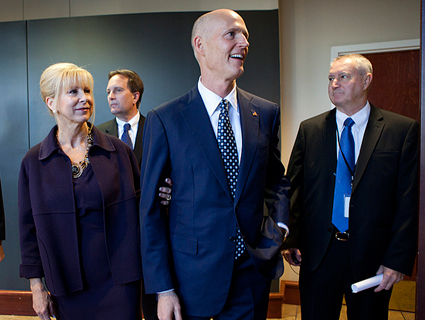
    Florida Gov. Rick Scott (R)<a href="http://www.flickr.com/photos/scottforflorida/5321064684/sizes/z/in/photostream/">Scott for Florida</a>/Flickr


    With the White House potentially at stake—not to mention control of Congress—Florida Gov. Rick Scott (R) is taking some extra precautions ahead of the November election. Scott has set about updating Florida’s voter rolls to purge names of people who aren’t eligible to vote in state elections. Sounds like a plan. Except, as Think Progress’ Judd Legum tells us, it’s actually kind of a disaster:

    Late last year, Governor Scott ordered his Secretary of State, Kurt Browning, to “to identify and remove non-U.S. citizens from the voter rolls.” But Browning did not have access to reliable citizenship data. The state attempted to identify non-U.S. citizens by comparing the voting file with data from the state motor vehicle administration, but the motor vehicle data does not contain updated citizenship information. The process, which created a list of 182,000 people, was considered so flawed by Browning that he refused to release the data to county election officials. Browning resigned in February and Scott has pressed forward with the purge, starting with about 2600 voters.

    Much of the discussion of Mitt Romney’s failings with Latino voters centers on his purported plan to win them over. Maybe he can woo Hispanic voters by talking about jobs and education. Maybe he can soften up on immigration. Maybe he can select Florida Sen. Marco Rubio as his running mate. Maybe he can play up his Mexican roots! But really, it’s looking more and more likely that his best plan for dealing with the Hispanic gap is to just let Republican governors make it harder for Hispanics to vote, either through strict voter ID laws, or by purges. As Legum notes, “Hispanics comprise 58 percent of the list but just 13 percent of eligible voters.”

    Tim Murphy is filling in while Kevin is on vacation.

  • Quote of the Day: “I Just, Ugh, God”

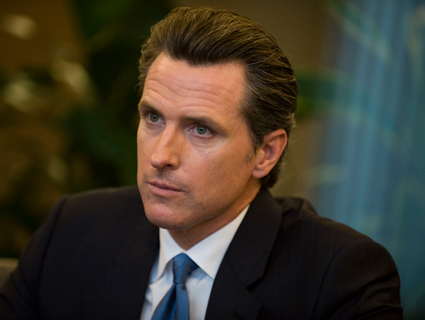
    California Lt. Gov. Gavin Newsom is bored out of his mind in Sacramento.Kevin Sullivan/The Orange County Register/ZumaPress.com


    Being governor of California is a grueling job. Democratic Gov. Jerry Brown, faced with a $15.7 billion shortfall (again) has proposed $8.3 billion in budget cuts; a two-thirds majority vote by the state legislature is required to increase taxes, which makes it prohibitively difficult to raise revenue.

    Being lieutenant governor of California? Not so grueling. The Sacramento Bee checks in with the state’s current number-two, former San Franciso mayor Gavin Newsom, who has found himself with enough downtime to start his own talk show on Current TV:

    Lt. Gov. Gavin Newsom, whose cable talk show premiered this month, was in the studio between segments Thursday, catching up with Chip Conley, his next guest and old friend.

    Read more here: http://www.sacbee.com/2012/05/28/4520611/gavin-newsom-breaks-boredom-in.html#storylink=cpy#storylink=cpy

    “How often are you up in Sacramento?” the hotelier asked.

    “Like one day a week, tops,” Newsom said. “There’s no reason.”

    It can be slow at the Capitol.

    “It’s just so dull,” Newsom said. “Sadly, I just, ugh, God.”

    Read more here: http://www.sacbee.com/2012/05/28/4520611/gavin-newsom-breaks-boredom-in.html#storylink=cpy#storylink=cpy

    Stay strong, Gavin.

    Tim Murphy is filling in while Kevin is on vacation.


  • Where in the World Is Kevin?

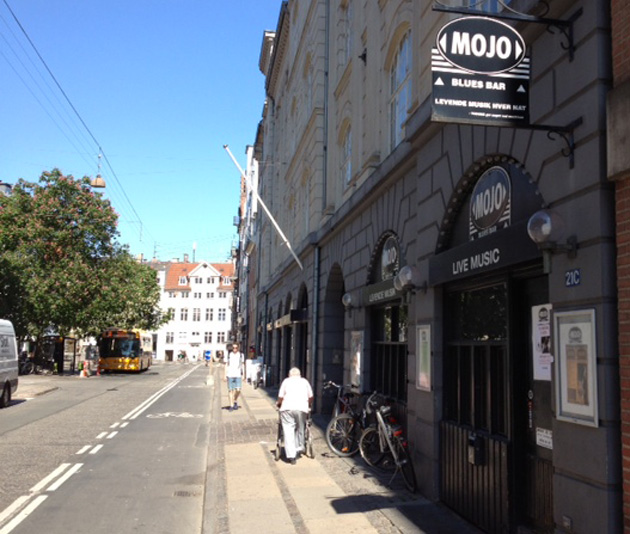
    Kevin sends this photo from his vacation. Where in the world is he? Leave your guesses in the comments. No Googling!

  • Friday Cat Blogging — 25 May 2012

    Last week, when I mentioned that I lived with four orange cats, some folks were disappointed I didn’t post pictures of all four. If you were one of those people, today is your lucky day.

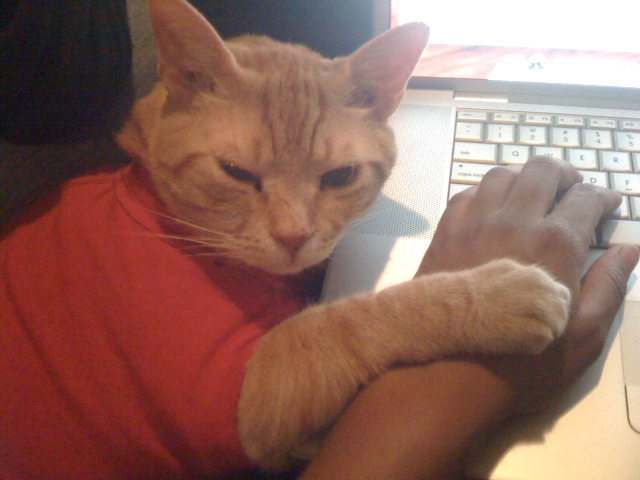
    Here’s Pumpkin, who says it’s time to get off the computer:

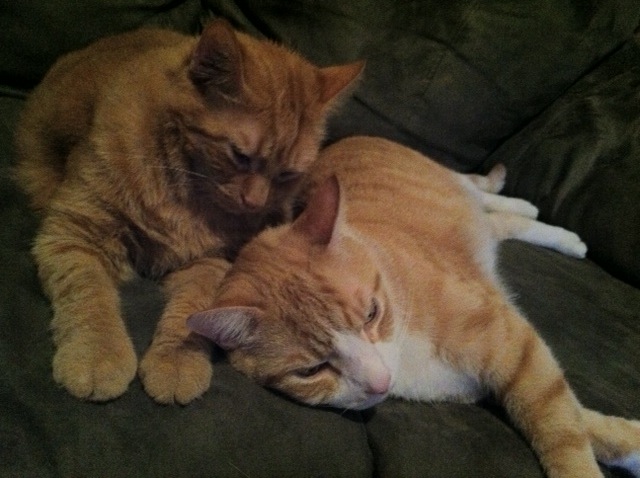
    And here are Butters and James, hanging out:

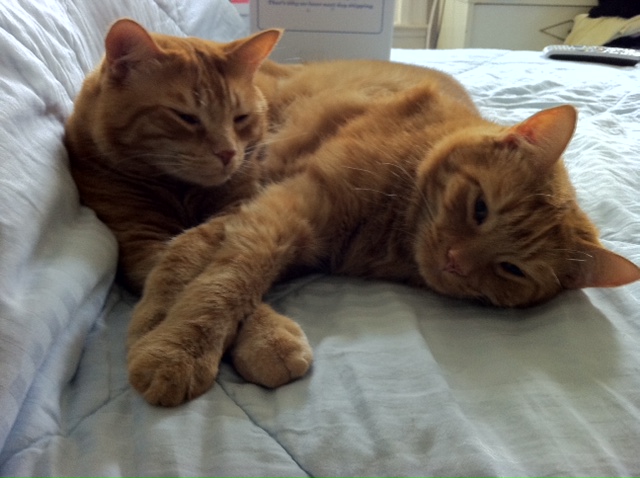
    Here are Burns and James (right), who happen to be twins although Burns takes much better care of himself:

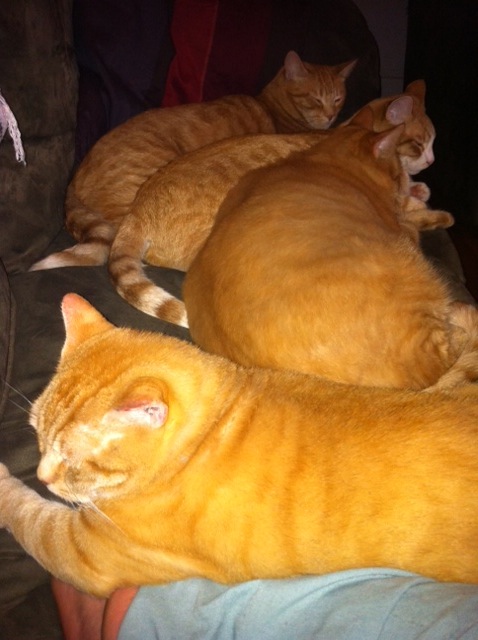
    Now, you might be wondering whether they all decide to crowd on one person ever. The answer is yes, and this is what it looks like when the herd of Garfields is at full strength:

    This is about sixty pounds of pure, uncut marmalade tabby.

    Anyway, I’m going on vacation next week, so some of my other Mother Jones colleagues will be pitching in. I’d like to thank Kevin for giving me the opportunity to blog in his absence, and all of you guys for putting up with the lack of charts in the meantime.

    Adam is now done filling in for Kevin while Kevin is on vacation.