
• The Supreme Court Parties Like It’s 1936


    I might as well confess that I’ve been in something like a state of shock for the past day. Tuesday was bad enough, but Wednesday’s arguments in the Supreme Court were nothing short of surreal, as the conservative justices, Kennedy and Scalia in particular, spent their time chatting as if they were in the Senate cloakroom, casually hashing out a deal to figure out how best to keep their campaign promises to the tea party. There was barely even a pretense of being a court, not a legislature.

    Randy Barnett is getting lots of kudos these days as the guy who created the conservative case against Obamacare, primarily by inventing and proselytizing the activity vs. inactivity distinction. And I guess he deserves his star turn. But watching yesterday’s session (or, rather, reading the transcript) it’s pretty obvious that none of it mattered. The conservatives looked like five men who just didn’t like Obamacare and were bound and determined to find an excuse to overturn it. The activity vs. inactivity distinction was good enough, so that’s what they glommed onto, but anything else even reasonably plausible would have worked too.

    It’s not over til it’s over, of course. Maybe the tone of the questioning has fooled us all, and at least a couple of the conservatives will pause before going fully rogue. But it looks grim right now, and even genial, generous E.J. Dionne is under no illusions about what it will mean if the court overturns Obamacare:

    A court that gave us Bush v. Gore and Citizens United will prove conclusively that it sees no limits on its power, no need to defer to those elected to make our laws. A Supreme Court that is supposed to give us justice will instead deliver ideology.

    I wasn’t alive the last time the Supreme Court acted like this, and I never thought I’d live to see the day it would go there again. And maybe it won’t. But they sure look like they’re all ready to party like it’s 1936 again.
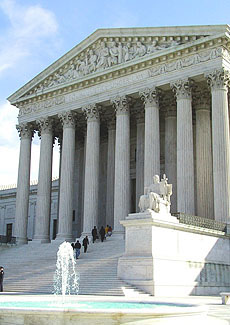
  • It’s the Supreme Court’s Job to Solve the Broccoli Test

    One of TPM’s readers wrote in today with a comment about the arguments in the Supreme Court healthcare case. It happens to be about something that’s been bouncing around in the back of my head for several days, so here it is:

    The only problem that Chief Justice Roberts and Justice Kennedy expressed with the mandate is the lack of limiting principle on Congress’s ability to mandate the purchase of privately-made/issued products. If that’s really the concern of each Justice, and it sure seemed that it was, neither man is lacking in the self-regard and intellect necessary to craft such a limiting principle. And that’s where my money remains. The Government didn’t make their jobs easier, but it’s one thing to fault the Government for failing to articulate a limiting principle and quite another to overturn momentous legislation on that basis. Because to do the latter is to say that the Justices can’t craft such a principle either. Here’s betting both can, and Roberts will.

    This is related to the “broccoli question.” If Congress can force you to buy health insurance, can they force you to buy broccoli too? In fact, if they can force you to buy health insurance, are there any limits at all on what Congress can do? Lots of smart observers think the conservative justices simply won’t accept the idea that Congress can essentially do anything, which means that if they’re going to uphold the individual mandate they’ll need some kind of “limiting principle” that explains why the mandate is OK but, say, broccoli isn’t.

    But it strikes me that the government’s job isn’t to craft such a principle. The government’s job is to argue that the mandate is already within existing limits on Congress’s power. And given how extraordinarily broad Wickard is, that never seemed very hard to me. If Congress can stop you from growing wheat for private consumption, something that has only the most tenuous connection to interstate commerce, mandating the purchase of health insurance seems like a no-brainer.

    But even if it’s not, it’s still not the government’s job to articulate a limiting principle. It’s the court’s job. That’s what they do. They write opinions that — in theory, anyway — provide guidance to lower courts about how to apply the law. Supreme Court opinions are chockablock with three-prong tests, significant nexus tests, balancing tests, and a million other kinds of tests. As long as Kennedy or Roberts or Breyer or Kagan or any of the others can come up with something that gets five votes, then we have our limiting principle. There’s no reason it has to come from the Obama administration. In fact, all things considered, it’s probably best if it doesn’t. The justices will all feel a whole lot smarter and a whole lot more decisive if they do it themselves.

  • Quote of the Day: The Big Solyndra Nothingburger


    From Rep. Darrell Issa, chairman of the House Oversight and Government Reform Committee, on the Solyndra investigation he’s been flogging for the past six months:

    Is there a criminal activity? Perhaps not. Is there a political influence and connections? Perhaps not. Did they bend the rules for an agenda, an agenda not covered within the statute? Absolutely.

    They bent the rules! Translation: The Obama administration really wanted the domestic solar industry to succeed, so they might have given Solyndra slightly more support than it deserved. That’s the big scandal. Yeesh.

  • Taking Race Seriously


    Conservative Josh Barro tells his fellow conservatives why they get attacked on racial issues so often:

    Why do conservatives catch such heat? It’s probably because there is still so much racism on the Right to go alongside valid arguments on issues relating to race and ethnicity. Conservatives so often get unfairly pounded on race because, so often, conservatives get fairly pounded on race.

    And this is the Right’s own fault, because conservatives are not serious about draining the swamp. In recent months, both Newt Gingrich and Rick Santorum have gotten questions at public events that referred to President Obama being a Muslim. Neither candidate corrected the questioner. Santorum later told a reporter that’s “not his job.” PPP polls in Mississippi and Alabama have found that about half of Republican voters believe Obama is a Muslim, and others aren’t sure.

    ….There has been a clear strategic calculation here among Republican elites. Better to leverage or at least accept the racism of much of the Republican base than try to clean it up….My challenge to conservatives who feel they get a bum rap on race is this. Stand up for yourself and your colleagues when you feel that a criticism is unfair. At the same time, criticize other conservatives who say racist things, cynically tolerate racism in the Republican base, or deny the mere existence of racial issues in America today. The conservative movement desperately needs self-policing on racial issues, if it ever hopes to have credibility on them.

    I think it’s fair to suggest that liberals use race as a cudgel more often and more crudely than we should. The problem conservatives have is that this is pretty much the sum total of their take on racial issues: that liberals bring it up too often. When they write about race there’s usually a pro forma “to be sure” somewhere, but I can’t remember the last time I saw a conservative take seriously — either generally or in a specific case — the idea that racism against ethnic minorities is still a genuine and important issue in America. If you inhaled nothing but conservative media, you’d think that African-Americans are endlessly pampered; that racial animosity is simply an invention of the “victim industry” these days; and that the white working class is the real object of oppression.

    Barro is right: if conservatives want nothing more than to appeal to the racial resentment voting bloc, they’re doing the right thing. But if they want to be taken seriously on racial issues, they need to take them seriously themselves. If they did, their criticisms would have a lot more force.

    (Via Andrew Sullivan.)

  • Explaining the Mandate in Language Conservatives Can Understand


    Matt Yglesias points today to former White House spokesman Reid Cherlin, who says “Take It From Me: Defending Obamacare is Super-Hard.” Matt thinks it’s not as hard as all that, but in general, I think I’m on Cherlin’s side here. Taken as a whole, Obamacare is really hard to explain to people.

    However, I do agree that defending the individual mandate isn’t that hard. In fact, the best explanation I’ve heard recently came in January from none other than Mitt Romney, explaining why a mandate is part of the healthcare reform bill he championed in Massachusetts:

    ROMNEY: For the 8 percent of people who didn’t have insurance, we said to them, if you can afford insurance, buy it yourself, any one of the plans out there, you can choose any plan. There’s no government plan.

    And if you don’t want to buy insurance, then you have to help pay for the cost of the state picking up your bill, because under federal law if someone doesn’t have insurance, then we have to care for them in the hospitals, give them free care. So we said, no more, no more free riders. We are insisting on personal responsibility. Either get the insurance or help pay for your care. And that was the conclusion that we reached.

    SANTORUM: Does everybody in Massachusetts have a requirement to buy health care?

    ROMNEY: Everyone has a requirement to either buy it or pay the state for the cost of providing them free care. Because the idea of people getting something for free when they could afford to care for themselves is something that we decided in our state was not a good idea.

    Not bad! No more free riders. “The idea of people getting something for free when they could afford to care for themselves is something that we decided in our state was not a good idea.” And guess what? It’s not such a good idea in the other 49 states either.

  • How Did Evangelicals Hijack the Word “Christian”?

    With my language cop duties out of the way, let’s go ahead and talk about misuse of the word Christian. I’m going to quote Ed Kilgore on this rather than Tim Noah himself:

    TNR’s Tim Noah wrote yesterday about one of my all-time biggest pet peeves: the constant appropriation of the word “Christian” by conservative evangelicals as exclusive to their distinctive and hardly uncontested point of view. What sent Noah off was an NPR story on “Christian films,” which, of course, turned out to be films by a very particular and not at all representative type of Christians.

    ….Noah figures secular media go along with this theft of Christianity in all its diverse glory because they’ve been intimidated into doing so by the endless whining of the Christian Right about “persecution.” That’s clearly a factor, but I suspect secular media ignorance contributes as well: a lot of media types simply don’t know much about religion, which they find faintly ridiculous and embarrassing.
    This is mostly a guessing game, of course, but this doesn’t sound quite right to me. I don’t think the media has been intimidated, and I also don’t think they’re that ignorant. Most of them might not be aware of the various sub-strains of charismatic/Pentecostal/evangelical/fundamentalist Christianity, but they’re well aware that Catholics and mainstream Protestants also exist. They aren’t quite as dumb as all that, are they?

    Rather, I suspect this is a case where, like it or not, we’ve developed a sort of tacit agreement among all Christian persuasions about this. I think media folks are willing to use “Christian” as a descriptive phrase not just for Christian right films and music and books, but for anything where overt Christianity is a key theme, not merely a subtext and not merely present by allusion. The problem is that the vast bulk of films and music and books that have overt Christianity as a key theme are, in fact, aimed at the Christian right. Mainstream Protestants have pretty much ceded the market.

    What’s worse, this actually seems to work for everybody. We all want labels that tell us whether we might be interested in something. Marketers want them and consumers want them. It saves time. So the use of “Christian” as a marketing term for “Christian right” works for marketers because it lets them target an audience. It also works for evangelical consumers, who want to make sure they’re spending their entertainment dollars on the kind of Christianity they like. And in a way, even though there’s a price to be paid for this, I have a feeling it works for mainstream Protestants as well, who’d just as soon be warned off that stuff.

    But I’m genuinely curious about this. I know that mainstream Christians have long been annoyed in general at the fact that so many people automatically associate “Christian” with “Christian right” these days, but I wonder how many of them are also annoyed by, say, the existence of “Christian rock” that’s almost exclusively evangelical Christian? The comment section of this blog is, for a variety of obvious reasons, a really poor place to get a representative read on this, but go ahead anyway. Is the modern marketing use of “Christian” as a way of targeting evangelicals a huge annoyance? Or just a shrug-your-shoulders kind of thing?

  • Policing the Language Police


    Ed Kilgore linked today to a Tim Noah piece about the misuse of the word “Christian,” and I was all ready to throw in my own two cents about this until I clicked the link and read Tim’s first paragraph:

    In November I introduced a periodic blog feature called “Language Cop” to “keep track of unacceptable words and catchphrases that enter the political dialogue.” In that column I exiled the terms “optics” and “inflection point.” Earlier this month I inveighed against “pivot,” and last week I suggested this euphemism be replaced with a new term, “shake,” in deference to America’s first multiplatform gaffe. Today I banish “Christian ”—not the word itself, but a specific, erroneous usage.

    Hold on there, pardner. Here’s what I want to know: why do so many people get so upset about particular new pieces of jargon that enter widespread use? There’s nothing wrong with optics or inflection point or pivot. They’re perfectly good descriptive words. “Optics” doesn’t mean quite the same thing as “appearances” and “inflection point” definitely doesn’t mean the same thing as “significant developments.” That makes them genuinely useful. “Pivot” seems fine too. All three of these terms seem like they’re both nicely descriptive and full of meaning. When someone says “optics,” for example, I know that they’re talking not just about general appearances, but about how something plays in the media and how it plays with public opinion. Using the word optics also suggests that you’re referring to a highly-planned operation managed by media pros, not just some random event on the street.

    Anyway, if Tim Noah can be a language cop, then I can be a language cop cop. And I hereby declare all these words just fine. Anyone want to fight about it?

  • Mitt Romney’s Big Problem: No One Likes Him

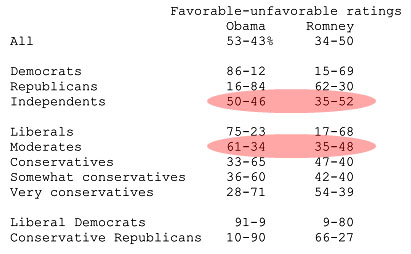
    I know it’s early days and all that, but this ABC News/Washington Post poll tells you all you need to know about Mitt Romney’s November problem: nobody likes him much. I figure he’ll make up his relatively poor showing among Republicans once the primaries are over and it’s time to sing Kumbaya, but independents and moderates just don’t want anything to do with the guy. Obama scores decently with both groups, but Romney is completely in the tank. I suppose he’ll make up some of this deficit once the general election campaign starts and he does his Etch A Sketch restart, but he’s got an awfully big hole to climb out of.

  • The Supreme Court Shows Its True Colors


    From an attorney friend who’s long been more pessimistic than me1 about the possibility that the Supreme Court might overturn Obamacare:

    Dalia Lithwick posted an updated piece after the arguments — the gist of which was that they really might strike it down. She didn’t mention her “no they really won’t” piece (I wouldn’t expect her to yet, but it’s interesting how fragile her previous piece’s argument seems to be).

    Toobin’s hair on fire response is interesting because I think legal watchers deep down believed that the Court would not be so superficial as to unhinge established jurisprudence for an ideological cause. It’s a fun parlor game, but they figure that when sobriety prevails the court will bow to precedent where — as here — the issue is squarely within existing precedent. Well, no, and they are perfectly free to channel right wing bullshit points such as inactivity vs. activity.  I think this really rattled Toobin to see justices behaving like congressmen from Alabama in their arguments.

    Lithwick points out that no one on the right discussed the case law. I mean …. why, who needs it!?

    I’m still sticking with my guess that the individual mandate survives. But I’ll confess that I’m sure not thinking it’ll be a 7-2 decision any longer.

    1Yeah, the Supreme Court is a political body and always has been. I’ve never thought otherwise. But I had a hard time believing they could be so brazenly political that they’d overturn a law so plainly supported by past precedent. Just goes to show that it’s almost impossible to be too cynical these days.

