• Quote of the Day: America’s Billionaires are Pissed Off at Karl Rove


    Via Atrios, this is pretty funny:

    “The billionaire donors I hear are livid,” one Republican operative told The Huffington Post. “There is some holy hell to pay. Karl Rove has a lot of explaining to do … I don’t know how you tell your donors that we spent $390 million and got nothing.”….Rove was forced to defend his group’s expenditures live on Fox News on Tuesday night, and will hold a briefing with top donors on Thursday, according to Politico.

    If conservative billionaires are looking for something else to be mad about, I’d recommend the Romney campaign’s apparent habit of paying about 50 percent more for TV spots than the Obama campaign. That helped line the pockets of the consultants who both recommended the buys and got the commissions for placing the spots, but it didn’t do much to win the election.

    In the end, it turned out that one side ran its campaign like a business, while the other side ran its like a local PTA. Ironically, it was the ex-community organizer who did the former and the ex-CEO of Bain Capital who did the latter.

  • We Should Probably All Calm Down a Bit

    I am going to be a killjoy tonight. I have two things to say:

    • Liberals, you should rein in the triumphalism. Obama won a narrow 51-49 percent victory and the composition of Congress changed only slightly. This was not a historic vindication of liberalism, and it doesn’t mean that we can suddenly decide that demography will sweep us to victory for the next couple of decades. The plain truth is that although an increasing number of voters are turned off by what Republicans represent, that doesn’t mean they’ve become lefty converts. A lot of them are still pretty nervous about a big part of our agenda, and we have a lot of work ahead to get them more solidly on our side. Also: No matter how much you hate to hear it, long-term deficit reduction and entitlement reform really are pretty important. Just because conservatives abuse the point doesn’t mean there isn’t something to it.
       
    • Conservatives, you should rein in the apocalytpic despair. Increasing top marginal rates to 39.6 percent is not a harbinger of torches and pitchforks in the streets, it’s a limited corrective to decades of skyrocketing incomes at the high end. Obamacare is not a sign of incipient tyranny, it’s a modest attempt to provide broad access to healthcare that’s based on a Republican plan and operates largely through the private sector. Universal access to contraceptives doesn’t represent the end of religious liberty, it represents a fairly narrow disagreement over the responsibilities of organizations that occupy a gray area between secular and religious. Fifty million people on food stamps doesn’t mean the final triumph of takers over makers, it means that we’re still recovering from the biggest economic downturn since the Great Depression. (Outside of healthcare, spending on low-income programs is actually pretty low.) America is still America, and it’s still the best place in the world to be if you’re an entrepreneur. More generally: You really do need to update your attitudes on a raft of social issues, but honestly, if you can manage to do something about your crackpot wing and your blood oath to Grover Norquist, you’d be in reasonably good shape.

    Oh, and smart people on both sides of the aisle should start thinking seriously about how to handle a future in which smart machines do more and more work and humans do less and less. I’m dead serious about this.

    That is all. For now. You may now start tearing me apart in comments.

  • Republicans Got Seriously Smoked in the Senate


    I know plenty of people have already said this, but the Senate is an even more impressive story for Democrats than President Obama’s reelection last night. Just a few short months ago it was conventional wisdom that Democrats would be lucky if they only lost three seats, and might very well lose enough to turn control over to Republicans. Instead, they gained two seats.

    In 2004, I remember being dismayed by Democratic performance in the tossup races. Out of five close Senate races, Republicans won four of them. This year was the exact opposite. Democrats won every single close contest but one (Heller in Nevada), and in the end most of the races didn’t even turn out to be all that close. Heidi Heitkamp won by one point; Tester by four; Kaine by five; Baldwin by six; Donnelly by six; Warren by seven; and McCaskill by 16 (!). That’s just a helluva performance.

    Republicans could have at least retained their current numbers if they’d had the good sense to reject tea party nutballs in Missouri and Indiana, but even if they had they still would have underperformed expectations substantially. Obama’s victory wasn’t a surprise to anyone living outside the Fox News bubble, but the results of the Senate races constituted a pretty serious, pretty pointed rejection of Republican ideology in red states and blue states alike.

  • John Boehner’s Desperate Bluff on Taxes

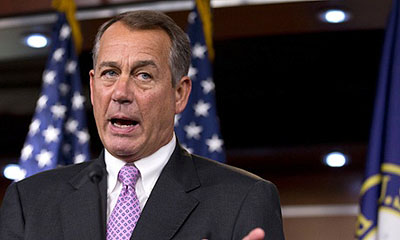
    House Speaker John Boehner lost no time getting in the first shot Wednesday on taxes and the fiscal cliff, telling reporters that in order to forge a bipartisan agreement Republicans are “willing to accept new revenue, under the right conditions”:

    While Boehner suggested that Republicans would still oppose Obama’s plan to take “a larger share of what the American people earn through higher tax rates,” he said the party is open to “increased revenue . . . as the byproduct of a growing economy, energized by a simpler, cleaner, fairer tax code, with fewer loopholes, and lower rates for all.”

    It was not immediately clear whether Boehner meant that Republicans would acquiesce only to fresh revenues generated through economic growth rather than actual tax increases.

    Really? That wasn’t immediately clear? I’d say Boehner was being crystal clear: he won’t accept higher tax rates on the rich, and he won’t even close loopholes unless they’re accompanied by lower tax rates on the rich. In other words, his offer is: nothing. After all, it’s not as if there’s anyone who opposes the prospect of getting more revenue as a byproduct of a growing economy.

    I think the right way to interpret this is as pro-forma, job-saving bluster. Boehner knows full well that his caucus will eat him alive, with Eric Cantor leading the charge, if he wavers on taxes, so he’s adopting the same hardline position as he did last year but trying to pretend that it’s some kind of kinder, gentler proposal. It’s not. This is precisely the position that Republicans offered during the debt ceiling showdown and precisely the position they’ve stuck to ever since. There’s not even a hint of a difference.

    But it’s still bluster and Boehner knows it. On January 1st, the Bush tax cuts expire. They’re gone. At that point, Boehner & Co. can agree to a deal that lowers taxes for everyone on all income under $250,000, or they can hold out for a deal that lowers taxes for everyone and lowers taxes on income over $250,000 back to Bush-era levels. However, if they refuse to make a deal, then no one gets a tax cut, and they’ll be crucified by public opinion for protecting the rich. As Dave Weigel says, voters have made that clear:

    Barack Obama ran on one consistent tax promise, in both 2008 and 2012. Vote for him, and you’d see middle-class tax rates stay the same while the rate on income over $250,000 increased to 39.6 percent. In 2008 and 2012, Republicans whaled on Obama for that message. If you flipped on TV in a swing state, you heard all about Obama’s “trillion-dollar tax increase.” Last month, in a comment that Republicans derided for its gaffitude, Joe Biden repeated the claim about tax hikes and leaned into the mic, drawing out his promise: “Yes. We. Will.” For months, Republican strategists told me that they’d beat Democrats on the tax issue just like they beat ’em in 2010.

    They didn’t beat Obama. Twice, in four years, a majority of voters have picked Obama for president, knowing full well that he’ll raise upper-income tax rates.

    And that’s not all: poll after poll shows big majorities in favor of higher rates on the rich. Opposing a broad, bipartisan tax cut because it’s not friendly enough to the rich is a losing hand and Boehner knows it. He just can’t admit it yet, so instead he hauled out the same tired talking points from a year ago and did his best to dress them up a little differently. Nice try.


  • Beware of Beguiling Explanations for Obama’s Victory


    One more quick thing: before everyone starts getting too enthralled with demographic time bombs and other in-the-weeds explanations for why Obama won last night, just remember this: most of the political science models, based on little more than a few economic fundamentals, predicted a modest Obama victory six months ago. Maybe Hispanics mattered, and maybe Benghazi and Sandy and 47% and the first debate and Jeeps in China all mattered too. But if they did, they sure seem to have conveniently canceled each other out and left us exactly where we thought we’d be back in the dog days of summer. Some coincidence, huh?

  • The Unappreciated Virtues of Doing Nothing


    Just a quick point: the conventional wisdom says that Barack Obama accomplished a lot in his first two years but won’t accomplish much in his last four. I think this is about right. But this should scare Republicans a lot. Obama really did preside over some substantial changes during his first term—most notably Obamacare—and that made it fairly easy to appeal to centrists who felt apprehensive about this pace of change.

    But if Obama spends his next four years presiding over nothing more than the implementation of laws already passed while simultaneously addressing America’s fiscal problems—something that’s inevitable given the end of the Bush tax cuts and an improving economy—then Democrats will look pretty good in 2016: steady, sober, and decidedly non-scary. It could be that doing nothing is about the best strategy the party could follow. And Republicans are going to do everything they can to help.

  • How Right-Wing Media Failed the Right Wing

    Speaking of “media-driven nightmares about the end of America-as-we-know-it under Obama’s leadership,” Conor Friedersdorf has a good post today about exactly the problem this poses for the Republican Party:

    Barack Obama just trounced a Republican opponent for the second time. But unlike four years ago, when most conservatives saw it coming, Tuesday’s result was, for them, an unpleasant surprise. So many on the right had predicted a Mitt Romney victory, or even a blowout — Dick Morris, George Will, and Michael Barone all predicted the GOP would break 300 electoral votes.
    ….Conservatives were at a disadvantage because Romney supporters like Jennifer Rubin and Hugh Hewitt saw it as their duty to spin constantly for their favored candidate rather than being frank about his strengths and weaknesses….Conservatives were at an information disadvantage because so many right-leaning outlets wasted time on stories the rest of America dismissed as nonsense….Conservatives were at a disadvantage because their information elites pandered in the most cynical, self-defeating ways, treating would-be candidates like Sarah Palin and Herman Cain as if they were plausible presidents rather than national jokes who’d lose worse than George McGovern.

    ….On the biggest political story of the year, the conservative media just got its ass handed to it by the mainstream media. And movement conservatives, who believe the MSM is more biased and less rigorous than their alternatives, have no way to explain how their trusted outlets got it wrong, while the New York Times got it right. Hint: The Times hired the most rigorous forecaster it could find.

    It ought to be an eye-opening moment.

    Like Conor, I agree that this should be an eye-opening moment but probably won’t be. The direct audience for conservative news, after all, may be small, but it’s fervent. There’s just too much money to be made pandering to them, and the folks who do it don’t care much about the fact that this pandering has effects that ripple far beyond the true believer base. Unfortunately, failing to be reality based eventually catches up with you.

  • The GOP’s Four Big Problems

    Greg Sargent is annoyed by the conservative drumbeat that Democrats didn’t win a mandate last night. Barack Obama was reelected by a big margin. Democrats picked up seats in the Senate, something that seemed inconceivable as recently as a couple of months ago. Democrats made substantial gains in state legislatures. And a whole raft of liberal initiatives passed: a tax increase in California; marijuana legalization in Washington and Colorado; and ratification of gay marriage in Maryland, Maine, and (probably) Washington. Here’s Greg:

    What happened yesterday is very clear. Romney campaigned on a platform of repealing (and not replacing) Obamacare….readjusting the social contract at the core of Medicare….and dramatically reducing the amount the rich contribute towards the upkeep of government.

    ….Obama campaigned on the necessity of continuing to implement health reform….on preserving Medicare….and on the moral need for the rich to sacrifice a bit more to enable a more robust role for government in improving the lives of the less fortunate.

    All of this was very explicit….People keep arguing that the campaign was regularly drawn into petty squabbles over offhand remarks by the candidates. But some of those squabbles — such as the battles over Obama’s “you didn’t build that” speech and Romney’s “47 percent” remarks — went directly to the heart of the basic ideological conflicts outlined above. Those supposedly petty battles actually embodied big, consequential arguments.
    Indeed, Republicans themselves regularly said that this election was a “big choice” between “two very different visions for America.” That was also the regular refrain of pundits just after Romney chose Paul Ryan, the leading architect of the GOP’s overarching ideological blueprint for the country’s future. So by the lights of Republicans and pundits themselves, this outcome should be seen as a big choice by the American people — a big decision about the future direction of the country. Why, now that Obama has won a resounding victory, is this suddenly being talked about as a small, no-mandate election?

    That’s all true. But let’s be honest with ourselves. Obama won the popular vote by a margin of 51-49 percent. The composition of the House stayed pretty much the same. Ditto for the Senate. By a slender margin, we find ourselves in almost exactly the same situation we were in before the election. It’s really hard to make the case for a mandate, even assuming you believe in mandates in the first place.

    Which I don’t. When was the last time a second-term president was able to pass something really significant? You could make a case for tax reform in Reagan’s second term, but that’s about it.

    But there is something else going on. Republicans really do have a problem, and they know it. Or, rather, an interconnected set of problems:

    • They’re obviously on the wrong side of history on gay marriage, and they’re losing young voters because of it.
    • The Hispanic population is growing, and they’re losing that too thanks to their xenophobic immigration policy.
    • Americans are tired of war, and (for better or worse) President Obama has proven hawkish enough that Republicans have lost their edge on national security issues. Mitt Romney more or less conceded that in the third debate by agreeing with practically everything Obama said.
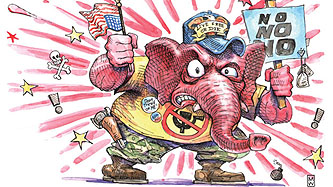
    • The GOP policy of maximal obstruction is probably nearing the end of its shelf life. There are already signs that independent voters are exhausted by it, but the base of the party still demands it.

    None of this is especially insightful. In fact, it’s practically banal. Everyone knows it. So there’s a sense in which it hardly matters if Obama “really” has a mandate. The Republican Party has a choice: either it tacitly acknowledges a mandate and reforms itself to fix the four big problems above, or else it withers further and faces a 2016 election in which the economy is good, the public is tired of crazy talk and mindless obstruction, and there will no longer be any question of whether anyone has a mandate. It will just be a question of counting votes.

    I don’t expect the Republican Party to reform itself anytime soon. They’ve become a victim of their own media-driven nightmares about the end of America-as-we-know-it under Obama’s leadership, and too many of their supporters now believe this stuff for them to change their tune anytime soon. Nevertheless, change they must. And the sooner they start, the easier it will be.

  • We Now Have Four Years of Trench Warfare Ahead of Us


    I’m unaccountably exhausted this morning. I don’t know why. I was never all that worried about the election because I believed the polls and figured Obama would win. I live on the West Coast, so I didn’t have to stay up late last night. My side not only won, but won bigger than anyone expected, so there’s no letdown. So what’s the deal?

    Beats me. Maybe I’m just loathe to face up to the next four years, which promises to be an awful lot like the past two. I don’t think Obama’s second term will devolve into scandal, as so many other second terms have, but neither do I believe that Republicans will back down from their all-obstruction-all-the-time agenda. It’s going to be four years of faux drama and trench warfare, and that just doesn’t seem very appealing.

    Then again, maybe I just slept badly. I’ll let you know tomorrow. 

  • Four More Years: The View From the Other Side

    I don’t really have anywhere to go with this at the moment, but I do sort of wonder what’s going to happen to the Republican rank-and-file now that the election is over. I’m not talking about party leaders: I assume that after a brief spasm of pretending to be willing to work with Obama, they’ll return to maximal obstruction mode without missing a beat. I’m thinking more of the tea partyish base.

    Losing a presidential election is always tough, but this one was presented to them in unusually apocalyptic terms. Obama was a closet socialist. He was un-American. He wanted to destroy capitalism. He’s been responsible for endless economic misery. He’s left America open to attack from foreign enemies. He wants to immiserate small business owners in order to distribute goodies to poor people. He engineered a total government takeover of the healthcare industry. He deliberately allowed four brave Americans to die in Benghazi and then ruthlessly covered it up. He wants to outlaw churches. He wants to take away your guns. Etc. On Fox News last night, there was palpable disbelief from right-wing pundits that he could possibly have won. They thought Mitt Romney should have been able to blow Obama out of the water in a massive defeat, and the fact that he didn’t meant the Republican Party ought to commit ritual suicide to pay for its world historic incompetence.

    And you know, if you immerse yourself in right-wing media, it all makes a sort of sense. “This is not hyperbole,” one Republican told Andy Kroll last night, “This country is done. The writing’s on the wall. Dead.” A relative told me last night about a friend who’s literally afraid that her life savings are now in danger because Obama was reelected. James Fallows has been following the story of a small businessman who says he’s going to close up shop now that Obama is back in office. All of these people believe that Obama is something close to a dystopian antichrist. And yet….a majority of Americans decided to put him back in office. If Obama really is the guy you’ve been told he is, that’s not just inexplicable, it’s nothing short of criminal.

    So what happens now? What happens when churches continue to thrive, the economy recovers, Obamacare turns out to be a fairly benign expansion of healthcare coverage, taxes don’t change much, and America doesn’t find itself under foreign occupation? I don’t know. Like I said, I don’t really have anywhere to go with this. But a big part of the conservative base has been told that another four years of Obama will literally result in America no longer being a free country, and their fear of what that means is quite real. So what happens now?