• In Which I Share My Voting Experience


    It appears to be something of a tradition for political bloggers to report on the state of their local polling station, so here’s my dispatch from the front lines of my white, upper-middle-class neighborhood:

    The weather was nice. I have a job that allows me to vote anytime I want, so I headed out at 10:58 am, which is conveniently during the midmorning lull. My polling place is about 200 yards from my house and I got there at 11:01 am. There was no line. It took two minutes to check in. Nobody asked for ID because California doesn’t require it. The machine worked fine. It printed an audit trail that correctly captured my vote. I returned home at 11:09 am.

    And that was that. Aside from the 200-yard thing, which obviously isn’t possible universally, this is how voting should go for everyone.

  • The New Black Panthers Give Fox News an Early Christmas Gift

    Dave Weigel wonders if the New Black Panther Party will give Fox News an early Christmas present by showing up again this year at polling places in Philadelphia. The answer turns out to be yes:

    The Panthers are so stupid that they deployed to the same site they hit in 2008: The 4th district of Philadelphia’s 14th ward. Very few of the people who hyperventilate about this story have been to the polling place and check out its vote. I have. The precinct, located in a retirement home, gave 596 votes to Barack Obama in 2008. It gave 13 votes to John McCain. Four years earlier, it had given 24 votes to George W. Bush. It’s a heavily black, Democratic area, which is why — four years after the first Fox freakout — no one has ever emerged to say he or she wanted to vote but was suppressed by the Panthers. And hell, in 2008, the Panthers had nightsticks. There’s one guy now, armed with nothing.

    Let’s be serious about this. One month ago, a court struck down part of Pennsylvania’s voter ID law. Voters in the state do not have to show ID, though poll workers may ask for it. Since then, the state has continued to run ads that tell voters to come to polls with ID — “SHOW IT” in large print, “if you have it in small print.” It’s likely that legitimate voters who lack multiple forms of ID have seen this, and assumed it’ll be tougher to vote today.

    But it’s boring to talk about a bogus campaign to complicate the vote in the entire state. It’s exciting to show a scary-looking black dude on TV, and imply to the Fox News viewer that another scary trooper — maybe a UN worker! — is laying in wait at his polling place.

    It’s all part of the Republican war on voters who might not vote for Republicans. You can read about it here.

  • The 2012 Campaign May Have Been Small, But the Election Itself Will Be Very Big Indeed

    In Politico, John Harris and Jonathan Martin complain that although both sides tried to pretend the 2012 election was an apocalyptic choice between competing worldviews, in the end it turned out to be “small”:

    These two opposites in fact are closely connected. Yes, there are specific people to blame, and no better place to start than the top: Barack Obama and Mitt Romney were co-conspirators in driving what they both claimed was the most important election of our lifetimes into cul-de-sacs of trivia and evasion. But it is clear that both men found themselves caught in a vortex of large forces that converged to make the election small.

    The arguments were small….The playing field was small….Most of all, the leading actors were small — either content with their diminished stature or powerless to change it. Obama, who four years ago encouraged people to view him as an epic figure, riding a wave of history, this time encouraged people to view him in life-size terms, as a mortal figure who had done the best he could amid setbacks and disappointments.

    There’s a lot to this, but I think Harris and Martin miss the real reason for it: for all the sound and fury, there’s a remarkable amount of consensus over big policies in America. The welfare state that Democrats have built over the past 80 years—Social Security, unemployment insurance, Medicare, subsidized public education, welfare, and the minimum wage—is pretty much here to stay, with neither side able to change it except on the margins. Ditto for the regulatory state: OSHA, workers comp, environmental regulations, consumer-protection laws, and, most recently, Dodd-Frank. Social attitudes continue to loosen up slowly in some areas (gay rights, religiosity) and remain stable in others (guns, abortion). Most of the heavy lifting on civil rights—the Civil Rights Act, the Voting Rights Act, affirmative action, gender discrimination laws, the Violence Against Women Act, and ADA—was finished years ago, with little left on the national agenda aside from things like the precise boundaries of affirmative action. Conservatives have won some battles too. We’ve reached a rough consensus on taxes, arguing now only about whether the marginal rate on top earners should change by four percentage points, and as Benjamin Wittes argues persuasively today, for better or worse we’ve reached a rough consensus on national security issues too. Extinguishing the private sector labor movement was a big deal for Republicans over the past few decades, but that job is mostly finished.  

    I’m not trying to downplay how important small changes can be, especially as they build up over time. Trench warfare may not be glamorous, but it makes a difference. And in some ways, the very lack of detail in the 2012 campaign has been refreshing: it made the campaign into a pure debate over broader views of the role of government without getting too caught up in all the niggling details.

    But here’s something else interesting: I’d say there are at least two very concrete areas where today’s election really will make a big difference. And yet, neither candidate spent much time talking about them. The first is abortion, where Supreme Court nominees over the next four years have at least the potential of overturning Roe v. Wade. But while the “war on women” has been a Democratic talking point all year, it’s never really become a major campaign topic.

    And the second? Obamacare. This is the capstone of the Democratic welfare state, the final big-ticket program that’s eluded liberals for nearly a century. In Joe Biden’s memorable words, it’s a big fucking deal. If Romney were elected along with a Republican Senate, he’d almost certainly be able to badly cripple Obamacare, even if he couldn’t quite repeal it outright. If Obama wins and keeps the Senate in Democratic hands, it will become institutionalized. And like Social Security and other similar programs that started out small, it will grow over time until, eventually, America really does have universal healthcare.

    But as with abortion, it simply hasn’t been a big campaign issue. Romney issues pro forma applause lines about repealing Obamacare on Day 1, but that’s about all. And Obama barely mentions it at all. For my money, this is by far the biggest issue of the campaign, and it’s been nearly invisible.

    So in a way, the 2012 campaign hasn’t been small. Both sides may have made a strategic decision to fight on other grounds, but Obamacare, all by itself, is about as big as things get these days. Even if an elephant in the room is invisible, it’s still an elephant.

  • The Story Behind Red States and Blue States

    Why are Republican states colored red and Democratic states colored blue? Answer: because Democratic states were colored blue in 2000, and the long recount that year seared the electoral map into everyone’s memory. After that, the association became permanent. 

    Fine. But why were Democrats blue in all the 2000 maps? After all, red is traditionally the color of lefty parties around the world, and before 2000 elections network maps had usually colored Democratic states red. Several years ago, one of my commenters provided the answer:

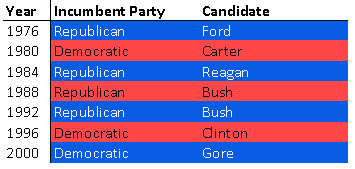
    Since the advent of color TV, there has been a formula to avoid charges of giving any party an advantage by painting it a “better” color. Here is the formula: the color of the incumbent party alternates every 4 years.

    I’ve never gotten ironclad confirmation of this rule, but it seems to be correct. The table on the right shows how this formula has applied since 1976, and it explains why Democrats had usually been colored red prior to the 2000 election: it’s a coincidence. In the six elections prior to 2000 every Democrat but one (Dukakis in 1988) had been coded red, but that was just because of how the cycle of incumbency happened to work out during that period. If the formula had continued, the incumbent Republicans would have been blue in 2008, but by then it was too late. The color of the parties had entered American folklore and become permanent.

    HOLD ON!: In the Smithsonian, Jodi Enda dives in deeper and calls my story a “myth.” Map colors weren’t monolithic among the networks, and she finds no evidence of any kind of rule for how the colors switched. Rather, in the early years of color mapping on TV they “changed back and forth from election to election and network to network in what appears, in hindsight, to be a flight of whimsy.”

  • Californians Started the Tax Revolt 34 Years Ago. Will They End it Today?

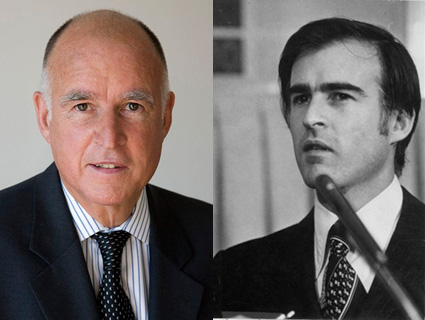
    California Gov. Jerry Brown, now and then<a href="http://ag.ca.gov/images/ag_brown.jpg">State of California</a>; <a href="http://en.wikipedia.org/wiki/File:JerryBrownInauguration1975.jpg">Sacramento Bee</a>

    The great American tax revolt got its start in June 1978, when California voters passed Proposition 13, a ballot initiative that cut and capped property taxes and required a two-thirds vote to pass any future tax increases. Jerry Brown was governor back then, and initially he opposed Prop. 13. Once it passed, though, he became such a fervent apostle that four months later Howard Jarvis, the father of Prop. 13, was cutting campaign commercials for Brown’s reelection bid. Today, at age 74, Brown is no longer the Gov. Moonbeam that Garry Trudeau famously dubbed him back in the ’70s, but he is governor again. And guess what? In a Groundhog Day kind of way, Proposition 13 is back on the ballot again too.

    Naturally, there’s a backstory here. The Golden State has had a rocky past decade, starting with over-optimistic spending during the dotcom boom; red ink as far as the eye could see during the dotcom bust; and finally, in 2003, a special election that propelled movie star Arnold Schwarzenegger into the governor’s mansion. Schwarzenegger won largely because of a second, mini-tax revolt, this time over an increase in the vehicle license fee, which he promised to roll back. He kept his promise, immediately plunging California back into deficit, and then passed a revenue bond that papered things over for a couple of years but, in the long run, just made California’s problems worse.

    Still, for a couple of years toward the end of Schwarzenegger’s second term, the state budget started looking a little better. But it was just a mirage. California’s structural deficits had never really been addressed, and when the Great Recession hit in 2008 things went pear shaped fast. And while Republicans may be a fading force in California, they maintain just enough members in the Legislature to prevent any tax increases—thanks to Prop. 13’s two-thirds requirement—something which has left Sacramento with no choice but to slash the budget brutally. In current dollars, California spent $3,100 per resident out of its general fund in 2007. Today that’s down to $2,400. (Raw numbers here.)

    Because of this, schools have suffered, universities have suffered, and, of course, the poor have suffered. Further cuts this year would cause even more devastation, so Brown is resorting, once again, to California’s initiative process to fix things. Ironically, though, this time he’s campaigning hard for Proposition 30, a measure that would temporarily increase income taxes on the rich and sales taxes on everyone. The money would mostly be earmarked for K-12 schools and community colleges. If it doesn’t pass, automatic triggers in the 2013 budget will take effect, slashing $6 billion in planned spending.
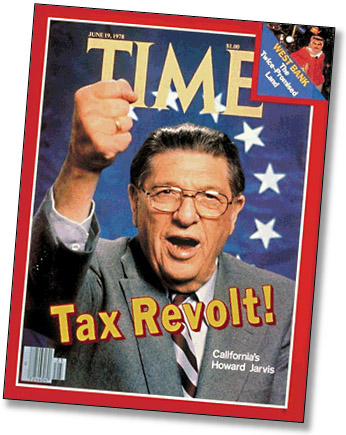
    So here’s the question: Will California voters, who so famously started the tax revolt 34 years ago, agree to Brown’s plan to bypass the two-thirds requirement they themselves put in place and raise their own taxes? If Prop. 30 passes, it would symbolically mark an end to the tax revolt, and for this reason it’s attracted more than just the usual opposition from within California. It’s also attracted huge amounts of opposition funding from outside the state. Huge and mysterious: An Arizona outfit called Americans for Responsible Leadership has committed $11 million to the fight against Prop. 30 (as well as the fight for Prop. 32, a union-busting measure), but has steadfastly refused to disclose where the money came from. Under a court order, they finally revealed the source of the money on Monday, but they still had the last laugh: The source they revealed was just another mysterious organization, and it’s too late to force that organization to reveal the real source of the money. Andy Kroll has the whole story here.

    So will Prop. 30 pass? It’s on a knife edge. The most recent Field Poll, the gold standard in California polling, shows that all that outside money has had an effect. Support has dropped substantially over the past month, and now stands at 48 percent to 38 percent. A separate poll from PPP put Prop. 30’s support at 48 percent to 44 percent. That may seem like a comfortable lead, but conventional wisdom says that once an initiative drops below 50 percent, it’s in trouble. The undecided voters almost always end up voting No in large numbers.

    So that’s where we stand. Today, at the behest of the same governor who came to personify the start of the tax revolt in America, Californians will decide whether they’ve had enough. After watching school funding and basic service funding atrophy for over a decade, is it finally time to call off the tax revolt? In a few hours, we’ll find out.

  • Final Election Forecasting Update – 5 November 2012

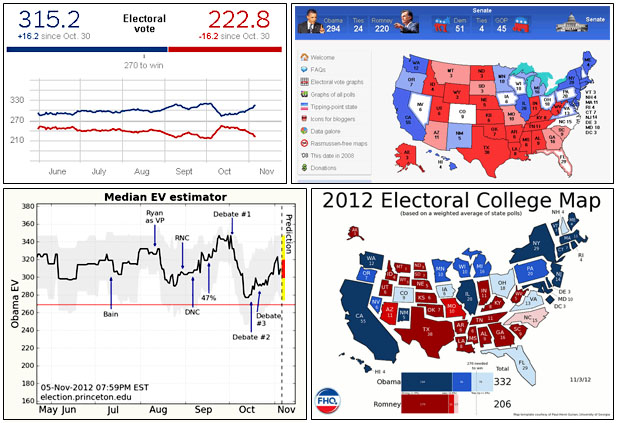
    Here it is: my final update on the status of the most popular presidential forecasting models. On the top are Nate Silver and Andrew Tanenbaum; on the bottom are Sam Wang and Josh Putnam. Three of the four have moved a bit in Obama’s direction since yesterday, and all four models continue to predict a convincing Obama victory. The average forecast is 312 electoral votes for Obama vs. 219 for Romney.

    So that’s that. On Tuesday, the most consequential election in the history of Western civilization, pitting a radical socialist revolutionary against a misogynist plutocratic reactionary, will finally be over (God willing). On Wednesday, the backbiting and sniping will begin. Then, after a long weekend to cool down, we’ll all start prepping for the next most consequential election in the history of Western civilization, the one that will determine the character of these United States for decades to come. I can’t wait.

  • Note to the Columbus Dispatch: 84 Percent Is Not a Toss-Up


    The Columbus Dispatch’s final pre-election poll has Obama leading Romney 50 percent to 48 percent. Their headline calls this a “toss-up,” and Robert Wright is unhappy about that:

    Presumably the reason the headline writer felt justified in calling the race a toss-up was this paragraph in the story: “The final Dispatch poll shows Obama leading 50 percent to 48 percent in the Buckeye State. However, that 2-point edge is within the survey’s margin of sampling error, plus or minus 2.2 percentage points.”

    That wording suggests that Obama’s two-point edge has no meaning. And that’s a common way for journalists to interpret results that fall within the “margin of error.” For example, in September a conservative columnist in the New York Post asserted that Obama’s lead in state polls didn’t matter because the “polls separating the two candidates are within the margin of error — meaning that there is no statistical difference in support between Obama and Romney.”

    Wright is right. The MOE for a single poll represents a 95 percent confidence interval for each individual’s percentage, but it doesn’t represent a 95 percent confidence for the difference between the two. In fact, a 2 percent difference in a poll with a 2.2 percent MOE suggests that there’s about an 84 percent chance that the guy in the lead really and truly is in the lead.

    And guess what? Based on averaging lots of polls, and thus reducing the MOE, Nate Silver figures that Obama’s chances of winning tomorrow are 86 percent—largely because he thinks those are Obama’s chances of winning Ohio. So it turns out that everyone is saying the same thing, but the Columbus Dispatch just doesn’t know it. Obama seems to have about an 84 to 86 percent chance of winning Ohio, and therefore an 84-86 percent chance of winning the election.

  • Judge Throws Book at S&P Over Shoddy Rating Practices


    Good news! Standard & Poor’s is finally being held to account for transparently manipulating its own models solely in order to give one of its customers a AAA rating for a rocket-science derivative product. Long story short, they plugged in whatever numbers it took to generate the AAA rating, even though they knew the numbers were bogus. In fact, says Felix Salmon, if they had plugged in reasonable numbers, “the CPDO would almost certainly not even have been investment grade, let alone triple-A.”

    And the bad news? The ruling came from an Australian judge. And it’s 635,500 words long (!). Wouldn’t it be nice to get a few rulings like this from American judges too? In the meantime, Felix has a reasonably understandable explanation of the whole thing here. Read it and weep.

  • The Kafkaesque World of the No-Fly List

    Glenn Greenwald recounts the story today of Saadiq Long, an Air Force veteran currently living in Qatar, a close U.S. ally. His mother in Oklahoma is sick, but when Long bought a ticket to visit her, he discovered that he had been put on the no-fly list:

    Long has now spent the last six months trying to find out why he was placed on this list and what he can do to get off of it. He has had no success, unable to obtain even the most basic information about what caused his own government to deprive him of this right to travel.

    He has no idea when he was put on this list, who decided to put him on it, or the reasons for his inclusion. He has never been convicted of any crime, never been indicted or charged with a crime, and until he was less than 24 hours away from boarding that KLM flight back to his childhood home, had received no notice that his own government prohibited him from flying.

    Is there a good reason that Long is on the no-fly list? I have no idea. There might be. But what’s outrageous about this, aside from the sheer number of people we’ve placed on the no-fly list over the past decade, is the lack of judicial oversight. Someone has put you on the list, but you don’t know who. There’s presumably a reason for being put on the list, but no one will tell you what it is. There’s a procedure that provides you with a “redress control number,” but it often appears to be meaningless. If you go to court, a judge will tell you it’s a national security issue and there’s nothing to be done about it. It’s a cliche to call this kind of system Kafkaesque, but what other word is there for it?

    And as Glenn reports, things were bad under Bush, but have gotten worse over the past four years. “Secret deprivation of core rights, no recourse, no due process, no right even to learn what has been done to you despite zero evidence of wrongdoing: that is the life of many American Muslims in the post-9/11 world. Most significantly, it gets progressively worse, not better, as the temporal distance from 9/11 grows.”

    Again: maybe there’s a good reason that Long is on the no-fly list. But if there is, the government should be required to stand up in court and make its case, and Long should have the chance to fight back. The executive branch should never have the power to do something like this with no oversight and no accountability.

  • Eggheads: The Secret Source of Democratic Campaign Success


    Sasha Issenberg is the author of The Victory Lab, a book about the increasing use of social science experiments to improve the effectiveness of political campaigns. The first big-name politician to really make use of this was Rick Perry, but since then it’s been almost exclusively a Democratic phenomenon. Dylan Matthews asks why:

    ISSENBERG: The reason Perry developed that partnership is that he made them an unusual offer, which is that they could publish their work. Most campaigns want to keep it proprietary, so the academics who are willing to work with them are often people who are aligned with their political goals, and not necessarily in it for research purposes.

    Hmmm. According to Issenberg, Democrats faced a crisis in 2004 that motivated them to figure out how to run their campaigns better. But that’s not all. They also found it pretty easy to find plenty of eager help within academia:

    The left has been way better than the right at engaging the political scientists and economists who use these techniques to measure real-world cause and effect. You just have dozens of professors and graduate students who want to work with Democratic campaigns, women’s groups and labor groups, and very little of that on the right.

    ….The fact that Republicans lost so overwhelmingly in 2008, I think, delayed an awareness of the technical gap between the two sides….For the sake of innovation on the Republican side, the best thing that could happen to them is that they lose narrowly on Tuesday, that the story becomes how Obama and his allies ran a mechanically superior campaign.

    ….That’s the first step. The second step is finding social scientists who want anything to do with the Republican party in the 21st century, and that probably won’t be solved on Tuesday one way or the other. That’s a bigger cultural problem.

    So there really are advantages to being (a) reality-based and (b) non-troglodytes. This is, truly, the revenge of the nerds.