• Republicans Finally Riding to Todd Akin’s Rescue


    Let us turn our attention to the Missouri Senate race being waged by Todd “legitimate rape” Akin. How am I doing with my prediction that once Akin was firmly in the race for good, Republicans would abandon their principled stand against him and start sending money his way? Well, the rehabilitation project started a month ago, and now it’s in full swing:

    Rep. Todd Akin and the Missouri Republican Party are launching a nearly $700,000 TV ad blitz in the closing days of his challenge to Democratic Sen. Claire McCaskill, but the source of the funds for the effort is unclear….The National Republican Senatorial Committee declined repeatedly to comment on whether it is the source of the funds being used by the Missouri GOP on Akin’s behalf. Previously, the committee has insisted it would stay out of the race. However, only national committees — the NRSC or the Republican National Committee — or individual campaign committees that raise money in compliance with federal limits are permitted to shift funds to a state party for a coordinated ad buy.

    So….yeah, it’s probably the NRSC, even though they promised never to give Akin a dime. I don’t really blame them for this, though. It’s just garden-variety politics. The next question, though, is: will it be enough? The latest polls still have Claire McCaskill up by a few points, and she’s outspent Akin heavily. So maybe not. I guess it all depends on just what $700,000 buys you in Missouri.

  • Mitt Romney Going for the Gold in Absurd Mudslinging Competition

    Here is the Romney campaign’s latest effort to mobilize the Hispanic vote in Florida with an uplifting, inspirational message:

    NARRATOR: Who supports Barack Obama?

    HUGO CHAVEZ: “If I were American, I’d vote for Obama.”

    NARRATOR: Raúl Castro’s daughter, Mariela Castro, would vote for Obama.

    MARIELA CASTRO: “I would vote for President Obama.”

    NARRATOR: And to top it off, Obama’s Environmental Protection Agency sent emails for Hispanic Heritage month with a photo of Che Guevara.

    CHAVEZ: “If Obama were from Barlovento (a Venezuelan town), he’d vote for Chávez.”

    ROMNEY: I’m Mitt Romney, and I approve this message.

    Is it wrong to admit that this made me laugh more than it actually outraged me? Probably. But this is so ridiculously negative that it’s almost as if Romney is competing in some kind of Monty Python-esque mudslinging competition. Apparently Romney knows it, too: he refused repeated requests from the Miami Herald to make the ad available, so they had to make their own iPhone recording of it straight off the TV.

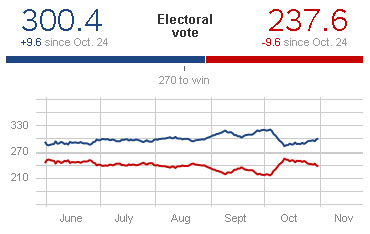
  • Here’s Why All the Polling Models Are Probably Right

    Paul Waldman describes the Bizarro-world war on polling guru Nate Silver that’s gained steam over the past week:

    In the last few days, we’ve seen a couple of different Silver narratives emerge as attention to him has increased. First, you have stories about how liberals are obsessing over Silver, “clinging” to him like a raft in a roiling sea of ambiguous poll data. Then you have the backlash, with conservatives criticizing him not because they have a specific critique of the techniques he uses, but basically because they disagree with his conclusions….Then you’ve got the reporter backlash. At Politico, Dylan Byers raised the possibility that Silver would be completely discredited if Mitt Romney won, because “it’s difficult to see how people can continue to put faith in the predictions of someone who has never given that candidate anything higher than a 41 percent chance of winning.”

    This whole thing is deeply weird. Could Nate be wrong? Sure. Ditto for Sam Wang and Drew Linzer and all the rest of the poll modelers out there. But if they’re wrong, it probably won’t be because of their models. After all, with minor differences they all do the same thing: average the publicly available state polls, figure out who’s ahead in each state, and then add up the electoral votes they get for each candidate. Sure, they all toss in a little bit of mathematical secret sauce, but not really all that much. You could do the same thing if you felt like it. Want to know who’s ahead in Ohio? Go add up the five latest polls and then divide by five. Voila. You are now your own Nate Silver.

    Needless to say, though, the poll modelers are only as good as the polls they use. If the pollsters are systematically wrong, then the models will be wrong. And while there are a few small sources of potentially systematic bias (not calling cell phones, demographic weighting, etc.), by far the biggest is the pollsters’ likely voter screens. But even here, with one or two exceptions, this is pretty simple stuff. Most pollsters just ask a question or two that go something like this:

    • Are you planning to vote?
    • How sure are you that you’ll vote?
    • Really? Honest and truly?

    That’s about it. If you tell them you’re highly likely to vote, they mark you down as a likely voter. If not, they don’t. There’s no rocket science here.

    So if the modelers are wrong, it will probably be because the pollsters were systematically wrong. And if the pollsters are systematically wrong, it will probably be because this year, for some reason, people started lying about their likelihood of voting. And while anything’s possible, I sure can’t think of any reason why this year there would be a sudden change in how truthful people are about their intention to vote.

    That’s what this whole controversy comes down to. Conservatives seem to be convinced that Democrats simply won’t turn out in high enough numbers to reelect Obama. A fair number of liberals fear the same thing. But there’s no analytic reason to believe this. The Obama campaign’s ground game seems to be as good as any in the business, and Obama voters are telling pollsters that they’re likely to vote in big enough numbers to give him the key swing states he needs to win. That’s the current state of our knowledge. It might be wrong, but if it is, the question isn’t going to be why Nate Silver went astray. The question is going to be, why was 2012 the year when people suddenly started lying to telephone pollsters?

    UPDATE: Asawin Suebsaeng has a roundup of all the prognosticators here. It’s a nice, Cliff Notes version of who’s who and what they’re saying.
     

  • Scary Climate Change Stories Aren’t Working. What’s Next?

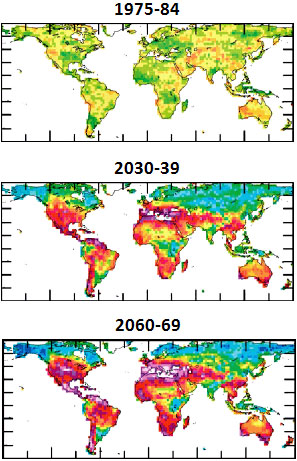
    In the wake of Hurricane Sandy, which he calls “a window into the way ahead,” Nick Kristof chides the media and our political class alike for paying too little attention to climate change:

    Politicians have dropped the ball, but so have those of us in the news business. The number of articles about climate change fell by 41 percent from 2009 to 2011, according to DailyClimate.org.

    HThere are no easy solutions, but we may need to invest in cleaner energy, impose a carbon tax or other curbs on greenhouse gases, and, above all, rethink how we can reduce the toll of a changing climate. For example, we may not want to rebuild in some coastal areas that have been hammered by Sandy.
    ….Democrats have been AWOL on climate change, but Republicans have been even more recalcitrant. Their failure is odd, because in other areas of national security Republicans pride themselves on their vigilance. Romney doesn’t want to wait until he sees an Iranian nuclear weapon before acting, so why the passivity about climate change?

    Let’s do something useful here. Yesterday I wrote a discouraged post suggesting that the world was unlikely to seriously respond to climate change in time to prevent catastrophe, so maybe we should spend more time instead thinking about adaptation and geoengineering, the latter as a last-resort option. I got a lot of pushback on this, which I probably deserved, since it sounded like I was giving up entirely on the idea of fighting greenhouse gas emissions. I wasn’t, but I was talking out loud about the likelihood that even if we keep up the fight, it probably won’t be enough. There are just too many big forces pushing in the opposite direction.

    One emailer who pushed back suggested we just needed to keep fighting relentlessly. It worked for Republicans on tax cuts, after all, so it could work for us on climate change. I told him I didn’t buy that. Republicans are working with self-interest in the case of taxes. Everyone likes low taxes, so it’s easy to convince them that low taxes are worth fighting for because they’re also good for the economy. But in the case of climate change, we’re working against self-interest. Way against. We have an invisible, far-future bogeyman we want to stop, but to do so requires considerable personal sacrifice right now today. It will cost us money in higher energy prices, force us to do things we don’t want (eat less meat, stop using plastic bags, give up our SUVs, etc.), and make us change our habits. Sure, there’s low-hanging fruit that’s an easier sell, but it’s nowhere near enough. There’s just no getting around the hard stuff. So I don’t think that merely fighting relentlessly will be enough.

    But my real gripe, I said, was that the liberal strategy basically amounts to writing scary stories—something I’ve done my share of. And there’s good reason for that: climate change is scary stuff, so merely writing about it accurately is inherently scary. Still, we’ve been writing these scary stories for more than two decades now, and I think that’s long enough to conclude that they don’t work very well. So while I agree with Nick Kristof that the press should write more about climate change, that mostly amounts to writing more scary stories. And I just don’t think that’s going to do the job.

    So here’s the something useful: if you agree with me that the scary story strategy has proven insufficient, what should we be doing instead? The answer can be either substantive (concentrate more on green R&D, for example) or rhetorical (use something other than scary stories to convince people they should endure a considerable amount of inconvenience in order to fight climate change). In either case, you should assume that Republicans and the fossil fuel industry will continue to fight us tooth and nail. No ponies allowed.

    So that’s the question: what’s next? If scary stories aren’t doing the job, what will?

  • The Case Against the Case Against Obama


    Jon Chait practically reads my mind today:

    I decided to support Barack Obama pretty early in the Democratic primary, around spring of 2007. But unlike so many of his supporters, I never experienced a kind of emotional response to his candidacy. I never felt his election would change everything about American politics or government, that it would lead us out of the darkness. Nothing Obama did or said ever made me well up with tears.

    Possibly for that same reason, I have never felt even a bit of the crushing sense of disappointment that at various times has enveloped so many Obama voters. I supported Obama because I judged him to have a keen analytical mind, grasping both the possibilities and the limits of activist government, and possessed of excellent communicative talents. I thought he would nudge government policy in an incrementally better direction. I consider his presidency an overwhelming success.

    It took me longer than Jon to decide between Obama and Hillary Clinton, but otherwise this mirrors my reaction precisely. In a way, though, all it shows is that both Jon and I missed something in 2008. I simply never took seriously any of Obama’s high-flown rhetoric—Hope and change, Yes we can! You are the solution, etc.—dismissing it as nothing more than typical campaign windiness. From the first day, I saw Obama as a sober, cautious, analytic, mainstream Democrat: a little to the left of Bill Clinton and Jimmy Carter, but fundamentally right smack in the middle of American liberalism. He’d get a bunch of good stuff done, but on other stuff he’d either never support a progressive position in the first place (Afghanistan, cramdown, etc.) or else he’d support it but fail to get his program through Congress (Guantanamo, cap-and-trade).

    Apparently, though, a lot of lefties really did buy the hype. Or so it seems. To this day, however, I wonder just how many of the people who are disappointed in Obama are liberals who took the campaign oratory seriously vs. moderates who are simply worn down by the long economic downturn and hesitant to give Obama another four years. Somebody ought to do a poll….

  • Chris Christie Probably Really Doesn’t Give a Damn About Presidential Politics Right Now

    Why has Chris Christie suddenly embraced President Obama as a long-lost brother in the aftermath of Hurricane Sandy? This joins many other great questions of the universe. Who is John Galt? Who promoted Peress? Where in the world is Carmen Sandiego? What did he know and when did he know it? What is the meaning of life?1 But today Dan Amira takes a crack at it anyway:

    Some might conclude that Christie is looking out for his own political future (again?), either as a Republican governor running for reelection in a blue state or as a straight-talking Republican presidential candidate hoping to win the support of independents. Or it may be that Christie, as he told Fox & Friends this morning, just doesn’t “give a damn about presidential politics” right now. But Romney surely still does, and he probably wouldn’t mind if Christie toned it down a bit.

    I find this oddly fascinating. I sort of give Christie the benefit of the doubt here. Partly this is because he does seem to be a genuinely emotional guy and may simply be reacting to the moment. But the other reason is that I find it hard to believe that Christie truly thinks he has a chance of winning the Republican nomination in 2016 regardless of what he does. We’ve been through this all before, but he’s (a) kinda sorta pro-choice, (b) thinks climate change is real, (c) is in favor of gun control, and (d) when someone asked him about tea-partyish concerns over Sharia law he famously said, “It’s just crazy. And I’m tired of dealing with the crazies.” I know people can convince themselves of all sorts of things, but you’d really have to be living in la-la land to think the Republican Party is going to nominate anyone like that sometime soon.

    But regardless of whether I’m right or wrong, Christie’s comments have been over-the-top enough that I doubt they’re solely a product of being overcome by emotion. Christie, I’d guess, has pretty much given up on the prospect of Romney winning next week. I wonder if he knows something the rest of us don’t?

    1In case you’re actually interested: (1) a pissed-off genius inventor, (2) bureaucratic inertia, (3) it depends, (4) probably quite a bit and rather a long time ago, and (5) 42.

  • America’s Recovery Looks Pretty Good If You Compare It to Everyone Else’s Recovery

    If you want to evaluate Barack Obama from a progressive point of view, you have to ask, “compared to what?” Or, as Matt Yglesias puts it today, “compared to whom?” He concludes that if you compare Obama to actual Democratic presidents of the past half century, he comes out looking pretty good.
    I agree, but more interestingly, he also makes a similar argument for how well Obama did steering the United States out of the Great Recession:

    A better comparison class might be to ask “how’s Obama doing compared to other leaders steering their country through the Great Crash of 2007-2008”?

    Here I think he looks pretty good but not great. The United States is doing better than Japan or the eurozone or the United Kingdom. On the other hand, we’ve done worse than Israel or Sweden or Australia or Canada. You can say maybe that small countries just have it easier, and maybe that’s right but I think it’s hard to test. Certainly Japan and the UK don’t seem to have it much easier than the US in virtue of being smaller. The comparative approach leads you, I think, to what’s more or less the intuitive conclusion that under Obama the American economy has done okay considering the circumstances but not nearly as well as it might have done. And so since swing voters mostly vote retrospectively based on macroeconomic performance, you wind up with a close election.

    No big argument here, though I’d actually be a little more charitable towards America on this score. Japan and the UK are pretty big countries, so if anything, I think their difficulties suggest that things really do get harder as you get bigger. In some ways a global behemoth like the United States has maneuvering room that, say, Switzerland doesn’t, but in other ways it’s hemmed in in ways that Switzerland isn’t.

    Given that, the truth is that the United States looks pretty good despite all the half measures from Obama and the endless obstructionism from Republicans. Russia has done better than us thanks to its booming resource sector, but aside from them I’d say we’ve probably done better than nearly all the other big economic zones in the world, including China, Europe, Japan, the UK, and India. There are lots of reasons for this that aren’t related to fiscal and monetary policy, but you still have the raw fact that, when you ask “compared to what?” America’s economic recovery looks surprisingly good.

  • Are Obama’s Good Polling Numbers Hurting Him?


    A couple of days ago, after I posted a bunch of poll models showing Obama with a fairly sizeable electoral college lead, a friend wrote to me:

    Rs vote no matter what, rain, shine, or submerged subways. And the aggregators are putting the fear of God into them, firing them up even more. In contrast, lots of lefties see the odds and plan to do something else on election day.

    As much as I’m not surprised to see the recent attacks on Silver, et al., I welcome them. There needs to be a lot less confidence in those numbers, regardless of how strong they are.

    Dems look for reasons not to vote and Silver and others — or “reality” — serves that up. Some superstitious fear now would be a good thing. I think Palin scared the bejeezus out of the left in ’08, but they lack that oddball character on the right these days.

    This is a fairly common sentiment. And it makes sense. It’s entirely reasonable to think that projecting an air of confidence might make your supporters overconfident and decrease turnout on Election Day. Better to keep them running scared.

    But there’s an odd thing about this: professional politicians apparently don’t believe it. At all. Oh sure, they’ll keep sending out the scary emails all the way through November 6. “Folks, there are a bunch of races that are simply too close to call,” screams the latest plea in my inbox from Dick Durbin. “Contribute $7 now, before time runs out.” (Really? $7?) Publicly, though, presidential campaigns pretty much never do this. In fact, they usually go to absurd lengths to demonstrate that their campaign is a juggernaut that will sail to victory. They apparently believe—and so do I—that people are energized by being associated with a winner. Confidence in victory boosts turnout, it doesn’t suppress it.

    Question: is this true, or is it just old-school conventional wisdom with no real basis in reality? I wonder if there’s any actual research that’s on point here?

  • Niall Ferguson’s Slow Road to Oblivion

    Dan Drezner tips me off today to an essay by the soon-to-be irrelevant Niall Ferguson in the soon-to-be defunct Newsweek. In it, Ferguson decides to go public with his fever dreams of what an Obama White House might do to swing the election over the next couple of days:

    If the White House could announce a historic deal with Iran—lifting increasingly painful economic sanctions in return for an Iranian pledge to stop enriching uranium—Mitt Romney would vanish as if by magic from the front pages and TV news shows. The oxygen of publicity—those coveted minutes of airtime that campaigns don’t have to pay for—would be sucked out of his lungs.

    ….[There is] an alternative surprise—the one I have long expected the president to pull if he finds himself slipping behind in the polls. With a single phone call to Jerusalem, he can end all talk of his being Jimmy Carter to Mitt Romney’s Reagan: by supporting an Israeli attack on Iran’s nuclear facilities.

    “Could this be the worst international affairs column of 2012?” Dan asks. I’d put it a little differently: I suspect that future generations will use Ferguson as the archetypal example of a perfectly decent scholar inexplicably deciding to pursue a career as an egregious hack. Personally, I’d rather be a decent scholar, but I don’t really have that option any longer, so here I am. Ferguson’s case is more mysterious. Why would anyone knowingly trade what he used to be for what he’s so rapidly morphing himself into?

  • Public Service Announcement re: Election Day


    We don’t know who will win Tuesday’s election. That is all.