
• Why Medicaid Is Important Even to the Middle Class

    Bob Somerby was happy to see Paul Krugman writing about Medicaid in the New York Times today, but thinks he errs in hauling out a bunch of facts and figures that portray Medicaid primarily as a program for the poor without giving equal time to a few other facts and figues:

    As far as we know, none of that is wrong. But what about all the middle-class people who receive (expensive) nursing home care through the Medicaid program, at least in certain states?

    To what extent does Medicaid pay for nursing home care for middle-class seniors? To what extent do middle-class voters understand this topic when they heard that Romney wants to slash spending for this program?

    We don’t know the full answer to that first question. That said, we’ll guess that the vast majority of middle-class voters don’t understand that Medicaid may pay the bills for the future care of their own parents or grandparents.

    Until recently, I would have agreed with Bob. But a couple of months ago the Kaiser Health Tracking Poll asked a question about Medicaid, and it turned out that:

    • 67 percent of respondents supported the Medicaid expansion in Obamacare.
    • Even among middle-class families, 61 percent said that Medicaid was important to them.
    • Of those who said Medicaid was important to them, 49 percent said it was because “you or someone you know” has received long-term nursing care via Medicaid.
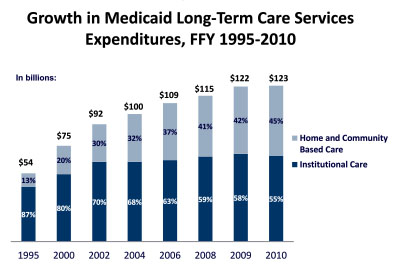
    As a matter of pure numbers, total Medicaid spending in 2010 was a little under $400 billion, and of that, $123 billion was for long-term nursing care. So that’s roughly a third of Medicaid spending.

    That’s for everyone, of course, not just middle class folks, but it’s obviously a big chunk of Medicaid spending no matter how you slice it. And judging from Kaiser’s poll responses, most middle-class voters probably do understand that. It’s one reason the Obama campaign may have missed a bet by not making a bigger deal out of Mitt Romney’s plan to slash Medicaid and then dump the whole program on the states.
  • Will Prop. 38’s Micro Appeal Work?

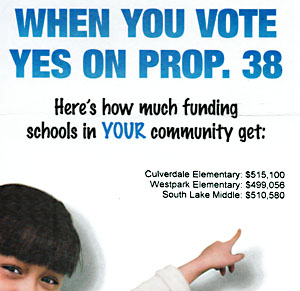
    Here’s an interesting mailer that we got a couple of days ago from the folks supporting Prop. 38, which would raise taxes in California to provide additional funding to schools. It’s personalized to me—or to my zip code—and tells me just how much extra money my local schools would get if 38 passes. Clever!
    And yet…oddly wrong. Of those three schools, only the middle school is near me. The two elementary schools are a couple of miles away even though I have two elementary schools within half a mile of my house. (Not to mention the nearby high school.) Does that mean that my local elementary schools wouldn’t get any Prop. 38 money? Or just that the Yes on 38 campaign uses a really lousy mapping program?

    I don’t know. But I’m curious: does an appeal to such naked local self-interest work? It might! Something about it feels ineffective, though, as if the gameplaying is a little too obvious. Opinions?

  • Why We Have So Many Dumb Rules: A Case Study

    New York mayor Michael Bloomberg has gotten a lot of abuse for his campaign to ban the sale of sugary drinks in cups larger than 16 ounces. There are lots of reasons for this, but among the economically literate his proposal is widely viewed as gratuitously inefficient. Simply taxing sugary sodas would be a lot more sensible, so why not do that instead?

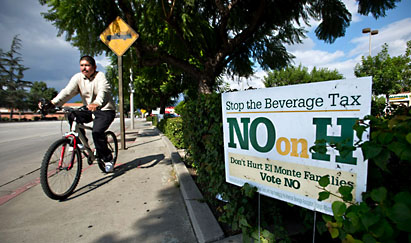
    Well, here’s what’s happening in Southern California, where the city of El Monte has placed an initiative on the November ballot to tax sugary drinks. El Monte has a high rate of obesity and big fiscal problems, so it seemed like a winner:

    But then the beverage industry converged on El Monte, turning the race into the most expensive campaign in the city’s history — and giving it an increasingly David-versus-Goliath feel.

    The beverage industry forces are open about their desire to not just kill El Monte’s proposal but to make the sugary drinks tax politically unfeasible to other cities. They’ve brought together consultants from across the country, including the firm of a Washington, D.C., political strategist whose famous “Harry and Louise” advertisements helped derail the Clinton administration’s healthcare legislation in the early 1990s.

    ….Ads targeting Asians, for example, feature a woman named Stephanie Dang explaining how the tax would hit “boba milk tea.” Ads targeting Latinos show a Mexican American woman talking about chocolate milk….Driving around El Monte last week, [El Monte mayor Andre] Quintero seemed overwhelmed by the opposition. The “No on H” committee has spent close to $1.3 million, compared to his side’s $57,000.

    The same thing happened in New York, of course, where the 16-ounce rule came only after attempts to levy a tax failed. And it explains a lot of other suboptimal policies too. Why do we have CAFE fuel economy standards for cars, for example? Part of the reason is that a more sensible policy — a carbon tax or a cap-and-trade plan — is politically impossible thanks to the anti-tax jihadists in Washington. So instead we implement a hodgepodge of command-and-control rules that don’t fall foul of Grover Norquist’s blood pledge and which the public accepts because it has no idea that these rules end up costing them more than a simple tax would.

    In other words, complicated, hidden costs are always better than simple, open costs. That’s always been the case to a certain extent, but it’s become practically a truism over the past couple of decades. Thanks to conservatives, it’s all but impossible to pass a simple, effective policy these days. So instead we get a morass of obscure, convoluted rules that barely get the job done and have a bunch of terrible side effects.

    And then conservatives complain about how oppressive all our rules are. Pretty nice work if you can get it.

  • Chicago Thugs in Labor Department Already Making Excuses to Delay Jobs Report That Would Sink Obama


    The most important jobs report in the history of the nation (really!) might turn out to be a fizzle:

    The U.S. Labor Department on Monday said it hasn’t made a decision yet on whether to delay Friday’s October jobs report, the final reading on the labor market before next week’s federal elections. A Labor official said the agency will assess the schedule for all its data releases this week when the “weather emergency” is over.

    I’m willing to bet that the report will be released on time. But if it’s not, can you just imagine the level of crackpot conspiracy theories we’re going to have to endure about it? And that’s without even knowing which candidate it putatively helps.

    Personally, I’m all for delaying it. In fact, at this point I think I’m all in favor of modifying the First Amendment to ban all news coverage of any kind for the week before Election Day. Who’s with me?

  • Why Mitt Romney Wanted to Shutter FEMA

    Everyone is having fun today with a clip from an old Republican primary debate in which John King asks Mitt Romney about federal handling of disaster relief. Romney makes a general statement about how it’s always better for states to handle things, and King then follows up:

    KING: Including disaster relief, though?

    ROMNEY: We cannot afford to do those things without jeopardizing the future for our kids. It is simply immoral, in my view, for us to continue to rack up larger and larger debts and pass them on to our kids, knowing full well that we’ll all be dead and gone before it’s paid off. It makes no sense at all.

    WTF? Is Mitt Romney really opposed to federal funding of disaster relief? What was going on here?

    It’s worth remembering the context. This debate was held in June 2011, just a few weeks after the disastrous tornado that hit Joplin, Missouri. At the time, FEMA was close to running out of money and Republicans were busy holding the country hostage over extension of the debt ceiling. This meant that, yes, FEMA funding really had become controversial. Democrats wanted to pass a supplemental spending bill to keep FEMA going, but on May 30, House Majority Leader Eric Cantor went on Face the Nation to say that he had conditions: there would be no money for Joplin unless something else was cut first.

    “I know that America is just stunned by the scope of devastation and loss and the horrific tragedy that the people of Joplin and other places across the country really are experiencing this tornado season,” Cantor said. The federal government typically pays for disaster relief, but Cantor has said repeatedly that the government must maintain fiscal discipline. On Sunday, he compared the situation to that of a family putting off buying a new car when a family member became ill.

    “When a family is struck with tragedy — like the family of Joplin … let’s say if they had $10,000 set aside to do something else with, to buy a new car … and then they were struck with a sick member of the family or something, and needed to take that money to apply it to that, that’s what they would do, because families don’t have unlimited money. And, really, neither does the federal government.”

    So a week later, this was the background for King’s question. Republican orthodoxy that demanded spending cuts in return for raising the debt ceiling had infested everything, even emergency spending. Sure, Joplin might be suffering, but by God, America was out of money and there was nothing left for them. Romney, who was still in his severely conservative phase back then, went along because he didn’t dare cross Eric Cantor. This is the real problem here. There’s no telling if Romney really believed what he was saying or not, but as president he probably wouldn’t dare cross Cantor either.

    For more, see Tim Murphy’s explanation of how Paul Ryan’s budget plan would affect disaster response and funding.

  • Mitt Romney Gets Desperate in Ohio

    Last Thursday, Mitt Romney told a group of Ohio autoworkers that Chrysler was planning to move Jeep production to China. Chrysler very quickly explained the real story: they’re thinking about opening new plants in China to sell Jeeps into the Chinese market. No American plants are going to be shuttered.
    But the Romney campaign decided none of this mattered. They want to win Ohio, so they’re running ads that say this:

    Obama took GM and Chrysler into bankruptcy, and sold Chrysler to Italians who are going to build Jeeps in China. Mitt Romney will fight for every American job.

    Technically, every word of this is true. Obama did force GM and Chrysler through a managed bankruptcy. Fiat did end up buying Chrysler. And Chrysler is thinking about building Jeeps in China. But remember my three-part test to judge how deceptive a statement is?

    1. What was the speaker trying to imply?
    2. What would it take to state things accurately?
    3. How much would accuracy damage the speaker’s point?

    On this scale, Romney’s ad rates about 9 out of 10 on the deceptiveness scale. He’s obviously trying to imply that American jobs will be shipped overseas; stating things accurately would require wholesale revisions; and doing so would completely destroy Romney’s point. But he doesn’t care. He’s got an election to win, and if scaring Ohio autoworkers is what it takes, then that’s what it takes. It’s truly nauseating.

  • Why Does Chrome Suck on My Android Tablet?

    I might blog this in more detail later, but for now I’ll just do something quick. I’m now the proud owner of an Android Tablet, an Asus Transformer Infinity, and overall it’s a pretty nice device. But I’ve sure had trouble finding a decent browser for it. The basic problem, as near as I can tell, is that Android browsers are all designed for phones, and haven’t really been rewritten to make sense on a device with more screen real estate. Presumably this will get fixed over time. Beyond that, though, the performance is pretty sucky on all of them.
    Opera’s rendering performance is actually pretty good. Unfortunately, it doesn’t work with MoJo’s famously finicky back-end blogging software, so it’s out. Firefox has so-so rendering performance, but also doesn’t work with MoJo’s back end. The stock browser is so-so too. And then there’s Chrome.

    I didn’t even try it at first, because even the desktop version doesn’t work with MoJo’s back end. But finally I gave it a whirl, and it turns out to be 100% compatible with our blogging software. Hooray! Their bookmark system is a little wiggy, but also OK. Double hooray! But performance. Oh my. I swear, the rendering engine looks like it was written by a five-year-old. It’s slow and jerky on most sites, really slow and jerky on other sites, and so bad that it renders other sites all but unusable. (Including, ironically, Google Groups.)

    In fact, the performance is so laughably bad that I half wonder if it’s somehow my fault. I can’t figure out how, though. I’m running the latest version of Android, the latest version of Chrome, the performance setting is on High, the Tegra 3 processor on the Asus is supposed to be pretty fast, and as far as I know, there are no background tasks running that could slow it down.

    Anyone else have this problem? Am I imagining things? This just seems really weird. Aside from this, feel free to consider this an open thread on Android, tablets, and computing in general. (Keep in mind, however, that I already own an iPad, so telling me to get a Mac really won’t do much good.)

  • Friday Cat Blogging – 26 October 2012

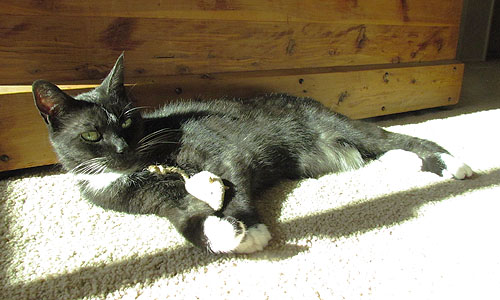
    This morning Domino was basking in the sunshine playing with her new catnip mouse. (It’s the bright blob on top of her paws.) This afternoon will be a little more stressful, featuring another trip to the vet. Hopefully the news won’t be too bad.

    If you need an additional cat fix, check out this LA Times profile of the guy behind the Henrí videos. I didn’t know this, but it turns out Henry is his neighbor’s cat. He himself lives alone. It takes all kinds, I guess.

  • 2012 Most Racialized Election in Past Two Decades


    John Sununu, the surrogate the Romney campaign uses to promote crazy uncle memes they can’t afford to be associated with themselves, told Piers Morgan yesterday that Colin Powell was endorsing Barack Obama mainly because, hey, Powell’s a black guy and endorsing Obama is the kind of thing you do in order to stand with “somebody of your own race.” Atrios:

    What’s “amazing” (horrifying) is that while old white dudes like Sununu instantly jump to the idea that the main thing which drives African-American voting habits (congratulations, Senator Steele) is racial solidarity, but would freak if you suggested white people are more likely to vote for white people.

    Funny he should mention that. The Washington Post reports today that this year’s election is the most thoroughly racialized in the past 20 years:

    The 2012 election is shaping up to be more polarized along racial lines than any presidential contest since 1988, with President Obama experiencing a steep drop in support among white voters from four years ago.

    ….Nearly half of all of those who supported Obama in 2008 but now say they back Romney are white independents. Overall, whites make up more than 90 percent of such vote “switchers.” Romney’s advantage here comes even as 48 percent of white voters in the tracking data released Monday said Romney, as president, would do more to favor the wealthy….Most whites, with and without college educations, saw Obama as doing more to favor those in the middle, not the wealthy.

    Do you think John Sununu was unaware of this when he made that comment? If you answer yes, please contact me immediately. I’ve come across an exciting opportunity to help a Nigerian widow collect her inheritance and I think you might be able to help.

  • BLAME THE UNITED NATIONS FOR ALL CAPS WEATHER SERVICE BULLETINS

    Matt Yglesias is unhappy that the National Weather Service continues to issue its bulletins in all caps, as if they were still using an old-style teletype. I direct his attention to this survey from 2006:

    NWS Customer Survey for Official and Experimental Products/Services

    Name of Product/Service: Use of mixed case and extended character sets in NWS text products

    1. On a scale of 0 to 10 (10 highest), rate technical quality of this product/service (e.g., forecast accuracy, timeliness, problems with display). Etc.

    And to this notice from two years ago:

    BEGINNING MAY 28 AND CONTINUING THROUGH SEPTEMBER 15 2010…

    NWS IS SEEKING USER FEEDBACK ON THE PROPOSAL TO CHANGE ALL NWS TEXT PRODUCTS TO INCLUDE UPPER AND LOWER CASE ALPHABETIC CHARACTERS RATHER THAN ALL UPPERCASE AS IS PRESENTLY DONE. ADDITIONAL PUNCTUATION AND OTHER CHARACTERS THAT ARE PART OF THE INTERNATIONAL REFERENCE ALPHABET NO. 5 WOULD ALSO BE PERMITTED.

    And finally to this 60-page document from November, 2010:

    2.1 Characters, Case, and Punctuation for Narrative Text. Narrative text uses upper case and only the following punctuation marks in the text: the period (.); the three dot ellipsis (…); the forward slash (/); the dash (-); and the plus (+). Use of other characters may inhibit the proper dissemination or automated processing by certain users’ systems.

    The goal of the NWS is to move to mixed case letters with additional allowed punctuation in its text products, while maintaining current text rules in products that are under the purview of the [World Meteorological Organization] requirements listed in the document above or that are required under international or national agreements. Until such changes are officially announced via Public Information Statements, offices will abide by the rules in the paragraph above and in the following sections of this document.

    In other words, NWS is on it!  But apparently international conventions are slowing things down. However, last year, a few select NWS offices began using mixed case, and NWS apparently offers a “non-operational product” nationally that also uses mixed case. What’s more, they want your feedback, since this will “help the NWS better plan the eventual transition of all NWS text products to mixed case and the expanded character set.” I have helpfully retyped this public information statement since it was, of course, originally issued in all caps.
