• Not Bombing Iran Turns Out to Be Working Pretty Well So Far


    Thanks to the Obama administration’s sanctions regime, Iran’s currency is collapsing:

    While the value of the rial has eroded for the past few years as Iran’s economic isolation has deepened, the severity of the drop worsened with surprising speed in recent days as Iranians rushed to sell rials for dollars. By the end of the day on Monday, it cost about 34,800 rials to buy $1 in Tehran. The rate had been 24,600 rials as of last Monday.

    “It’s sort of in a full-blown stampede mode today,” said Cliff Kupchan, a Washington-based analyst at the Eurasia Group, a political risk consulting firm. “There’s very little confidence among many Iranians in the government’s ability to adroitly manage economic policy.”

    Dan Drezner comments:

    Hey, it turns out that the sanctions against Iran really are crippling — so much so that even Mahmoud Admadinejad is admitting it and Benjamin Netanyahu now has sanctions fever. Based on my own sanctions model, I’d predict that the sanctions are now becoming so costly that Iran will in fact be willing to compromise on its nuclear program — but any concessions will seem tiny compared to how devastating the sanctions have been.

    Regardless of what you think about Iran’s nuclear program (and the sanctions regime itself), there’s a lesson here: foreign policy isn’t always — or even often — about who can bluster the hardest. Nor is it about “red lines” and toughness. It’s messy. No one just sails from success to success. But Obama has pursued a sensible and persistent course against Iran’s nuclear program: first getting the world on his side by demonstrating a genuine willingness to engage with Iran’s leaders; pushing relentlessly for sanctions when that didn’t work; declining to back down when Iran tried to split the coalition he’d built; consistently turning down policy options that might have turned Iran’s people against him; and keeping military threats visible but always in the background.

    Will it work? Anyone who claims to know for sure is a fool. It’s just too nonlinear. But if the Bolton/Cheney crowd could see beyond the ends of their own eyelashes, they’d realize that although Obama may be quieter than they are, he’s stuck to a pretty effective policy for years without blinking. And so far it looks like it’s working. For those of us who think that bombing foreign countries is a sign of failure, not a first best option, Obama deserves a pretty solid grade for how he’s handled things.
  • America’s Most Ineffectual Billionaire

    Michael Hiltzik writes today about who’s really the most important moneybags in contemporary American politics:
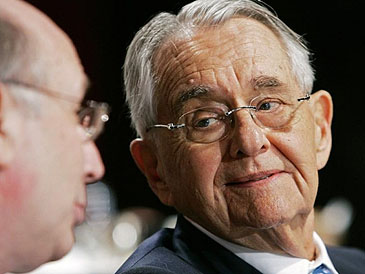
    The most influential billionaire in America is Peter G. Peterson. The son of Greek immigrants, Peterson, 86, served as Commerce secretary under President Nixon, then became chairman and chief executive of Lehman Bros. Subsequently, he made his big money as co-founder of the Wall Street private equity firm Blackstone Group.

    ….Peterson’s views are subtly infiltrating the Washington debate — which is why Americans should start getting worried about him. He isn’t content merely to express concern about the federal deficit. His particular targets are Social Security, Medicare and Medicaid, which he calls “entitlement” programs and which he wants to cut back in a manner that would strike deeply at the middle class.

    Actually, I’d offer a different perspective on this, one that I’m reminded of because a few days ago I happened to receive a copy of Robert Ball’s book about the Greenspan Social Security Commission. The year is 1983, and here’s an excerpt from a section about the PR aspect of his job on the commission:

    I encouraged Alicia Munnell […] to write on what to do about Social Security and what not to do, particularly to rebut Wall Street banker Peter G. Peterson, then as now a strident critic of the program and an unrelenting prophet of demographic doom.

    In other words, Peterson has been a prophet of doom for 30 years now, and so far his actual influence on Social Security has been approximately….zero. The 1983 commission didn’t pay any attention to him, Bill Clinton didn’t pay any attention to him, and the 2005 attempt to privatize Social Security failed utterly. His influence on the federal deficit has likewise been approximately zero, and his influence on Medicare has been, if anything, even less. He wears nicer clothes, but he’s basically had about as much impact as your average curmudgeon holding forth on a soapbox in Hyde Park Corner.

    There are, of course, plenty of people who say they hate the deficit and plenty of people who have it in for Social Security and Medicare. It’s just that most of them are tea party Republicans who adopt these positions when they’re politically convenient and drop them when they aren’t. Pete Peterson had almost nothing to do with it, and his influence within the tea party movement is pretty much nonexistent. He’s had a bit more influence with the centrist Washington Post-ish crowd, but frankly, even there it’s not at all clear to me that their opinions owe much to Peterson. This stuff is in their DNA.

    I could be wrong, I suppose. Certainly Peterson has kept up a steady drumbeat of background noise about entitlement programs, and that kind of thing always sinks in at least a little bit. But he’s never built up a serious political constituency, the way that folks like Grover Norquist and Karl Rove have, and the Beltway elites who take his money and cite his white papers are mostly people who already agree with him anyway.

    Still, maybe this is his moment. Maybe after 30 years of futile effort, the current political atmosphere is finally providing him with a willing audience for his message. Maybe he’s finally going to make a difference. But I kinda doubt it. Despite his money, he’s just not a player. In fact, far from being America’s most influential billionaire, Pete Peterson might well be the guy who’s wasted more money on political causes than any other billionaire in history.

  • News Coverage of Debates Matters More Than the Debates Themselves

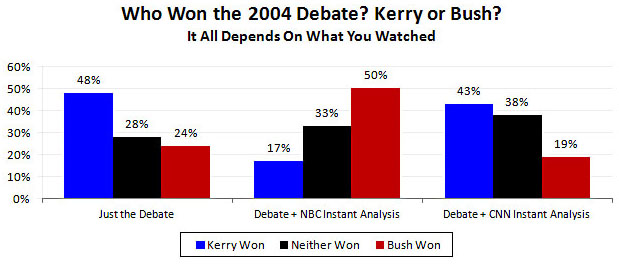
    John Sides passes along this chart from a piece of research that Kim Fridkin did after one of the 2004 debates between John Kerry and George Bush. I’ve reconstructed it to make it prettier (we’re all about the aesthetics here), but the results are the same no matter what the chart looks like. Test subjects who just watched the debate itself thought Kerry won in a landslide. Test subjects who watched the debate plus 20 minutes of analysis on NBC thought Bush won in a landslide. And test subjects who watched the debate plus 20 minutes of CNN commentary were more likely to think that neither candidate won. Obviously public perception of a debate can depend pretty heavily on the spin given to it afterward by the news coverage.

    Likewise, as Sides says, Gerald Ford’s famous “Poland gaffe” didn’t even register with viewers until the next day, after the media had gotten hold of it. And Al Gore handily won his first 2000 debate with George Bush in every single overnight poll. His famous sighing only became a cause célèbre after the talking heads started talking about it nonstop.

    This is why I always try to write up my thoughts on debates and speeches without listening to any commentary first. If I don’t, it’s nearly impossible to disentangle my own thoughts from those I’ve heard from the TV commentators. That way lies groupthink.

  • Mitt Romney’s Math Becomes Even Harder

    A few days ago I suggested that if Mitt Romney wasn’t willing to tell us which tax deductions he’d eliminate to make up for his across-the-board tax rate cuts, somebody should at least ask him if there were any deductions that were off the table. Today, Paul Ryan answered exactly that question after a woman at a town hall event told him she was frustrated by his lack of specifics:
    RYAN: If you subject more of their income to taxation — more of their income is taxed — and that allows us to lower revenues for everybody across the board. That means middle class taxpayers have lower tax rates, and there’s plenty of fiscal room to keep these important preferences for middle class taxpayers — you know, like charitable donations, or buying a home, or health care. Every time we’ve done this, we’ve created economic growth.”

    Hoo boy. Now I really want to see that famous math that Ryan said he didn’t have time to go through on Sunday. Greg Sargent comments:

    By seeming to take some middle class deductions off the table, Ryan made the math even more hallucinatory. This might be good politics — Ryan is getting more specific in promising not to raise middle class taxes — but it further confirms that Romney and Ryan have completely jettisoned deficit neutrality as a goal of their plan, and that they are selling people a fiscal bill of goods that doesn’t pass the laugh test.

    It’s worth noting that Ryan didn’t categorically promise never to touch the tax deductions he mentioned above. But he sure did come close, and he’s plainly opened himself up to legitimate questions about whether these deductions are off the table in a Romney administration. If they are, Romney’s plan becomes simply impossible to take seriously. After all, those three deductions, along with the tax preference for capital gains, account for about a third of all tax expenditures — and if those aren’t going to be touched you have to somehow pay for the rate cuts out of the remaining two-thirds. At that point Romney’s plan becomes not merely garden-variety impossible, but one of the all-time most laughable political panders of all time.

  • Beware the Drug Company That “May Be Able to Help”


    Austin Frakt points us to David Schultz today, who explains the financial incentives behind the coupon wars currently raging in the pharmaceutical industry:

    Using cholesterol-lowering drugs as an example, researchers found that the popular statin Lipitor comes with an average co-pay of $30 a month, compared with a $10-a-month co-pay for simvastatin, a generic drug also used to treat high cholesterol. But with a coupon from Pfizer, the drug’s manufacturer, the co-pay for Lipitor goes down to $4 a month, making it less expensive for the consumer than simvastatin.

    It’s a great deal for the patient, but not the insurer. According to the JAMA article, the insurer pays $18 a month for simvastatin and $137 a month for Lipitor.

    In other words, by picking up the tab for the copay, Pfizer encourages patients to demand Lipitor instead of the generic alternative. The result is higher overall costs for the medical industry as a whole and the sweet jingle of increased patent rents for Pfizer. Needless to say, this pitch is especially effective on the poor and the elderly, who live on low incomes and are likely to push their doctors hard to prescribe the drug that saves them a few dollars.

    There’s more, and the whole piece is worth a read.

  • -$251 + $165 + 0 = 0

    Catherine Rampell provides the simple, nickel version of why the Romney/Ryan tax plan is mathematically impossible:

    As the Tax Policy Center demonstrated, cutting individual income tax rates by 20 percent from today’s levels would reduce tax burdens by $251 billion per year (in 2015) among households with income above $200,000.

    If you leave preferential tax rates for savings and investing (e.g., long-term capital gains and dividends) untouched, as Mr. Romney has said he would do, that leaves only $165 billion of available tax expenditures that can be eliminated from this same group of high-income earners once their marginal tax rates fall.

    In other words, even if you completely eliminated all tax deductions for high earners — the mortgage interest deduction, the charitable deduction, the exclusion of healthcare benefits, etc. — it still wouldn’t make up for the 20% rate cut Romney wants to give them. Their total tax bill would go down. However, Romney has also said that his total tax plan is revenue neutral, which means that someone else’s tax bill has to go up to make up for the tax cuts he’s giving to the rich. But Romney says that won’t happen either. Middle-class taxes, on net, will stay the same. In other words:

    -$251 + $165 + 0 = 0

    In my 7th-grade pre-algebra class, this bit of arithmetic wouldn’t have passed muster. Maybe they taught math differently at Cranbrook. In any case, all I’d really like to see from Romney is a proof of concept. It doesn’t have to be his final plan or anything like that. Just any combination of a 20% rate cut and the closing of tax deductions that produces no net tax decrease for the rich. Anything at all that proves it can be done.

    But he can’t do it, and he knows it. Not without invoking the dynamic scoring fairy, anyway. But at this point, more than a decade after George Bush’s tax-cutting extravaganza, if you still believe that tax cuts for the rich will hypercharge the economy and produce huge pots of free revenue, then you deserve whatever you get. For the rest of us, we just want to see the math. It really shouldn’t take too long.

  • Slate Satisfies My Pet Peeve Quota For the Day

    Today, Slate takes on two of my pet peeves. First, Farhad Manjoo on the pagination of online stories:

    Pagination is one of the worst design and usability sins on the Web, the kind of obvious no-no that should have gone out with blinky text, dancing cat animations, and autoplaying music. It shows constant, quiet contempt for people who should be any news site’s highest priority—folks who want to read articles all the way to the end.

    Pagination persists because splitting a single-page article into two pages can, in theory, yield twice as many opportunities to display ads—though in practice it doesn’t because lots of readers never bother to click past the first page. The practice has become so ubiquitous that it’s numbed many publications and readers into thinking that multipage design is how the Web has always been, and how it should be.
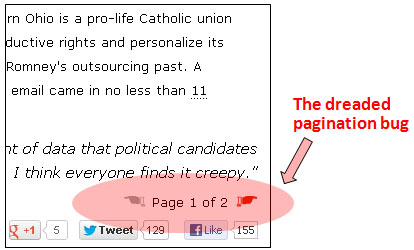
    Manjoo talks about some of the problems with pagination, and as you’d expect, they’re not exactly world-shaking. So I’ll add one to the pot. Someone I know, who will remain nameless, spent years reading LA Times articles on the web and not realizing that the wording at the bottom indicated that there was a second page of text. He did think it was odd that so many stories ended rather abruptly, and also odd that the online edition sometimes didn’t always carry the full text that was in the print edition. But until I mentioned it one day, he never made the connection between this and the mysterious “Next” that often showed up at the end of online pieces. This could be solved by either stopping the use of pagination or else using a more descriptive word to tell people that there’s more if they click a link. Naturally I’d prefer the former.

    Mother Jones paginates its articles too, of course. Everyone does. The panjandrums at MoJo galactic headquarters have, however, been very good about humoring my unwillingness to paginate long posts on my own blog just because I hate it so much. Death to pagination! (By the way: I do my part by always linking to the single-page version of stories whenever I can. You’re welcome.)

    Pet peeve #2 comes from Daniel Engber, and it’s about the endless, smug overuse of “correlation is not causation” as an exasperated conversation ender:

    The correlation phrase has become so common and so irritating that a minor backlash has now ensued against the rhetoric if not the concept. No, correlation does not imply causation, but it sure as hell provides a hint. Does email make a man depressed? Does sadness make a man send email? Or is something else again to blame for both? A correlation can’t tell one from the other; in that sense it’s inadequate. Still, if it can frame the question, then our observation sets us down the path toward thinking through the workings of reality, so we might learn new ways to tweak them. It helps us go from seeing things to changing them.

    I get where this comes from. Too many people really do see correlations and just assume that they imply causation of some kind. So it became common to warn people away from this. But honestly, it’s gotten so out of hand that I sometimes think we now have the opposite problem: too many people think that correlations are entirely meaningless. But as Engber says, they aren’t. At the very least, they provide clues and don’t deserve to be immediately dismissed as meaningless.

    At the very least, I’d offer the following challenge: You’re not allowed to airily dismiss correlations in research studies unless you actually read the study and understand what controls the researchers used to check for causation. Was there a dose-response effect? Did they do a good job of controlling for confounding factors? Did they discuss possible mechanisms for causation? Etc. If it turns out that the researchers didn’t even bother addressing the question, then feel free to mock them. If they did, then address their evidence.

    And if it’s not a research paper, but just a blogger tossing up a pair of lines on a graph? Same deal: at the very least, you should propose some alternative explanation, or provide some reason for doubt. It doesn’t need to be bulletproof, but it ought to be something. Let’s raise the bar a bit here.

  • Pennsylvania Photo ID Law Put on Hold


    This is good news:

    A judge on Tuesday blocked Pennsylvania’s divisive voter identification requirement from going into effect before Election Day, delivering a hard-fought victory to Democrats who said it was a ploy to defeat President Barack Obama and other opponents who said it would prevent the elderly and minorities from voting.

    ….Election workers will still be allowed to ask voters for a valid photo ID, but people without it can vote on a regular voting machine in the polling place and would not have to cast a provisional ballot or prove their identity to election officials after the election.

    His ruling came after listening to two days of testimony about the state’s eleventh-hour efforts to make it easier to get a valid photo ID. He also heard about long lines and ill-informed clerks at driver’s license centers and identification requirements that made it hard for some registered voters to get a state-issued photo ID.

    Honestly, this is a reasonable decision regardless of what you think about photo ID laws in general. Pennsylvania’s law was simply passed too late to be implemented in any kind of fair and equitable way. At a bare minimum, you need time to make sure people know about the law, time to staff up DMV offices to process new ID cards, and time for independent groups to start up community drives to make sure everybody who wants one can get an ID. This is just common sense.

    Unless, of course, your goal is just the opposite: to make sure that lots of people who want to vote aren’t going to be able to. But that’s not anyone’s goal, is it?

  • Armageddon in Greece

    The New York Times reports on the latest draft budget from Greece:

    The draft budget spells out about $10 billion in spending cuts and savings for 2013. About one-quarter of that would come through reductions in civil servants’ salaries and social welfare benefits, and about 15 percent through cuts in spending on health, defense and local authorities, the government said.

    ….The draft budget is expected to be revised significantly because it must be approved by the country’s troika of foreign lenders — the European Commission, the European Central Bank and the International Monetary Fund — before it can be submitted for a parliamentary vote. The troika is insisting on further cuts in the public sector — including laying off public servants, a political third rail in Greece and other European countries — while the coalition government has been pushing back.

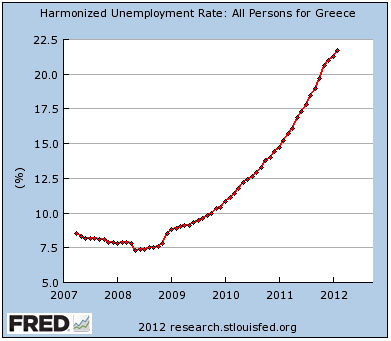
    ….The negotiations are taking place against a backdrop of unrelenting, depression-level conditions in the Greek economy, which the draft budget predicted would contract by 6.5 percent this year and by 3.8 percent in 2013 — far more than the troika’s earlier estimates and about 25 percent below its peak before the crisis struck. The budget says unemployment is expected to rise to 24.7 percent from 23.5 percent this year.

    Just for perspective, this is about a 10% cut in total government spending. The U.S. equivalent would be a cut of about $350 billion in federal spending and another $200-300 billion in state and local spending. All against the backdrop of an economic catastrophe that rivals the Great Depression in scope and will be made even worse by the proposed spending cuts.

    If you happen to be wondering why Greeks are rioting in the streets, this is why. You might be too if this were happening to your economy.