• Romney’s Tax Returns Are Hurting Him Badly

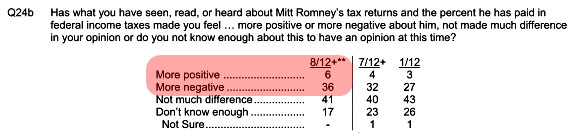
    Jamelle Bouie highlights the following question from today’s NBC/Wall Street Journal poll:

    Recent events have hurt both candidates, but Jamelle points out that the tax issue has hurt Romney much more than anything else:

    Romney’s anger over the Obama campaign’s decision to go after his tax returns makes more sense in this light; the controversy is doing real damage to his campaign, and more important, it has the potential to do more if Team Obama can return it to the forefront of the discussion.

    I wouldn’t bet against that possibility. As long as Romney refuses to release his returns, Obama can continue to hit him on the issue. Death by a thousand cuts is an exaggeration, but it’s not far off from what might happen; Romney could become defined by the things he won’t reveal, and gradually loses the trust of the public. His low favorability becomes a burden he can’t lift, keeping him behind Obama through the fall, and into the election.

    We’ll see. My guess is that Romney’s tax returns don’t have quite that much staying power, and the Obama campaign will move on to other topics in the near future. Romney’s tax plan, which is almost comically tilted toward the rich, is one possibility. It plays off Romney’s tax returns nicely, and I understand that attacks on Romney’s plan poll pretty well.

  • If I Were Julian Assange, I Wouldn’t Want to be Extradited to the United States Either

    WikiLeaks founder Julian Assange is currently holed up in the Ecuadorean embassy in London because he doesn’t want to be turned over to Sweden, where he faces charges of sexual assault. However, Assange says he’s not trying to evade Swedish justice. He just wants assurances that Sweden won’t extradite him to the United States as soon as their investigation is finished. Via Glenn Greenwald, Alan McIntosh suggests a possible solution:

    If Assange leaves the Ecuadorean Embassy then he is likely to be arrested for breaking his bail conditions. This would provide the UK Government with two options: first they postpone the surrender of Assange to the Swedish authorities until he is prosecuted for breach of bail; or alternatively they surrender him but enter an agreement with the Swedish authorities that once proceedings are complete (which would include the serving of any sentence) Assange will be returned to the UK for trial.

    This is permitted under Article 24(2) of the European Council Framework Decision on European Arrest Warrants. The UK could then give assurances that it would refuse consent to any application to remove Assange from Sweden as that would breach the agreement and the UK’s consent is required under Article 28 (4).

    If the UK Government is to believed, it is only extraditing Assange as it has a legal obligation to; if the Swedish Government is believed it wants to investigate the allegations that have been made; and if Assange is to be believed he is prepared to go back, but doesn’t want a bag over his head and to be wearing an orange jumpsuit whilst tied to a gurney.

    So that’s that.

    The assault charges against Assange have always been hard to get a handle on. On the one hand, you can’t ignore them. They have to be investigated. On the other hand, the timing has always seemed weirdly convenient. After an entire lifetime of apparently not sexually assaulting women, suddenly there were two separate charges coming right at the time that WikiLeaks began releasing confidential U.S. cables and videos.

    But regardless of what you think of that, Assange’s fear of being extradited to the U.S. seems pretty reasonable. What’s more, I have little doubt that if the UK and Sweden really wanted to, they could figure out a way of giving Assange the assurance against extradition that he wants. I’ll bet they’d do it if it were someone worried about being extradited to China. I can’t pretend to know everything that’s going on here, but still, common sense suggests that the fact that both the UK and Sweden are stonewalling is telling.

  • American Education Is Not in Catastrophic Decline

    Hey, my latest piece for the magazine is online today. It’s actually a sidebar to a big piece by Kristina Rizga about the year she spent embedded at Mission High, a low-income high school in San Francisco. At Mission High, she reports, test scores aren’t enough to tell you the whole story of how well they’re performing:

    One of the most diverse high schools in the country, Mission has 925 students holding 47 different passports. The majority are Latino, African American, and Asian American, and 72 percent are poor. Yet even as the school was being placed on the list of lowest-performing schools, 84 percent of the graduating class went on to college, higher than the district average; this year, 88 percent were accepted. (Nationally, 32 percent of Latino and 38 percent of African American students go to college.) That same year, Mission improved Latinos’ test scores more than any other school in the district. And while suspensions are skyrocketing across the nation, they had gone down by 42 percent at Mission. [Principal Eric] Guthertz had seen dropout rates fall from 32 percent to 8 percent. Was this what a failing school looked like?

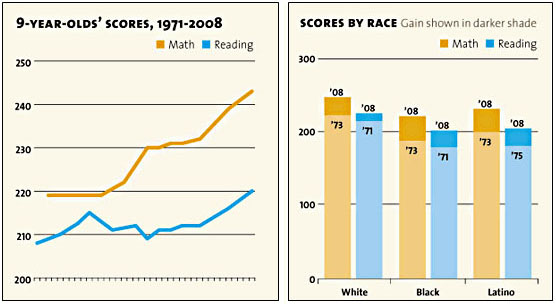
    As we used to say back in the day, read the whole thing! My sidebar is a counterpoint aimed at people who think test scores do say a lot about whether a school is successful or not. And my point is simple: if you look at the most widely accepted national test (the NAEP), and if you look at its results over the past few decades, American schools aren’t getting worse. They just aren’t. You might think they aren’t improving fast enough, and that’s fine. You might think we spend too much on them, and that’s fine too. But based on test scores, today’s kids aren’t doing worse than kids of the previous couple of generations. Despite the endless doomsaying you hear practically everywhere, they’re doing better:

    There’s more to this story, and if you make it to the end you’ll see that the news isn’t all rosy. But the news isn’t terrible, either.

    We have plenty of failing schools, and we should be doing a lot more to figure out how to fix them. It’s a disgrace for a rich country like the United States to be failing so many of its kids. At the same time, taken as a whole, the American educational system isn’t in decline. That’s something you don’t hear very often because there are a lot of interest groups who are invested in a narrative of educational failure. But the data just doesn’t back them up.

  • The Comforting Little Lie That Seniors All Tell Themselves

    Aaron Blake notes that recent polling demonstrates that seniors love Paul Ryan. Dave Weigel comments:

    As Blake affirms, this has a lot to do with Ryan’s constant promise that the Romney-Ryan regime will not touch the Medicare plans of people currently over 55. Not only that, Ryan/Romney will restore funding to Medicare. Obama is “changing the program forever.” Ryan will “protect and strengthen” it. Look, a TV ad!

    The reason Ryan gets away with this is the reason that Republicans won the Medicare issue in 2010, taking seniors from a 50-50 vote to a 60-40 pro-GOP vote. He puts Medicare, theoretically, in a sort of lock-box. He promises to treat it separately from every other government program, and promises seniors of a certain age that they won’t have to sacrifice.

    The upshot of all this, of course, is that Medicare can never be reformed. Both parties can talk about reform all they want, but when the campaign rubber hits the electoral road they know that attacking cuts to Medicare is the way to win votes. And if both Democrats and Republicans take turns bashing anyone who has the gall to cut back Medicare spending, then Medicare spending will never get cut back.

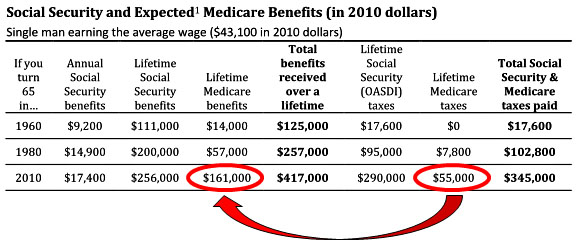
    On a wonky note, it’s worth pointing out just how outrageous this whole “no one over 55” approach is. If you don’t want to rein in Medicare growth in the first place, that’s fine. But if you do want to rein in Medicare growth, current and near seniors are the #1 group that should be required to share in the pain. Seniors all like to think that they’re just getting their due from a system they paid into all their lives, but it ain’t true. They paid a pittance compared to what they’re taking out. People in my generation, and the one before mine, will end up getting far more in Medicare benefits than we ever paid in:

    If Medicare costs too much, everyone should be required to share in the pain of cutting it back. There’s simply no reason to exempt current seniors.

    Except, of course, that it’s politically impossible. The “free ride” generation — those of us born just before and just after World War II — will go to our graves convinced that we spent our entire lives working harder than any other generation in history and are now getting back just a small piece of the enormous tax burden we paid in. It’s a very comforting little lie, and not one that any sane politician is likely to challenge. It’s not just a third rail of politics, it’s more like the China Syndrome of politics.

  • No, Republicans Don’t Have a Lock on Racism, But…

    Chris Hayes stepped in it this weekend when he said, “It is undeniably the case that racist Americans are almost entirely in one political coalition and not the other.” Both Alex Tabarrok and John Sides marshalled survey evidence to suggest that this isn’t really true. There are plenty of racist Democrats.

    So what should Chris have said? I think you can safely say two things about the modern Republican Party:

    • They tolerate racism in their ranks far more than Democrats do. Bernie Goldberg, a liberal turned conservative, admitted this on air earlier this year when he told Bill O’Reilly, “I am immensely uncomfortable with the bigotry on the right, and I don’t care how many people don’t like it. I am sick of it.” Republicans are also more willing to make political appeals with an anti-minority racial subtext, as Fox News did during its Summer of Hate in 2010, or as Mitt Romney is doing now with his claims that Obama is gutting work requirements for welfare.
    • For the past 40 years, Republicans have opposed virtually every effort to address racism in the legislative sphere. Politically, this has been suicidal for their standing in the nonwhite community, and it’s safe to say that they wouldn’t have done this unless there was a corresponding benefit for them among whites. Quite clearly, appealing to white resentment of minorities is an important part of the Republican brand in a way it’s not for Democrats, even if plenty of racists still inhabit the Democratic Party.

    There’s a lot more to be said about this, but I don’t want to write a long post on the subject. I just want to make the point that (a) demographically speaking, Chris was probably wrong, but (b) politically speaking, he was mostly right. The Democratic Party may still harbor racists, just like any large group in America, but it doesn’t tolerate or benefit from racial animus in its ranks. These days, that’s pretty much the exclusive province of the conservative movement, and it needs to end.

    For more on this from a different perspective, check out Will Wilkinson here.

  • Here’s Why Obama Is Maintaining His Lead Over Mitt Romney


    Four weeks ago, thanks to Mitt Romney himself, the political world was consumed with “Romneyshambles,” Romney’s gaffe-filled disaster of a trip to Europe and Israel. Three weeks ago, thanks to Harry Reid, the political world was consumed with Mitt Romney’s taxes. Then, thanks to Priorities USA Action, we spent a week arguing about whether Mitt Romney killed Joe Soptic’s wife. A few days later, thanks to Paul Ryan, we spent a week being consumed by Medicare. Now, thanks to Todd Akin, it appears that we’re going to spend this week talking about “legitimate rape” and abortion politics.

    Barack Obama must be laughing his ass off about this. When was the last time Mitt Romney actually got to talk about the weakness of the economy? Over a month ago?

  • Yes, Plenty of Republicans Want to Ban All Abortions, Full Stop


    In an editorial that joins the Republican lynch mob asking Todd Akin to leave the Missouri Senate race, National Review takes Democrats to task for pretending that Akin’s views on abortion are anything but a laughable fringe. Sure, Akin wants to ban abortion in cases of rape, but no one else does. Why, not a single state would ever do that. “Everyone knows this,” says NR airly.

    Dave Weigel points out today that not only is this not ridiculous, several states have already done it:

    I needled a couple of National Review writers about this point yesterday (on Twitter, of course). Ramesh Ponnuru, one of the best writers in the country on life issues, was skeptical that the bans could “succeed” and be “read in court as barring abortions in cases of rape.” I’m not as sure. Imagine that it’s 2015, and Supreme Court Justice Ted Cruz has joined a 5-4 majority striking down Roe. How soon are you going to get majorities in Louisiana and North Dakota to undo their abortion bans? Are we betting on more liberal lower courts to do it for them?

    Weigel is right. If Roe is overturned and states have the authority to regulate abortion as they please, of course some of them will ban abortion completely. And if abortion is murder — which it would be under the human life laws that virtually all Republicans now support — on what grounds could the courts overturn them? They couldn’t. Everyone know this, and it’s sophistry of the tawdriest and most cowardly kind to pretend otherwise.

  • Does Obama Regret Reappointing Ben Bernanke?

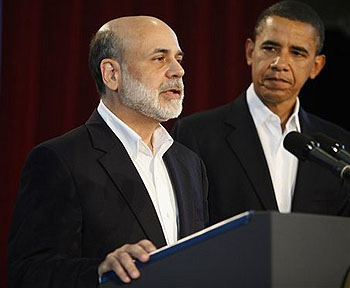
    John Cassidy thinks President Obama was wrong to reappoint Ben Bernanke as Fed chair in 2009. I thought so too, so obviously I agree. Matt Yglesias agrees too, but he doubts that Obama himself has had second thoughts:

    An interesting further nuance is provided by [Cassidy’s] very last line, which says “I’d bet that right about now the president is wishing he’d made a different choice.”

    What’s interesting is that my read of the situation is that Obama doesn’t wish this, even though he ought to. The key evidence is that Bernanke is hardly the only member of the Federal Reserve’s Open Market Committee who Obama has appointed, and none of his appointees are calling for monetary expansion. Instead the strongest voices at the Fed for expansionary policy are regional bank presidents—Charles Evans of Chicago has been the champion, followed by Eric Rosengren of Boston and John Williams of San Francisco.
    ….This is a Fed full of Obama appointees pursuing a disastrous policy trajectory that’s creating all kinds of problems for Obama. But I’ve never read any reporting indicating that the Obama economic team is upset about monetary policy….

    OK, hold on right there. On the subject of Bernanke in particular, I don’t know what he thinks in his heart of hearts. Would he support a more expansionary monetary policy if he had enough backing on the Fed board? Would he have more backing if Obama had appointed better colleagues? Could better colleagues have won Senate confirmation? There’s reason to doubt it.

    We don’t know much about this because the inner workings of the Fed have always been pretty opaque. But here’s what perplexes me: Why am I perplexed about what Obama thinks of this? The inner workings of the West Wing are the exact opposite of opaque. As with most administrations, there’s been an absolute mountain of reporting on the inner workings of the Obama White House. And yet, I’ve barely read a word about what Team Obama really thinks of the Fed. Why is this? I, for one, would sure like to know.

    UPDATE: Jonathan Bernstein thinks Obama could have had a better Fed if he’d tried a little harder:

    Ben Bernanke received 70 votes for confirmation — and 77 votes for cloture. That sounds like there was room for someone else, especially since Bernanke lost some Democratic votes (even on cloture). Two other nominees were approved in September 2010 on voice votes. Both nominees approved in 2012 — after the Democratic majority was slimmed down considerably — still cleared 70 votes.

    Nor is this an area where I think anyone has made an argument that Barack Obama employed a full-court press on the Senate. Yes, there was some lobbying on Bernanke, but overall it’s clearly been a back-burner issue for Obama….I’m open to arguments on this one, but I just don’t see any evidence that Obama couldn’t have had a significantly different Fed if he had wanted one.

    I definitely agree that Obama could have appointed a more liberal Fed chair than Bernanke. High profile appointments are different. It’s the others I’m not so sure about. But I’m open to arguments on this too.

  • Dean Baker Says We Need to Reduce Our Trade Deficit. But How?

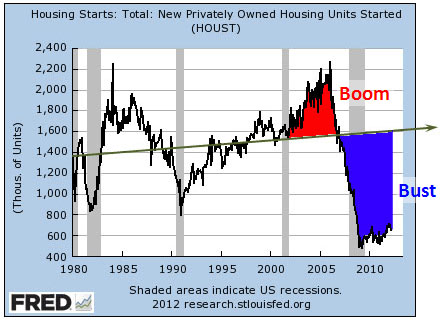
    Dean Baker argues today that it’s wrong to view bad housing policy as the main thing holding back the economy. I think that’s right, and it’s a point worth making:

    Bubble-inflated house prices created close to $8 trillion dollars of housing equity. The housing wealth effect implies that people would spend between 5 to 7 cents on the dollar of this additional wealth, creating between $400 billion and $560 billion in additional annual consumption….When the bubble burst, there was nothing to replace the lost demand. Residential construction fell by more than 4 percentage points of GDP ($600 billion annually in today’s economy). It fell below normal levels because the boom of the bubble years had led to record vacancy rates. Consumption plunged because the housing bubble equity disappeared.

    ….All of this seems clear and simple. We lost $1.2 trillion to $1.4 trillion in annual private sector demand. Some of this has been replaced by the federal government’s budget deficits, but not enough to fill the gap.

    Even though I’m not quite as convinced as Dean that the wealth effect alone explains the Great Recession, it explains a lot. Home prices had to fall, and demand was always going to fall along with it, no matter how many underwater mortgages got rewritten.

    One quibble, though: This doesn’t mean we wouldn’t have benefited from better housing policy early in the Obama presidency. Just because it wouldn’t have solved our entire problem doesn’t mean it wouldn’t have solved some of it. Better housing policy would have helped, and could have been an effective part of broad set of tools to boost the economy.

    At this point, though, the bigger question is what to do going forward. Dean again:

    The simple story is that we need a new source of demand to fill the gap left by the collapse of the housing bubble. In the short term that can only be the government. In the longer term it will have to be trade, which means a reduction in the trade deficit. That means first and foremost getting the value of the dollar down, but macho politicians in Washington don’t talk about a lower valued dollar. The folks on Wall Street don’t like it.

    True enough. But I demand a follow-up post! The theory of trade deficits is murky enough on its own, but the actual practice of reducing trade deficits is positively swamplike — especially when the world is full of countries that also want to reduce their trade deficits and pretty much bereft of countries willing to give up their trade surpluses in order to help us out. So what should we do? On a purely mechanical, operational basis, how do we eliminate our trade deficit? No fair assuming that we’ll stop importing oil, either.