• Harry Reid Doubles Down

    So what’s going on with Harry Reid? When he decided, out of the blue last week, to tell a reporter that he’d gotten a call from a “Bain investor” who told him that Mitt Romney had paid no taxes for ten years, I figured he was just talking smack. He wanted to get under Romney’s skin and decided this was a good way to do it. His obvious next step was to wait a day or two, then tell some other reporter that, you know, he didn’t really know for sure, and then congratulate himself for winning a news cycle or two.
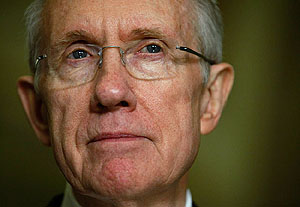
    But now he’s doubling down:

    A second source, said to be “close to Senator [Harry] Reid,” has told CNN’s Dana Bash that Reid’s original source for the claim that Mitt Romney “didn’t pay any taxes for 10 years” exists, is a “Bain investor” and a “credible person.”….

    I did speak to one source who is very close to Senator Reid who claims to also know who the Bain investor is that Reid spoke with, and insists that it is a credible person and this person if we knew the name we would understand they would have the authority and the ability to know about Romney’s tax returns.

    ….This was reinforced in a statement from Reid spokesman Adam Jentleson, which Bash read on the air: “Senator Reid stands by his comments. Governor Romney’s continued refusal to release his tax returns raises legitimate questions about what he is hiding and whether he paid any taxes at all. Governor Romney can easily end this debate by following the precedent set by his father and releasing tax returns.”

    This is all pretty weird. In one sense, I suppose Reid isn’t really risking much. He’s not up for reelection, after all, and it would be pretty hard for anyone to prove that he’s lying. And even if he is, so what? Is Mitch McConnell going to start obstructing Senate business even more? How could he?

    Still, Reid isn’t leaving himself any breathing room at all on this, and if he gets caught out it would still be pretty damn embarrassing. He’s taking one for the team in a way that I’m not sure I’ve ever seen from someone in a leadership position. Is it because he’s 72 and doesn’t care anymore? Because of some longstanding intra-Mormon feud? Because he’s just fed up with Republicans? I dunno. But if he can’t back this up, it’s about as sleazy a ratfuck as we’ve seen since the days of CREEP.

    UPDATE: Eric Rauchway tweets, “Sleaziest since CREEP? Does @kdrum remember the 1990s?” Point taken. Between Willie Horton and Bill Clinton’s black baby and Al Gore’s earth tones and the great Swift boating of 2004, Reid’s gameplaying probably doesn’t make the ratfucking top ten.

    Still, it’s a little different when it comes straight from the Democratic leader in the Senate. Is that better or worse than conducting this kind of stuff in the shadows, or at arm’s length from the campaign? I guess you could argue both ways. But I’m really not sure we should be thrilled with high-ranking party leaders openly embracing this kind of stuff.

    If Reid had said, “You know, my guess is that Romney didn’t pay any taxes at all in some years, and that’s why he won’t make his returns public” — well, that would have been fine. Just rank speculation of the kind that lots of people have engaged in. (Including me!) But when he specifically says that he has some secret source who’s seen Romney’s returns, that’s different. That’s almost certainly a lie. No matter how tempting it is, this really isn’t something we should be applauding.

  • Friday Cat Blogging – On Hiatus

    I know this is going to disappoint a lot of you, but I’m afraid today is the final installment of Friday catblogging — at least for a little while.
    There are actually several reasons I’m doing this, but the obvious one is reason enough: Inkblot was the original inspiration for catblogging, and he was always the real star of the show. It just doesn’t feel the same without him. I might start up again someday, though not for at least a few months, I think. After that, we’ll see. In the meantime, we’ll always have our memories.

  • Repeat After Me: In-Person, In-Person, In-Person

    The court case against Pennsylvania’s new voter ID law is wrapping up, and supporters of the law say it’s necessary in order to reduce voter fraud. However, when you hear the words “voter fraud,” there are three things you need to keep clearly in mind:

    • In-person
    • In-person
    • In-person

    Got that? There’s only one kind of fraud that voter ID stops: in-person voter fraud. That is, the kind of fraud where someone walks into a polling place and tries to vote under someone else’s name. That’s it.

    There are plenty of other types of voter fraud, of course. There’s registration fraud, where you send in forms for Mary Poppins and James Bond. There’s insider fraud, where election officials report incorrect tallies. There’s absentee ballot fraud, where you fill in someone else’s absentee ballot and mail it in. But a voter ID law does nothing to stop those kinds of fraud. Even in theory, the only kind of fraud it stops is in-person voter fraud.

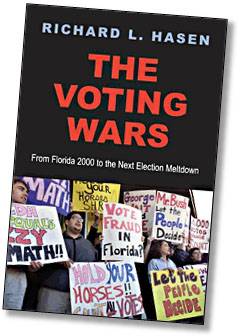
    A couple of days ago, that got me thinking: are there any recent documented cases of in-person voter fraud in the United States? I figure there must be in a country with over 100 million registered voters. But I realized that I didn’t really know, even though I spent quite a bit of time on the subject for my voter fraud piece in the current issue of the magazine. Luckily, though, I happen to be reading an advance copy of Rick Hasen’s The Voting Wars, and just last night I got to page 61, where he addresses exactly this question. His answer:

    There are virtually no recent cases of voter impersonation fraud and no evidence in at least a generation that it has been used in an effort to steal an election.

    Hasen provides what few examples he can. Hans von Spakovsky, a Bush-era Justice Department appointee, claimed to have found an occurrence of impersonation fraud in a 1984 case in Brooklyn. But when Hasen finally managed to get a copy of the DA’s report (von Spakovsky refused to share it), it turned out that the fraud consisted almost entirely of insiders manipulating registration books and cards. What little impersonation fraud they found was possible only thanks to collusion with corrupt election officials. Von Spakovsky also brought up a 1997 case in Miami, but that turned out to be absentee ballot fraud. In a later op-ed, he pointed to a case in Kansas, but a court ruled that, in fact, no illegal votes had been cast.

    So there you have it. Hasen apparently doesn’t know of any confirmed cases of in-person voter fraud, and the folks who have tried their best to find some have failed. There are several known cases of other kinds of voter fraud (though not very many, despite the Bush administration’s focus on digging up voter fraud cases), and there are also cases of, for example, felons voting when they aren’t allowed to. But these almost all turn out to be accidents: the state sent them registration forms, so they registered and voted, not knowing it was illegal. It was incompetent registration operations that were at fault, and anyway, voter ID wouldn’t have stopped it. The felons’ names were all on the voter rolls.

    So we’re left with this: the folks pushing the idea that voter fraud is rampant apparently don’t have any examples of in-person voter fraud ever happening in the past decade or so. At a minimum, if this were a serious problem, surely you could dig up, say, one case per state per election cycle. That’s not many. Maybe a few hundred since 2000. But they can’t. They’ve passed dozens of laws, making it harder to vote for millions of people, based on a phantasm. In-person voter fraud is an entirely invented problem. What it was invented for is left as an exercise for the reader.

    UPDATE: Rick Hasen emails to say that he recently came across a case that might be genuine in-person voter fraud. The allegation is something stupid (a mother taking her teenage son to vote in her husband’s place), not something corrupt, but still. It’s a case!

    If the facts are proven as alleged, this looks like it could be one of those extremely rare cases in which a photo identification actually would have made a difference in preventing the casting of a fraudulent ballot, and for this reason I expect it to gain canonical status among those clamoring for voter ID….For reasons explained in my last post, however, the very stupidity of this action (if proven) and the fact that this kind of ham-handed fraud was so easily caught shows why this kind of fraud is so rare and why state voter ID laws are generally unnecessary.

    So there you have it.

  • A Good Job Is Hard to Find

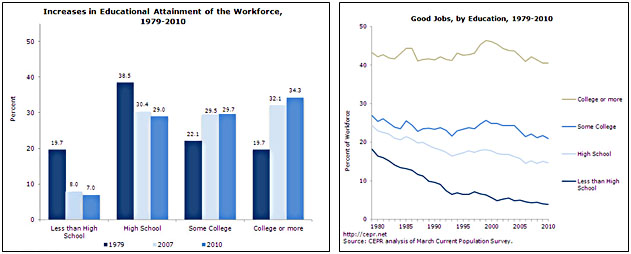
    Via Richard Kirsch, here’s an interesting juxtaposition courtesy of the Center for Economic and Policy Research. They set out to calculate the number of workers with “good jobs,” and they set a fairly low bar. A good job is one that pays $37,000 (the median wage for men in 1979), includes at least some health insurance, and some kind of retirement plan. It doesn’t have to be generous health coverage or a generous retirement plan. Mediocre health plans with big copays still count, and modest 401(k) retirement plans count. The job just has to include something.

    The two charts below show what’s happened over the past 30 years. The chart on the left tracks education levels, and it shows that the number of high school dropouts and high school grads has gone down, while the number of workers with at least some college or a college degree has gone up. Despite that, as the chart on the right shows, the percentage of people employed in good jobs has steadily declined. It’s gone down more at the bottom, but it’s gone down everywhere else too. Overall, the number of workers with good jobs has declined from 27% to 24% since 1979.

    The full report is here. Full-size versions of the charts are here. Bottom line: more education is better, but it’s not a magic bullet for the bottom 99%. Even with educational attainment up considerably over the past three decades, good jobs are fewer and farther between.

  • Taxes vs. Chicken Sandwiches at the New York Times


    Today Bob Somerby takes a look at how the New York Times treated Catherine Rampell’s story about Mitt Romney’s tax plan, the one that cuts taxes on the rich and raises them on the middle class:

    Her report totaled 423 words. It was crammed at the bottom of page A10. It didn’t even make the front page of the newspaper’s National section.

    By way of contrast:

    Last Friday, the Times devoted 1001 words (and some sexy-time photos) to the state of strip clubs in Tampa, where the GOP will hold its convention. (This was the featured report on the National section’s front page.) Today, the Times devotes 861 words to an airy-fairy report about the way the Chick-fil-A chain is viewed in Atlanta, its hometown, with an emphasis on the way those southern (white) folk think about things like this.

    Kim Severson’s report about southerners and their chicken appears on page one of the National section, complete with a double headline and a color photo of a guy eating his chicken. Along with its superior placement, it got twice as much space as Rampell’s report about the world’s craziest plan.

    There’s more, and it’s worth reading the whole thing. I’ll add a couple of things, though. First, I don’t really have the heartburn Bob does over the fact that the Times runs human interest stories, even if some of them are kind of dumb. One man’s dumb is another man’s intriguing. Second, I’ll give the Times a few more weeks to see what they do with the Romney tax story. Rampell’s piece was just a next-day report on a piece of news, but it’s entirely possible that the Times plans much more extensive coverage of both Obama’s and Romney’s tax plans in the future, with data collected from more than just a single study. I’m willing to wait a few weeks to find out.

    That said, we could indeed wish that our nation’s news outlets had a little more time for important but number-heavy policy pieces, especially during presidential campaign season. After all, they’ve shown in the past that they have the time and ability to make this stuff comprehensible when they apply some resources to it. This is, frankly, even more important than usual this year, since Mitt Romney is very deliberately trying to run the most policy-free campaign I can remember in my lifetime. Given his immense war chest, he’ll get away with it unless the national media insists on making it a Page 1 topic.

  • Chart of the Day: Net New Jobs in July

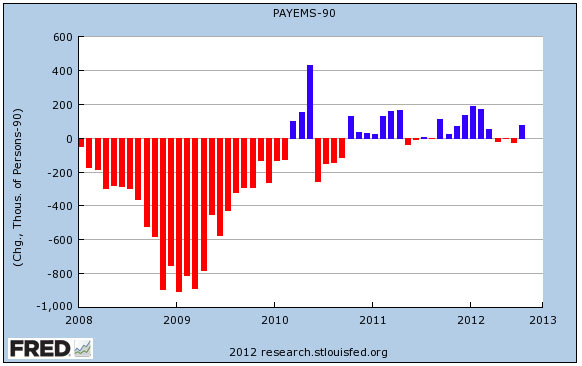
    The government’s latest jobs report is out, so here’s my usual monthly jobs chart, adjusted for population growth to show actual net job creation. It’s finally in positive territory for the first time since March. However, because more people are looking for work (which is basically good news), the unemployment rate actually rose, from 8.22% to 8.25%. Due to rounding, this means the headline unemployment rate increased from 8.2% to 8.3%.

  • Will Congress Screw Underwater Homeowners on December 31?

    <a href="http://www.shutterstock.com/cat.mhtml?lang=en&search_source=search_form&version=llv1&anyorall=all&safesearch=1&searchterm=underwater+homes&search_group=#id=92325670&src=8979db43164fee235a0baa4f9fe6b8c6-1-9">Lightspring</a>/Flickr


    I wrote a post on Wednesday about Ed DeMarco’s decision not to participate in a new Treasury program of principal forgiveness for underwater homeowners. The main purpose of the post was to dig into the details and figure out what DeMarco’s real issues were, so that if we were going to slag him, at least we were slagging him over the right stuff. As it turns out, one of DeMarco’s biggest issues is his fear that a principal forgiveness program might encourage strategic defaults, which would wipe out any benefit the program might otherwise have. However, housing guru David Dayen wrote to let me know that although the mortgage industry complains constantly about the specter of strategic default, it almost never actually happens. It is, he wrote, “a dog that hasn’t barked.”

    I think that’s right, which makes DeMarco’s reluctance to at least try principal forgiveness pretty inexcusable. If it had a long history of failure, that would be one thing. But if his agency’s own models say the program would work, and there’s no significant history of homeowners gaming the system by strategically defaulting, surely it’s worth participating in the program and finding out for sure? It’s not as if it couldn’t be shut down in the future if it turned out to be unworkable.

    David also pointed me to a new piece he has at Salon, suggesting that unless Congress acts the whole thing could be moot. The problem is simple: If the bank forgives, say, $50,000 in principal on your mortgage, the IRS counts that as income and you have to pay taxes on it. This would make the program less attractive at a minimum, and quite possibly completely out of reach. After all, the people this program would help probably don’t have $10,000 lying around to pay the taxman. If they did, they wouldn’t be in such trouble in the first place.

    Back in 2007, Congress passed an exemption to this rule, and a few years later they extended it. But the extension runs out on December 31, the date of the fabled “fiscal cliff”:

    The difference now is that principal reductions and other debt relief are set to become more widespread…Because of the mortgage settlement, banks are mandated to forgive at least $10 billion of principal, as a punishment for using false documentation to foreclose on homeowners, among other abuses. Though this is a relatively small amount of forgiveness (homeowners have roughly $700 billion in negative equity on their mortgages), the implications for the borrowers who receive it are significant.

    …At this point, only Congress can fix this problem by extending the exemption, and there are two parallel efforts underway to do so…Given that this is in essence a tax cut—the Congressional Budget Office estimates that excluding principal reductions from taxation for two more years will save recipients $2.7 billion—many Democrats in Washington believe that Republicans will eventually get onboard. But that’s no guarantee. “I’m not sure we can get that extended,” Rep. Miller said. “Republicans are not keen on principal reduction in the first place. When we extended the law in 2010, that was considered a give to Democrats.” Given that the tax issue would in all likelihood bring principal reductions to a screeching halt, Republicans could view resisting an extension as a way to stop something where they have ideological opposition. And it could be used as a bargaining chip in other negotiations.

    Perhaps Americans for Tax Reform, the Grover Norquist outfit that opposes taxes in all their myriad forms, could start worrying about a real tax increase like this instead of a ginned-up faux tax outrage over prizes that American Olympians get for winning medals in London. Unfortunately, this tax increase would hit working and middle-class families the hardest, and conservatives have always had a hard time worrying much about their taxes.

  • There is Value in Believing Things That Aren’t True


    David Brooks on how much credit we deserve for the things we accomplish:

    As an ambitious executive, it’s important that you believe that you will deserve credit for everything you achieve. As a human being, it’s important for you to know that’s nonsense.

    Actually, that’s not a bad two-sentence summary. The rest of the column isn’t bad either.

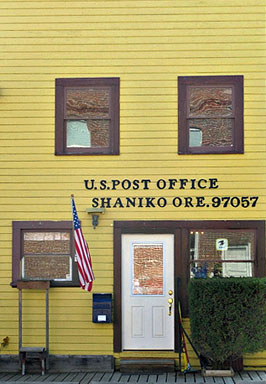
  • Do We Still Need Universal Postal Service?

    David Dayen thinks that the postal service remains an important public function. Matt Yglesias isn’t so sure:

    What’s so important about it? Obviously it’s very important that people be able to get stuff delivered to their house. But there’s no reason to think that absent a public entity this would suddenly become impossible.…The Postal Service, in my opinion, does a really fantastic job of doing its job—namely providing guaranteed six days a week flat rate mail delivery. But when he says “right now the country still needs universal flat rate postal service” I’m left to wonder: Why? Why would it be so terrible to put up with differential pricing, or with a situation where some parts of the country had less frequent delivery?

    This was all prompted by the fact that mail volumes are down and the postal service is losing money. Privatizing the post office is one solution, but David suggests instead that the post office should get into either the banking business or the broadband business in order to fix its financial problems. Unfortunately, I’m not much of a fan of that idea. It’s true that this might bring in revenue if USPS were given some kind of monopoly position or public subsidy, but I don’t really see how it would be profitable otherwise. USPS has no expertise in either area, and I simply don’t see how they’d compete with existing banks or existing broadband providers. Having a bunch of buildings doesn’t give you much of a leg up in the banking biz, since all the existing big banks have lots of buildings too, and knowing how to deliver mail effectively doesn’t give you a leg up in either the internet backbone market or the last-mile market. A privatized USPS simply doesn’t have much to offer in either area.1

    Back on the ordinary mail front, my question has always been more about universal service than flat-rate service. I’m sure Matt is right that differential pricing wouldn’t be a national disaster. But it really does seem as if universal service is an important function, and I’ve never believed that a private post office would provide it. A private USPS would provide differential pricing up to a point, with small towns having higher postal rates than big cities, but there would be plenty of places left that are just flatly unprofitable. At any reasonable postal rate they’d be money losers, and at very high rates they’d get so little use that they’d still be money losers. There would literally be no rate at which they’d be profitable to service.

    Now, maybe that’s OK. Maybe you could privatize the postal service with a requirement that they either deliver to an address or provide a free PO box for delivery and pickup. Unfortunately, this would work only if the privatized post office retained its monopoly status on first class mail, which means you’d lose all the benefits of competition.2 What’s more, you’d almost certainly still be left with a pretty fair number of people who effectively have no mail delivery, since a private operator would probably shut down thousands of small post offices, leaving some customers with a 30-mile drive or more to pick up their mail.

    Again: maybe you think that’s OK. I’m not sure I do, but I might be exaggerating the problem. Nevertheless, that’s the problem that needs to be addressed, and expanding into banking or broadband wouldn’t help even if those ventures were successful.

    1Honest, this is true. Postal banking is successful in other countries because it’s been around forever and people still use it through sheer inertia. And foreign postal services sometimes provide broadband because they have government telephone monopolies already, so beefing that up with lots of fiber optic cable really does make sense. Neither of these things is true in the United States.

    More generally, it’s common to mock companies that get put out of business by new technology. “Train companies failed,” goes the saying, “because they thought they were in the train business when they were actually in the transportation business.” Well, no. That sounds like a sophisticated thing to say, but in fact they knew perfectly well what business they were in. The reason they didn’t get into the airline business is because virtually none of their expertise gave them a genuine leg up against emerging airline operators. You can make up just-so stories about how they should have leveraged their logistics expertise to get into the airline business, but logistics is only a small part of these businesses, and in any case train logistics are quite a bit different from airline logistics. (There were also legal and regulatory issues that played a role here, though I don’t know a lot about them.) The truth is that being in a business that provides a particular kind of service doesn’t necessarily help you enter an entirely different business just because it provides a similar kind of service. In fact, often it’s just the opposite. All you do is bring a train mentality to a business that needs something entirely new.

    2If competitors were allowed, but the universal requirement applied to them, it’s almost certain that there would be no competitors. The USPS would thus retain its monopoly. If the universal requirement weren’t applied to everyone, then competitors would cherry pick service in the biggest cities, which would probably put USPS out of business.