• Friday Cat Blogging – 16 August 2013


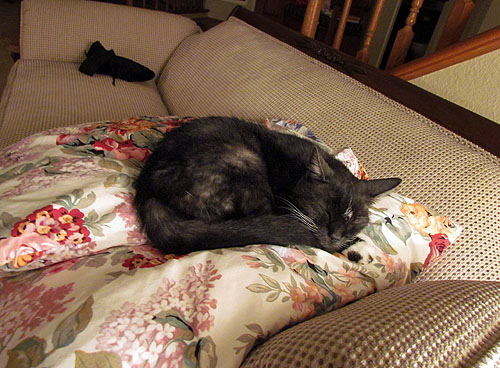
    Obviously this has been a trying week for humans here at the Drum household, what with all our elbow and ankle injuries. But there are silver linings. Back when I was almost totally immobilized, Marian brought down a huge collection of pillows to prop me up in various spots. Then I got better and didn’t need the pillows, so they got piled up on the sofa. That turned out to be a boon for Domino, who very much enjoyed playing princess-and-the-pea with the big stack of downy softness that we had obviously laid down just for her.

    Sadly, the pillows have now been moved to their usual resting spot upstairs, so once again Domino has to make do with ordinary cushions, carpets, and sunny spots on the floor. Sic transit etc.

  • The Latest One-Upmanship on the Lunatic Right


    It’s hard to keep up with the latest in right-wing looniness. But Andrew Sullivan helps out by highlighting American Betrayal, a loopy new book that updates and then turbocharges the whole Yalta-treason-conspiracy-so-vast fever swamp of the late 40s and 50s:

    Take a new book by Diana West about how the Soviet Union “occupied” America under FDR and dictated foreign policy to serve communist interests….And then you begin to inquire further and your eyes widen a little. A few paragraphs into reading the debate, you realize that all of this is connected with the claim of a current huge conspiracy lying in plain sight — the Muslim Brotherhood’s grip on the White House. Obama is a closet Islamist, just as FDR was a closet Stalinist. It all makes sense now!

    ….So do yourself a favor and get a glimpse of the insanity now dominating what was once a vibrant intellectual culture by reading Ron Radosh’s devastating review of the book. (David Horowitz gives his side of the kerfuffle here.) Front Page offered West equal space to respond but she wisely refused (see her position here). After reading Radosh, you realize why. She’s got nothing. But she still has much of the movement right on her side.

    This morning he added an update:

    I was dismayed by how isolated the push-back against the book — by David Horowitz and Ron Radosh — seemed to be on the right. So it’s worth revisiting the debate after a few days to check in on developments. First up: some good news today. Conrad Black’s review in NRO surely counts as a serious public counter to the legitimization of this conspiracy theory, lumping West’s far right-paranoia in with Oliver Stone’s far-left version.

    Sadly, Conrad Black hardly counts. Sure, he’s a conservative, but he’s also a biographer of FDR who adores his subject. The fact that he’s defending Roosevelt doesn’t actually say much about the right.

    On the other hand, Horowitz and Radosh aren’t exactly squishes on this stuff. If even they agree that West’s book is nonsense, then you can be pretty sure that it must be pretty well marinated in the worst kind of Glenn Beck-style nutballism. And yet, great swathes of the right wing have embraced it eagerly. This is part of a peculiar trend on the right over the past few years, in which conservatives are no longer content to argue that liberalism and the New Deal were merely misguided policies. That’s not enough. They’re now returning to Bircher-esque narratives that were abandoned long ago, in which the history of America since the 30s is just one long story of treachery, corruption, economic decline, and deliberate appeasement.

    What’s the point of this game of one-upmanship? I’m not sure. But it’s sort of like the history of Hollywood blockbusters: spectacular battle scenes that seemed awesome just a few years ago are now old hat. New movies have to up the ante, which makes them more and more ridiculous every year. Likewise, conservatives seem to feel that they have to continually up the historical ante. You can barely get any attention these days by writing merely that liberals are trying to turn America into a socialist hellhole. That’s so 2009. Instead you have to argue that FDR was basically a Soviet mole. I’m not sure where it ends.

  • It Costs $350 to Make an Artificial Hip. But It Will Cost You $30,000 to Get One.


    For the last few months, Elisabeth Rosenthal of the New York Times has been working on a series of stories about the high price of healthcare in America. In July she wrote about the high cost of childbirth, and earlier this month she wrote about the truly insane cost of hip replacements in America. But Bob Somerby has noted something interesting: nobody else in the media seems to care:

    These articles deal with a very important topic—the massive looting of U.S. consumers which characterizes American health care. This looting helps explain a welter of major social and political problems—our nation’s growing income inequality; our stagnant wages; the failure to provide full medical coverage; the nation’s problems with federal deficits and debt.

    But so what? Despite their high profile and apparent salience, Rosenthal’s reports have met with universal silence, except for last week’s Fresh Air….It’s going to win the Pulitzer Prize—and it’s going to do so in silence!

    Despite the high profile afforded this series, the silence has been general all over the press, which seems paralyzed, dead in life. At the end of this report, we’ll offer our own speculations about the resounding silence.

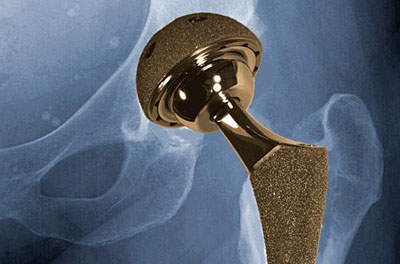
    Is this really true? Rosenthal’s piece implied that artificial hips cost about $350 to manufacture, but sell to hospitals for upwards of $5,000 or more—and are then marked up further by the hospital before they end up in an OR getting installed. It’s not clear if $350 is just the manufacturing cost, or if that’s the all-in burdened cost of producing a hip, but it almost doesn’t matter. Even if it’s the former, it means the full cost is unlikely to be more than $1,000 or so. Nonetheless, in the case of one particular implant, Rosenthal reports that U.S. hospitals pay an average of $8,000 and that even Belgian hospitals, which benefit from government-controlled pricing, pay $4,000. So everyone is paying a pretty hefty markup. Americans are just paying a super-hefty one, made worse by the fact that hospitals then add their own markup, bringing the price of the implant up to $30,000 or more.

    So that’s at least a 30x markup to the end user just for the cost of the part. And that’s despite the fact that the technology is mature, volumes are high and increasing, and there are five companies “competing” for business. So what’s going on?

    Rosenthal has some ideas, but in the end it remains unclear. Where are insurance companies? Where’s Medicare? Why isn’t anyone outraged by this? Is it just fatigue at the never-ending tsunami of stories about the lunatic cost of all the various bits and pieces of American healthcare? Bob is right: it’s a mystery.

  • Today in Lunatic Hollywood Disputes


    “The Butler,” a film about a man who served eight presidents in the White House, opens this weekend. But wait. That’s not its full title. It’s actually called “Lee Daniels’ The Butler.” Is Lee Daniels an insane egomaniac? Nope:

    First a word about the title’s clumsiness, and the story’s provenance. The director, Lee Daniels, is no stranger to clumsy titles. Four years ago he was nominated for an Oscar for “Precious,” a film whose contractual title was “Precious: Based on the Novel ‘Push’ by Sapphire.” His name appears in this contractual title because of a legal dispute over “The Butler,” a silent comedy released by Warner Brothers 97 years ago.

    I figured there must be some fascinating backstory here, but in the end, not really. Those of you who have followed this all along should feel free to add interesting tidbits in comments, but as near as I can tell this really is just a lunatic Hollywood dispute based on bad blood between a couple of moguls over some previous deals. In the end, though, they really did have to change the title because Warner Bros. claimed exclusive rights to it based on a short silent film released in 1916. Don’t you just love Hollywood?

  • Can You Hate Obamacare But Love ACA? Maybe!

    Americans for Prosperity recently launched a multimillion-dollar campaign to trash Obamacare, and its first radio spot has drawn more than the usual derision from the left. Steve Benen summarizes:

    The spot features a woman voice that tells listeners, “Two years ago, my son Caleb began having seizures … if we can’t pick our own doctor, how do I know my family is going to get the care they need?”

    In reality, there’s simply nothing in the Affordable Care Act that stops consumers from choosing their own doctor. Literally, not one provision. Under a variety of HMOs, there are limits on out-of-network physicians,but that was an American norm long before “Obamacare” came around.

    You know, I get that the administration hasn’t yet rolled out its big educational push for Obamacare. And I get that most people just don’t pay a lot of attention to stuff like this and are easily confused. And yet….I’ve nonetheless been a little stonkered for a long time about why supporters haven’t spent more time hammering away on just a few basic things. The sad fact is that most middle-class voters don’t really care about expanded Medicaid or subsidies for the poor. But they do care about this:

    • If you lose your job, you can still get health coverage for your family at an affordable price.
    • And you can’t be turned down because you have a preexisting condition.
    • And you’ll have your choice of policies and access to any doctor you want.

    Sure, not everyone is afraid of losing their job. But lots of people are, and Obamacare provides a level of security they currently don’t have. That’s a very appealing pitch for workers who are non-poor but know that their jobs are shaky. So why hasn’t this gotten more attention?

    Beats me. On the bright side, here’s a novel idea: when the big educational push does come along, it will be all about the “Affordable Care Act,” not Obamacare. But the right has spent so much time demonizing “Obamacare” that the public might not even realize that ACA is the same thing. Seriously. I could easily imagine everyone going out and signing up for ACA at the same time that they’re listening to Fox and frothing at the mouth about how “Obamacare” is socialist fascism. Weirder things have happened. The tea party’s insistence on mocking ACA as Obamacare might come back to bite them this fall.

    UPDATE: It turns out that Jonathan Bernstein made this same “keep your Obamacare away from my Affordable Care Act!” observation at greater length a couple of months ago. You can read it here.

  • Race, Lead, and Juvenile Crime

    Mark Weber/ZUMA Press


    I know, I know: I’m a broken record on the subject of lead exposure in kids and crime rates 20 years later. But there’s lately been a renewed focus on black crime and black incarceration rates, as well as the racial profiling of blacks and Hispanics in New York City’s stop-and-frisk program. Guess what? The lead theory has something to say about that.

    For starters, did you know that arrest rates for violent crime have fallen much faster among black juveniles than among white juveniles? They have, as the charts below show. Rick Nevin explains why:

    African-American boys disproportionately involved in the criminal justice system were also disproportionately exposed to lead contaminated dust as young children, because black children were disproportionately concentrated in large cities and older housing. In 1976-1980, 15.3% of black children under the age of three had blood lead above 30 mcg/dl (micrograms of lead per deciliter of blood), when just 2.5% of white children had blood lead that high. In 1988-1991, after the elimination of leaded gasoline, 1.4% of black children and 0.4% of white children under the age of three had blood lead above 25 mcg/dl.
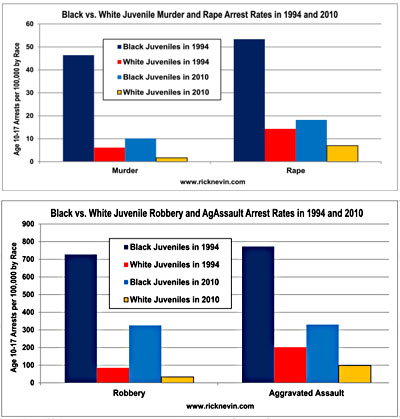
    In other words, black juvenile crime rates fell further than white juvenile crime rates because they had been artificially elevated by lead exposure at a much higher rate. In the early 80s, black kids had elevated lead levels at 6x the rate of white kids. After the elimination of leaded gasoline, black kids still had elevated lead levels at 3x the rate of white kids, which explains some of the continued disparity in juvenile crime rates, but that still represented enormous progress. Not only was the ratio lower, but the absolute numbers were far lower too.

    There have been, and still are, lots of potential explanations for the disparity in violent crime rates between black and white teens: the toxic legacy of racism and slavery; poverty rates in inner cities; gang culture; and many more. But as Nevin points out, none of the popular theories explains the dramatic rise and fall of crime over the past 50 years, nor in particular why black crime declined more than white crime starting in the early 90s. That’s because none of the usual suspects has varied dramatically in the past 20 years. Family structure in black households has been largely unchanged; poverty went down but then went back up; and incarceration rates haven’t increased.

    But the number of kids with toxic levels of exposure to lead has decreased steadily throughout the entire period, and it decreased far more among black kids than white kids. It’s true that black juvenile crime rates are still higher than white juvenile crime rates, but they’re nowhere near the levels that caused so many people to live in fear in the 70s and 80s. Nevin wishes more people knew about this:

    If the public were more aware of the magnitude of the ongoing changes in juvenile arrest rates, then law-abiding youths might not be unfairly viewed as interchangeable with juvenile criminals….The fact that black children still had disproportionately elevated blood lead in 2007-2010 is an egregious racial injustice. The fact that the news media fails to recognize the magnitude of ongoing declines in juvenile arrest rates creates other injustices, sometimes veiled in a cloak of sympathy, sometimes in the form of an ominous lecture, and sometimes in the form of arrest rate trends for minor offenses.

    No one pretends that lead exposure is the only source of crime, or the only source of disparity in crime rates. But it’s a big part of the picture, and the plain fact is that a lot of people are still living in the past when it comes to fear of black teens. Thanks to falling lead exposure, both black and white teens are far less violent than in the past, and the fall has been most pronounced among blacks. If we wanted to, we could produce even further declines by reducing lead exposure among black toddlers to the same levels as white toddlers, but we’re not there yet because blacks still live disproportionately in old housing and in areas where lead dust from nearby highways settled into the soil decades ago. That’s due to the toxic legacy of racism, redlining, poverty, and more. But we could fix it, even if we can’t entirely overcome racism itself.

    The bottom line is simple: We poisoned them. We owe it to them to clean up the poison, not just lock up their kids.

  • Report: NSA Violates Surveillance Rules About Ten Times Per Day


    Barton Gellman has yet another release from the Snowden files today, this time an internal report on violations of surveillance rules by NSA analysts. It’s hard to come to any firm conclusions about NSA compliance just from the report, which provides little more than raw numbers and a few basic breakdowns of violation type. In the first quarter of 2012 there were a total of 865 “incidents,” two-thirds of which involved foreign cell phones that were under surveillance and weren’t removed when they entered the U.S. According to the report, “Roamer incidents are largely unpreventable, even with good target awareness and traffic review, since target travel activities are often unannounced and not easily predicted.”

    So how bad is this? Good question. Here’s what the NSA had to say:

    “We’re a human-run agency operating in a complex environment with a number of different regulatory regimes, so at times we find ourselves on the wrong side of the line,” a senior NSA official said in an interview, speaking with White House permission on the condition of anonymity. “You can look at it as a percentage of our total activity that occurs each day,” he said. “You look at a number in absolute terms that looks big, and when you look at it in relative terms, it looks a little different.”

    I wonder what that percentage is? If it’s, say, around 0.1 percent of total activity, that would mean NSA doesn’t make very many mistakes. That’s good. But it would also mean that NSA initiates upwards of a million database queries per quarter. That’s a helluva lot.

    Click the link for the full story, including a copy of the oversight report.

  • Time to Pull the Plug on Egypt


    America’s $1.5 billion annual aid to Egypt is supposed to give us a bit of leverage in high places. But in the wake of yesterday’s massacre by the military—in direct opposition to repeated appeals from the U.S.—that leverage seems to be pretty much nonexistent. For that reason, Marc Lynch thinks it’s finally time to pull the plug. Here’s the conclusion of an interview over at Wonkblog between Lynch and Brad Plumer:
    BP: Is it possible to envision how the current crisis in Egypt might get resolved at this point?

    ML: Honestly, I think things are going to get a lot worse, not better. The military’s rationale for moving in on the protester camps was that this was a festering wound, we just need to clear it out, do a surgical operation, end this, and move on. I think it’s clear that this is not what’s happening. The streets are incredibly polarized right now, and I think it’ll be extremely difficult to calm things down and get people back on the table.

    For the past few years I’ve been one of the more optimistic people that Egypt would work things out. It just seems like there were enough state institutions, enough political consensus, enough of a robust civil society to keep things going.

    Now I’m not so sure. I think what we’ve got now is a fairly transparent attempt by the military at Mubarak’s restoration, except without Mubarak. I’ve called it “High Mubarakism.”You’ve got a state of emergency, lots of anti-American propaganda. Sissi is a bit more popular, but I don’t think it will work. Mubarak failed for a reason.

    BP: And at this point there’s not much the U.S. can do but watch?

    ML: The problem is pretty much everyone is hostile to us at this point. The U.S. tried to take the stance of not supporting a particular group. But the more polarized Egypt got, the more everyone thought we were against them. All the liberals thought we were on the Brotherhood’s side. All the Brotherhood thought we were on the liberals side. So now you’ve got antipathy from every player in Egypt. And it’s being fed by a really malicious and malevolent anti-American propaganda campaign in the state media and in the pro-coup independent media. That just creates a really toxic atmosphere.

    So America’s ability to do things like being evenhanded broker or try to mediate the conflict is just infinitely harder in that kind of situation.

    I think it’s been fairly clear for over a month that the Egyptian military began planning all of this in the spring, possibly even earlier. It was rolled out very carefully, very strategically, and very ruthlessly. And while Mohamed Morsi may have been no saint, it probably didn’t matter. The military never had the slightest intention of allowing true civilian rule, whether from the Muslim Brotherhood or anyone else.

    All the too-clever questions over the past few weeks from reporters trying to get Obama spokesmen to commit to calling the military action a coup was always silly. Everyone knew perfectly well why they didn’t, and everyone knew it made perfect sense for them to leave their options open as long as there was any hope of influencing the course of events. At this point, though, there pretty obviously isn’t, so there’s no longer much point to holding back. Lynch is right: you can’t just ignore the massacre of 500 people. It’s time to pull the plug.

  • Let’s Make Presidential Debates More Ideological!


    Republicans seem to be inching in the direction of no longer allowing any primary debates to be hosted by non-conservatives or televised on non-conservative channels. The debates would all be on Fox (I guess) and the questioners would all be conservatives who truly understand what it is that conservatives are interested in. Ed Kilgore ponders what this means:

    The key point here is the ability of these kind of “moderators” (to use the unavoidable but unintentionally hilarious term) to “vet” candidates by forcing them to “differentiate their positions on core conservative values.” That could mean slicing and dicing the field according to position differences less ideological questioners don’t even understand (e.g., degrees of commitment to the more radical tenets of “constitutional conservatism” that imply abolition of church-state separation or a roll-back of all federal programs not explicitly authorized in the Constitution), or simply an emphasis on “issues” of particular importance to “the base” and pretty much no one else (e.g., Fast and Furious, “voter fraud,” “death panels,” Shariah Law, home-schooling, the gold standard and even “birtherism.”).

    Personally, I think this would be great. I can think of three reasons off the top of my head:

    Substantive: Why shouldn’t conservatives be questioned by other conservatives who know just what it is that conservatives really care about? That actually sounds pretty reasonable to me. The Huckabee Forum in 2011, starring Pam Bondi, Ken Cuccinelli, and Scott Pruitt, was surprisingly interesting.

    Entertainment value: As a blogger, I would really look forward to making the GOP clown show even more clownish. I know that hardly seems possible, but think about it. “Governor Jindal, do you think Christian churches should merely be free of all government interference, or do you think that state governments should require the adoption of Christian curricula in our schools?” “Representative Ryan, do you think global warming is a myth, or do you think it’s actually a sinister plot by the scientific community to destroy the economy?” Bring it on!

    End of idiocy: I totally sympathize with the conservative desire to put an end to “Elvis or the Beatles?” kinds of questions. It would be worth it just to accomplish this.

    I’m not sure how this translates on the Democratic side, but I wouldn’t mind seeing a few of the debates moderated by honest-to-goodness lefties rather than John King and Wolf Blitzer. Why not make the candidates defend themselves against criticism from the left? It’d be good for them to go up against Rick Perlstein and Katha Pollitt once or twice. Why not?

  • A Wee Case Study in How Fox News Makes Shit Up


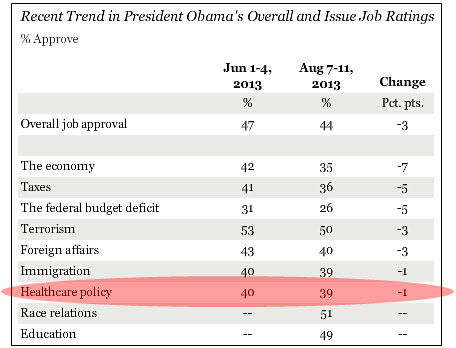
    My sprained ankle is recovering nicely, but I’m still taking more frequent breaks than usual to elevate it and keep the swelling down. Naturally that means more TV watching, which is how I ended up viewing a segment on Fox a few minutes ago about President Obama’s declining approval rating on the economy in the latest Gallup poll. Both the fill-in anchor and Fox’s poll analyst claimed to be puzzled: the economy is showing signs of life lately, after all. So how is it possible that Obama’s approval ratings were falling?

    The poll analyst had an answer ready: Obamacare. You see, as it becomes ever clearer that Obamacare is a raging disaster, people are assuming that means disaster for the economy as well. They think it means higher taxes, bigger deficits, more inflation, higher copays, etc. etc. etc. And what with all the news about pieces of the law being postponed, clearly the public really is expecting a disaster of biblical proportions.

    Perhaps this just sounds like standard Fox News nitwittery? Not at all! Because the two on-air personalities weren’t just shooting the breeze about stuff they had no evidence for. They did have evidence. They had the evidence of the very same Gallup poll they were commenting on in the first place. You see, Gallup actually asked people if they approved of Obama’s healthcare policy. And guess what? It’s pretty much unchanged. If the American public is expecting an epic healthcare meltdown over the next few months, they sure aren’t showing it. And they sure aren’t blaming Obama for it.

    This is what sets Fox News apart from the common herd. Aside from Shep Smith, whose bipartisan contempt for idiocy appeals to me, I barely ever watch Fox. I only do it in the mornings if I have to spend some time doing a boring exercise, or elevating my ankle, or something similar that plunks me in front of the TV. But despite the rarity of that happening, practically every segment I ever see produces some kind of obvious boneheaded misdirection that’s worthy of a blog post. Every one. It’s amazing. It’s one thing to blather on in the absence of facts, but it’s quite another to deliberately ignore evidence right in front of your face because it would interfere with whatever agitprop you happen to feel like phoning in. At some point, you’d think it would get embarrassing, especially on what’s supposed to be a straight-news show. But it never does.