What would happen if Apple and Google went to war? Really went to war, that is? I think I resisted getting sucked into this, but it’s pretty amusing. Worth a read over lunchtime.

What would happen if Apple and Google went to war? Really went to war, that is? I think I resisted getting sucked into this, but it’s pretty amusing. Worth a read over lunchtime.
Bradley Manning’s verdict has been handed down:
An Army judge on Tuesday acquitted Pfc. Bradley Manning of aiding the enemy by disclosing a trove of secret U.S. government documents, a striking rebuke to military prosecutors who argued that the largest leak in U.S. history had assisted al-Qaeda.
The judge, Col. Denise Lind, found Manning guilty of most of the more than 20 crimes he was charged with. She also acquitted him of one count of the espionage act that stemmed from his leak of a video that depicted a fatal U.S. military airstrike in Farah, Afghanistan.
This is a bit better than I had hoped for. I never thought that Manning had any chance of avoiding conviction on the basic charges related to publishing classified information. Nor did I think he deserved to. But Judge Lind acquitted him of the egregious charge of aiding the enemy, and then went a step further and also acquitted him of leaking material from an Army investigation into a 2009 airstrike in Afghanistan’s Farah province. That was a justified act of whistleblowing regardless of whether or not it came from Manning.
CORRECTION: Sorry, I screwed up. I initially wrote that Manning was acquitted of leaking the “Collateral Murder” video. The Farah airstrike was in Afghanistan and was entirely different. I’ve corrected the text.
James Fallows recommends a Guardian column from this weekend about the real effect of the Edward Snowden affair. John Naughton says it’s not about Snowden—and I agree. Rather, it’s about what we now know:
Without him, we would not know how the National Security Agency (NSA) had been able to access the emails, Facebook accounts and videos of citizens across the world; or how it had secretly acquired the phone records of millions of Americans; or how, through a secret court, it has been able to bend nine US internet
companies to its demands for access to their users’ data.
Actually, this isn’t really true. We’ve known for years that federal agencies have been issuing NSLs and warrants to get data from Facebook and others. We’ve known for years that the NSA was collecting phone records.
Which isn’t to say that Snowden’s disclosures haven’t mattered. They have. The public (and Congress) react far more strongly to documented details than they do to general knowledge that something is going on. Snowden’s revelations have plainly galvanized public opinion and spurred Congress into action. That’s a big deal. But it’s not because we really know all that much more than we did before. This is why I’m a little skeptical of the conclusion Naughton draws from this. I’m going to quote Fallows’ version of it since it’s a little clearer:
In short: because of what the U.S. government assumed it could do with information it had the technological ability to intercept, American companies and American interests are sure to suffer in their efforts to shape and benefit from the Internet’s continued growth.
- American companies, because no foreigners will believe these firms can guarantee security from U.S. government surveillance;
- American interests, because the United States has gravely compromised its plausibility as world-wide administrator of the Internet’s standards and advocate for its open, above-politics goals.
Why were U.S. authorities in a position to get at so much of the world’s digital data in the first place? Because so many of the world’s customers have trusted U.S.-based firms like Google, Yahoo, Apple, Amazon, Facebook, etc with their data; and because so many of the world’s nations have tolerated an info-infrastructure in which an outsized share of data flows at some point through U.S. systems. Those are the conditions of trust and toleration that likely will change.
This is one of those arguments that I’d really like to believe. After all, it’s perfectly logical, and it helps make the case against a program that I don’t like. And yet, for several reasons, I just don’t think I buy it.
First, I suspect that the vast, vast majority of overseas Facebook/Microsoft/etc. customers already assume that intelligence agencies can read their files if they want to, and they just don’t care. These users aren’t spies or terrorists, and rightly or wrongly, they believe that intelligence agencies aren’t interested in them and won’t find anything interesting even if they are.
Second, would moving to a non-U.S. service protect you? Sure, if it’s one of those super-secure, highly-encrypted data vaults you read about once in a while. But that’s something very few people are interested in. They just want ordinary internet services: email, social networking, chat, etc. And if you’re a foreign national using a non-U.S. service, guess what? The NSA has no restrictions at all about spying on you. It’s true that they actually have to figure out how to get your data, since they can’t just demand it via warrant. But they can use any method they want to intercept or steal it. There are no rules when it comes to overseas data.
Third, I assume that most foreign governments have police and intelligence agencies that work in much the same way as the FBI and the NSA. We don’t hear much about this since they operate on a far smaller scale, but if the French police want access to your email, they can get a warrant issued for it. Likewise, I suspect that French intelligence agencies have some of the same data mining capabilities as the NSA. It’s certainly nowhere near as broad, but I’ll bet it exists.
Put all this together, and it’s really not clear to me that broad public reaction is going to be very strong. Will Danish users stop using Facebook until some Danish company creates an alternate social networking platform? Probably not. The fear of NSA spying is simply nowhere near as compelling as the huge inconvenience of everyone being on a different platform and being unable to chat and share pictures with their friends in other countries.
As for businesses, they’re probably less interested in avoiding NSA spying than they are in staying ahead of hackers and concealing their more dubious dealings from ordinary law enforcement agencies. Using a non-U.S. platform won’t do them any good on either of these scores.
We’ll see, of course. Maybe this is the beginning of a long decline in U.S. information services, as overseas users start to move to other platforms. It’s possible. Unfortunately, I sort of doubt it. At most, I suspect we’ll start to see a bit more nationalistic reliance on domestic network infrastructure, but that’s something that’s always been likely anyway. Beyond that, people will just keep on doing what they’ve been doing.
UPDATE: For a contrary take, read Henry Farrell here. He believes that privacy authorities in Europe will drive major changes in surveillance law, which is a fairly widespread view. I suspect that things will turn out differently than Henry does, but it’s worth reading his argument.
This was in today’s morning mailbag from a friend: “The higher ups at Democrat World Domination, Inc. should be congratulated on planting Erickson. This investment could pay off substantially.” He included a link to the following from Erick Erickson:
For several years, Republican establishment types and their allies in the press have mocked conservatives for wanting an all or nothing strategy. They’ve said we have to be willing to compromise. So Mike Lee proposes a plan to fund the government except for the discretionary funding for Obamacare. The reaction of GOP leaders? They only want to support a plan that fully repeals Obamacare.
….We inch ever closer to a third party as Republican Leaders commit suicide by lie.
The funniest part of this is Erickson’s belief that defunding just the discretionary portion of Obamacare is a “compromise.” In any case, I’m personally eager for the true believers in conservo-land to break off and start their own party. I’m sure they’ll find that the American public is disgusted with the RINOs currently running the GOP and has just been waiting for an even more hardnosed version of the Republican Party they can vote for.
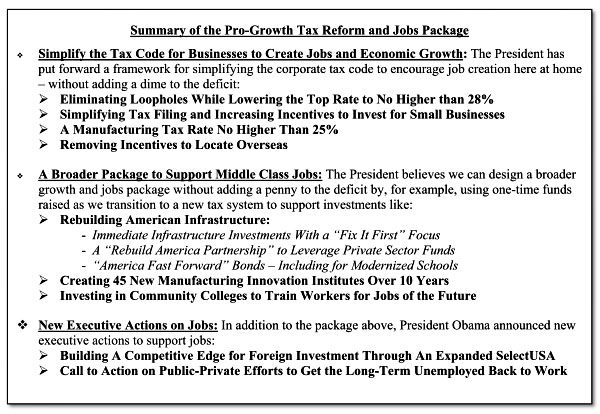
I just finished reading three stories about President Obama’s upcoming proposal to revamp the corporate tax system in return for some short-term infrastructure spending. However, White House officials have apparently been very sparing with details, because none of the stories made it clear just what tax breaks Obama was offering. The whole thing is still very vague.
But one thing was clear: Republicans have rejected it. Completely. They’re not interested in waiting for the details. They’re just against it, full stop.
Welcome to America.
UPDATE: I’m not sure if this is online yet, but for the record, here’s the summary from a White House fact sheet on Obama’s proposal:
Joan McCarter passes along a story from the Dayton Daily News about the latest effort to sabotage Obamacare in Ohio. It comes from radio host Twila Brase:
With time running out, opponents of the Affordable Care Act have taken to the airwaves in Ohio and elsewhere with ad campaigns not only attacking the bill’s merits but also actively encouraging uninsured Americans not to sign up for coverage under the health care law.
….Brase launched the “Refuse to Enroll” campaign earlier this month on her daily radio show, “Health Freedom Minute,” which is broadcast on more than 350 stations nationwide, including the American Family Radio Network with stations throughout Ohio….”Contrary to popular belief, non-enrollment in the exchanges does not result in any penalties; fines are only for failure to be insured,” said Brase, whose organization claims the law will limit consumers’ choices, threaten their privacy and increase the cost of health insurance. “We look at the law as being unconstitutional because it’s a government takeover of health care, so we want to make it difficult for the law to function as its proponents want it to.”
Lovely. This doesn’t come as a surprise anymore, since Brase is hardly the first conservative to do this, but it’s still a remarkable display of spite and meanspiritedness. Conservatives are just hellbent on trying to keep poor people from getting decent health coverage. The right-wing intelligentsia can claim otherwise, but the plain truth is that no one in the actual governing wing of the Republican Party wants to replace Obamacare with anything else. They just want to repeal it, full stop. For some reason, the mere idea of poor and working-class people getting medical care with taxpayer help drives them into conniptions.
I love this story. Apparently Christel DeHaan is a big Republican donor who runs a charter school in Indianapolis, and last year she became a big problem for Indiana schools superintendent Tony Bennett. Why? Because lousy 10th grade algebra scores meant that her school would receive an embarrassingly low official state grade. What to do?
Trouble loomed when Indiana’s then-grading director, Jon Gubera, first alerted Bennett on Sept. 12 that the Christel House Academy had scored less than an A.
….A weeklong behind-the-scenes scramble ensued among Bennett, assistant superintendent Dale Chu, Gubera, Neal and other top staff at the Indiana Department of Education. They examined ways to lift Christel House from a “C” to an “A,” including adjusting the presentation of color charts to make a high “B” look like an “A” and changing the grade just for Christel House.
Hmmm. That sounds about like the kind of lame plan that a desperate 10th grader who had failed algebra might come up with. In the end, though, Indiana’s public education brain trust came up with a more sophisticated plan from the John Lott school of statistical analysis: Just change the state ranking formula so that Christel House would get a better grade.
Sadly, AP’s Tom LoBianco, who rounded up the incriminating emails about this, couldn’t tell us just how the formula was changed:
It’s not clear from the emails exactly how Gubera changed the grading formula, but they do show DeHaan’s grade jumping twice….Indiana education experts consulted for this article said they weren’t aware the formula had been changed.
I sure hope we learn more about this. Did they decide to reduce the importance of all math tests? Just algebra tests? Or maybe raise the importance of some subject that Christel House did especially well in? Or perhaps just toss out 10th grade scores entirely since, really, who cares about 10th grade anyway? Inquiring minds want to know.
Compare and contrast. Here is the Wall Street Journal editorial page today:
As an economist with long experience at the Fed, she doesn’t lack for professional credentials. But her cause has been taken up by the liberal diversity police as a gender issue because she’d be the first female Fed chairman….That led our friends at the New York Sun to wonder if they had somehow missed the creation of “the female dollar” given that they thought the Fed’s main task is to preserve the value of the currency.
Golly. According to the Journal’s editorial board, it would be little more than pure gender pandering if Yellen were somehow chosen to lead the Fed. Let’s see what the Journal’s actual reporters have to say about that:
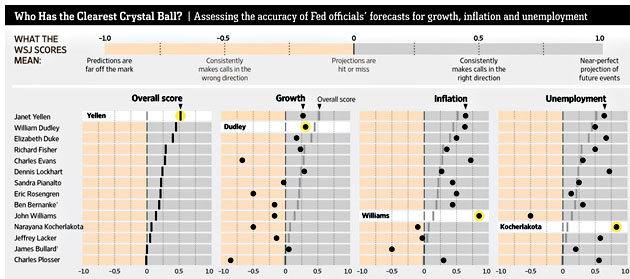
Predicting the direction of the U.S. economy with precision is impossible. But the Fed must forecast growth, inflation and unemployment to guide its decisions on interest rates….The Wall Street Journal examined more than 700 predictions made between 2009 and 2012 in speeches and congressional testimony by 14 Fed policy makers—and scored the predictions on growth, jobs and inflation. The most accurate forecasts overall came from Ms. Yellen, now the Fed’s vice chair.
The Fed can’t do its job unless it has a clear view of what direction the economy is heading, and Yellen has the best track record on that score—better than the current chair, Ben Bernanke, as the chart below shows, and way better than the hard-money cranks the Journal seems to like so much. She’s also enormously well qualified on practically every other measure. The fact that the smarmy frat boys at the Sun and Journal editorial pages are in such a lather over the fact that breaking the glass ceiling at the Fed is also a point in her favor tells you everything you need to know about how they view the world.
From Dave Weigel, commenting on the interplay of Clintonworld and Weinerworld in the wake of Anthony Weiner’s latest tawdry disclosures:
It’s like a Trollope novel, but with lobbyists.
I’ve never read a Trollope novel, so I don’t know if this is true. But if it’s not, it should be.
Steve Benen notes today that after soliciting bids for the healthcare exchanges due to open next year, some states are announcing lower premiums than others:
The pattern isn’t exactly subtle: if you live in a state where officials want “Obamacare” to work, the law looks great. If you live in a state where officials are actively trying to undermine the law, regardless of what it does to you, your premiums, and your family’s access to quality and affordable care, then — you guessed it — the news isn’t as encouraging.
….My question is, what happens in those red states when residents start looking across borders and they wonder to themselves, “Why aren’t my benefits as great as theirs?” In theory, this should prompt those folks to start asking their state officials to do more of what works.
And this in turn might create an interesting political situation for red-state Republicans who want to listen to their constituents but who also want to undermine the health care law out of partisan spite.
It’ll be interesting to see if this pattern holds up once we get rate details from all the states. Right now it’s sort of hard to judge, since there aren’t all that many red states setting up exchanges in the first place. Most of the states who were really opposed to Obamacare simply punted on the whole thing and left everything up to the federal exchanges.
My guess is that once the dust settles, rates are going to be fairly similar across the country. Competition among insurance companies will get us part of the way there, and constituent pressure will eventually do the rest. In the end, residents of red states are going to have access to reasonably priced health insurance no matter how much it infuriates their Republican leaders.

Award-winning photojournalism.
Stunning video. Fearless conversations.


