• Economic Growth Slows to 0.5% in First Quarter


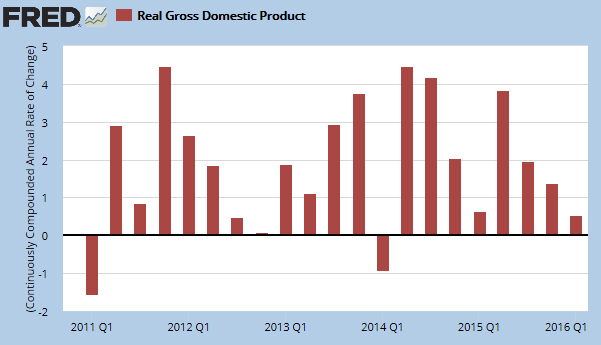
    The economy grew at a sluggish 0.5 percent annual rate in the first quarter. The main culprits for the poor performance were downturns in durable goods, nonresidential construction, and defense spending. This is the third year in a row in which growth has been poor in the first quarter, which means that one-off excuses about snowstorms and so forth don’t really hold water anymore. But it might be a statistical artifact. Jared Bernstein says “there’s some concern with the seasonal adjusters, which some argue are biasing Q1 down and Q2 up.” I guess we’ll have to wait until Q2 to find out.

    Even if that’s true, however, growth is still fairly listless, averaging around 2 percent per year. It’s yet another indication that the global economy remains fragile and the Fed should think twice before raising rates any more than they’ve already done.

  • High-Risk Pools Don’t Work, Have Never Worked, and Won’t Work in the Future


    Even among conservative voters, Obamacare’s protection of people with pre-existing conditions has always been popular. In a recent Kaiser poll, it garnered 74 percent approval from Democrats, 70 percent approval from independents, and 69 percent approval from Republicans.

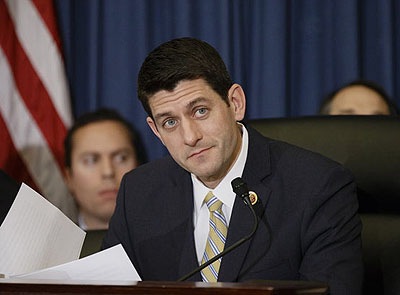
    Technically, this protection is guaranteed by two different provisions of Obamacare: guaranteed issue, which means that insurance companies have to accept anyone who applies for coverage, and community rating, which means they have to charge everyone the same price. But popular or not, Paul Ryan wants nothing to do with it:

    In election-year remarks that could shed light on an expected Republican healthcare alternative, Ryan said existing federal policy that prevents insurers from charging sick people higher rates for health coverage has raised costs for healthy consumers while undermining choice and competition.

    ….”Less than 10 percent of people under 65 are what we call people with pre-existing conditions, who are really kind of uninsurable,” Ryan, a Wisconsin Republican, told a student audience at Georgetown University. “Let’s fund risk pools at the state level to subsidize their coverage, so that they can get affordable coverage,” he said. “You dramatically lower the price for everybody else. You make health insurance so much more affordable, so much more competitive and open up competition.”

    It’s true that the cost of covering sick people raises the price of insurance for healthy people. That’s how insurance works. But there’s no magic here. It costs the same to treat sick people whether you do it through Obamacare or through a high-risk pool—and it doesn’t matter whether you fund it via taxes for Obamacare or taxes for something else. However, there are some differences:

    • Handling everyone through a single system is more efficient and more convenient.
    • High-risk pools have a lousy history. They just don’t work.
    • Implementing them at the state level guarantees a race to the bottom, since no state wants to attract lots of sick people into its program.
    • Ryan’s promise to fund high-risk pools is empty. He will never support the taxes it would take to do it properly, and he knows it.

    This is just more hand waving. Everyone with even a passing knowledge of the health care business knows that high-risk pools are a disaster, but Republicans like Ryan keep pitching them anyway as some kind of bold, new, free-market alternative to Obamacare. They aren’t. They’ve been around forever and everyone knows they don’t work.

  • Democrats Have a Class Gap. Republicans Have a Generation Gap.


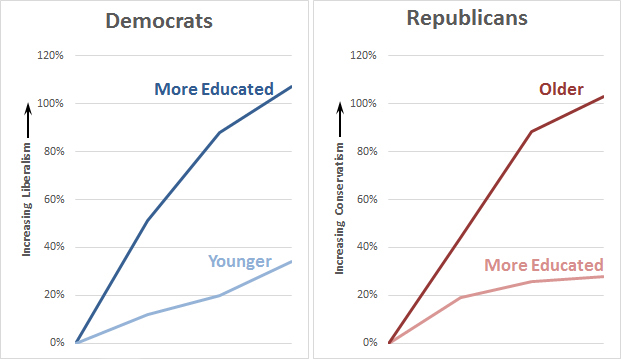
    What are the big fault lines within the Democratic and Republican parties? According to a recent Pew report, Democrats have a class gap: Democratic elites are far more liberal than less educated members of the party. But there’s not much of a generation gap: old and young voters are pretty similar ideologically.

    Among Republicans, it’s just the opposite. They have a huge generation gap, with older voters skewing much more conservative than younger voters. But there’s no class gap: their elites are in pretty close sync with the party base. The raw data is here, and the chart below shows the magnitude of the difference:

    This is interesting, since the most talked-about aspect of the Democratic primary was the astonishingly strong preference of young voters for Bernie Sanders over Hillary Clinton. But why did they prefer Bernie? The obvious answer is that they’re more liberal than older Democrats and therefore preferred his more radical vision—but the Pew data says that’s not the case.

    So what is the answer? The age gap could still explain a bit of it, since young Democrats are a little more liberal than older Democrats. And the class gap could also explain a bit of it, since Bernie voters tend to be both young and well educated. But even put together, this doesn’t seem like enough.

    Obviously there was something about Bernie that generated huge enthusiasm among younger voters. But if it wasn’t ideology, what was it?

  • Trump’s Foreign Policy Doesn’t Improve When Read From a Teleprompter


    I kinda sorta listened to Donald Trump’s foreign policy speech this morning. You know, the one we were all looking forward to because it was written by an actual speechwriter and would be delivered via teleprompter. That’s Trump being presidential, I guess.

    So how did Trump do? That depends on your expectations. For a guy who never uses a teleprompter, not bad. By normal standards, though, he sounded about like a sixth grader reciting a speech from note cards. On content, it was the same deal. Compared with normal Trump, it wasn’t bad. By any real-world standard, it was ridiculous.
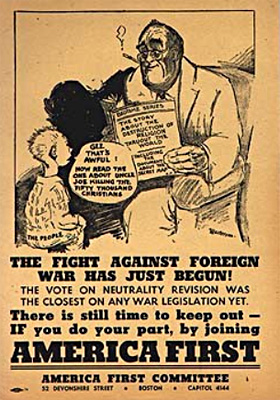
    Fact-checking his speech is sort of pointless, basically a category error. Trump is a zeitgeisty kind of guy, and that’s the only real way to evaluate anything he says. In this case, the zeitgeist was “America First”—and everyone’s first question was, does he know? Does he know that this is a phrase made famous by isolationists prior to World War II? My own guess is that he didn’t know this the first time he used it, but he does now. Certainly his speechwriter does. But he doesn’t care. It fits his favorite themes well, and the only people who care about its history are a bunch of overeducated pedants. His base doesn’t know where it came from and couldn’t care less.

    So: America First. And that’s about it. Trump will do only things that are in America’s interest. He will destroy ISIS, crush Iran, wipe out the trade deficit with China, eradicate North Korea’s bomb program, and give Russia five minutes to cut a deal with us or face the consequences. Aside from that, Trump’s main theme seemed to be contradicting himself at every turn. We will crush our enemies and protect our friends—but only if our friends display suitable gratitude for everything we do for them. We will rebuild our military and our enemies will fear us—but “war and aggression will not be my first instinct.” We will be unpredictable—but also consistent so everyone knows they can trust us. He won’t tell ISIS how or when he’s going to wipe them out—but it will be very soon and with overwhelming force. He will support our friends—but he doesn’t really think much of international agreements like NATO.

    Then there was the big mystery: his out-of-the-blue enthusiasm for 3-D printing, artificial intelligence, and cyberwar. Where did that come from? In any case, the Pentagon is obviously already working on all three of these things, so it’s not clear just what Trump has in mind. (Actually, it is clear: nothing. Somebody put these buzzwords in his speech and he read them. He doesn’t have the slightest idea what any of them mean.)

    So what would Trump do about actual conflicts that are actually happening right now? Would he send troops to Ukraine? To Syria? To Libya? To Yemen? To Iraq? Naturally, he didn’t say. Gotta be unpredictable, after all.

    But whatever else you take away, America will be strong under Donald Trump. We will be respected and feared. Our military will be ginormous. No one will laugh at us anymore. We will proudly defend the values of Western civilization. This all serves pretty much the same purpose in foreign policy that political correctness, Mexican walls, and Muslim bans serve in Trump’s domestic policy.

    And there you have it. Did he really need a teleprompter for that?

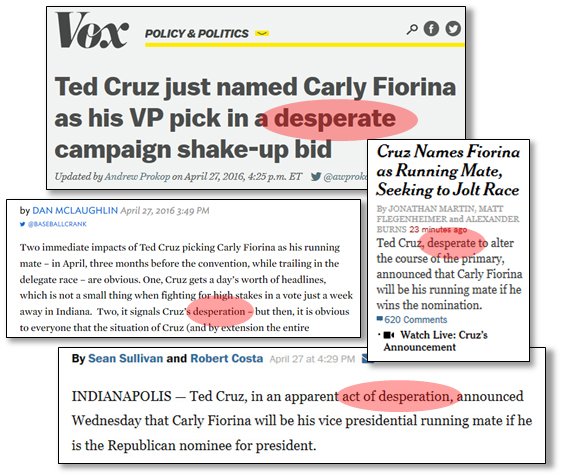
  • Cruz-Fiorina in 2016!


    The rumor mill says that Ted Cruz plans to announce today that Carly Fiorina will be his running mate. Jim Geraghty comments:

    Announcing Fiorina today would be a big gamble for Cruz. There’s a lot to like about Fiorina, but will this announcement help lock up Indiana and give Cruz a slew of delegates in places like California? If Fiorina is today’s big news, we may look back on this as a key moment where Cruz united the anti-Trump factions of the party… or we may look back on this as a Hail Mary pass.

    Hmmm. Pretty sure I know which one of these it will be. In fact, it’s even worse than it seems. Given Fiorina’s popularity in California, it’s more like a Hail Mary pass to the wrong end zone.

  • Do Lucky People Feel Better About Paying Taxes?


    Robert Frank thinks that we can get rich people to support higher taxes by reminding them of how lucky they are:

    Underestimating the importance of luck is [] a totally understandable tendency….Most highly successful people are very talented and hardworking, after all, and when they construct the narratives of their own lives, the most readily available memories are the difficult problems they’ve been solving every day for decades. Less salient are the sporadic external events that also invariably matter, like the mentor who helped you during a rough patch in 11th grade or the promotion you got because a more qualified colleague had to turn it down to care for an ill spouse.

    ….I’ve seen even brief discussions of the link between success and luck temper the outrage many wealthy people feel about taxes….In my own recent conversations with highly successful people, I’ve seen opinions change on the spot. Many who seem never to have considered the possibility that their success stemmed from factors other than their own talent and effort are often surprisingly willing to rethink. In many instances, even brief reflection stimulates them to recall specific examples of good breaks they’ve enjoyed along the way.
    I’ve long wondered how it is that so many people are completely clueless about how lucky they are. Off the top of my head, here’s the story of my life:

    I was born in the richest state in the richest country in the richest era of human history. I was born white, male, straight, and healthy. I was born with a high IQ and an even temper. My parents loved me and took care of me. We weren’t rich, but I never wanted for anything important. I attended good quality state schools free of charge for 17 years. I never had any catastrophic money problems after I left home. By a rather unlikely chance, I ended up marrying the most wonderful person in the world. I had a great mentor at one job who helped me make an improbable move into high-tech marketing. Later I found myself working for a guy I happened to click with, and ended up vice president of marketing. Our company eventually got acquired and I made a bunch of money. After I left, I just happened to start blogging as a hobby right at the time blogging became big. A couple of years later I got a call out of the blue asking if I wanted to blog for pay. A few years after that I got another call out of the blue and ended up at MoJo.

    There’s more, but that’s enough for now. And of course, recently I’ve had some bad luck. But even that hasn’t been so bad. Thanks to all the good luck I had before, I’ve received hundreds of thousands of dollars of top-notch medical treatment at practically no cost.

    Does any of this mean I didn’t work hard and diligently? Of course not. But lots of people work hard and diligently. In fact, most people do. If I had worked hard and diligently but been born in a small village in Pakistan, I’d be…living in a small village in Pakistan right now. All the hard work and diligence in the world wouldn’t have done much of anything for me.

    I can easily believe that most people give short shrift to all this stuff. Hell, I’ve known people who were smug about their real estate acumen because they happened to buy a house in 2002, and then cried about their terrible luck when they failed to sell it in 2007. We all like to fool ourselves into believing that good things are due to our smarts while bad things are all down to bad luck. But for most of us, there’s an awful lot of good luck involved in our lives too.

    But here’s the thing I’m interested in: is it really true that pointing this out to a rich person is likely to turn them into a tax-loving supporter of the welfare state? That hasn’t been my experience, but then, I’ve never gone whole hog on the luck argument. Maybe it works! But if it does, we liberals have sure been remarkably negligent for the past few decades. This is a pretty easy argument to make, after all.

    So: has anyone (other than Robert Frank) tried this? Ideally with a rich person, but even an upper-middle-class Republican will do. Did it work? Inquiring minds want to know.

  • Hillary Clinton Wants All Millennials to Feel Free to Use Her Lawn


    I guess I’m finally curious enough about something to write a post about it. The subject is The Kids Today. Here are a couple of recent posts from Atrios:

    I know I keep returning this subject, and I probably don’t have anything especially new to say about it, but I guess support for Bernie by The Kids Today has brought a lot of it out recently. I’m increasingly amazed that The Kids Today seems to include anyone under 40, and that the olds (#notallolds) hate them with white hot passion. The Kids Today are Generation Screwed, and the Old Economy Steves of the world really should shut their pie holes.

    And:

    Hope to be wrong, but suspect that team Clinton (very broadly defined) will still be talking about Berniebros in September. I’m quite happy for Hillary Clinton to be the nominee, as I always thought she would be. I’m not happy with the months of “we would have won it easy if not for these meddling kids who won’t vote in November” rhetoric. Better figure out how to appeal to them. Stop calling them immature and stupid. The goal is to win, not to make early excuses for why you’re going to lose.

    I realize that our personal takes on this subject are strongly influenced by which blogs/tweets/etc. we happen to read, and Atrios and I are probably reading different stuff. But I still wonder where this is coming from. Do older folks really hate millennials with a white hot passion? Is Team Clinton obsessed with Berniebros? I just don’t see it. What I’ve seen is a competitive primary where both sides have been sniping at the other, just like 2008. And now that it’s over, the sniping will fade away. Just speaking personally, my Twitter feed and general reading list has been about equally full of rancor aimed at both sides. The youngs are starry-eyed idealists; the olds are corrupt sellouts. Berniebros are disgusting; Hillarybots are cutthroat. Bernie is clueless about how to get things done; Hillary is a warmonger. Etc.

    If you yourself are a millennial, I suppose it’s only natural to pay special attention to every single op-ed ever written on the subject of millennials. But I don’t think this particular genre is any more prevalent today than op-eds about young Gen Xers a couple of decades ago or op-eds about young boomers back when I was graduating from college. They’re no more critical, either. Just the same old stuff about middle-aged folks trying to understand younger folks, sometimes with sympathy and sometimes without.

    I guess I’m doing that annoying oldster thing where I use my personal experience to shrug off what’s happening today as just more of the same. But honest, I wouldn’t do it if I saw endless streams of criticism of Bernie and Bernie supporters—and millennials in general—that truly seemed way out of proportion to what I’ve seen before. But I just haven’t.

    As for Hillary, I can guarantee that the only thing she and her team want from millennials is their support. That’s been crystal clear from the start, and the fact that there are some assholes on her side doesn’t change that. There are always assholes on all sides. But Team Hillary itself, even broadly defined, has no greater desire than to prove itself to millennials and get their votes in November. Just wait and see.