• Could Bernie Sanders Have Beaten Trump?


    My pal Josh Harkinson tweets:

    That’s certainly possible. But I think it suffers from a lack of imagination about the counterfactual.

    It’s obvious that Hillary Clinton’s biggest weakness during the election was Emailgate. Republicans successfully took a fairly minor bit of misjudgment and turned it into the world’s greatest crime—and kept it alive by shrewdly dribbling out new information regularly. Aided and abetted by Vladimir Putin, Julian Assange, a last-minute assist from James Comey, and a press corps that played along gleefully, this turned into a huge millstone around Clinton’s neck that Donald Trump hammered on relentlessly. He also kept up a drumbeat of criticism on TPP, NAFTA, and other economic concerns of the working class.

    Plainly Bernie Sanders wouldn’t have suffered from either one of these problems. So does that mean he could have beaten Trump?

    Sure, maybe. But it probably just means Trump would have attacked him in a different way. Most likely, he would have hammered away at Sanders being a wild-eyed communist. Then Sanders would have lost, and we’d be sitting around wishing we’d nominated Clinton. After all, Trump certainly couldn’t have attacked her as a crazed radical. As for that email thing, it was old news. It wouldn’t have hurt her much.

    In the end, this is unanswerable. For myself, I doubt that Sanders could have beaten Trump. Once he left the cozy confines of the Democratic primaries, he would have been pilloried.

    POSTSCRIPT: To put this in plainer terms, of course Sanders could have won some votes that Clinton didn’t. But a leftier agenda would also have lost him some votes. It’s not at all obvious that this would have ended up a net positive for Sanders.
  • Republicans and the White Working Class


    Jim Tankersley:

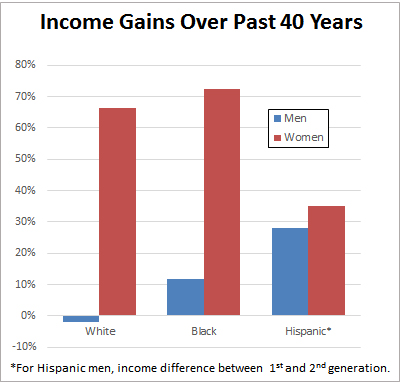
    For the past 40 years, America’s economy has raked blue-collar white men over the coals. It whittled their paychecks. It devalued the type of work they did best. It shuttered factories and mines and shops in their communities….They were not the only ones who felt abandoned by a rapidly globalizing economy, but they developed a distinctly strong pessimism in its face.

    On Tuesday, their frustrations helped elect Donald Trump, the first major-party nominee of the modern era to speak directly and relentlessly to their economic and cultural fears….It was a rejection of the business-friendly policies favored at various points by elites in both parties, which deepened trade relationships with foreign countries and favored allowing more immigrants in. And it was a raw outburst at the trends of rising inequality and economic dislocation that defined America’s economy thus far this century.

    We’re going to hear a lot about this over the next few months. We’re going to hear about it so much we’re all going to get sick of it. But every time it comes up, I ask myself: Just what are Democrats supposed to do about this? Whatever they are or aren’t doing, you have to keep two things in mind:
    • It’s only the white working class that has abandoned the party. Working class blacks, working class Latinos, and working class Asians all seem to be perfectly happy with Democratic policies.
    • By any objective measure, Democratic economic policies are better for the white working class than Republican economic policies. And yet the white working class keeps moving inexorably toward the Republican Party anyway.

    So is this about policies? Is it about NAFTA and the decline of unions and friendliness to Wall Street? It’s hard to see how, since Republicans support these policies far more avidly than Democrats.

    Is it about economic decline? Absolutely yes. Nonwhites may be in worse shape than whites, but they’ve generally made progress over the past few decades. White men alone have seen absolute declines. But what can Democrats do about this? Blacks and Latinos started from such a poor position that they were bound to close some of the gap with whites.

    Is it about taxes? Not in any objective sense. The American working class barely pays any federal income tax at all. They’re on the hook for payroll taxes, but that’s about it. It’s all but impossible to cut their taxes any more.

    I could go on. And maybe I will eventually. But it’s hard to conclude from all this that the white working class is angry about Democratic economic policies. It’s mostly about racial and cultural identity—and Republicans appeal to that primarily via symbolic attacks on welfare and immigration and affirmative action and “inner city” crime. Can Democrats join them in doing that? I don’t see how.

  • Things We Can Count On In the Next Two Years


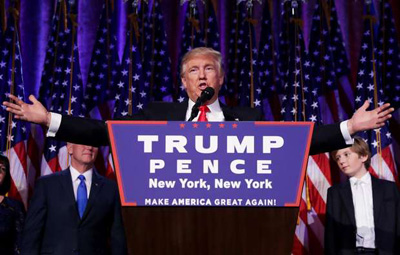
    What is Donald Trump going to do in office? Beats me. For the most part, I’d ignore what he said on the campaign trail, since he said so many different things at different times. It’s obvious that (a) he doesn’t know much, and (b) he doesn’t truly care about very many things—and that means he’s going to be willing to negotiate. On that score, I mostly agree with Tyler Cowen, who speculates that “his natural instinct will be to look for some quick symbolic victories to satisfy supporters, and then pursue mass popularity with a lot of government benefits, debt and free-lunch thinking.”
    However, this also means Trump is likely to follow the lead of Congress, which is completely in Republican hands and likely to follow the lead of Paul Ryan. Given that, I think there are a few things we can speculate about. Here’s a short list:

    • The filibuster is toast. Republicans will get rid of it as soon as they need to.
       
    • There are three Supreme Court justices who support Roe v. Wade and are getting on in years: Stephen Breyer (78), Anthony Kennedy (80), and Ruth Bader Ginsburg (83). Using standard actuarial tables, there’s a 60 percent chance that at least one of them will die during Trump’s term. That means there’s a 60 percent chance that Roe v. Wade will be overturned.
       
    • Repealing Obamacare will be harder than Republicans think, and it’s possible that they’ll shrink from it when they truly have to face up to the consequences. For one thing, it’s impossible to keep the “good parts” (pre-existing conditions, community rating, etc.) and only get rid of the bad parts. In the best case, they’ll pass a bill that repeals Obamacare in name, but leaves most of it in place under a different name. But I doubt that. In the end, I think they’ll rip down the whole thing.
       
    • There will be a recession sometime during Trump’s term. I don’t know what this means. But I’ll bet the Republican Congress will be a whole lot more eager to fix it with crude Keynesian pump priming than they were for Obama.
       
    • Trump seems to really care about infrastructure, which makes sense since he thinks of himself as a builder. So we might very well get an infrastructure bill passed. I expect that a wall on the southern border will be part of it.
       
    • Congress will pass a big tax cut for the rich. Not as big as Trump’s, I think, but plenty big anyway.
       
    • Winners from a Trump presidency: rich people; pro-lifers; Paul Ryan, who will now be reelected Speaker easily; China; Wall Street; Vladimir Putin; James Comey; and CNN president Jeff Zucker, who did everything in his power to help elect a guy who could keep his ratings up.
       
    • Losers from a Trump presidency: poor people; anyone on Obamacare; illegal immigrants; climate change; the white working class, which fell for Trump’s con but will get virtually nothing from his presidency; anyone who cares about human decency and national dignity; Barack Obama, whose presidency will now be considered a failure; and the Democratic Party, which has lost control of the presidency, the House, the Senate, the Supreme Court, and most of the states.

    Since I have the Reconstruction era on my mind right now, it’s hard to avoid the obvious comparison. Reconstruction lasted about eight years, and then was dismantled almost completely. Barack Obama’s presidency lasted eight years and will now be dismantled almost completely. I will withhold my opinion for now on the obvious reason for this similarity.

  • There Was No Apparent “Whitelash” This Year


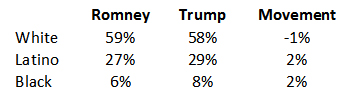
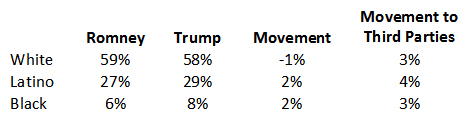
    Among liberals, one of the most popular explanations for Donald Trump’s victory is that it was a “whitelash,” a primal scream of lost influence and latent racism among white voters. I myself certainly talked about racial animus quite a bit during the runup to the election. However, in the spirit of figuring out where we went awry, the actual voting patterns suggest this is flat wrong. Using exit poll data from 2012 and 2016, here is Trump’s share of the vote compared to Romney in 2012:

    Whites voted less for Trump than for Romney, while both blacks and Latinos voted more for Trump.1 There’s nothing here that suggests Trump appealed to white backlash in any special way. Quite the opposite. But now let’s add a column to the table:

    Among whites, Trump lost 1 percent of white votes, but third-party candidates gained 3 percent. Among Latinos, third-parties gained 4 percent, and among blacks they gained 3 percent.

    This is the big difference. Who did third-party candidates hurt the most, Trump or Clinton? And why? Or was the damage equal? You need to answer this question before you can say anything sensible about race.

    It’s worth nothing that this doesn’t mean that race played no role in this election. But it does mean two things. First, white racial animus seem to have played no more of a role than it did four years ago. Second, although Trump’s blatant appeal to white ethnocentrism did him little good, it also did him no harm—and that was true among all racial groups. That’s disheartening all on its own.2

    When more detailed data is available, it might turn out there are specific subsets of the white vote that moved very strongly toward Trump. But what we have so far doesn’t suggest anything of the sort. If you still want to claim that whitelash played a big role in this election, you need to contend with this.

    1You can break this down by age or gender, but it doesn’t really change anything. For example, white men moved slightly toward Trump while white women moved slightly away from him. Likewise, middle-aged whites moved slightly toward Trump while young and old whites moved slightly away. But the differences are small enough that they don’t change the picture much.

    2Since I first put up this post, several people have suggested that national data isn’t the right way to look at voter demographics. Instead, we should look at the key swing states of Pennsylvania, Wisconsin, and Michigan. But that doesn’t change things. If you look at the exit poll data, Trump did slightly worse than Romney in Pennsylvania and slightly better in Wisconsin and Michigan. But the operative word is “slightly.”

    Still, maybe turnout was up among white voters? That’s possible. But we don’t have that information yet, and I’m not sure when we’ll get it.

  • Post-Election Cat Blogging


    My usual schtick at this point is to tell everyone to settle down. Things won’t be as bad as they seem. Not this time. What happened yesterday is appalling. We have elected a buffoonish, misogynistic, race-baiting, game-show host to be president of the United States. I can’t even begin to assess the damage he’s likely to do over the next four years.

    I didn’t see this coming, and it’s no comfort that few others did either. But obviously everything I thought I knew was wrong. I need time to digest this, and in any case, there’s no point in reading anything I have to say until I come to grips with why and how I was so wrong. While I’m digesting, however, someone needs to take a close look at unmarried men. If there’s any single demographic group that powered Trump to victory, that was it.

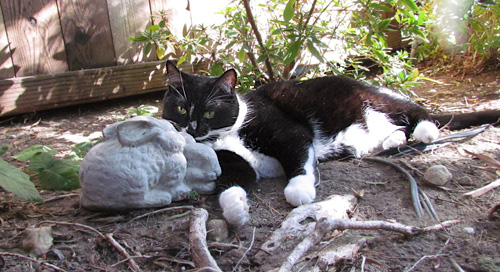
    I’ll be back tomorrow. In the meantime, here are the only people in my household taking this philosophically.

  • The Numbers: How Hillary Clinton Lost


    Once all the votes are counted, it looks like Hillary Clinton will underperform Barack Obama by about 4 percentage points in the national vote. Was this an across-the-board loss, or was it concentrated among certain groups?

    The quickest way to get a sense of what happened is to compare the exit polls from 2012 and 2016. What we’re looking for is demographic groups that differ from -4% by a significant margin. As it turns out, there aren’t very many. Clinton underperformed Obama across the board. She did somewhat better than -4% with seniors, college grads, married voters, and high-income voters. She did worse with low-income voters, union households, and unmarried voters.

    This was not a “white revolt.” White men followed the national trend (-4% compared to 2012) and white women did better for Clinton (+1%). Black men and Latino women underperformed for Clinton by significant margins.

    The big surprise here is that Clinton did so much worse with unmarried voters. She underperformed Obama among unmarried men by a whopping 10 points, and among unmarried women by 5 points. What’s up with that? I would sure like to see a crosstab of unmarried men by age, race, income, etc. Latino voters are also a surprise. Clinton only did slightly worse than Obama, but surely she should have done much better. What happened?

    Here’s the full set of comparisons to Obama in 2012. For reference, 2012 exit polls are here. 2016 exit polls are here.

    Category

    Men
    Women

    18-29
    30-44
    45-64
    65+

    White
    Black
    Latino

    White men
    White women
    Black men
    Black women
    Latino men
    Latino women

    High School
    Some college
    College
    Postgrad

    <$50K
    $50-100K
    $100+

    Democrat
    Republican
    Independent

    Protestant
    Catholic

    Married men
    Married women
    Unmarried men
    Unmarried women

    Liberal
    Mod
    Conservative

    White born again
    Other

    Union household
    Not union

    Comparison to
    Obama 2012

    -4
    -1

    -5
    -3
    -2
    +1

    -2
    -5
    -6

    -4
    +1
    -7
    -2
    -3
    -8

    -6
    -6
    +2
    +3

    -8
    0
    +3

    -3
    0
    -3

    -3
    -5

    -1
    +3
    -10
    -5

    -2
    -4
    -2

    -5
    -1

    -7
    -3

  • Hillary Clinton Is Way Ahead in Florida


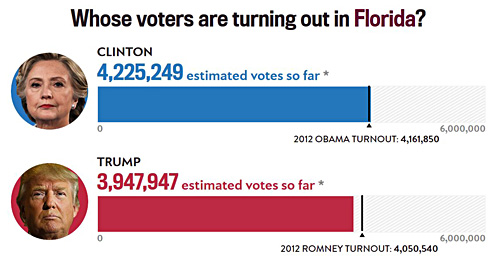
    Slate’s VoteCastr experiment has turned out to be less mesmerizing than I had hoped, partly because I’m not totally sure what it’s telling me. Plus I don’t know how much early turnout is predictive of final voting. That said, the Florida data is pretty interesting:

    This snapshot was taken at 5 p.m. Eastern time. There are two things to note here. First, turnout in Florida is sky high: With two hours of voting left, it’s already nearly as high as it was in 2012. Second, Hillary Clinton is ahead by 3.4 percentage points. Out of 8 million votes, that’s a lot. At this point, it looks like Clinton is a lock to win Florida, and if she does, that’s the race. There’s no way for Trump to win without Florida.

    Among the other states in the Eastern time zone, Clinton is ahead by 4.1 percent in New Hampshire; 2.9 percent in Pennsylvania, and 0.7 percent in Ohio. In the other three states VoteCastr tracks, she’s ahead by 7.5 percent in Wisconsin; 1.8 percent in Iowa, and 0.8 percent in Nevada.

    I have no idea how meaningful any of this is. No one’s ever done it before. But if it means anything at all, it suggests Clinton is very close to becoming president-elect.

    UPDATE: Well, apparently the VoteCastr folks have some work to do on their model. Trump won Florida handily.

  • Who Is Melania Trump Voting For?


    Ha ha ha. The Trump men don’t even trust their own wives to vote for Donald. I’m not sure I blame them.

  • Time to Vote!


    I think it’s time to toddle up to my polling place and cast my ballot for the candidates of my dreams. I’ll be back in a few minutes.

    UPDATE: Everyone has to contribute their polling anecdote, so here’s mine. There was a huge line. I had to wait five minutes to vote.

    Seriously. I always vote at 10 am, and normally there’s maybe two or three people voting and no line at all for the remaining machines. Today, all six voting booths were full and there were four people in front of me in line. The poll workers were so worried about this state of affairs that they were offering paper ballots to anyone who didn’t want to wait.

    I know: boo hoo. But compared to normal, my polling place was much busier than usual. I have no idea what this means.