It occurs to me that we now have three tests of Donald Trump’s barstool approach to public policy:
Immigration. Trump hasn’t done much on the policy side to reduce illegal immigration, but he has stepped up the pace of high-profile raids. He’s also blustered a lot and pissed off just about the entire nation of Mexico. Will this be effective in scaring Latin Americans away from crossing the border into El Norte?
Qatar. The US has been unhappy with Qatar’s support for terrorist groups for several years. Now Trump has decided to turn this into a highly public battle. Will Qatar respond positively to this?
NATO. Every American president has pressed our NATO allies to spend more on defense, with only sporadic success. Trump has decided to up the ante by implicitly threatening to leave NATO if they don’t. Will this finally get them to commit to higher defense budgets?
All of us overeducated types are sure that Trump’s approach will make things worse, not better. That’s certainly what I think. In a year or two, these three issues should give us a pretty good idea of whether we’re right.
Republicans have been griping for years about the “worthless” health insurance provided by Obamacare. Why worthless? Because the deductibles are so high.
This takes some serious chutzpah, since high-deductible insurance has been a favorite Republican meme for decades. Practically every Republican health care proposal is based on some combination of high-deductible plans and health savings accounts, and Trumpcare is no exception. Under Trumpcare, average deductibles would increase considerably and HSAs would double in value. The only reason you haven’t heard about this is because Republicans have kept pretty quiet about it. You see, conservatives love it, but voters don’t. They just want health insurance to pay the damn bills.
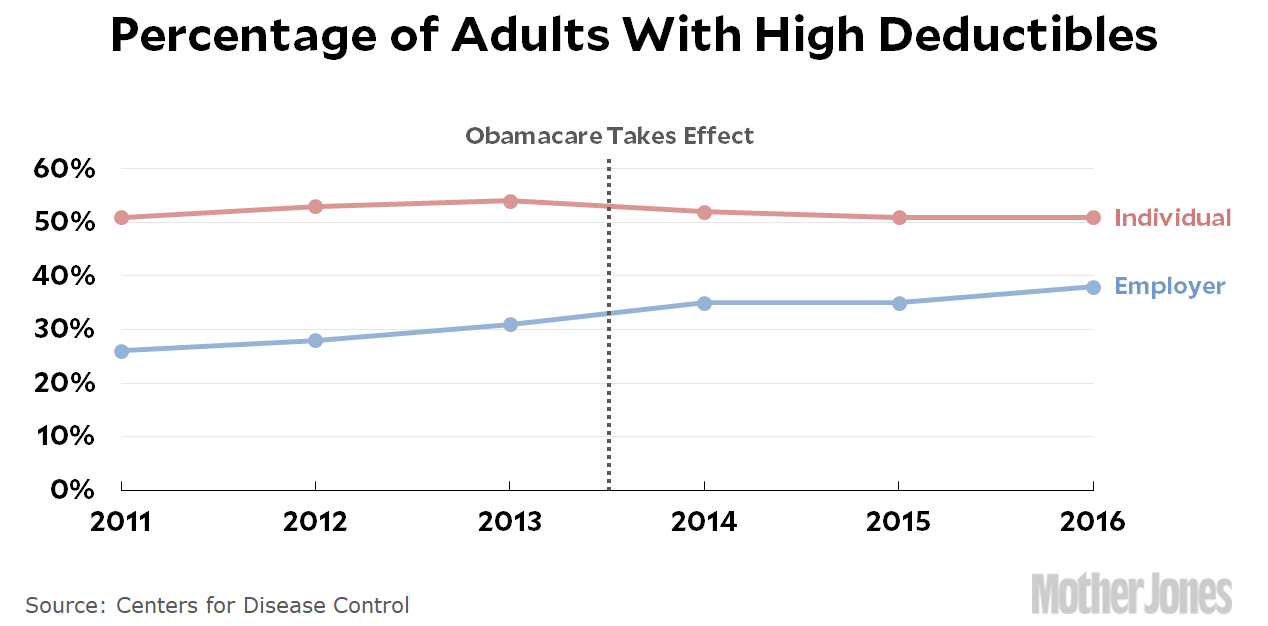
But shameless or not, it’s still true that many people on the Obamacare exchanges buy plans with deductibles of $3,000 or more. That’s a drag. Of course, before Obamacare lots of people with individual insurance bought plans with high deductibles too. So what we really want to know is whether this changed when Obamacare went into effect. Here are the latest numbers from the CDC:
Among those with individual insurance, high-deductible plans have stayed dead level since Obamacare took effect. It’s had zero effect on the number of people who choose to buy less expensive plans with higher deductibles.
On the other hand, employer plans have been getting steadily crummier the entire time, and once again this has nothing to do with Obamacare. Deductibles have gone up solely because large companies have chosen to pare down their health coverage even though corporate profits are at an all-time high.
This is just the latest in a long list of Obamacare disasters that have turned out not to be. It didn’t send the cost of health care skyrocketing. Obamacare didn’t destroy part-time jobs. It’s not in a death spiral. Premiums haven’t been higher than originally projected. And now we know that it’s had no effect on deductibles either.
Obamacare does have a few real problems. They are generally small and technical, and could be fixed very easily. But fixing Obamacare wouldn’t provide a big tax cut for the rich, so Republicans aren’t interested. That’s all you need to know about why they hate it so much.
Here’s something that’s been brewing for a while, but is only now starting to get some attention. The Trumpcare bill that passed the House allows states to waive the ten essential benefits mandated by Obamacare. But this doesn’t just affect individual insurance purchased on the exchanges. It also affects employer insurance:
Under the House bill, large employers could choose the benefit requirements from any state—including those that are allowed to lower their benchmarks under a waiver, health analysts said. By choosing a waiver state, employers looking to lower their costs could impose lifetime limits and eliminate the out-of-pocket cost cap from their plans under the GOP legislation.
A company wouldn’t have to do business in a state to choose that state’s benefits level, analysts said. The company could just choose a state to match no matter where it is based.
….A House GOP spokesman [said] the bill didn’t intend to touch employer plans and any unintended consequences could be addressed by Health and Human Services Secretary Tom Price.
Please raise your hand if you trust Tom Price to take care of this little boo-boo after the fact. Anyone?
There’s going to be more stuff like this. Democrats spent months writing the legislative language for Obamacare, and even so there were mistakes and unintended side effects. House Republicans spent a few days on their bill. What are the odds that they have any idea what it actually does?
The intelligence wars look likely to start up again in the near future. For those of you who aren’t familiar with them, here’s the nickel version.
Variation in intelligence, as measured by IQ tests, is generally thought to be partly a result of genes and partly a result of environment and upbringing. This is hardly controversial since the same is true of lots of human characteristics, but in the case of IQ it’s inevitably bound up in racial politics: If intelligence is partly mediated by genes, then it’s possible that different races have different average IQs. This is the case that Charles Murray and Richard Herrnstein made two decades ago in The Bell Curve. The reason this is more inflammatory than, say, racial differences in eye color or curly hair should be obvious.
So far, there’s little persuasive evidence for racial differences in intelligence. What’s more, the evidence we do have is mostly ecological in nature, involving comparisons at a group level. That’s interesting, but it will never be conclusive. Eventually, if you want to make a case for or against racial differences, you’re going to have to get down to the biochemical level and take a look at genes that affect the cognitive factors that make up overall intelligence (short-term memory, pattern recognition, etc.). That’s been a pipe dream for years, but not any longer. Last month, a team of 30 researchers published a study showing correlations between 40 newly-discovered gene variations and scores on IQ tests:
We combined genome-wide association study (GWAS) data for intelligence in 78,308 unrelated individuals from 13 cohorts….All association studies were performed on individuals of European descent….Our calculations show that the current results explain up to 4.8% of the variance in intelligence and that on average across the four samples there is a 1.9-fold increase in explained variance in comparison to the most recent GWAS on intelligence.
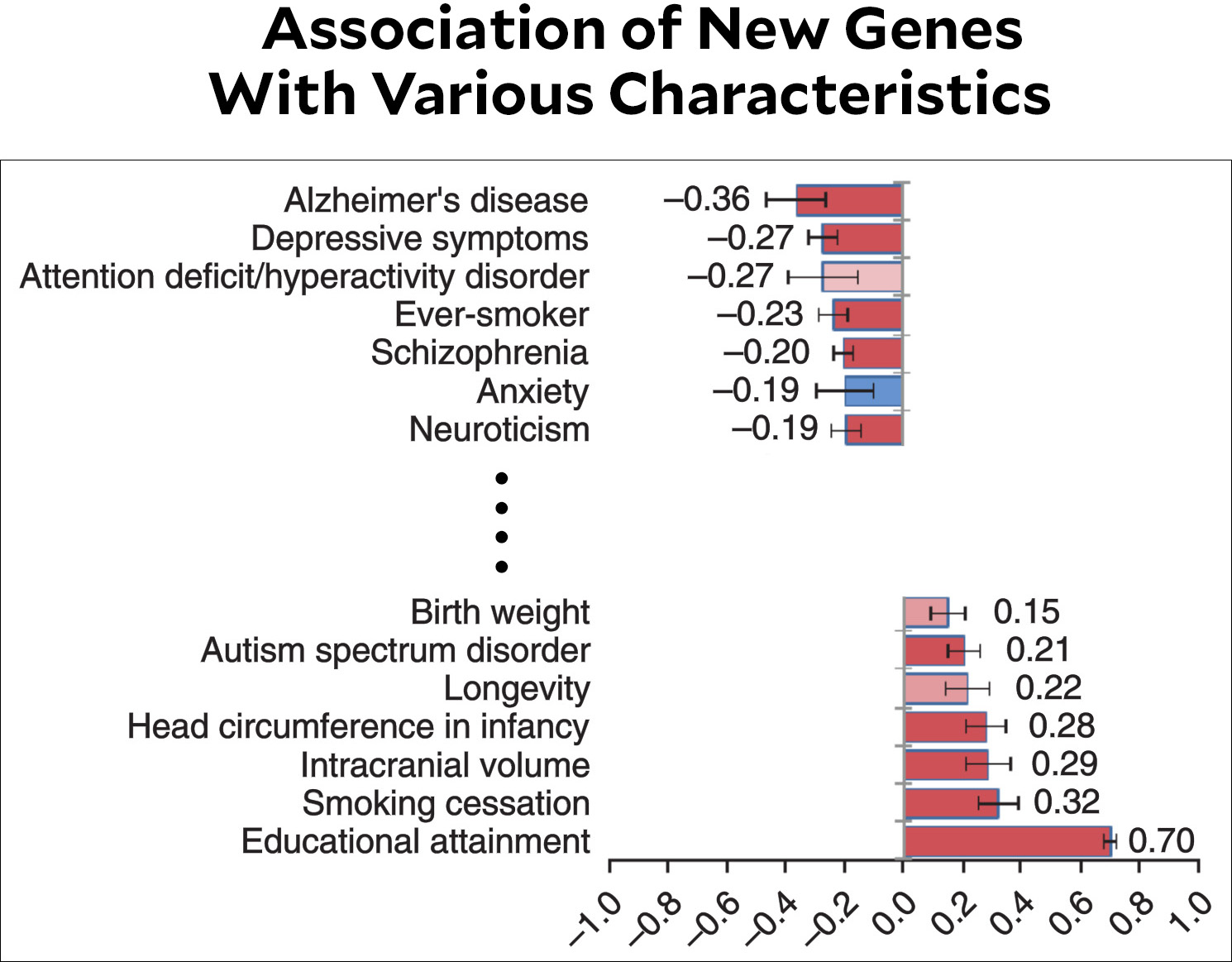
You may not think that 4.8 percent is a lot, but it is. And the genomic revolution that led to these results is only a few years old. In another few years we’ll be up to 20 or 30 or 40 percent. Nor is this just about intelligence, either. Here’s a chart showing the association of the newly discovered genetic variations on different characteristics:
As more people have their genomes sequenced, and as computers become more sophisticated at seeking out patterns in data, these types of studies will proliferate. But there’s also a deep uneasiness at the heart of this research — it is easily misused by people who want to make claims about racial superiority and differences between groups. Such concerns prompted Nature to run an editorial stressing that the new science of genetics and intelligence comes to no such conclusions. “Environment is crucial, too,” Nature emphasized. “The existence of genes ‘for’ intelligence would not imply that education is wasted on people without those genes. Geneticists burned down that straw man long ago.”
Also, nothing in this work suggests there are genetic difference in intelligence when comparing people of different ancestries. If anything, it suggests that the genetics that give rise to IQ are more subtle and intricate than we can ever really understand
This research can be easily misused, but it can also be properly used. It’s still way too early for it to point toward any conclusions about group differences in cognitive abilities, but in a few years it will start to provide meaningful real-world results. This doesn’t bother me too much since I think the research will show either zero or minuscule differences between racial groups. But it might not. You never know with science.
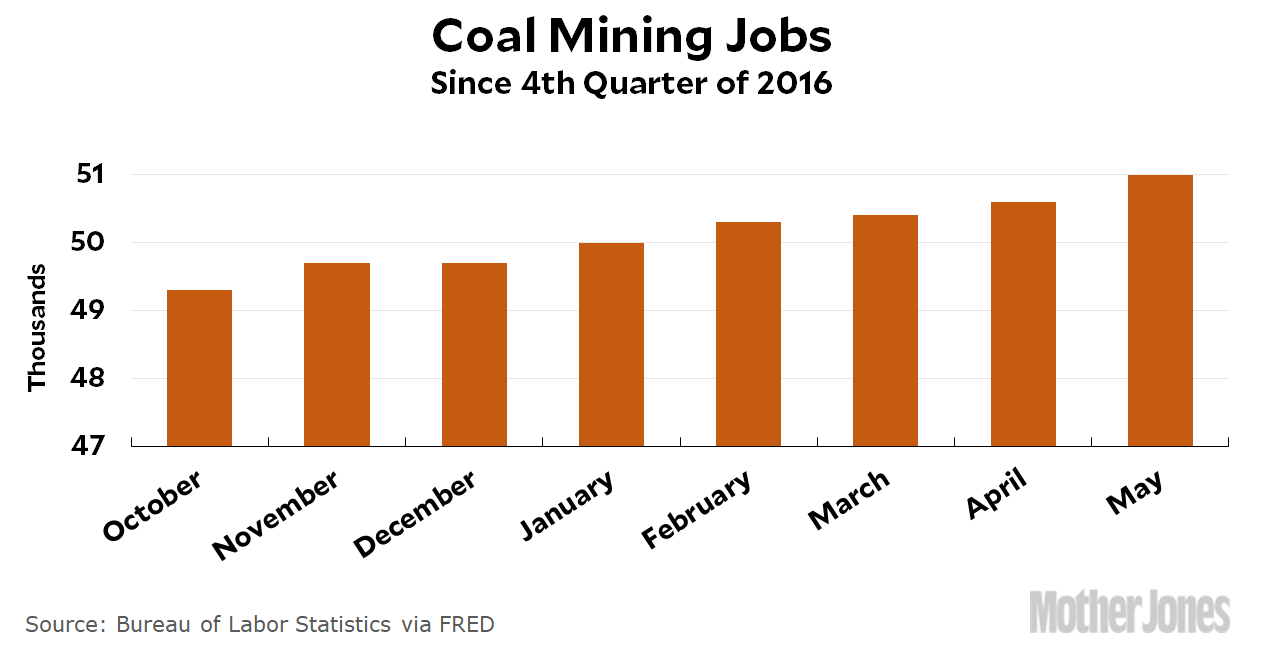
OK, now let’s try a post with an image in it. And what better way than to visually deconstruct a Trump administration lie? Here is EPA chief Scott Pruitt this weekend:
Since the fourth quarter of last year until most recently, we’ve added almost 50,000 jobs in the coal sector. In the month of May alone, almost 7,000 jobs.
This is my last post for the day. Starting in a few minutes we’ll be replacing the guts of our website with something newer and better than what we have now, and no one at MoJo is allowed to edit the site until we’re done. That will be Tuesday morning according to our tech boffins.
I fully expect everything to go flawlessly during this conversion, because that’s how things usually go with computers. Right? Still, there’s an outside chance of something going wrong, which might mean I don’t show up for blogging duty on Tuesday. If that happens, don’t panic. Leave that to us professionals. We’ll get it all sorted.
In the meantime, I have important robot research to do and even more important vacation planning to do. See you Tuesday.
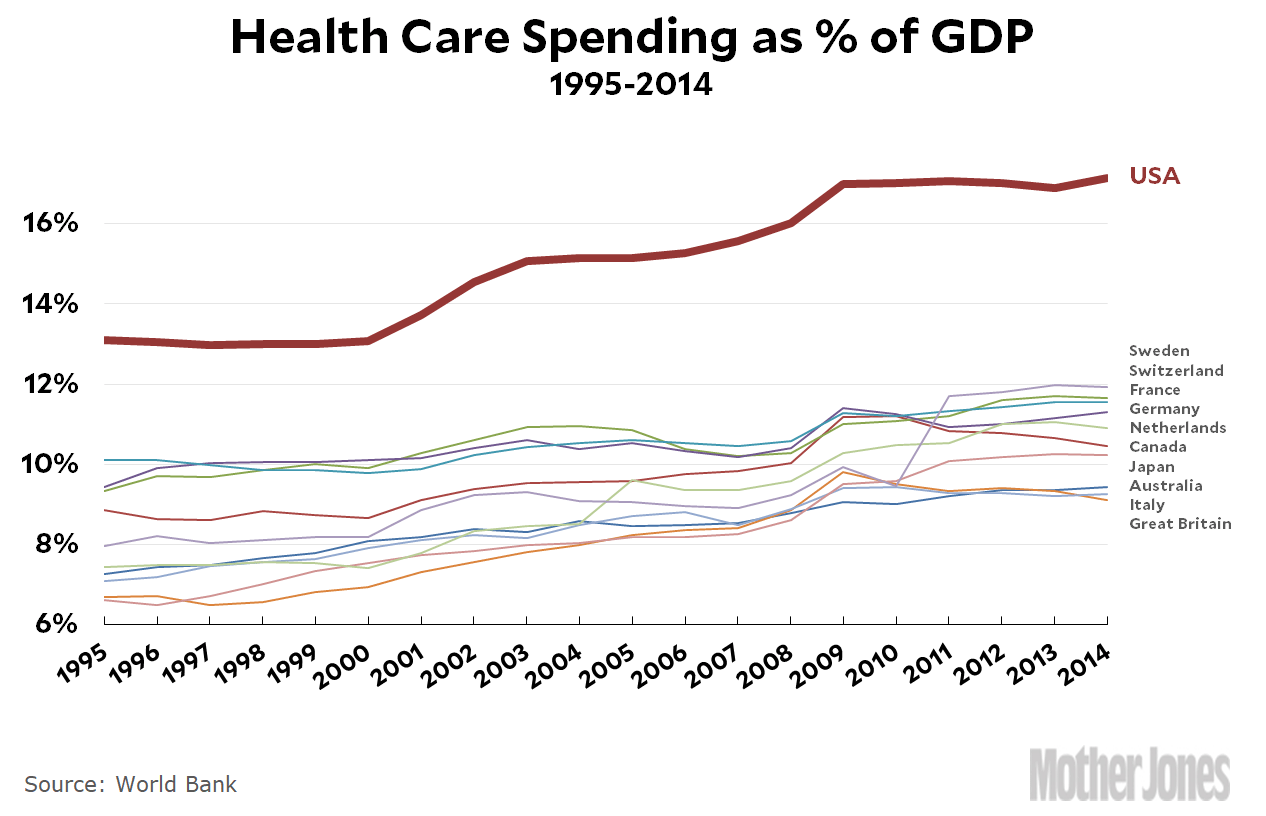
This is apropos of nothing in particular. I was over at the World Bank site fiddling around with some stuff and happened to look at their chart for health care spending. There’s a good case to be made that as GDP rises, the share devoted to health care also rises. This is because richer countries have more “spare” income and health care is what they spend it on.
But Sweden and Switzerland have per-capita GDPs as high as ours, and they still spend a whole lot less. The sooner we start reining in the growth of health care spending the better.
And we respect that! But maybe you’re of a mind to support our work directly instead? We have until December 31 to raise the last $400,000 we need to keep our nonprofit newsroom running at full strength into 2026. Will you make a gift today?
We noticed you have an ad blocker on. Can you pitch in a few bucks to help fund Mother Jones' investigative journalism?
Billionaires own the media,
but they don’t own us.
At Mother Jones we know these aren’t conventional times, and they require unconventional coverage. That’s what deliver every day: fierce, independent journalism you can’t find elsewhere. Perhaps never in the history of our country has that been more necessary than now. But we can’t do it without reader support—your support. Please chip in today.
Billionaires own the media,
but they don’t own us.
At Mother Jones we know these aren’t conventional times, and they require unconventional coverage. That’s what deliver every day: fierce, independent journalism you can’t find elsewhere. Perhaps never in the history of our country has that been more necessary than now. But we can’t do it without reader support—your support. Please chip in today.