Sigh.
Roy Moore Spox: “Poppy, we need to make it clear there’s a group of non-accusers.” pic.twitter.com/zWEXQIExgK
— Josh Marshall (@joshtpm) December 5, 2017
More and more I wonder to myself why I even bother getting out of bed these days.

Sigh.
Roy Moore Spox: “Poppy, we need to make it clear there’s a group of non-accusers.” pic.twitter.com/zWEXQIExgK
— Josh Marshall (@joshtpm) December 5, 2017
More and more I wonder to myself why I even bother getting out of bed these days.

CIA Director Mike Pompeo.Jeff Malet/Newscom via ZUMA
What’s the protocol for passing along a story that seems absurd on its face and is supported solely by anonymous sources? In the past, it probably would have been prudent to hold off. Sure, this is a blog, and the rules are a little looser, but it’s still not the National Enquirer.
But in the Trump era? Let’s just say that “absurd on its face” has a very different meaning these days than it used to. So feast your eyes on this report from the Intercept:
The Trump administration is considering a set of proposals developed by Blackwater founder Erik Prince and a retired CIA officer — with assistance from Oliver North, a key figure in the Iran-Contra scandal — to provide CIA Director Mike Pompeo and the White House with a global, private spy network that would circumvent official U.S. intelligence agencies….“Pompeo can’t trust the CIA bureaucracy, so we need to create this thing that reports just directly to him,” said a former senior U.S. intelligence official with firsthand knowledge of the proposals, in describing White House discussions. “It is a direct-action arm, totally off the books,” this person said.
….The proposals would utilize an army of spies with no official cover in several countries deemed “denied areas” for current American intelligence personnel, including North Korea and Iran. The White House has also considered creating a new global rendition unit meant to capture terrorist suspects around the world, as well as a propaganda campaign in the Middle East and Europe to combat Islamic extremism and Iran….According to two former senior intelligence officials, Pompeo has embraced the plan and has lobbied the White House to approve the contract.
Needless to say, everyone connected with this denies everything. And who knows? They might be telling the truth. Maybe this story is just a farrago of nonsense. On the other hand, BuzzFeed reported something last week that was more limited, but still eerily similar:
The White House and CIA have been considering a package of secret proposals to allow former US intelligence officers to run privatized covert actions, intelligence gathering, and propaganda missions, according to three sources who’ve been briefed on or have direct knowledge of the proposals.
One of the proposals would involve hiring a private company, Amyntor Group, for millions of dollars to set up a large intelligence network and run counterterrorist propaganda efforts….Another proposal presented to US officials would allow individuals affiliated with the company to help capture wanted terrorists on behalf of the United States. In keeping with that proposal, people close to the company are tracking two specific suspects in a Middle Eastern country, the sources said, for possible “rendition” to the United States.
….Those familiar with the proposals say one of the driving impulses for privatizing some missions is a fear by some supporters of President Donald Trump, outside government, that the CIA bureaucracy has an anti-Trump bias that would thwart efforts to fulfill the president’s objectives.
It’s not clear (to me, anyway) if something like this would be illegal. It probably depends on where the funding comes from and whether this group performs any explicitly prohibited actions.
That aside, it does not fill one with confidence to see the names Mike Pompeo, Oliver North, and Erik Prince mentioned in the same breath. This story may or may not go anywhere, but it’s worth keeping an eye on.
Back in 2009 I wrote a piece for the magazine about marijuana legalization. One of the things I learned is that a key question about the effect of legalization is whether marijuana and alcohol are substitutes or complements.
If alcohol and marijuana are substitutes, it means that higher sales of marijuana will likely produce lower sales of alcohol. This would, generally speaking, be a good thing, since marijuana smoking is less hazardous than alcohol on multiple levels: It does less physiological damage to the imbiber and less damage to others (drunks tend to get mean while smokers tend to get stoned).
However, if alcohol and marijuana are complements, then higher sales of marijuana are likely to lead to higher sales of alcohol too. There would be nothing good about this.
A trio of researchers recently tried to settle this question using detailed scanner data of alcohol sales. Their methodology was fairly simple: they picked out states that had enacted medical marijuana laws and measured sales of alcohol at the county level. For each state that passed an MML law, they compared its alcohol sales to states that hadn’t legalized medical marijuana. Here’s what they found:
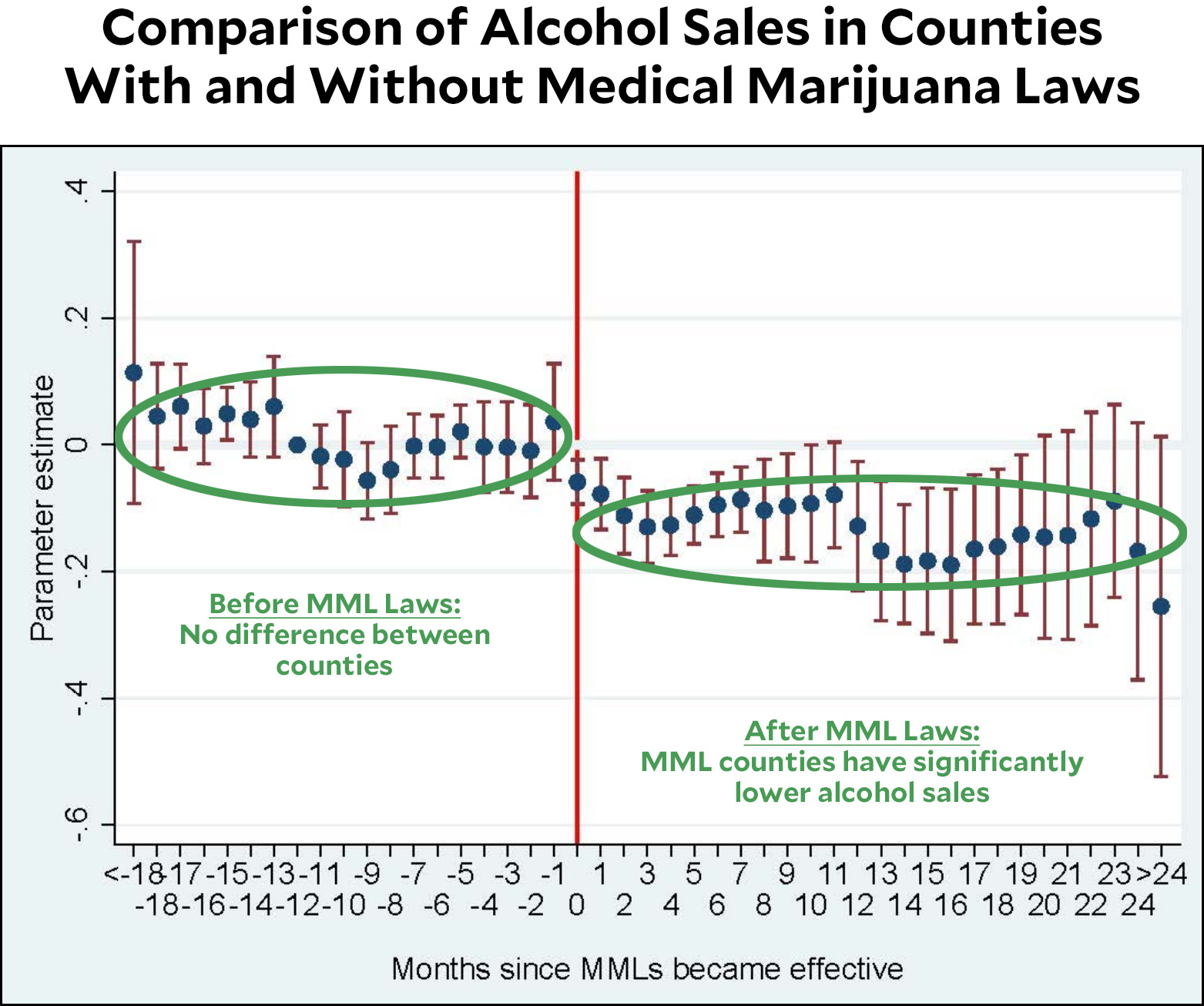
In order to test substitutability, the authors created a parameter associated with alcohol sales. They set the parameter so that it was (on average) the same in all states before medical marijuana laws were enacted. In the chart above, this is why the pre-MML data points cluster around zero. Then they tracked the parameter over time and found that after MML laws were enacted, sales of alcohol were lower in the MML states:
We find that marijuana and alcohol are strong substitutes. Counties located in MML states reduced monthly alcohol sales by 15 percent, which is a consistent finding across several empirical specifications. When disaggregating by beer and wine we find that legalization of medical marijuana had a negative effect on corresponding sales by as much as 13.8 and 16.2 percent, respectively.
The authors also measured sales of alcohol in border counties. The effect was the same: after medical marijuana laws were enacted, counties in MML states had lower alcohol sales than counties across the state border.
There are a few caveats here. First, it’s based on scanner data, but not all alcohol is sold in stores. Second, as usual for studies like this, the authors control for a wide range of things: “county economic conditions such as unemployment rate and median household income…total population, percentage of male and Hispanic population, and the share of population by age groups.” Is that enough? Is it too much? It’s always hard to tell.
There’s more to marijuana than just this, but it’s nonetheless positive news. If it holds up, it’s yet another reason that legalizing marijuana is, on net, probably a good thing.
Chris Hayes:
The entire culture and our politics are now dominated by people who have weaponized bad faith and shamelessness.
— Chris Hayes (@chrislhayes) December 4, 2017
Hayes is responding to the fact that MSNBC has “severed ties” with Sam Seder. And why did they do that? Because eight years ago Seder made a joke on Twitter about Roman Polanski:
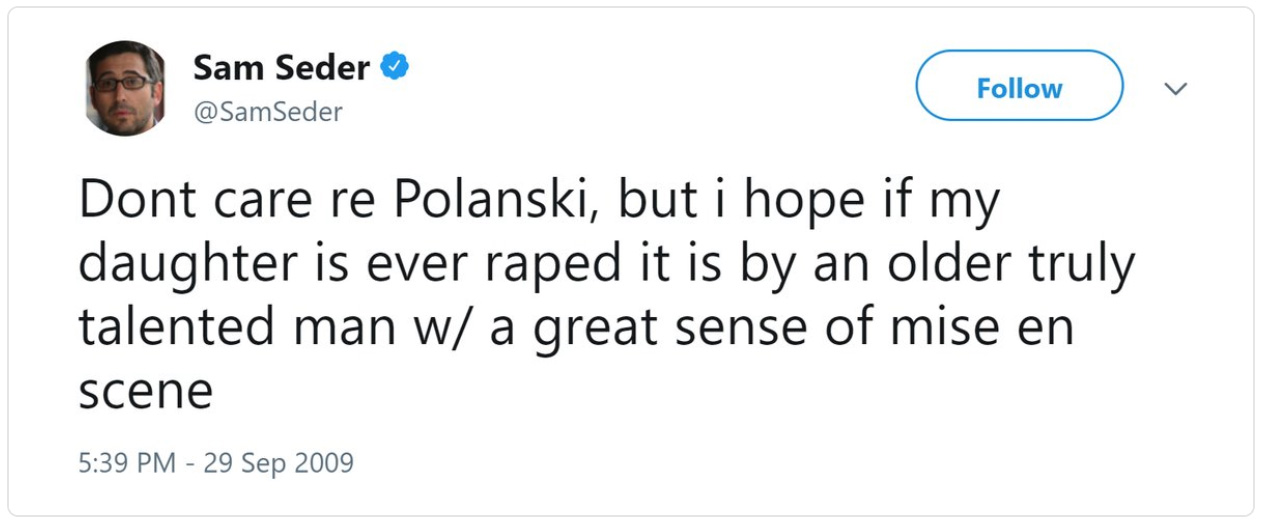
Was it a dumb joke? Sure, I guess so. Should people be blackballed for making dumb jokes? Nope. Should anybody really care about this tweet? Nope. Even some conservatives agree that nobody should care about this.
So why does MSNBC care about it? Apparently because the man who brought us Pizzagate—the story that Hillary Clinton was running a pedophile ring out of a Washington DC pizza joint—has spent the last month demanding that they care.
Let’s tot up the scorecard here. NBC News passed on the Harvey Weinstein story. They harbored a sexual abuser for years even though “everyone knew” what Matt Lauer was up to. Ditto for Mark Halperin.
But thanks to the demands of a lunatic conservative, they cut off Sam Seder for a single lame joke made on Twitter in 2009. What the hell is in the water these days at 30 Rock?
I’ve long thought that cows are among the hardest animals to get good pictures of. Aside from not being especially handsome in the first place, they never do anything. They just stand around. Sometimes they munch grass. That’s about it.
But Ireland is overrun with cows, so I figured I should at least try to get something interesting. In the end, I didn’t, but I think this is the closest I came. Will I keep trying? I’m afraid I’d be lying if I said yes. I think that cows are just not worth the trouble.

Over at the Equality of Opportunity Project, a team of researchers has written a new paper that tries to explain some of the root sources of innovation. In particular, what kinds of kids are likely to become inventors? The researchers study this by looking at patent applications and then linking the names with a tax database in order to tease out the demographics of children who grow up to become inventors. I’m not 100 percent convinced that patent applications are a good way of measuring innovation, but it’s a start.
Basically, the entire study is an effort to explain this chart:
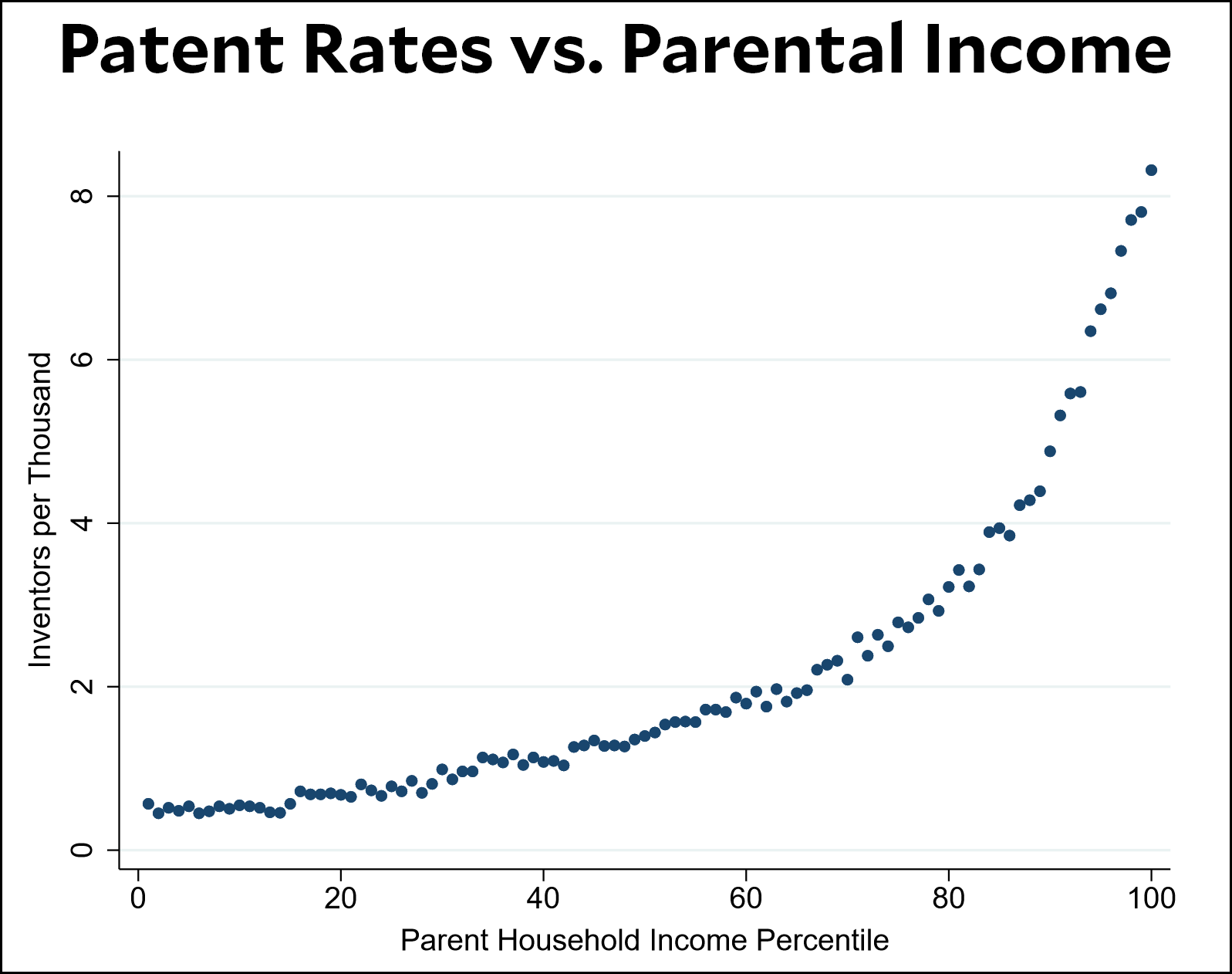
There’s nothing surprising here: Children in well-off households—which I suspect is mostly a proxy for well-educated households—are much more likely to become inventors than children in poor households. As usual, though, there could be two reasons for this:
Unsurprisingly, the researchers conclude that it’s some of both. For a subsample in New York City, they obtained math and reading scores in 3rd grade and then compared the invention rate later in life for kids who got similar scores. What they found was that richer kids did better than poorer kids even if their scores were similar. If you are suspicious of this result, you probably shouldn’t be. After all, no one thinks that women are biologically less capable of being inventors than men, and yet here’s what their invention rate looks like:
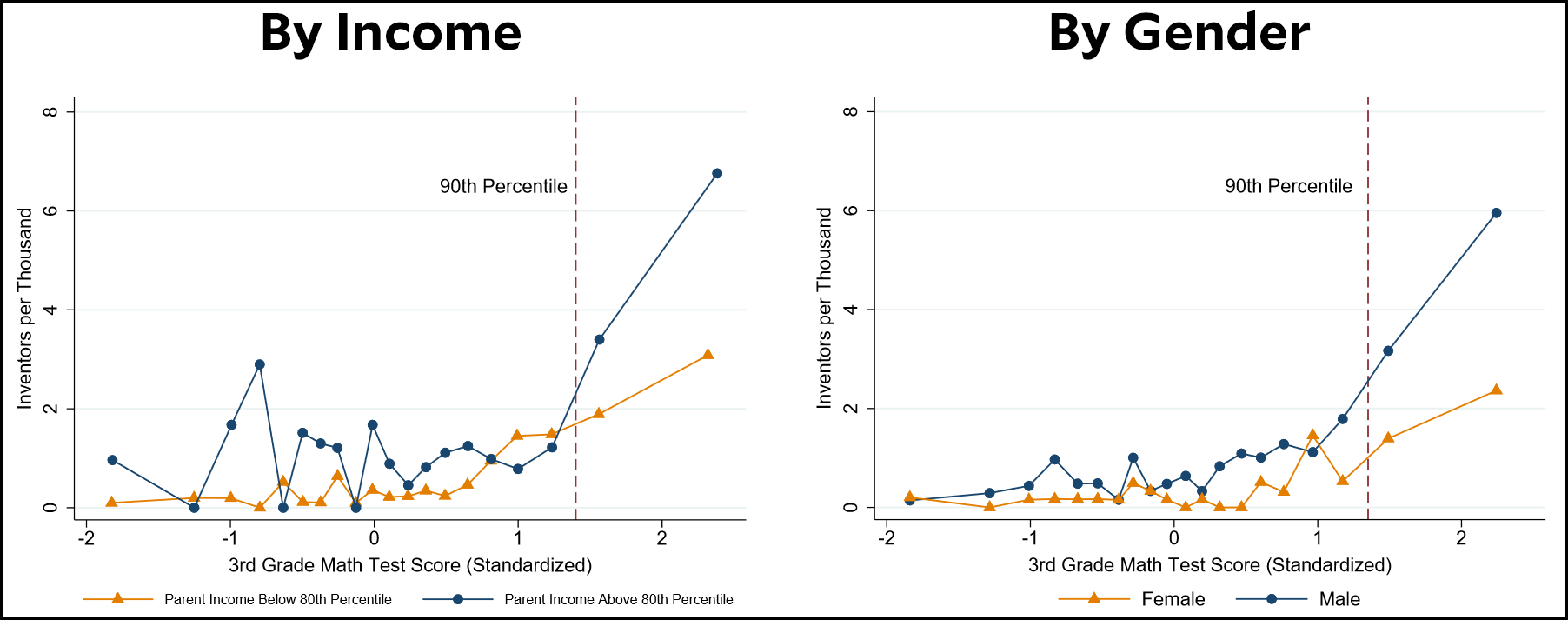
If smart girls grow up to be inventors at much lower rates than equally smart boys, it means that basic IQ plays only a limited role. In fact, the researchers conclude that it accounts for only about a third of the difference. The other two-thirds comes from environment in various ways.
It’s not clear precisely what those other ways are, but one clue comes from looking at precisely what kinds of things kids grow up to invent. As it turns out, this is very far from random. They grow up to invent almost exactly the same stuff as their fathers:
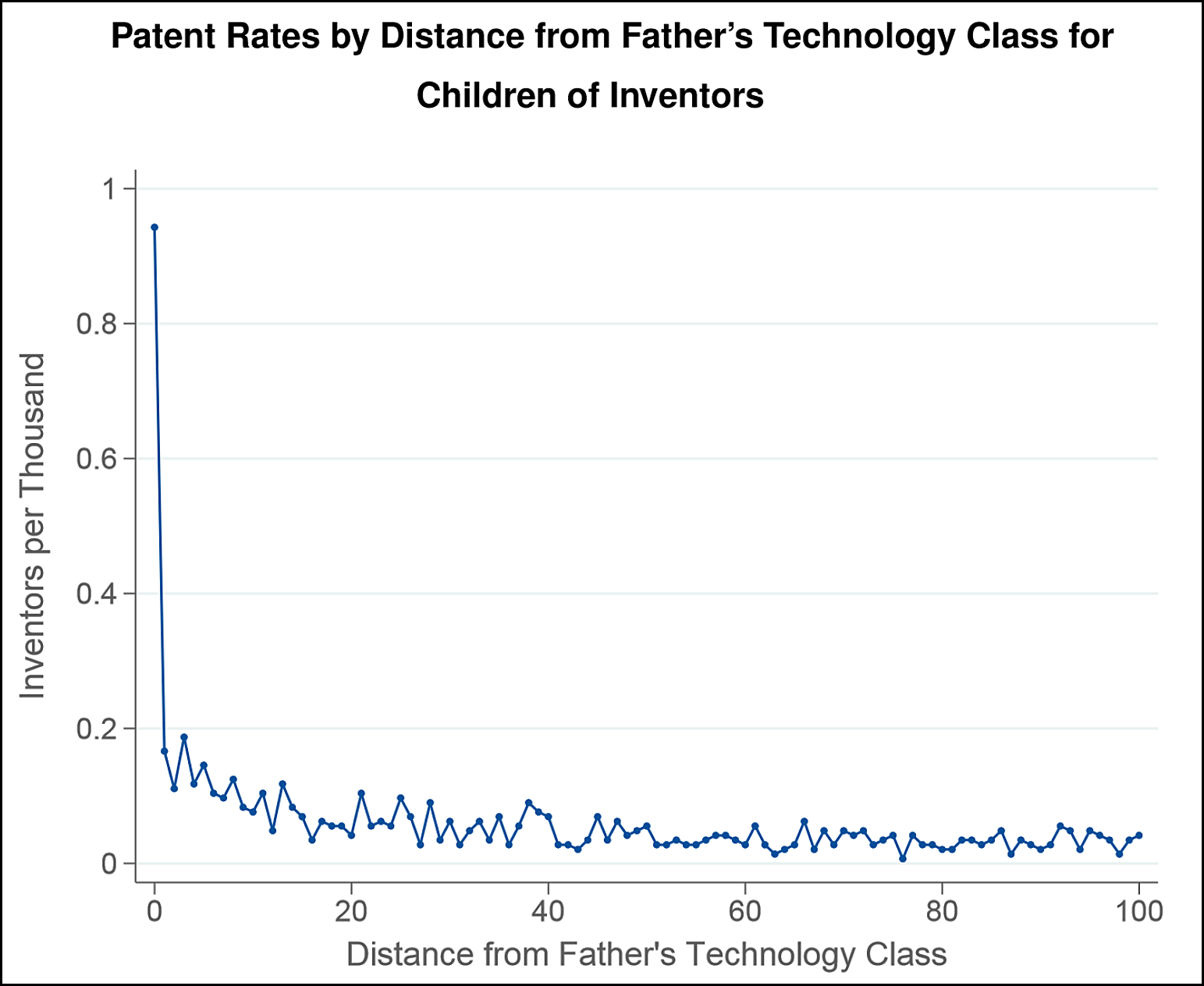
If dad was a medical researcher, the kids grow up to create medical inventions. If he was a programmer, they grow up to create software inventions. In fields that are even the tiniest distance away from what dad did, invention rates plummet.
Now, this is not the whole study. There are plenty of other interesting tidbits that I might write about later. In the meantime, you can read a couple of more comprehensive summaries here and here. A set of slides from the authors is also a good place to go if you want to dive in a little further.
That said, the basic takeaway is fairly simple. First, most inventors are pretty smart as kids. They come almost exclusively from the ranks of children who score above the 90th percentile in math and reading in 3rd grade. Second, exposure to other inventors is wildly important. If your father was an inventor, you’re far more likely to become an inventor yourself if you have the necessary smarts. Girls are more likely to become inventors if they’re exposed to women who are inventors.
However, the phrase everyone is picking up from this paper is “lost Einsteins,” and I’m not sure just how accurate that is. Among girls, it’s almost certainly apropos: there are lots of girls who score well on tests of math and reading and could be inventors later in life if they had the right exposure and the right motivation. Among both the poor and children of color, things are a little less clear. In the New York data used to look at test scores, there are only 452 inventors (out of 400,000 children) in the whole dataset. That’s a pretty small group and a pretty small sample size. What’s more, the “inventor gap” only really shows up among kids who score in the 95th percentile, and that’s an even tinier number among both the poor and children of color. Even if you doubled or tripled the number of poor black kids who were exposed to inventors, the absolute number of newly minted inventors would be pretty minuscule.
I don’t mean to either disparage the importance of this study or to cast doubt on what we can do to inspire every child to become an inventor later in life. I would just take the overall results with a grain of salt. We can do more, but it’s not clear just how big a difference this would make for the future of innovation.
I see that Donald Trump is now all-in on Roy Moore:
Democrats refusal to give even one vote for massive Tax Cuts is why we need Republican Roy Moore to win in Alabama. We need his vote on stopping crime, illegal immigration, Border Wall, Military, Pro Life, V.A., Judges 2nd Amendment and more. No to Jones, a Pelosi/Schumer Puppet!
— Donald J. Trump (@realDonaldTrump) December 4, 2017
This is no surprise, I suppose. Of course, it might mean nothing more than this:
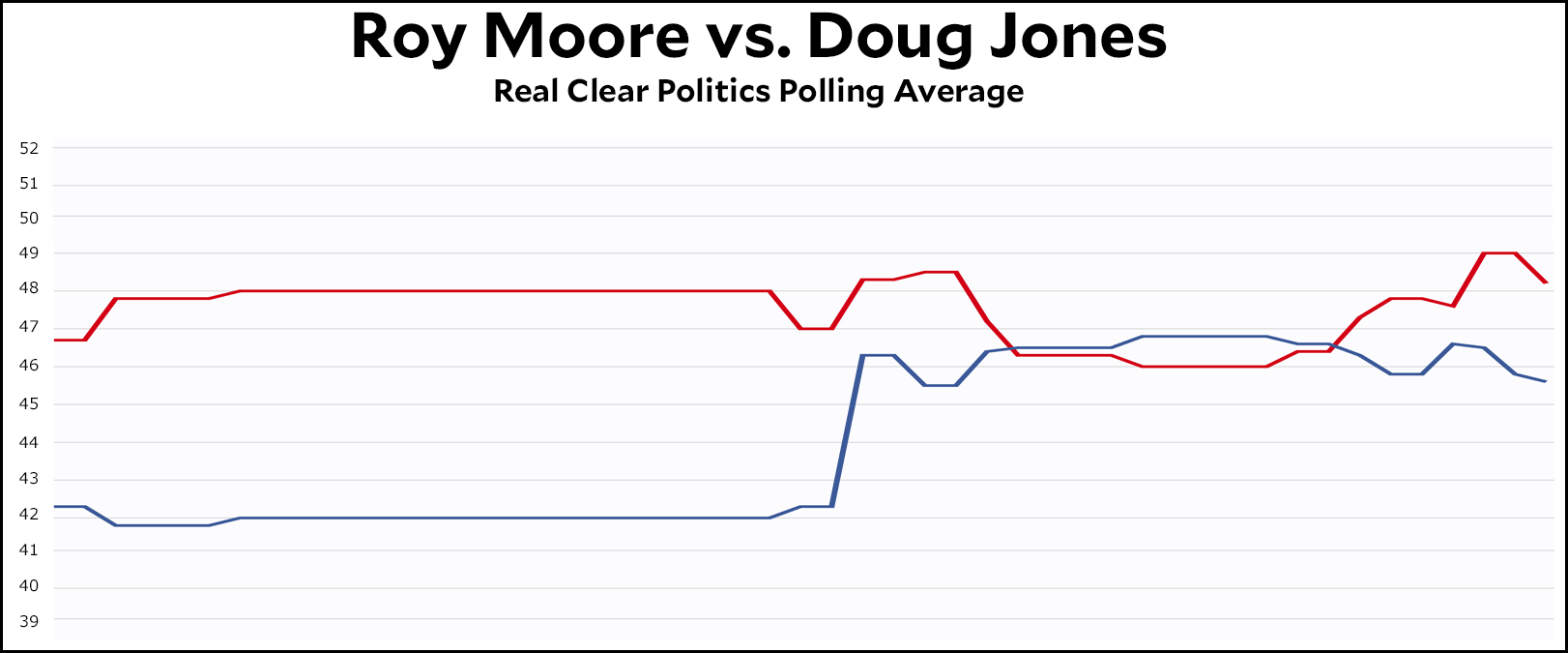
For a while, it looked like Moore was likely to lose. Naturally Trump didn’t want to be associated with a loser, so he stayed quiet. But that changed about a week ago, when Moore started polling a couple of points ahead. Ever since then Trump has been getting more and more vocal in his support for Moore. A real profile in courage, our president.
Daniel DeSlover via ZUMA
Atrios digs himself into a gigantic hole today:
I Don’t Care About Your Lyrics
Good lyrics can make a song. I completely get that. But making a song is not the same as being the important part of a song. The thing I hate about all “music criticism” of pop/rock music is that it focuses on the lyrics. I get it. It’s hard to write about the music part of music. But “Musician X used to write about farms and trees and now writes about love and milkshakes” doesn’t actually tell me anything about whether I might like the… music?
A good lyric is good. A catchy lyric can make a person rich, when attached to the right melody. But setting Taylor Swift lyrics to music by Rush isn’t going to convince fans of either.
Well, he had a good run. But after 17 years, I think Atrios has finally written his death sentence. It was nice knowing him.
Nonetheless, his bravery is a lesson for us all. I, for example, will go even further. Not only do I not care about your lyrics, I think most of your songs would be better if they were set to Gregorian chants or Russian poetry. I mostly don’t listen to lyrics at all, but every once in a while I do, or I get curious and google them up. And almost without exception, they are so puerile and stupid that I can hardly believe anyone over the age of 15 takes them seriously. They work fine as sounds to make while singing your favorite song in the shower, but on the printed page? Please.
I would like to say that I hold this opinion only about pop lyrics, but it’s not so. Your favorite indie band? Your favorite rapper? Bob Dylan? About 99 percent of what they write is just plain dumb.
Now, this is obviously a provocation. I am provoking people to form torchlight mobs and come over to my house and blast their favorite songs through my windows. However, there’s actually an interesting question here: how many people care about lyrics vs. only caring about the tunes in popular music? To me, the human voice is just another instrument in a song, like a keyboard or a guitar. The meaning of the words is extraneous. But for many people, the lyrics are really important. Even a catchy tune leaves them cold unless they like the lyrics. And then there’s the vast middle ground.
So which are you? And does it say anything about your personality? I hereby call on some enterprising PhD candidate in freakonomics to study this burning issue.
The New York Times this morning has an article about artificial intelligence:
There are basically three big questions about artificial intelligence and its impact on the economy: What can it do? Where is it headed? And how fast will it spread?
Three new reports combine to suggest these answers: It can probably do less right now than you think. But it will eventually do more than you probably think, in more places than you probably think, and will probably evolve faster than powerful technologies have in the past.
I think this basically gets things right. What we have today can’t properly be called AI at all. It’s just not advanced enough. But before long it will be, and once we hit that point—in around ten years by my guess— progress will accelerate quickly.
One of the reports the Times points to is called the AI Index, and overall I found it sort of disappointing. I don’t really much care that enrollment is up in AI classes or that we have lots of AI startups. But this was interesting:
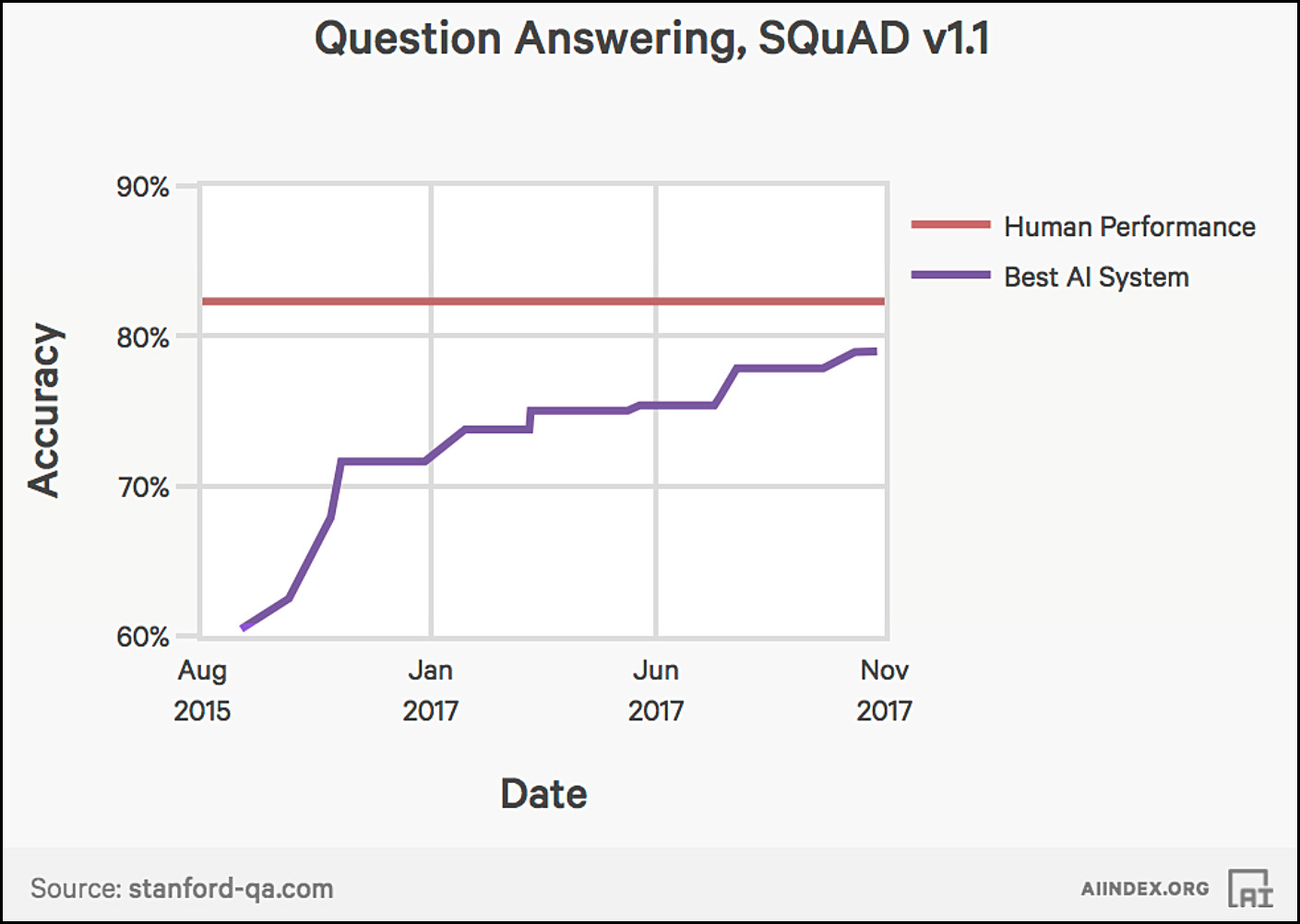
The best measures of AI aren’t numbers in a vacuum. They’re measures that compare the best software to the average human. In this case, both computers and humans are asked to read articles and then answer questions about the content of the articles. It’s still a bit artificial, but the general idea is to test general reading comprehension, surely a decent measure of what we commonly think of as “intelligence.” Computers are now only a finger’s breadth away from human performance. That’s pretty impressive, especially considering that a computer can come up with its average answer in a second or two, compared to several minutes for us meat types.
On the other hand, this chart shows the limitations of this kind of test:
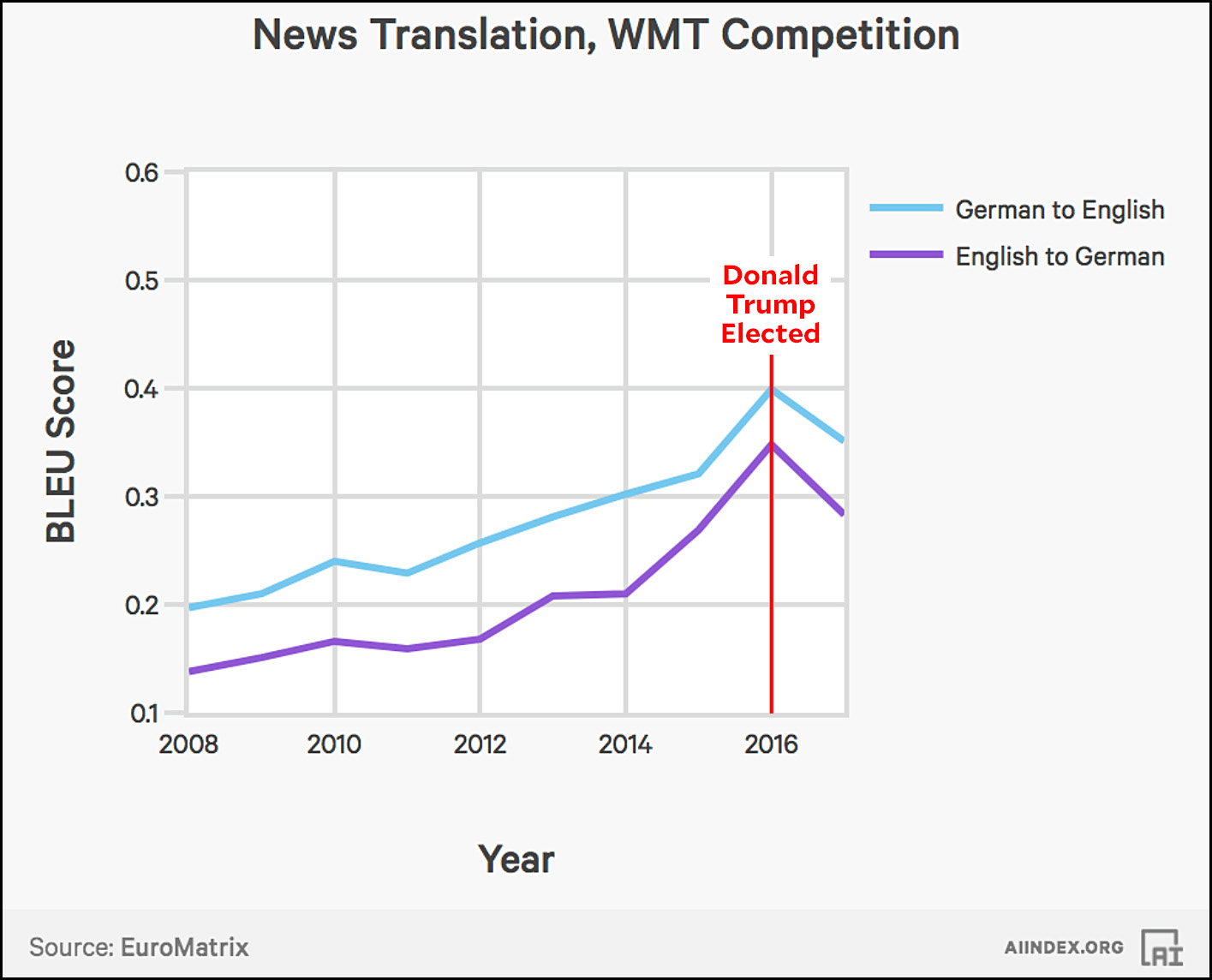
Language translation has made considerable strides in the past decade, and this chart puts a number to that. At the same time, it shows that machine translation has deteriorated in 2017. That’s hardly seems plausible.¹ As the authors admit, “It is unlikely that the performance of MT systems declined compared to 2016, but the evaluation scheme presented here is not perfect.” So take all these charts with a grain of salt.
¹Alternatively, this merely represents the Donald Trump effect. News articles in 2017 are stuffed with bizarre Trump quotes, and even the best machine translation software probably chokes when it tries to make sense of them. When it comes to bafflegab, humans are still the world champs.
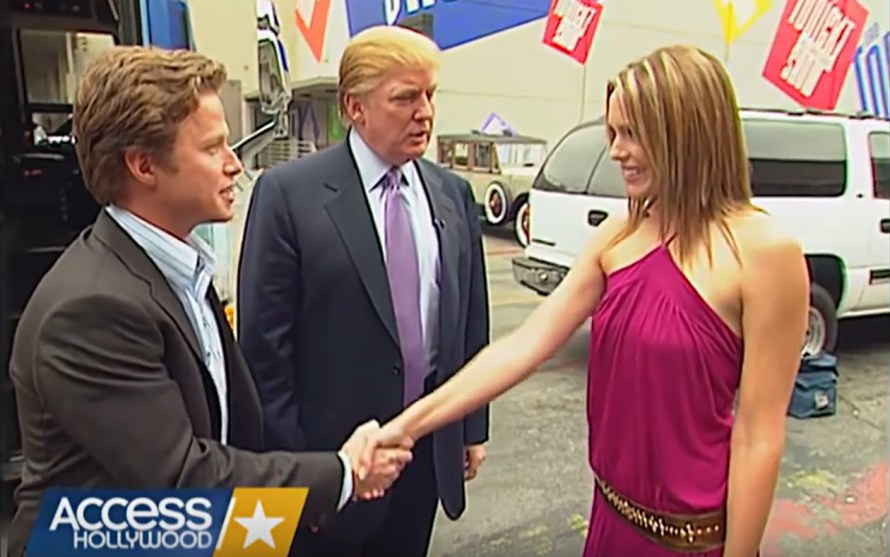
Billy Bush of Access Hollywood fame has a piece in the New York Times today. It’s mostly about Donald Trump’s infamous “grab ’em by the pussy” remark, but there’s also this about the summer of 2015, right after Trump announced his candidacy:
In the days, weeks and months to follow, I was highly critical of the idea of a Trump presidency. The man who once told me — ironically, in another off-camera conversation — after I called him out for inflating his ratings: “People will just believe you. You just tell them and they believe you,” was, I thought, not a good choice to lead our country.
This is a very shrewd remark from Trump. And while it’s not an insight unique to him, he’s certainly taken it to far greater lengths than we’re used to.
I remember thinking about this years ago. It was pretty clear that the vast majority of people—not cynical political junkies like us, but normal people—basically just believe whatever politicians say. It’s an interesting contradiction. In surveys, huge majorities say that politicians are horribly untrustworthy charlatans, but in real life they uncritically accept nearly anything they say. Their past records don’t matter much. The unlikelihood of what they’re promising doesn’t penetrate. Even fairly obvious insincerity isn’t a deal killer. If you say you’re going to cut taxes and reduce the deficit, they believe. If you say you’re going to provide universal health care without raising taxes on the middle class, they believe. People believe pretty much anything.
Or maybe not. It’s also possible that they don’t believe so much as they simply discount everything and treat promises as mere declarations of a candidate’s values. The fact that Trump approves of cutting taxes and reducing the deficit is all that matters. The fact that Bernie Sanders approves of universal healthcare and funding it solely by taxes on the rich shows that he’s a true progressive.
In the end, Trump may turn out to be less right than he thinks. But he’s still pretty close to right: “You just tell them and they believe you.” It’s not true of everyone, and it’s not true all the time, but it’s true for an awful lot of people an awful lot of the time.

Award-winning photojournalism.
Stunning video. Fearless conversations.


