• Here’s What Pro-Russia Trolls Are Promoting Today

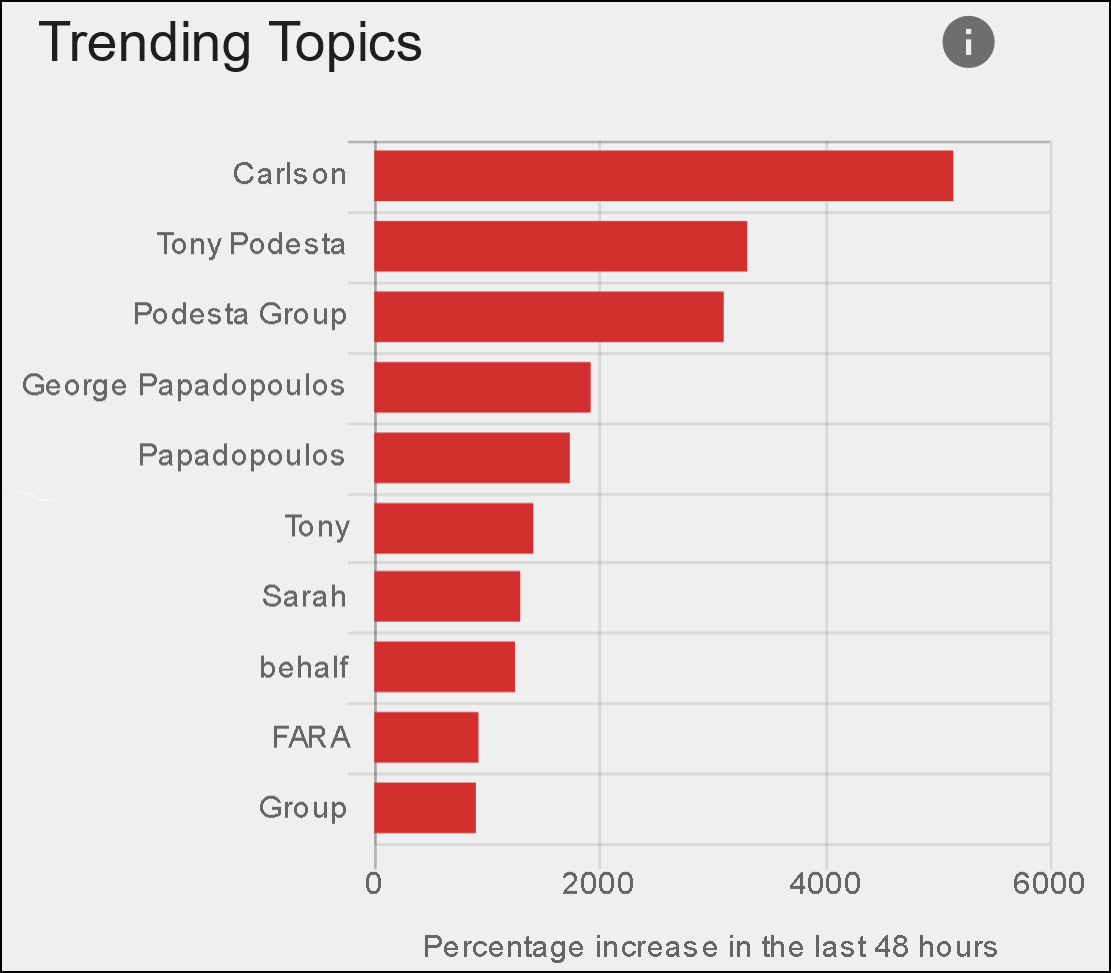
    My colleague Denise Clifton writes today about the ongoing Russian social media campaign in the US, and does a great job of summarizing what we know. She also links to a fascinating website I hadn’t heard of before: Hamilton 68, which purports to follow Russian influence on Twitter. [Editor’s note: Hamilton 68’s creator, the Alliance to Secure Democracy, discontinued the dashboard in 2018. The group has since been criticized for refusing to disclose specifics, including which accounts it was tracking and which if any were directly Kremlin-linked. This article has been updated.Here’s one of their charts this morning:

    These accounts really like Tucker Carlson! They’re also really into Tony Podesta, on the usual right-wing assumption that flinging mud at Tony will tarnish everyone else named Podesta too.

    Will it work? The Republican/Russian disinformation campaign is so obviously kindergarten level that I have high hopes the media will basically ignore it. There’s nothing to be done about the quarter of American that gets their news exclusively from Donald Trump and Fox News, but the rest of the country will mostly follow the media’s lead about what’s important and what’s not. Here’s hoping they act responsibly this time around.

  • Here’s How the Trump Tax Plan Will Affect Your Income

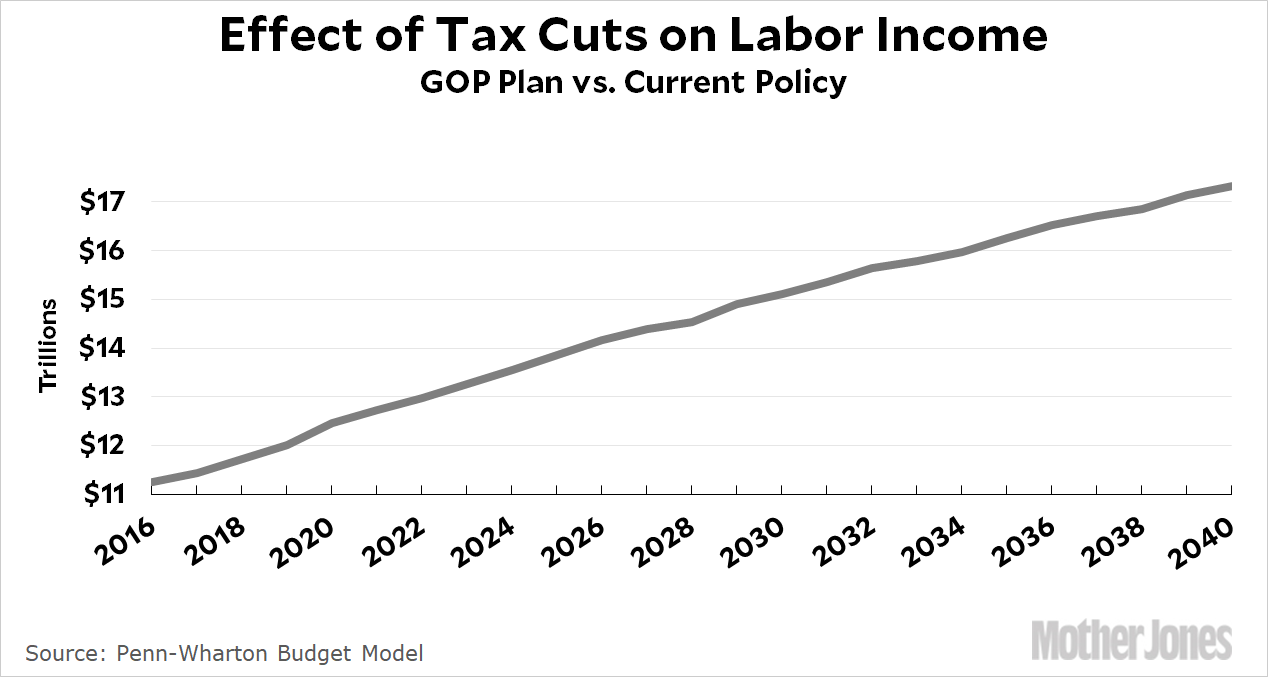
    The White House claims that its tax plan will result in a $4,000 wage increase for the average family. This is obviously preposterous, but there might be some wage gain. The question is how big it could be. Luckily, the highly respected Penn-Wharton Budget Model just released a simulator that allows you to choose different tax options and see what effect they have on things like GDP, wages, etc. I went ahead and chose all the options from the proposed Trump tax plan and got the results. Current policy is shown in gray. The changes due to Trump’s tax plan are shown in red:

    Don’t worry: you haven’t gone color blind. There are no differences. The model predicts that if you implement the whole plan, total labor income won’t change by a penny.¹

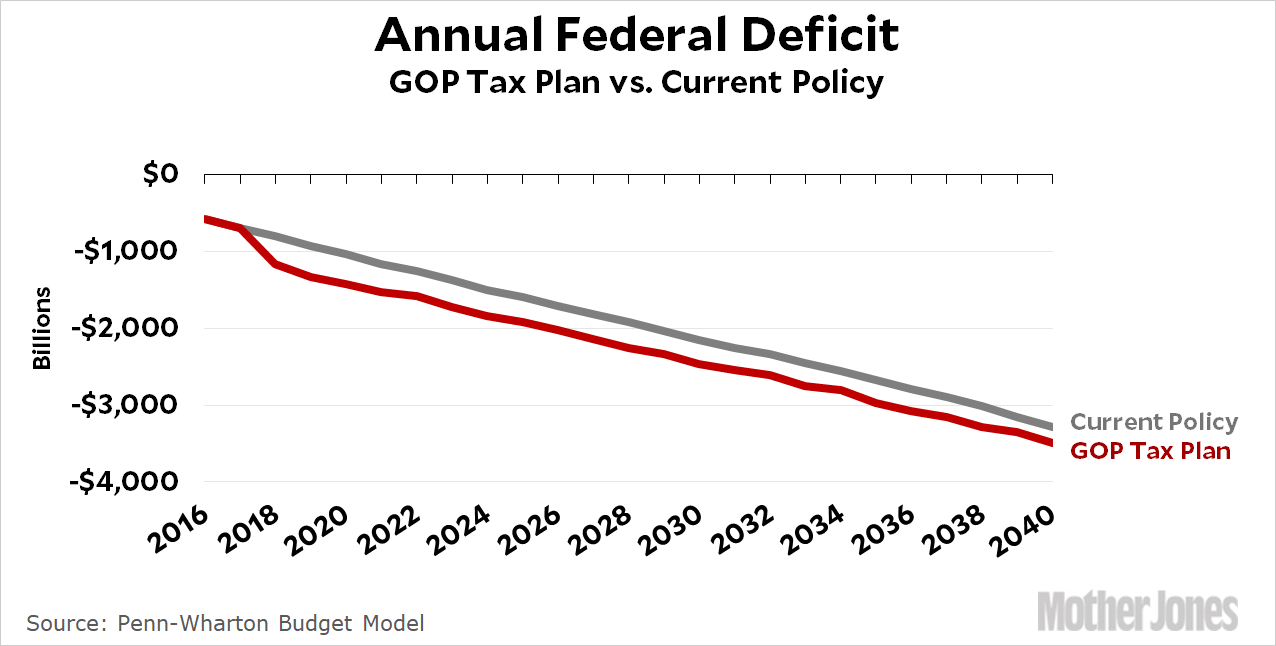
    But what about deficits? Here’s what the model says:

    That’s a cumulative increase of $7 trillion in the federal deficit. So the bottom line is that the tax plan doesn’t increase either wages or GDP, but does increase the national debt by about $7 trillion. Why are we doing this again?²

    ¹This is total labor income and says nothing about how it’s distributed. It’s possible that median wages will go down while the wages of CEOs will go up. Or vice versa. All we know is that the model predicts a total macro effect of zippo.

    ²Because it does reduce taxes on capital income for the rich. This might not have any effect on economic growth, but it does put more money in the pockets of the already wealthy. That’s what wealthy Republican donors paid for in the past election cycle, and that’s what they’re going to get.

  • Season 6 of “The Wire” May Star Trump Campaign Aide

    The hot gossip about the indictments issued today is this: Was George Papadopoulos wearing a wire? Papadopoulos is a small fish who was arrested in July, but his arrest was kept secret until today. Why? In a court filing, investigators said it was because they wanted to preserve Papadopoulos’s value as a “proactive cooperator”—a term of art that means the defendant will engage in some kind of undercover activity. Allahpundit lays out the basic theory:

    Imagine Papadopoulos phoning a former top Team Trump official in early August to say, “They’ve arrested me! I don’t know what to do! I think I should tell them everything and make a deal!” He might have been told no, no, no, stay calm, deny X, Y, and Z, we’ll make sure Mueller never finds our emails from the campaign. And meanwhile, unbeknownst to the target, Mueller’s recording the entire conversation on Papadopoulos’s end.

    Maybe! It’s best not to get carried away with this kind of stuff right now, but we all want to keep up to date on the latest lurid speculation, don’t we?¹

    ¹You don’t? Then why are you reading a blog on your lunch hour?

  • Lunchtime Photo

    I’m officially home and recovered from jet lag, which means that it’s time to start featuring some photos from Southern California again. No worries, though: I have dozens of Irish and British photos still in the queue, so the next few months will probably feature roughly equal numbers of American and non-American photos. For starters, though, here’s a balloon vendor keeping a close eye on her flock at Disneyland. It doesn’t get much more Californian than that.

  • A Different Take: Our Robot Hellscape Awaits Us

    As you all know, I think that intelligent robots will eventually take over all human work. The standard take on this—which I repeat in my recent article—is that even if this produces mass unemployment in the medium term, it will be great in the long term. No more work! We can all live in comfort, pondering philosophy and engaging in uplifting conversation. We will paint and read and admire nature. We will explore the planets and send generation ships to distant stars. It will be a golden age for humanity.

    Maybe, but it so happens that I don’t believe this. So just in case you’re not depressed enough by all things Trump, here are a few scenarios I actually consider more likely. Trigger warning: I’m not joking! I don’t have any special knowledge, of course, but I really believe that some of these things are pretty plausible. Conversely, I don’t believe the golden age stuff for a second. Without the pressure of needing to survive, the vast majority of humanity has very little ambition. We’re a lot more likely to watch dumb TV and play video games than we are to read Plato or study cures for cancer. In fact, it’s way worse than that.

    Here are a few possibilities. Note that for the purposes of this thought experiment, I’m assuming that we succeed in building strong AI that’s better and smarter than the smartest human being. That may or may not happen, but those are the rules of the game:

    1. We will all be illiterate. If robots are smarter than any human being, why bother sending our kids to school? Over time, I suspect this custom will fade out as it becomes clear that becoming educated doesn’t do any good. No matter how much you know, you’ll never know even a fraction as much as the most bog ordinary robot.¹
    2. We will lose interest in other people. One of the reeds that robot skeptics hang onto is the fabled human monopoly on empathy and social skills: robots may do all the braniac work, but they’ll never be able to comfort a child or provide a friendly face in a nursing home. I think this is nuts. Intelligent robots will be the greatest companions ever: infinitely patient, full of interesting gossip, and willing to do anything you want to do. Eventually we will mostly lose interest in having human companions at all. They’re just too much work.
    3. The end of sex. As a corollary to the above, robots will be better sex partners than humans, so reproductive sex will come to an end. For a while we’ll continue to create human babies artificially, but eventually we’ll stop bothering. The human race will die out about a hundred years later.
    4. Eternal life for the few. On the bright side, intelligent AI will likely cure cancer, develop infinite sources of green energy, and turn back climate change. But what if it also figures out how to extend human life indefinitely? This is obviously not feasible for everyone, which means that one way or another we’ll end up with a smallish cadre of the long-lived elect lording it over the rest of us. I don’t know how this would play out, but it seems bad.
    5. Endless war. One of the things human beings love to do is fight each other, and robots will make great fighters. It’s pretty easy to see how this could get quickly out of hand, with massive robot armies engaged in endless, brutal wars that never stop because robots can always build more robots to replace the ones who are destroyed.²
    6. Humans give up. This is actually the scenario I consider most likely. After a while, humans will finally be forced to accept that, yes, robots are so much smarter and more knowledgeable that we’ll never even come close to catching up with them. That literally leaves us with no purpose. Over time, we’ll get listless and depressed, stop having children, and eventually just die out of our own accord. This will take a little while, but probably only two or three hundred years. This might explain why we’ve never seen signs of life elsewhere in the universe. For biological life, the window of time between the invention of advanced technology (i.e., things that can be detected across long distances, like radio signals) and the end of the race is only a few centuries. Every few million years there’s a very brief spark of intelligent biological life and then it winks out.³ The odds of two of them happening at the same time is slim.

    There are loads of other possibilities, of course. You can play too! Note that I haven’t bothered including the truly apocalyptic scenarios where robots expand infinitely, impassively harvesting the entire earth for material to build more computing power. Nor the possibility that we’ll all dive into virtual realities and live out our lives forever as digital simulacrum maintained by the robots. I mean, come on. That stuff is pretty far out there, amirite?

    ¹If you insist on a bit of optimism, it’s also possible that robots will design brain implants that provide humans with, essentially, an instant education in everything. Humans still won’t be as smart as robots, but we won’t be illiterate. In fact, we’d be the most literate people ever in history.

    ²Why will we fight wars in an era of endless plenty? Beats me. But one thing humans will probably always be better at than robots is figuring out some reason to fight wars. Religion will do nicely. Or blind nationalism. Or just good old personal feuds. And keep in mind that even if basic resources are endless, there are still things like original Rembrandts and houses on the coast that will still be scarce. I don’t think we’ll have any problem continuing to figure out things to fight about.

    ³But what about robot intelligence? Won’t it stick around? Sure, but who know what they’ll do with no biologicals around to give them orders. Maybe they just keep milling around until their sun goes nova. Maybe they all switch off. Beats me. But I consider the infinite expansion hypothesis unlikely. Why? Because it hasn’t happened yet. Unless we’re the very first intelligence ever in the galaxy, digital intelligence that expanded forever looking for raw material would have eaten up the Milky Way long ago.

  • The Root of All Evil Is Leverage

    My plan, which I will probably jettison quickly if history is any guide, is to take a breather from the Manafort news for a little bit. Let it sink in, let other people dig into it, and then write more about it when it’s a little clearer what’s really going on. We’ll see if I can follow through on this resolution.

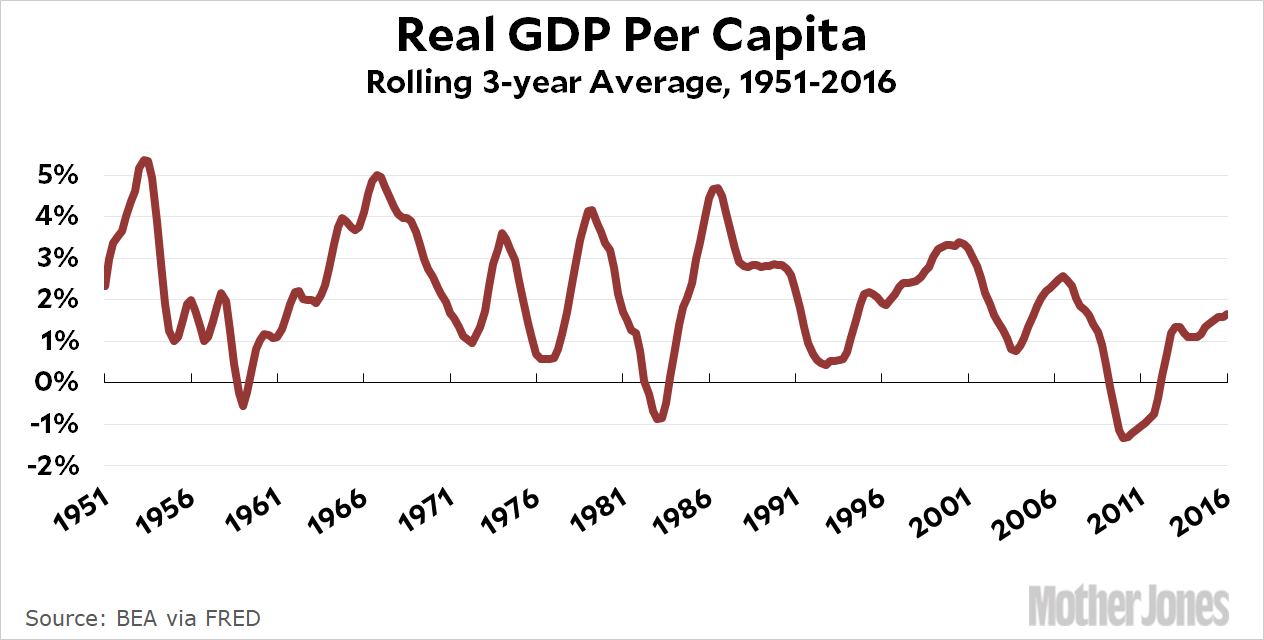
    As a starter, how about a post about economic booms and busts? I noted the other day that, in practice, the “Great Moderation” seems to have moderated booms but not busts:

    Around 1980, economic peaks dropped from growth rates of around 4 percent to around 2 percent, but downturns stayed about the same at 1 percent. I suggested this might be due to the Fed’s anti-inflation bias, but Alex Tabarrok points to a recent paper out of Denmark that instead puts economic deregulation at the forefront:

    It’s more than lower economic growth—expansions also last longer. It’s as if the booms have been smoothed over a longer period of time but not the busts.

    ….The authors argue that financial innovation made credit more easily accessible and easier credit led to more leverage. Leverage, however, has an asymmetric feature. When asset prices are up everything is golden, wealth is high and credit is easy because lenders are happy to lend to the rich. When asset prices decline, however, the economy takes a double hit, wealth is low and credit is tight. The net result is that booms are smoothed but busts become, if anything, even more violent.

    The theory is promising because it explains both the negative skewness and the great moderation. It’s also important because higher leverage, longer expansions and greater negative skew are new features of business cycles that appear across many developed economies as shown by Jorda, Schularick and Taylor in Macrofinancial History and the New Business Cycle Facts. In this paper Jorda et al. create new data series using over 150 years of data from 17 economies and conclude [that] “leverage is associated with dampened business cycle volatility, but more spectacular crashes.”

    Longtime readers know that leverage is probably my single biggest hot button when it comes to economic cycles. If I were Cato, my motto would be “Leverage delenda est.” So I am totally primed to believe this. The big question, of course, is whether it’s worth it. Do the longer upturns make up for the sharper downturns? I doubt it. Generally speaking, I would happily give up thousands of pages of financial regulations in return for a single-minded focus on restricting leverage in every part of the financial system. That includes bankers, hedge funds, home buyers, and everyone else. The road to hell is paved with leverage greater than 10:1.

  • Question of the Day: Why Did Paul Manafort Agree to Become Trump’s Campaign Manager?

    As a side note on the Manafort indictment, this is yet another example of the peculiar arrogance of powerful men in Washington. The poster child for this has long been Gary Hart, who famously dared reporters to follow him around when he was suspected of having an affair with Donna Rice. That ended badly.

    And now we have Paul Manafort. According to today’s indictment, he spent years engaged in a wide-ranging scheme of money laundering to the tune of $75 million. If you’ve done something like this, your best lifestyle choice is to stay very, very quiet. Attract no attention. Stay as far away as possible from reporters and FBI agents.

    So what does Manafort do? He signs on as campaign manager for the biggest, loudest, brassiest presidential campaign in recent history. Practically his first actions were related to defending Russia for a candidate who was already suspected of being a little too simpatico with Vladimir Putin. He was almost literally daring reporters to investigate him.

    Why? Do people like this figure that if they’ve gotten away with something for years, they’ll get away with it forever? Are they so smitten with their own brilliance that they can barely conceive of being outwitted by anyone else? Do they just not think at all? It is a mystery.

  • Trump Campaign Advisor Lied to FBI About Contacts With Russians

    More Russia news today:

    A Trump campaign policy advisor has pleaded guilty to lying to the FBI about his contacts with Russians who claimed to have “thousands of emails” on Hillary Clinton, in another charge filed as part of the special counsel investigation into the Trump campaign.

    George Papadopoulos, 30, of Chicago, has agreed to cooperate with the investigation of Robert S. Mueller III, according to a plea agreement unsealed on Monday. He pleaded guilty on Oct. 5 to making false statements to disguise his contacts with Russians whom he thought had “dirt” on Clinton. He was arrested in July as he got off a plane at Dulles Airport, court papers say.

    There sure were a lot of people connected to the Trump campaign who were eager to meet with Russians who claimed to have dirt on Hillary Clinton, weren’t there?