• Lunchtime Photo

    Every week I try to put up at least one picture of an animal, a vegetable, and a mineral. But what is this one? Animal or mineral? That’s a little tricky, isn’t it? However, my backlog of pictures is pretty top-heavy with animals, so I’m counting Mickey as a mineral. I don’t suppose the guy wearing the giant plastic head would appreciate that, but sometimes we bloggers have to make tough decisions. This was one of them.

  • Donald Trump Lied and Lied and Lied in Arizona

    From Donald Trump at his campaign rally last night:

    We want walls that you can see through in a sense. You want to see what’s on the other side.

    That’s called a “fence,” Mr. President.¹ But how can we ever have a fence if Trump refuses to say the word? Say the word! Say the word!

    I didn’t listen to Trump’s rally last night. My toenails needed tending, I think. So I went looking for a transcript this morning. “Trump Ranted For 77 Minutes in Phoenix,” said the headline in Time, but I managed to read the whole thing in about five minutes. That’s efficiency!

    Honestly, though, pulling out a few quotes here and there just doesn’t give you a sense of how this thing went. The remarkable part is that he just told lie after lie after lie with barely a pause for breath. And everyone in the audience, most of whom probably don’t follow this stuff in gruesome detail,² believed him. His 15-minute rant about Charlottesville—which he had prepared notes for—was just a flat-out lie about what he said, when he said it, and what he was criticized for. After that he lied about CNN turning off their cameras. He lied about the size of the protest outside. He lied about job creation. He lied about his tweeting. He lied (yet again) about the New York Times apologizing for its campaign coverage of him. He lied about the media ignoring big stories. He lied about auto companies bringing jobs back to America. He lied about how much illegal immigration has declined. He lied about extreme vetting. He lied about Obamacare. He lied about how close he was to repealing it. He lied about defense spending. He lied about clean coal. He lied about economic growth. He lied about corporate tax rates.

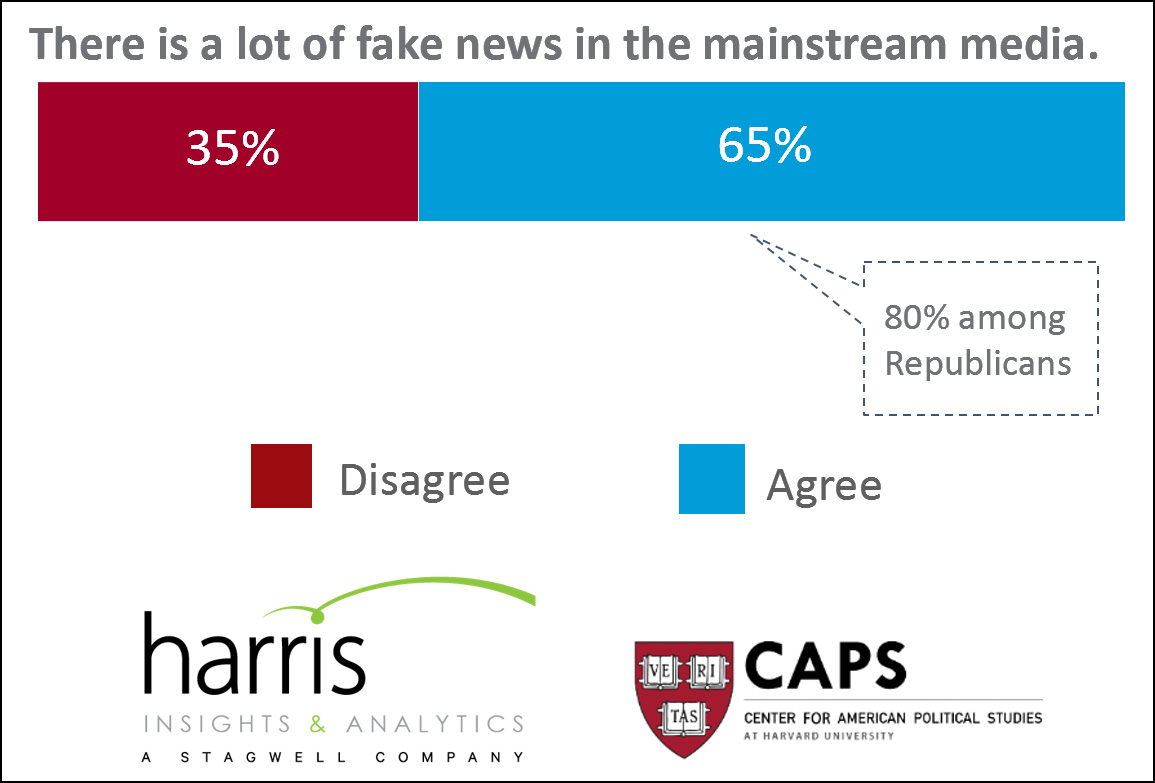
    It was a 77-minute spittle-flecked presentation of alternate reality. And above all, it was a continuation of his war on the media. His goal is to convince all of his followers, not just the true believers, that everything in the mainstream press is a deliberate fiction and they shouldn’t believe any of it. And it’s working pretty well:

    Republicans are very close to believing that literally nothing they hear is true unless they hear it from Trump. This is the road to catastrophe if it keeps up.

    ¹Unless it’s made of transparent aluminum, of course. Did anyone get a screenshot of the formula for that on Scotty’s little Macintosh?

    ²Or follow it on Fox News, which is probably worse.

  • California Cap & Trade Permits Hit a New Auction High

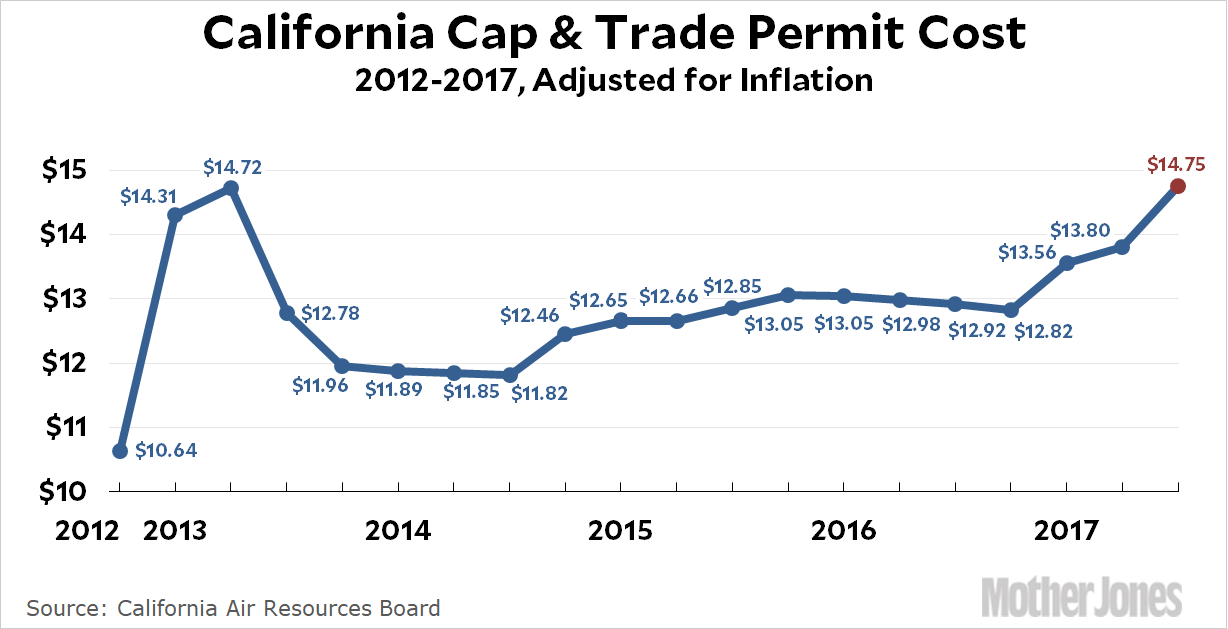
    Permits to emit greenhouse gases in California hit a new high at the most recent quarterly auction:

    The LA Times has more:

    During August’s auction, every emission permit offered by the state was sold, and prices reached their highest level since the program launched five years ago. The auction results, announced Tuesday, were the first since Gov. Jerry Brown signed legislation continuing cap and trade until 2030, erasing some of the political and legal uncertainty that had dogged the program.

    ….Even though the cost of permits has been rising, it may not happen fast enough to provide an adequate financial incentive for companies to clean up their operations, said Danny Cullenward, a Stanford University energy economist. State regulators should take steps to ensure they’re auctioning the right number of permits because making too many available could allow too many emissions, he said.

    It’s a start.

  • Oh Yes, American Industries Are Much More Concentrated Than They Used to Be

    Tyler Cowen is skeptical that there are very many sectors of the US economy that have become more concentrated:

    Or ask yourself a simple question — in how many sectors of the American economy do I, as a consumer, feel that concentration has gone up and real choice has gone down? Hospitals, yes. Cable TV? Sort of, but keep in mind that program quality and choice wasn’t available at all not too long ago. What else? There are Dollar Stores, Wal-Mart, Amazon, eBay, and used goods on the internet. Government schools. Hospitals. Government. Did I mention government?

    This is very un-Tylerlike. Off the top of my head, here are a dozen more:

    1. Airlines
    2. National accounting firms
    3. Telephone companies
    4. Search engines
    5. Household appliances
    6. Drugstores
    7. Health insurance companies
    8. Banks
    9. Hardware stores
    10. Bookstores
    11. Beer
    12. Supermarkets

    Note that high concentrations don’t necessarily mean less consumer choice. Amazon has wiped out nearly the entire bookstore industry, but my choice of books from Amazon alone is probably better than my choice from all my local bookstores combined two decades ago. The problem with highly concentrated industries is that they have too much pricing power; they inhibit innovation; and they wield too much influence over policymaking. Consumer choice is a red herring, and the sooner we focus our attention on other aspects of oligopoly the better off we’ll be.

  • Senate Republicans Hate Donald Trump

    Alex Edelman via ZUMA

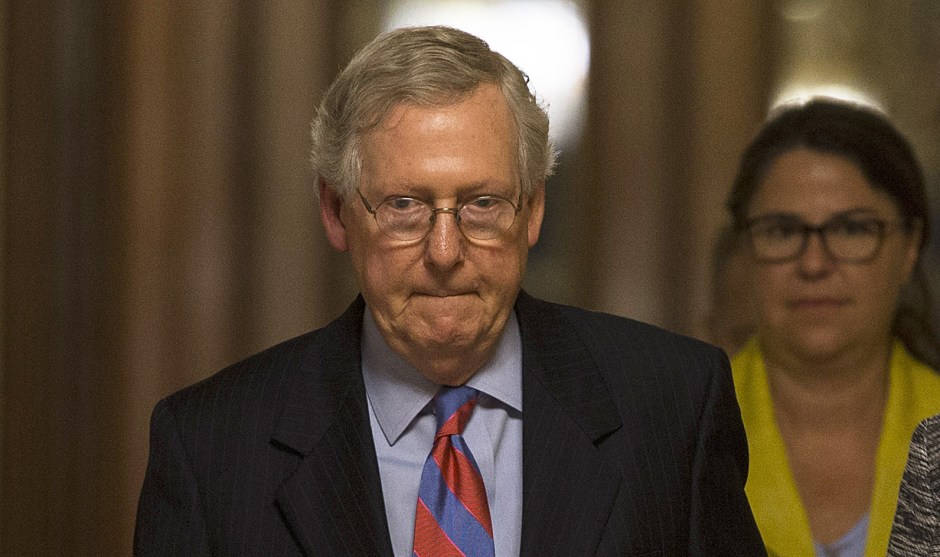
    In the New York Times today, Alexander Burns and Jonathan Martin have a piece about the relationship between Mitch McConnell and Donald Trump. It’s—how do the kids put it?—complicated. Basically, McConnell can barely stand the sight of the guy: “In a series of tweets this month, Mr. Trump criticized Mr. McConnell publicly, then berated him in a phone call that quickly devolved into a profane shouting match.” What’s more, it turns out that lots of other Republican senators feel the same way. In fact, apparently senators kept calling them back even after the article was published to throw in their two cents:

    I guess ten words is about what I’d expect. But which ten? Let’s think about this:

    1. fantastic
    2. everyone
    3. failing
    4. disaster
    5. repeal
    6. replace
    7. premiums
    8. deductibles
    9. state lines
    10. ???

    I can’t think of ten. Sorry. Am I missing one?


  • There’s No Simple Way to Unite the Democratic Party

    Alex Edelman via ZUMA

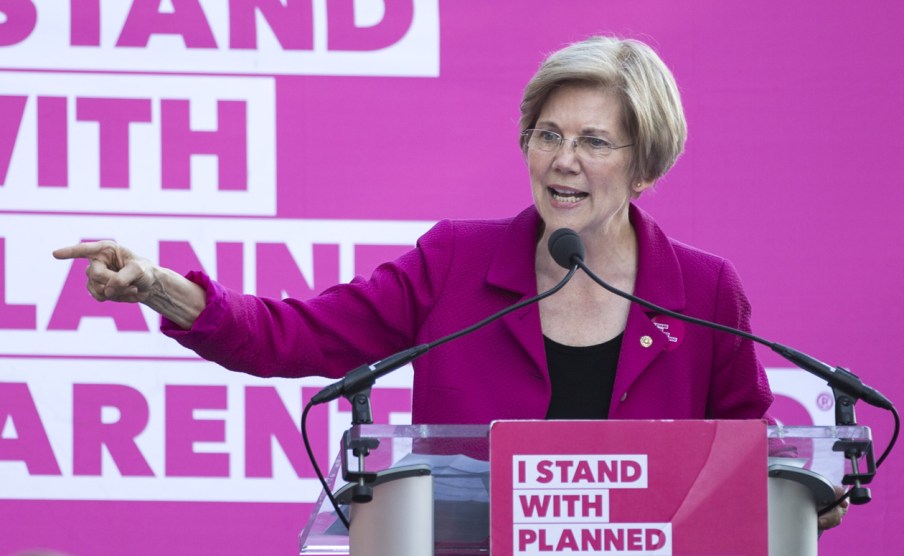
    Riffing off a recent Elizabeth Warren speech, David Atkins says that Democrats can easily stop their internal bickering. There is, he says, “no contradiction between winning back some of the white working class that defected to Trump, and achieving social justice on the issues of importance to Black Lives Matter activists.” We just have to take everyone’s concerns seriously:

    The war within the left is based on false choices and straw men. There is no need for conflict if both sides are acting in good faith. Leftists who dismiss “identity politics” as an irrelevant distraction need to be sidelined, as they are not dependable allies of the Democratic Party’s true base. Center-leftists who eschew economic populism and worker empowerment in defense of the Wall Street-dependent donor class in the dream of an identity-blind faux meritocracy of oppression must also be sidelined.

    ….If Democrats listen to Warren, they can quickly and easily bury the hatchet, advance in unity toward common goals, and win back power at the state and federal level. Hopefully her advice didn’t go entirely unnoticed.

    If it were really that easy, I think this whole problem would have been solved a long time ago. Unfortunately, there are still moderate lefties out there who Democrats need to win—not to mention moderate moderates who they also need. These are the kind of people who are OK with increased regulation of banks, but not with a full-bore Bernie assault on the entire financial system. Likewise, there are moderates who support social justice campaigns, but think that Black Lives Matter goes too far. If the answer is to boot everyone like this out of the Democratic Party, it’s going to be a pretty small party that’s left over.

    Warren’s speech sounds nice. But speeches are meaningless. You can always make a speech sound nice by picking and choosing what issues you address. The problems start as soon as you begin taking questions and folks demand answers to the hard problems that you delicately tiptoed around.

    I wish the fighting on the left were merely rhetorical, but it’s not. It’s substantive. As with all movements, there are moderates and there are extremists and there are people in-between. And they really and truly believe different things. Talented politicians like Ronald Reagan and Bill Clinton can paper over these differences to some extent, but not for long. Eventually, voters are going to start asking the tough questions, and then you have to take sides. That’s when the fighting starts all over again.

    POSTSCRIPT: There’s a good example of this in Warren’s speech, where she says this:

    A few weeks ago, I saw an op-ed in the New York Times from a so-called Democratic strategist titled, “Back to the Center, Democrats.”…We’ve been warned off before. Give up, keep your heads down, be realistic, act like a grown-up, keep doing the same old same old.

    But here’s what’s interesting: instead of lots of ferocious back-and- forth and piling on, this time, no one cared. Big yawn. Why? Because the Democratic Party isn’t going back to the days of welfare reform and the crime bill.¹ It is NOT going to happen.

    Bill Clinton campaigned on both those things and he won the presidency. But when he actually followed through, a lot of lefty Democrats rebelled. Nevertheless, Clinton won reelection by a huge margin. Warren is correct that the Democratic Party has moved left on these issues since Clinton’s presidency, but she’s not correct that this means moderates no longer exist. They do, and Democrats still need them to win.

    ¹Actually, I don’t think that’s why nobody cared. It’s because the op-ed was by Mark Penn, and nobody cares about Mark Penn anymore.


  • Facts or Anecdotes? Pick One and Stick With It.

    Photo: JϋRgen BäTz/DPA via ZUMA, Chart: Millennium Development Goals: Child Malnutrition 2006

    Here’s a quiz for you. Which of these articles about, say, starving children in Africa is likely to get the widest readership?

    1. A piece that tells the story via description and personal anecdotes.
    2. A piece that tells the story via facts and numbers.
    3. A piece that combines the two.

    Some of us respond to numbers, while some of us respond to stories about people, so the common-sense answer is option C. That should rope in everyone.

    In fact, it turns out that C is the worst possible option. Nobody likes it. The numbers people get tired of all the personal stuff, while the tender-hearted people are put off by all the numbers. It turns out that you have to pick one or the other and just accept that you won’t reach everyone.

    I learned this years ago, and I don’t remember where. However, I was reminded of it by an interview with Paul Slovic, who has done loads of research on the limits of human compassion. I’ve had this interview saved for a while because I’ve been meaning to write something related to it—and eventually I will!—but there was one particular bit that’s pretty fascinating. Here is Slovic:

    We have an experiment of helping a starving child. A certain percentage of people help [by donating money to the kid]. Then we have another condition with a different group, same child, same situation, except we put the numbers of the statistics of starvation next to her picture, and the donations dropped in half.

    I wonder how universal this is. Is it always a bad idea to mix anecdotes and data? Slovic chalks up his experimental result to “pseudo-inefficacy,” meaning that the numbers make the problem look so big that people just give up, figuring that their donation will never make any difference. However, I suspect it’s something more general than that. There’s something about numbers that actively turns off people who respond most strongly to anecdotes. And vice-versa, perhaps. It would be interesting for Slovic to run his experiment in reverse: begin with a simple, punchy bit of data about starvation, and then add the picture of the child. Do donations still drop?

    If this is indeed a fairly general finding, it should affect the way advocacy journalists work. Instead of trying to write (or film or record) comprehensive pieces designed to move everyone, they should always write two separate pieces. One contains lots of troubling anecdotes with only a few simple numbers, while the other lays out the fact-based case for action, with only brief mentions of real-world suffering. More work, perhaps, but it’s also likely to make more difference.

  • “Despacito” Is…OK, I Guess

    This weekend, I read a Voxsplainer by Alex Abad-Santos about this summer’s mega-megahit, “Despacito.” What’s the deal?

    Quite simply, “Despacito” is magic….chord progressions and melody….American listeners and even artists seem to be burned out on [the electronic dance music sound] and are craving something new….intimate vocals, and shifts away from high-energy choppy vocal synths and swirling drops….“Despacito” is a scorcher of a tune — the experts I talked to all agree.

    Alternatively, here is Wikipedia’s more restrained description:

    It is a reggaeton-pop song composed in common time with lyrics about having a sexual relationship, performed in a smooth and romantic way.

    I’m going to preface this with my usual disclaimer: I don’t know much of anything about music, and what I do know is limited to Top 40 classical and Top 40 classic rock. Anyone who takes music seriously should just ignore what I have to say.

    Which is this: I’ve listened to “Despacito” many times over the past month. I wanted to give it a fair try, since it often takes a few listens to really get into a new song. But no matter how many times I listen, it only seems…OK. I don’t hate it or anything. But a scorcher of a tune? I just don’t get it. The tune seems distinctly ordinary. I haven’t found myself humming it in the shower. I haven’t added it to my playlists. It’s just…OK.

    I’m genuinely curious about this. “Despacito” didn’t become a megahit by appealing to music afficianados. It became a hit by appealing to millions of teenagers with no more knowledge of music than me. What do they hear that I don’t? In particular, what do they hear in the tune that I don’t? I’m as susceptible to a tune with a great hook as anybody, but I just don’t feel it. Is it really an addictive earworm for most people?

    I assume my audience is not exactly the perfect group of people to ask about this. Still, you go to war with the audience you have, not the audience of plugged-in teenagers you wish you had. Anyone have anything to say about this?