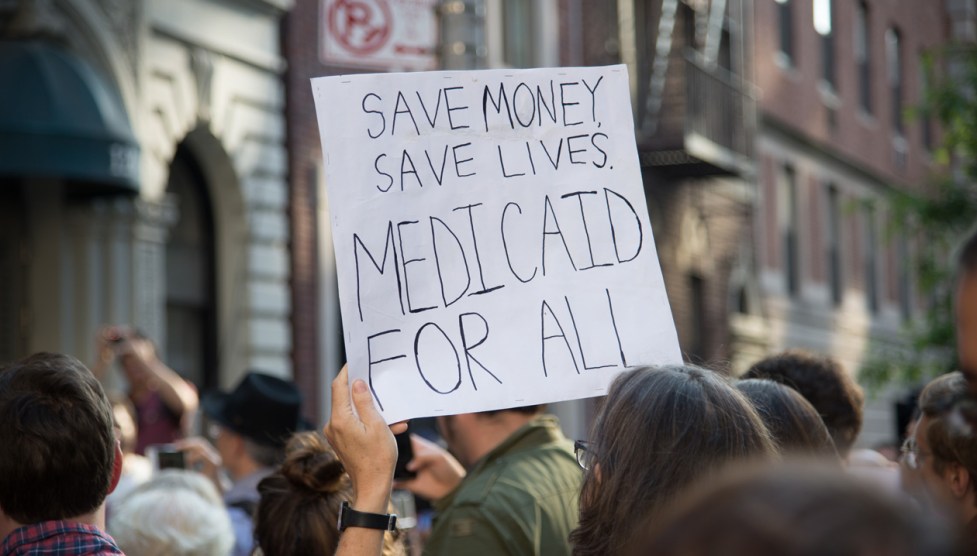
“One of the unintended consequences of the Republicans trying to cut Medicaid is they made Medicaid really popular,” Sen. Schatz said in an interview. “This conversation has shifted. There was a time where Medicare was really popular and Medicaid was slightly less popular. What this ACA battle did was make both of them almost equally popular.”
Schatz wants to take advantage of that by allowing states to add a Medicaid option to Obamacare’s exchanges. However, his proposed legislation also does this:
The Schatz bill would also raise Medicaid’s payment rates to doctors and hospitals to match those of the Medicare program. Currently, the Medicaid prices are 72 percent of those that Medicare pays — which in turn pays less than private insurers. Raising Medicaid prices to be equal would likely lure more doctors to participate in the program — but also make Medicaid (and the premiums to buy into Medicaid) significantly more expensive.
Yes, this would raise the cost of Medicaid a lot. It would also—I think—make Medicaid a more generous program than Medicare. Even liberal states like my home state of California probably wouldn’t buy into Schatz’s program under these circumstances. It’s just too expensive. We spend about $40 billion on Medi-Cal, and upping reimbursement rates to Medicare levels would probably cost something on the order of $10-15 billion. In a state budget where bitter fights break out over health care costs of $500 million, this is a nonstarter.
I suspect a smarter approach would be to raise Medicaid reimbursement rates slightly. Maybe to 75 percent of Medicare. And then work on raising them again a few years from now. Realistically, it’s hard to see any other way to get states to buy into this idea.
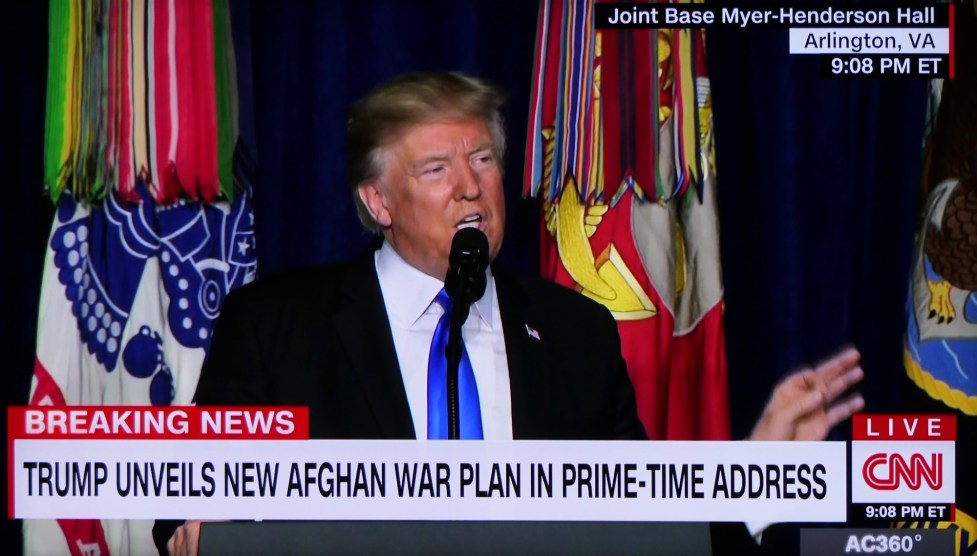
I heard this line during Donald Trump’s Afghanistan speech tonight, but I was distracted and wasn’t quite sure what he had said. But now the transcript is available, so here it is:
In this struggle, the heaviest burden will continue to be borne by the good people of Afghanistan and their courageous armed forces. As the prime minister of Afghanistan has promised, we are going to participate in economic development to help defray the cost of this war to us.
That zipped by mighty quickly, didn’t it? Let’s rewind and pause a bit. What exactly does Trump mean? What does he plan to extract from Afghanistan to help “defray” the cost of the war?
When Donald Trump took office, he asked his generals for a new plan in Afghanistan. Here is how I imagine things have gone since then:
March
GENERALS: Not much more we can do. Maybe a few additional troops. Push harder on Pakistan. Stop worrying so much about civilian casualties.
TRUMP: Try again.
April
GENERALS: Not much more we can do. Maybe a few additional troops. Push harder on Pakistan. Stop worrying so much about civilian casualties.
TRUMP: Not good enough.
May
GENERALS: Not much more we can do. Maybe a few additional troops. Push harder on Pakistan. Stop worrying so much about civilian casualties.
TRUMP: You have to do better.
June
GENERALS: Not much more we can do. Maybe a few additional troops. Push harder on Pakistan. Stop worrying so much about civilian casualties.
TRUMP: Goddamit, I want to kick some ass!
July
GENERALS: Not much more we can do. Maybe a few additional troops. Push harder on Pakistan. Stop worrying so much about civilian casualties.
TRUMP: Fine. Where’s my speechwriter?
August TRUMP: Today I am announcing a bold, new plan for total victory in Afghanistan. We will stop talking about troop levels. We will stop coddling Pakistan. We will unleash our military. And we will win.
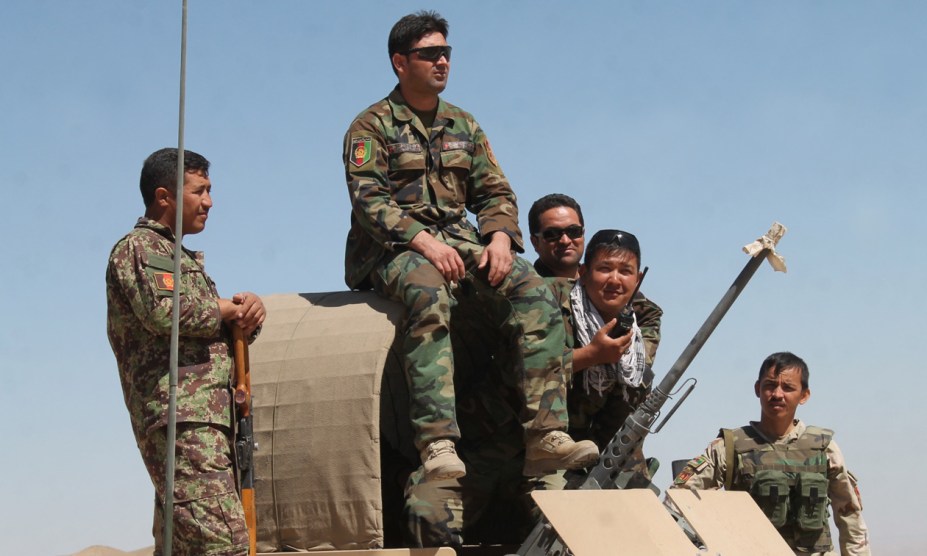
There really isn’t a whole lot we can do in Afghanistan. The Pentagon knows this. After all, a few years ago they had upwards of 100,000 troops there—compared to 8,000 right now—and it barely budged the needle. They’ve been pushing on Pakistan the whole time, but if they push too hard we’ll lose our drone bases there and be in even worse shape. And looser rules of engagement just enrage the Afghan populace and provide the Taliban with recruiting material. It’s a no-win situation. All we can do is keep on training the Afghan army and cross our fingers. Maybe eventually the government will have enough support and the army will have enough discipline to maintain order without us.
Or we can pull out. If we do that, the Taliban will take over in short order and that’s politically unacceptable. No American president wants to be the guy who “lost Afghanistan.”
So we just stay there forever, fighting a low-level war meant to contain the Taliban—barely—and not get too many US soldiers killed. That’s what Bush did. It’s what Obama did. And it’s what Trump is doing.
President Trump was frustrated and fuming. Again and again, in the windowless Situation Room at the White House, he lashed out at his national security team over the Afghanistan war, and the paucity of appealing options gnawed at him.
….Trump’s private deliberations — detailed in interviews with more than a dozen senior administration officials and outside allies — revealed a president unattached to any particular foreign-policy doctrine, but willing to be persuaded as long as he could be seen as a strong and decisive leader.
As long as it makes him look good, Trump doesn’t really care what we do in Afghanistan.
So what is President Trump’s long-awaited new plan for Afghanistan? In a half-hour prime-time speech, he didn’t really say. Trump started out by complaining a bit, saying that he had been dealt “a bad and very complex hand,” but one he’d fix because “I’m a problem solver.” The solution, however, was pretty vague. Here were the main changes he announced:
We will shift from a time-based strategy to one based on conditions. In other words, we may just stay in Afghanistan forever.
We will no longer talk about numbers of troops. This is most likely because the increase in troops he approved was so minuscule as to be pointless.
Trump will bring to bear all elements of American power: diplomatic, economic, military. We’ve been doing this for the past decade, but whatevs.
There will be no more coddling of Pakistan. How? By threatening to cut off money, it sounds like.
There will be no more micromanagement from Washington. The subtext here is that if we don’t make progress, we should blame Mattis, not Trump.
The rules of engagement will be loosened, though it’s unclear how.
There will be no more nation building. We’re killing bad guys, and that’s all.
But we’ll keep giving lots of money to Afghanistan for, um, bation nuilding.
“Victory will have a clear definition,” Trump said, though he didn’t really say what that is. However, it appears to mean that ISIS and al-Qaeda are wiped out, the Taliban is transformed into a bunch of moderates, and there is no possibility of new terrorist groups emerging. That sounds good, but it’s just hot air. It will never happen.
All snark aside, I have no idea what this means. There were no details, just a lot of generalized tough talk. Trump basically promised to accept nothing less than total victory, but there seems to be very little in his plan that’s different from what we’re doing already. The only potentially new item was his promise to force Pakistan to stop giving a safe haven to terrorists. We’ll see what that means in practice.
He did, however, take credit for our recent success in Mosul, which certainly takes some chutzpah. The Mosul offensive was entirely an Obama operation, and one that Trump had nothing but contempt for in the past. But it worked, so now it’s a Trump victory.
We didn’t get a total eclipse here in Southern California, but that only lasts a couple of hours anyway. So why not visit this summer and enjoy our lovely beaches? You can spend days or weeks enjoying our golden sunshine. Doesn’t that really sound better?
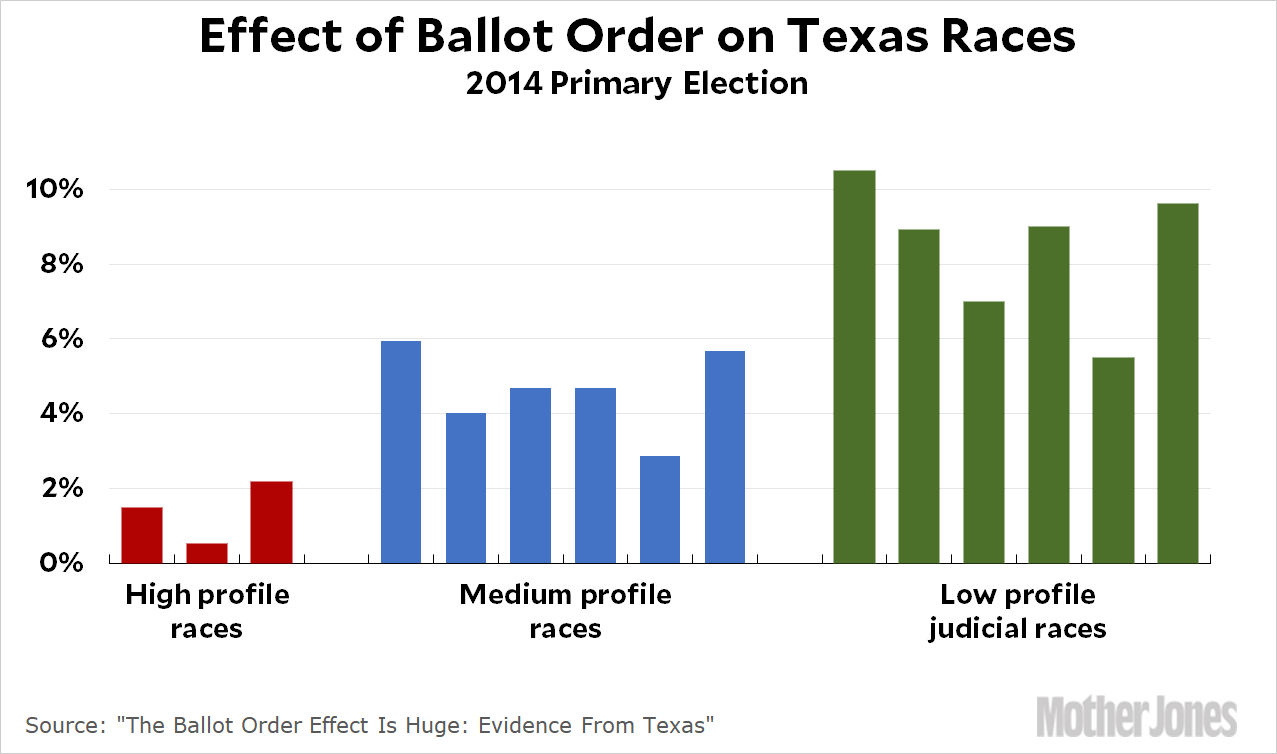
Here’s a fascinating bit of political science research. It’s a few months old, but I just recently found out about it. In Texas, names are placed on the ballot in different orders depending on the county. The order is selected randomly, which allows an examination of whether being first on the ballot matters very much. Darren Grant of Sam Houston State University did exactly that, and he found that it really, really makes a difference:
Across all twenty-four contests, the effect is invariably positive and, with two exceptions in runoff elections, statistically significant. The smallest effects are found in high-profile, high information races: the Republican primary for U.S. Senator, which featured the incumbent, John Cornyn; the governor’s race, which featured long-time Attorney General Greg Abbott; and Land Commissioner, which featured well-known political newcomer George P. Bush. In these races the ballot order effect is only one or two percentage points.
Larger estimates obtain for most “medium-profile, medium-information” races such as Comptroller, Railroad Commissioner, or the Democratic nominee for U.S. Senator. Most of these fall in a fairly tight band that ranges from three to five percentage points. Estimates are even larger in the low-profile, low-information judicial elections, generally ranging from seven to ten percentage points. Overall, the ballot order effect tends to be larger in contests that receive less attention and in which voters are likely to know less about the candidates on the ballot.
Here this is in colorful chart form:
In medium and low-profile races, the ballot order effect is big enough that it might decide races all by itself. Even in high-profile races, “one or two percentage points” can be a pretty big effect. There are plenty of races for governor or senator that have been won by less.
In states that don’t randomize ballot order, this means that the first candidate on the ballot has a huge advantage. And this could be true even in states that do. If you got lucky and ended up at the top of the ballot in Houston, Dallas, and San Antonio, you’d get an advantage in areas with millions of votes, while your opponent would get an advantage in areas with only thousands of votes. And there are certain unusual circumstances where the ballot order effect can be truly massive:
In an ironic twist of fate, we were recently able to [test our hypothesis] with the March, 2016 Texas Republican primary, held just after the first draft of this paper was completed. Featuring a highly visible Presidential race, it drew twice as many voters as in 2014—and had contests for three Supreme Court positions, one of which was between Paul Green and Rick Green, two men with common first names and identical last names. It was The Perfect Storm, and our logic implies that this should lead to large ballot order effects. This is immediately evident in the histogram of county vote shares presented in Figure 2(a), without even looking at ballot order: in a race won with 52.1% of the statewide vote, virtually no county’s vote was nearly evenly split. Instead Paul Green’s vote shares are bifurcated into two clusters, one around 40%, and another around 60%, suggesting a ballot order effect approaching twenty percentage points. The regression results in Figure 2(c) confirm this: the coefficient estimate is 19.4 percentage points. We have never seen a ballot order effect this large, and may never again.
Since different counties had different ballot orders, this might not have made a difference in the final result. But with an effect that gigantic, getting even a little bit lucky with the ballot order in the biggest cities might have made the difference.
I’m not sure if there’s a policy answer to this. At the very least, ballot order should always be randomized. Beyond that, Grant suggests that if you’re not sure who to vote for, vote for the person at the bottom of the ballot. They could use the help.
Sure, sure, you can do better at the NASA site, with all their fancy telescopes and stuff. But what you really want to know is what the eclipse looked like in my backyard with a cheap camera. Right? Well, here you go:
UPDATE: Hey, this is a perfect opportunity to try out my camera’s HDR function, which cleverly takes multiple shots at different exposures and then combines them. In theory, this means the camera can properly expose both the sun and the surrounding trees. In theory:
Jeez, you really have to hold the camera steady for HDR to work, don’t you? I’m not so good at that. And I guess there’s a limit to just how much contrast HDR can handle. Either that or I need to learn more about it. I just switched the HDR setting to ON and fired away. Oh well. At least I got a moderately interesting effect out of it.
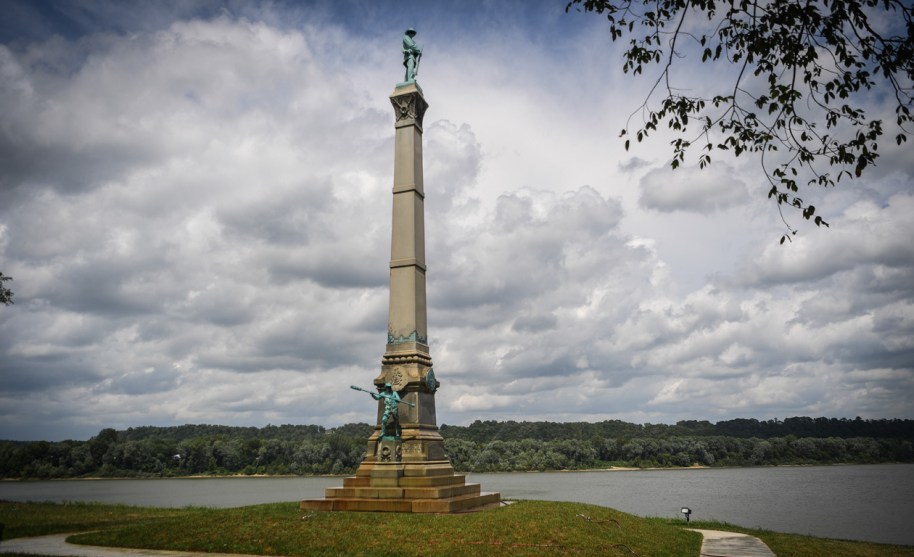
This weekend the Washington Post ran a story about a huge Confederate statue in Louisville that was dismantled and shipped off to the town of Brandenburg, which thought it might be a good tourist attraction. Apparently everyone was pretty happy about it except for Mildred Brown, an African-American seamstress who’s lived there for 50 years:
She recalled telling him [the judge executive in Meade County] that having the monument was a mistake. It was a symbol of dark times — dark enough that she no longer went to the riverfront. “It doesn’t unify us,” she said. “It separates us.”
He recalled telling her: “Don’t worry, we’re not going to let people come down there and throw a fit and have Confederate flags and call names.” He also said the monument was about preserving a part of history with a lot of nuance. “It had a whole lot more to it than slavery,” he said.
I don’t want to pretend to be naive, but when Southerners talk about these statues representing their heritage, or their history, or their culture, what heritage do they think it represents? Let’s assume they don’t buy the argument that these statues are mostly 20th century monuments to Jim Crow and white terror. Fine. They’re certainly monuments to the Civil War. I can understand why northern states would build monuments to the war, but why would Southern states do it? It was a war of treason. It was a war to protect slavery, even if there were other catalysts too. It was a war of white supremacy. It was a war of personal bravery in defense of the indefensible. It was a war they lost.
From the perspective of 2017, what exactly is there to honor about that? What’s the party line here?
And we respect that! But maybe you’re of a mind to support our work directly instead? We have until December 31 to raise the last $400,000 we need to keep our nonprofit newsroom running at full strength into 2026. Will you make a gift today?
We noticed you have an ad blocker on. Can you pitch in a few bucks to help fund Mother Jones' investigative journalism?
Billionaires own the media,
but they don’t own us.
At Mother Jones we know these aren’t conventional times, and they require unconventional coverage. That’s what deliver every day: fierce, independent journalism you can’t find elsewhere. Perhaps never in the history of our country has that been more necessary than now. But we can’t do it without reader support—your support. Please chip in today.
Billionaires own the media,
but they don’t own us.
At Mother Jones we know these aren’t conventional times, and they require unconventional coverage. That’s what deliver every day: fierce, independent journalism you can’t find elsewhere. Perhaps never in the history of our country has that been more necessary than now. But we can’t do it without reader support—your support. Please chip in today.