• Southwest Border Apprehensions Continue Their Big Decline

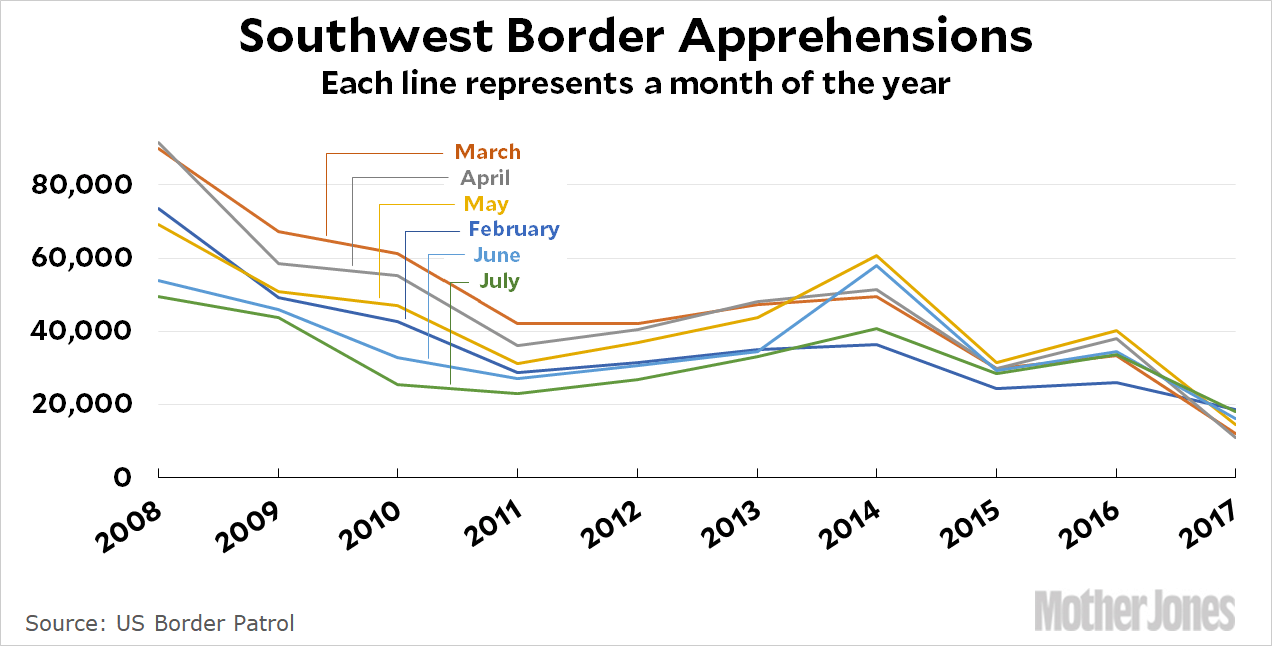
    A few months ago I put up a chart showing the decline in Southwest border apprehensions during the first three months of the Trump administration. I was curious to see what it looked like after a few more months had passed. Here it is:¹

    The downward trend in 2017 is unmistakable. But will it stick? The past decade is full of ups and downs. Border apprehensions dropped substantially from 2009-11, then dropped again in 2015, and now are down again in 2017. Roughly speaking, apprehensions dropped from about 70,000 per month to 30,000 per month under Obama, and have now dropped to 15,000 per month under Trump. That’s an 80 percent decline, and all without the benefit of a wall.

    ¹Data for FY 2000-16 here. Data for FY 2017 here. All lines in the chart are for calendar years.

  • Friday Cat Blogging – 18 August 2017

    I was over at my mother’s house on a digital mercy mission a few days ago, so I took the opportunity to photograph her cats. This one is Tillamook. Tilly is a very photogenic cat, but unfortunately he’s also a camera-shy cat. In fact, he’s just generally people shy. He doesn’t run away and hide under a chair when I come over, but he does generally make himself scarce. So good pictures are rare.

    The odd thing is that if he’s snoozing and I walk up to him, there’s no problem. He opens one eye, streatches a bit, and starts purring when I pet him. Just like a normal cat. But if he’s already awake, he skitters off. Very odd.

  • We Need a Backup Plan In Case Robots Don’t Work Out

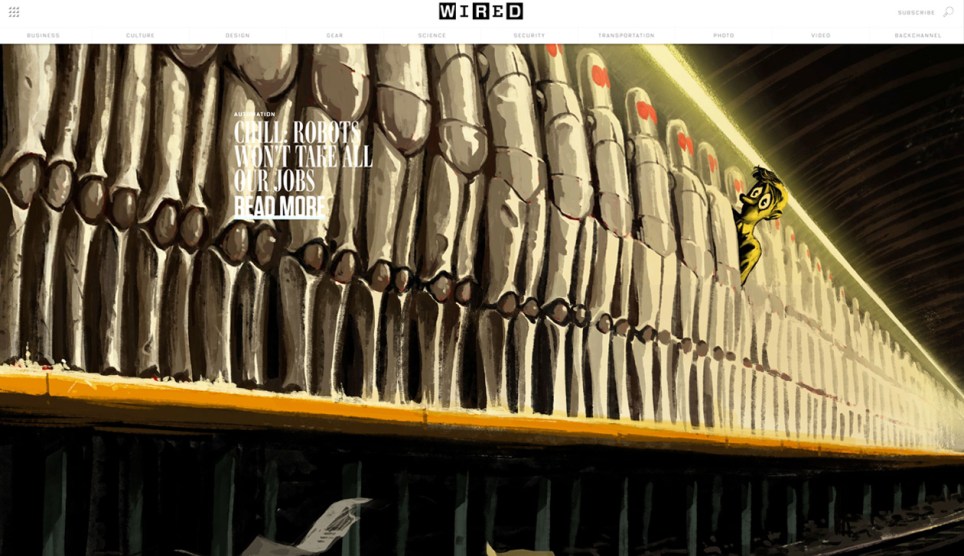
    With today’s Trump O’Clock news seemingly out of the way, I want to make one more comment about James Surowiecki’s robot story in Wired. There’s one issue he highlights that deserves more attention than it gets:

    The peculiar thing about this historical moment is that we’re afraid of two contradictory futures at once. On the one hand, we’re told that robots are coming for our jobs and that their superior productivity will transform industry after industry. If that happens, economic growth will soar and society as a whole will be vastly richer than it is today. But at the same time, we’re told that we’re in an era of secular stagnation, stuck with an economy that’s doomed to slow growth and stagnant wages. In this world, we need to worry about how we’re going to support an aging population and pay for rising health costs, because we’re not going to be much richer in the future than we are today. Both of these futures are possible. But they can’t both come true. Fretting about both the rise of the robots and about secular stagnation doesn’t make any sense. Yet that’s precisely what many intelligent people are doing.

    The irony of our anxiety about automation is that if the predictions about a robot-dominated future were to come true, a lot of our other economic concerns would vanish. A recent study by Accenture, for instance, suggests that the implementation of AI, broadly defined, could lift annual GDP growth in the US by two points (to 4.6 percent). A growth rate like that would make it easy to deal with the cost of things like Social Security and Medicare and the rising price of health care. It would lead to broader wage growth. And while it would complicate the issue of how to divide the economic pie, it’s always easier to divide a growing pie than a shrinking one.

    This is totally true. But I don’t think it’s quite as paradoxical as Surowiecki says. I fret about both those futures, and it makes sense because I’m not 100 percent sure about the future of artificial intelligence. If you asked me to put a number to it, I’d say I’m 80 or 90 percent sure that it’s coming in the next two or three decades, and that it will, in fact, render concerns about Social Security and health care obsolete. My biggest concern—about which I’ll have more later—is the near-term transition period: what happens during the years from, say, 2025 to 2045, when workers are being disemployed in big numbers but we haven’t quite gotten to the point of figuring out how to give them all decent incomes?

    However, I’m still 10 or 20 percent unsure about all this. Maybe AI won’t come for another century. In that case, we still have to worry about Social Security and health care. It always makes sense to have a backup plan, doesn’t it?

  • Bannon Out?

    Consider the source, but….

    UPDATE: The New York Times reports the same thing:

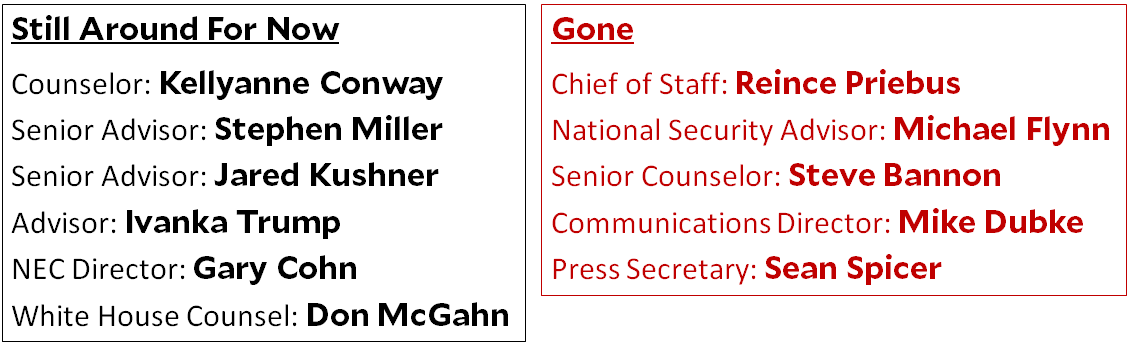
    President Trump has told senior aides that he has decided to remove Stephen K. Bannon, the embattled White House chief strategist who helped Mr. Trump win the 2016 election, according to two administration officials briefed on the discussion….As of Friday morning, the two men were still discussing Mr. Bannon’s future, the officials said. A person close to Mr. Bannon insisted the parting of ways was his idea, and that he had submitted his resignation to the president on Aug. 7, to be announced at the start of this week, but it was delayed in the wake of the racial unrest in Charlottesville, Va.

    It’s only August, and the worst of the crazy ideologues in Trump’s cabinet are both gone (Bannon and Michael Flynn). When will it be Jeff Sessions’ turn?

    UPDATE 2: And there’s this:

    Who can it be?

  • New Study Suggests Minimum Wage Increases Have Small Effect on Blue-Collar Jobs

    Marshall/Rex Shutterstock via ZUMA

    The minimum wage debate has settled into a dreary format: you can pretty much guess what a paper concludes just by reading the author’s name on the title page. The latest entry is from Grace Lordan and David Neumark, and since Neumark has never met a minimum wage he liked, it’s a pretty good guess that his latest paper describes job losses from increases in the minimum wage. Sure enough, it does.

    That doesn’t mean he’s wrong, though, and the issue described in the paper is a real one: a higher minimum wage increases the financial motivation to automate jobs. Lordan and Neumark focus on workers with only a high school education working at “automatable tasks.” Here’s the basic result:

    In the aggregate across all industries, as indicated in column (1), we find that minimum wage increases cause a statistically significant reallocation of labour away from automatable tasks. We find that a $1 increase in the minimum wage leads to a 0.43 percentage point decrease in the share of automatable jobs done by low-skilled workers.

    If I’m reading Table 1 correctly, “automatable” tasks make up 30 percent of the total. This means that among all blue-collar workers, a $1 increase in the minimum wage leads to a 0.13 percentage point decrease in total employment. However, the authors also report that only 12 percent of these workers become unemployed (the rest move into other jobs). That implies a 0.016 percentage point decrease in actual employment

    Nationwide, the unemployment rate is 4.5 percent among workers with only a high school degree. Raising the minimum wage by a whopping $6 would increase that to 4.6 percent.¹ This is probably why the authors focus less on unemployment and more on how minimum wage increases could lead to job changes:

    Our work suggests that sharp minimum wage increases in the United States in coming years will shape the types of jobs held by low-skilled workers, and create employment challenges for some of them….Given data limitations, we cannot address the permanence of the effects.

    The effects they find are higher for some groups than others (old and young vs. middle aged), and higher in some industries than others (manufacturing vs. transportation). And the reallocation of labor is likely to increase in the future as automation becomes more and more capable. At the moment, however, the effect is pretty small.

    ¹This actually seems surprisingly low to me. I would have expected a bigger effect. Perhaps it’s because industries with lots of automatable jobs (manufacturing, for example) already pay more than the minimum wage, while industries that actually depend on minimum wage labor (housecleaning and fast food) aren’t easily automatable.

  • Robots: Our New Overlords, Or Just the Latest Bit of Silicon Valley Hype?

    Will artificial intelligence take away all our jobs in the fairly near future? I think so, but I acknowledge that the case either way is speculative since there’s no way to know for sure how fast we’re going to make progress on AI. All any of us can do is marshal the evidence about how fast AI is progressing and then make our best case one way or the other about the likely pace of future progress.

    That said, there are good argument and bad ones against AI-driven robots taking away all our jobs. Here are the two absolute worst:

    • If automation were taking away jobs, we’d see it in high productivity growth figures. But productivity growth is low, not high.
    • Automation creates jobs, it doesn’t eliminate them. Just take a look at the Industrial Revolution.

    I say these are the worst because they’re almost literally hot air:

    • It’s true that productivity growth is low, and and it’s also true that this means AI isn’t taking away jobs right now. That’s because AI doesn’t exist yet. My best read of the evidence is that we’ll see the first glimmers of true AI in about ten years, with full AI coming 20 or 30 years later. That’s a guess, but nobody—not one single person—thinks we’re anywhere close to AI today. So of course it’s not reflected in the current productivity statistics.
    • The AI Revolution will be nothing like the Industrial Revolution except for the fact that both have “Revolution” in their names. AI, by definition, implies human-level intelligence. Thus, by definition, if the AI Revolution creates new jobs, those new jobs will also be done by AI-equipped robots.¹ There’s really no way around this if you accept that AI is coming anytime soon in the first place.

    I truly don’t understand why smart people keep making these arguments.² They’re embarrassing. And yet here is Wired, which surely knows better, publishing an article by a very good writer, who ought to know better, telling us not to worry about this whole robot thing. And it’s based almost entirely on exactly these two arguments. Why?

    ¹It’s possible, of course, that a few jobs will still be left for humans: legislators, CEOs, a few artists, who knows? But this is just nitpicking. If 1 percent of the jobs stay around—or even 10 percent or 20 percent—we still have mass unemployment on our hands.

    ²So what are the good arguments that mass unemployment is a long way away? You can argue that Moore’s Law is breaking down and it’s going to be a very long time before we have the computing power for true AI. You can argue that robots will be smart but never very sociable, so humans will all move into jobs that require social skills. You can argue that our knowledge of the human brain is rudimentary and we’re still underestimating what it will take to emulate it. I think all of these arguments have weaknesses that undermine them, but they aren’t ridiculous.

  • Here’s an Odd Thing About the Stock Market

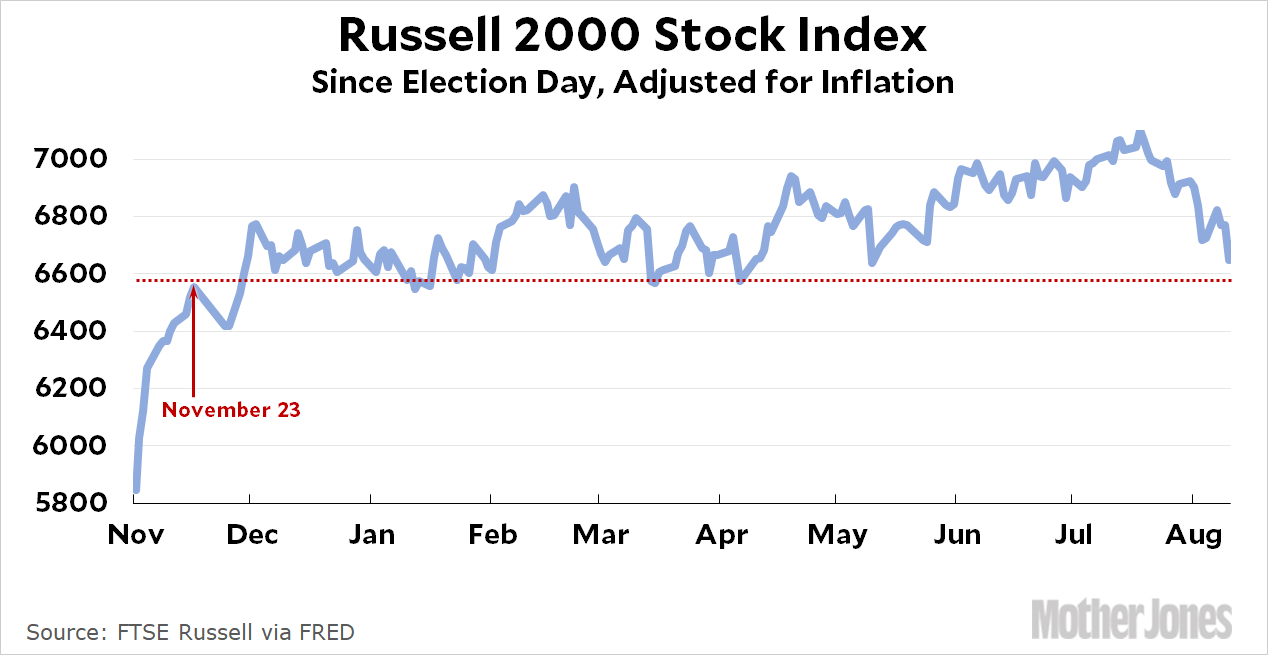
    I was doodling away on some stuff and happened to notice something odd: the broader the stock index, the less it’s grown since the end of November. All of the widely tracked stock indexes spiked upward in the two weeks after Donald Trump’s victory, but since then they’ve grown very differently. Unadjusted for inflation, the Dow Jones has gone up about 15 percent. Pull out a bit, and the S&P 500 has gone up 11 percent. Pull out even further and look only at mid-size companies, and the Russell 2000 has gone up only 4 percent.

    This might mean nothing. The Russell 2000 spiked a lot after Election Day, so maybe it just didn’t have a lot higher to go. Alternatively, it might mean that investors have remained pretty bullish on big companies in the Trump era but not so much on smaller ones. Here’s what the Russell 2000 looks like since November 8:

    It’s barely moved since the end of November. Is this meaningful, or just some odd artifact of this particular index? I’m not sure, but I thought I’d share anyway.

  • Lunchtime Photo

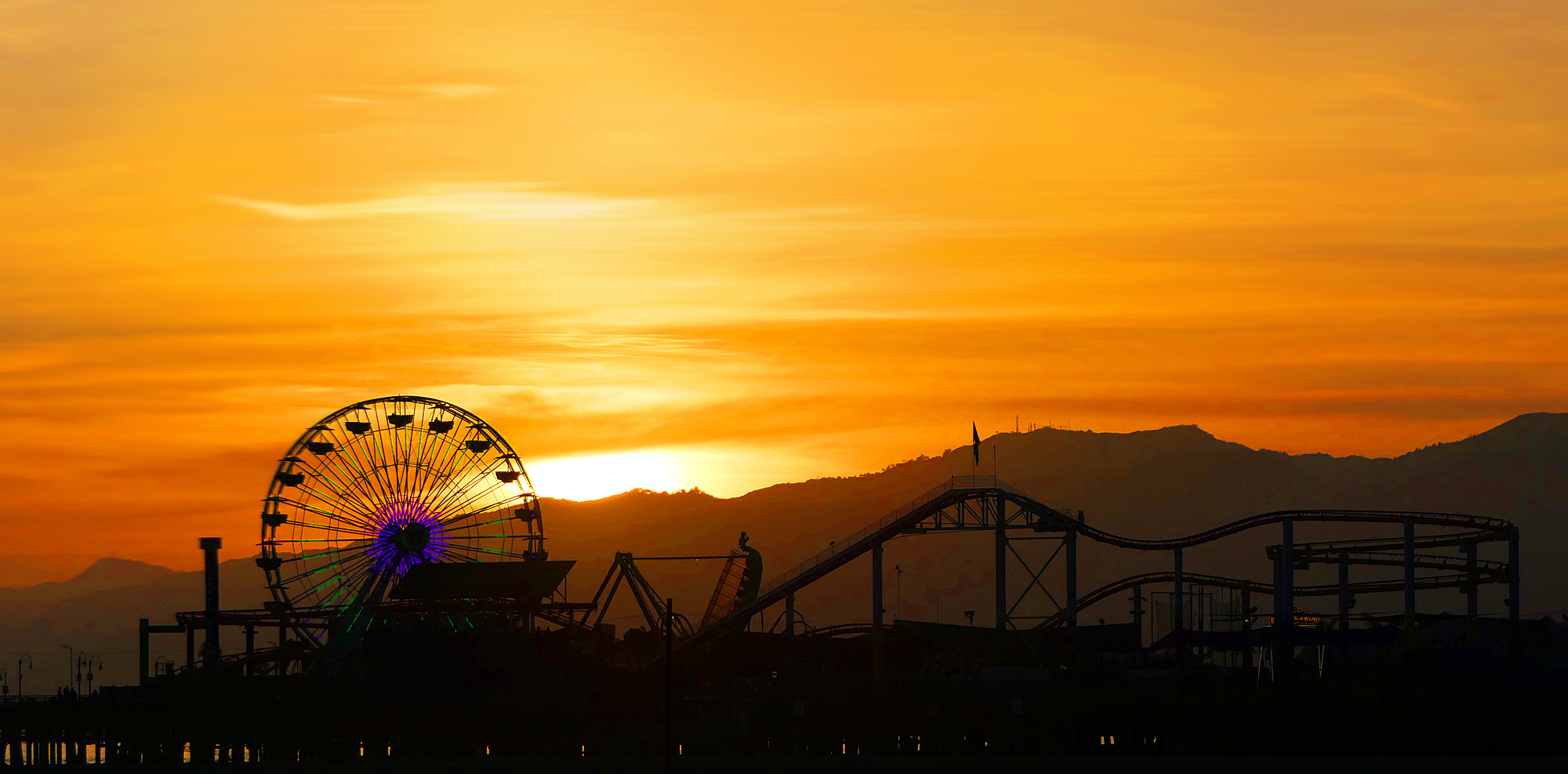
    As this week drags to its dismal and depressing close, it’s time to start relaxing. Or to start thinking about it, anyway. So here’s a pair of sunsets at Santa Monica beach from a couple of months ago. Now start reciting your mantra. Breathe in. Breathe out.